
Students Centric
Placements Report
Trackable results, real numbers
Reviews
Proven success, real voices
Trainers
Expert-led, Industry-Driven Training
Life at IIDE
Vibrant Spirit student life
Alumni
Successful Journeys, Inspiring Stories
Learning Centre
Webinars
Blogs
Case studies
Live, Interactive Masterclasses
Fresh Insights, quick reads
Real-life, Industry relevant
More
Hire from us
Hire Top Digital Marketing Talent
Work with us
Join Our Team, Make an Impact
Customised Training
Personalised digital marketing training for your company
Refer & earn
Simple, easy rewards
Contact us
Get the answers you need
About us
Know more about IIDE
Explore all course options

FOR FRESH GRADUATES
Post Graduation Program in Digital Marketing & Business Strategy- Ideal for Age: 20–25 Years

Can’t decide? Explore all our
Digital Marketing Courses
COMPARE ALL 3 PROGRAMSOnline & Offline
Explore Top AI CoursesIndustry-Aligned TRACKMost Popular
UG Program in Digital Business & Entrepreneurship- Ideal for 12th Pass out / FY Degree Student

PARTNER PROGRAMS



Can’t decide? Explore all
BBA In Digital Marketing Colleges

Orginally Written by Karan Shah
Updated on Mar 30, 2026
|7,453K+ views
Share on:


In 2025, the debate of digital marketing vs traditional marketing remains crucial for businesses.
While digital marketing offers precision targeting, real-time analytics, and cost efficiency, traditional marketing continues to provide broad visibility and local impact through print, TV, and billboards.
Understanding these marketing differences in 2025 is essential for businesses to align strategies with consumer behaviour and stay competitive in today’s evolving landscape.
If you want to explore how businesses can leverage these factors strategically, check out our Online Digital Marketing Course to learn practical skills and frameworks that help make the right choice.
From roadside billboards to targeted Instagram ads, the way businesses reach consumers has changed dramatically.
Traditional marketing, once the backbone of brand communication, relied on one-way channels like newspapers, television, and radio. The rise of the internet in the 1990s shifted the landscape, introducing digital strategies that made marketing more measurable, interactive, and customer-centric.
In 2025, this transformation has only accelerated. With over 5.5 billion internet users worldwide, businesses now have opportunities to connect with global audiences in real time. At the same time, consumer habits have evolved - 76% of people research online before buying offline - making digital-first strategies almost unavoidable.
Add to this the power of data-driven decision-making and cost-effective online campaigns, and the shift from traditional to digital becomes clear.
But does that mean traditional methods no longer matter? Not quite. Both have their strengths, and businesses need to understand where each fits into today’s marketing ecosystem.
For a deeper dive into the fundamentals, explore what digital marketing is and why it matters today.

Learn Digital Marketing for FREE

Traditional Marketing vs Digital Marketing: A Side-by-Side Comparison
In the ever-evolving business landscape, one question persists: Is traditional marketing still relevant, or has digital marketing completely taken over? The comparison below breaks down their differences:
| Criteria | Traditional Marketing | Digital Marketing |
|---|---|---|
| Definition |
Uses offline channels like TV, radio, and print. |
Uses online platforms like social media, SEO, and email. |
| Target Audience |
Broad, less segmented, usually local or regional. |
Global reach with highly targeted demographics. |
| Consumer Interaction |
Limited, face-to-face or one-way. |
Real-time, two-way interaction via comments, messages, etc. |
| Cost |
High due to printing, TV/radio airtime. |
More affordable with scalable budgets and analytics. |
| Speed of Results | Slower, feedback is delayed. |
Instant feedback with analytics dashboards. |
| Strategy | Push-based (ads, flyers). |
Pull-based (SEO, content marketing). |
| Sustainability |
Resource-heavy (paper, printing). |
Eco-friendly, fully digital. |
| ROI Analysis | Difficult to track precisely. |
Easy to measure via tools like Google Analytics. |
| Communication | One-way communication. |
Two-way communication, fostering engagement. |
| Flexibility |
Hard to modify once launched. |
Easily adjustable in real time. |
| Branding Impact |
Strong visibility but less targeted. |
Focused visibility with specific targeting. |
| Examples | TV ads, billboards, flyers. |
Social media ads, SEO, Google Ads. |
What is Digital Marketing?
Digital marketing refers to the use of online channels to promote products or services. It covers a wide range of strategies, including social media marketing, email campaigns, SEO, PPC ads, and content marketing.
Key Characteristics of Digital Marketing:
- Targeting: Businesses can create detailed audience segments and ensure their campaigns reach the right people at the right time. For example, a fitness brand can specifically target young professionals interested in healthy lifestyles
- Cost-Effectiveness: Campaigns can be run with small budgets and scaled depending on results. This makes digital marketing accessible to startups and established corporations alike
- Analytics: Platforms like Google Analytics and Meta Ads Manager provide detailed reports on campaign performance, allowing data-driven decisions
- Global Reach: A small business in India can sell products to customers in the U.S. thanks to the reach of e-commerce and social media
- Flexibility: Campaigns can be paused, adjusted, or retargeted in real-time without incurring additional costs
Pros and Cons of Digital Marketing
Pros of Digital Marketing:
- Cost-Effective: Businesses can run campaigns with small budgets and scale them as results improve, making it accessible for all sizes
- Measurable Results: Every click, view, and conversion can be tracked in real-time using analytics tools, ensuring transparency in performance
- Precise Targeting: Ads can be shown to specific groups based on demographics, interests, location, and online behaviour, maximising relevance
- Global Reach: Digital platforms allow even small brands to expand internationally without significant additional cost
- Flexibility and Speed: Campaigns can be launched instantly, tested, paused, or optimised in real-time
- High Engagement: Social media, email, and content marketing encourage two-way interactions, building stronger customer relationships
- Scalability: Campaigns can grow from local to global without changing the overall structure, ensuring long-term adaptability
Cons of Digital Marketing:
- Platform Saturation: Audiences are bombarded with ads online, making it harder to stand out
- Requires Technical Skills: Success often depends on knowledge of SEO, analytics, or ad platforms
- Privacy Concerns: With rising awareness of data usage, consumers are more cautious about sharing personal information
- Dependency on Internet Access: Reaching consumers is limited in areas with poor connectivity
Curious about how businesses use these tools? Read more on digital marketing strategies to stay competitive.
What is Traditional Marketing?
Traditional marketing focuses on offline promotional methods that have been used for decades. While not as measurable as digital, these methods can still be powerful for building brand visibility and reaching mass audiences.
Key Characteristics of Traditional Marketing:
- Broad Reach: Ideal for businesses looking to spread awareness across cities or regions, such as FMCG brands
- Tangible Presence: Flyers, brochures, and billboards give consumers something physical to remember the brand by
- Static Nature: Once an ad is printed or aired, it cannot be altered, limiting flexibility
- Mass Appeal: TV and radio ads create brand recognition on a large scale, making them suitable for businesses with wide target audiences
Pros and Cons of Traditional Marketing
Pros of Traditional Marketing:
- Mass Awareness: Reaches large audiences at once through TV, radio, print, and billboards, making it ideal for brand visibility
- Credibility and Trust: Ads in established media like newspapers or TV are often perceived as more reliable and authoritative
- Local Effectiveness: Perfect for community-focused businesses that need to attract regional or neighbourhood customers
- Tangible Impact: Flyers, brochures, and physical ads provide a lasting presence that audiences can keep and revisit
Cons of Traditional Marketing:
- High Costs: Production, printing, and media placement expenses make it less accessible for small businesses
- Limited Targeting: Campaigns reach broad audiences without precise demographic or behavioural segmentation
- Difficult to Measure ROI: Tracking effectiveness is challenging as results rely on estimates rather than real-time data
- Slow Feedback Loop: Campaigns take time to produce results, offering little flexibility for quick adjustments
You should also explore the different types of digital marketing used by brands today.
Find Your Best Marketing Fit
Digital Marketing: Grow Your Business Online
Digital marketing is ideal when:
- Global Reach is a Priority: Perfect for brands looking to expand beyond local markets
- Targeted Demographics are Needed: Helps narrow down audiences to age, gender, interests, and location
- Measurable Results Matter: Campaigns can be tracked in real-time with clear ROI
- Budget is Limited: Even with smaller budgets, campaigns can be effective
- Younger Audiences are the Focus: Since younger consumers spend most of their time online, digital channels are the best way to reach them
- Instant Adjustments are Valuable: Campaigns can be tweaked on the go, ensuring resources are not wasted
Traditional Marketing: Connecting Offline
Traditional marketing works well when:
- Local Businesses Want Visibility: Flyers, newspaper ads, and local billboards drive community-level engagement
- Older Demographics are Targeted: This group trusts traditional media more than digital platforms
- Mass Awareness is Key: Brands launching new FMCG products or services can benefit from TV or outdoor ads
- Credibility and Trust are Crucial: Appearing in established newspapers or TV channels gives businesses an added sense of reliability
To understand where the industry is heading, check the scope of digital marketing.
Match Your Strategy to Goals & Budget
1. Target Audience
- Digital Marketing: Best suited for tech-savvy, younger audiences who spend time online and prefer personalised, interactive content. For example, e-commerce brands selling to Gen Z and millennials thrive digitally
- Traditional Marketing: Effective for older demographics, families, or audiences in areas with lower internet penetration who trust offline media like TV, radio, or newspapers
2. Business Goals
- Digital Marketing: Ideal if your goals are lead generation, online sales, global reach, or measurable ROI. Startups and online-first businesses benefit the most here.
- Traditional Marketing: Works well for building local presence, mass brand awareness, or when credibility is key - for instance, political campaigns, real estate launches, or FMCG products.
3. Budget & Resources
- Digital Marketing: Flexible and scalable - businesses can start with small budgets, test campaigns, and increase spending based on performance. Tools and automation make it cost-effective for smaller teams
- Traditional Marketing: Requires a higher upfront budget due to production and distribution costs, making it more suitable for enterprises or brands with large-scale campaigns
4. Measurability & Data Insights
- Digital Marketing: Every action is trackable, from impressions to sales, allowing businesses to fine-tune campaigns in real-time and maximise ROI
- Traditional Marketing: Difficult to measure while exposure is high, businesses rely on indirect metrics like footfall or brand recall surveys
5. Speed & Flexibility
- Digital Marketing: Campaigns can be launched instantly, tested with A/B experiments, and adjusted in real-time to consumer responses
- Traditional Marketing: Campaigns are slower to launch and harder to modify once live, making them less agile in fast-changing markets
6. Engagement Opportunities
- Digital Marketing: Enables two-way communication, allowing businesses to directly interact with customers through comments, messages, and polls
- Traditional Marketing: Offers little scope for direct engagement, as it mainly involves one-way broadcasting
7. Industry Relevance
- Digital Marketing: Works best for industries like e-commerce, IT, fashion, education, and services that thrive online
- Traditional Marketing: Still strong for industries like FMCG, real estate, automotive, and healthcare, where offline presence and credibility matter
8. Geographic Focus
- Digital Marketing: Suitable for businesses targeting international or nationwide audiences, as campaigns can cross borders without additional cost
- Traditional Marketing: Best for local or regional businesses that depend on nearby customers, such as restaurants, gyms, or retail stores
9. Longevity of Impact
- Digital Marketing: Campaigns often have shorter attention spans due to high competition online, requiring consistent updates
- Traditional Marketing: Billboards or print ads can create a longer-lasting impression as they remain in one place and are repeatedly viewed by the same audience
Conclusion
Digital marketing and traditional marketing both have their place in today’s ecosystem. Digital marketing offers personalisation, global reach, and measurable ROI, making it the go-to choice for most businesses in 2025. Traditional marketing still works well for local impact, older demographics, and campaigns where credibility and mass awareness are key.
Key Takeaway: The smartest strategy is often a hybrid approach - blending the broad visibility of traditional media with the precision of digital. Businesses that strike this balance can maximise reach, build credibility, and still stay agile in an evolving marketplace.
Want to Know Why 2,50,000+ Students Trust Us?
Dive into the numbers that make us the #1 choice for career success


MBA - Level
Post Graduate in Digital Marketing & Business Strategy

Best For
Fresh Graduates

Mode of Learning
On Campus (Mumbai & Delhi)

Starts from
Jul 31, 2026

Duration
11 Months

Live & Online
Advanced Online Digital Marketing Course
Best For
Working Professionals
Mode of Learning
Online
Starts from
Aug 7, 2026
Duration
4-6 Months

Online
Professional Certification in AI Strategy
Best For
AI Enthusiasts
Mode of Learning
Online
Starts from
Sep 8, 2026
Duration
5 Months

On Campus
Advanced Certification in Artificial Intelligence
Best For
AI Enthusiasts
Mode of Learning
On Campus (Mumbai)
Starts from
Aug 31, 2026
Duration
3 Months

Online or Offline
Top AI Courses to Make You Future Ready!
Best For
AI Enthusiasts
Mode of Learning
2–5 Month Program
Starts from
Sep 8, 2026
Duration
Flexiable
Offline
Undergraduate Program in Digital Business & Entrepreneurship
Best For
12th Passouts
Mode of Learning
On Campus (Mumbai)
Starts from
Aug 19, 2026
Duration
3 Years
Offline
Degree In 2026 ≠ Enough Degree + Digital Skills = Future-Ready
Best For
12th Passouts
Mode of Learning
At IIDE Campus
Starts from
Aug 6, 2026
Duration
3 Years
Recent Post
Digital Marketing Courses Nearby
You May Also Like

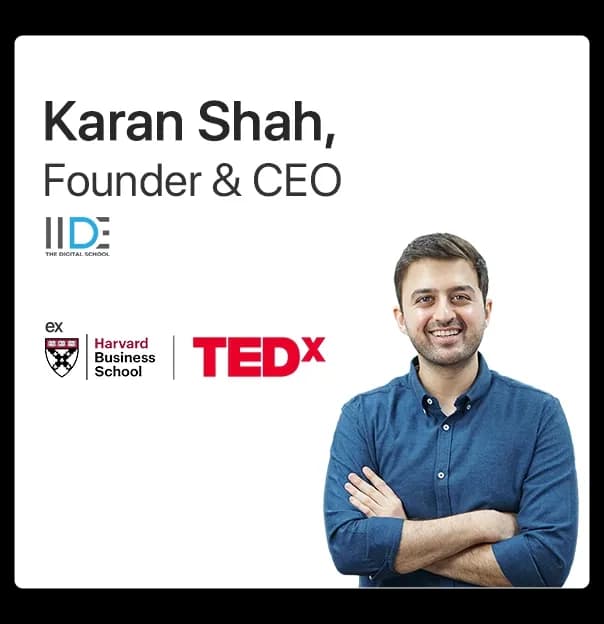
Founder and CEO at IIDE
Karan Shah is the Founder and CEO of IIDE – The Digital School, Asia’s premier digital marketing institute. With over ten years of hands-on experience in the digital marketing industry, Karan has played a pivotal role in empowering thousands of students to forge successful careers in this ever-evolving field.
His vast expertise encompasses various areas such as paid search, social media marketing, programmatic marketing, and much more. Karan's passion for education, teaching, and public speaking led him to establish IIDE, where he offers world-class digital marketing education designed to meet industry standards.
To date, he has trained over 60,000 students and worked with more than 25 corporates, sharing his knowledge through both online and offline platforms. A Harvard Business School alumnus with a specialisation in E-commerce, Karan is also an accomplished Tedx speaker. His industry insights and teaching excellence have earned him a prestigious role as a visiting faculty member at India’s top management institutes, including the Indian Institutes of Management (IIMs).