
Students Centric
Placements Report
Trackable results, real numbers
Reviews
Proven success, real voices
Trainers
Expert-led, Industry-Driven Training
Life at IIDE
Vibrant Spirit student life
Alumni
Successful Journeys, Inspiring Stories
Learning Centre
Webinars
Blogs
Case studies
Live, Interactive Masterclasses
Fresh Insights, quick reads
Real-life, Industry relevant
More
Hire from us
Hire Top Digital Marketing Talent
Work with us
Join Our Team, Make an Impact
Customised Training
Personalised digital marketing training for your company
Refer & earn
Simple, easy rewards
Contact us
Get the answers you need
About us
Know more about IIDE
Explore all course options

FOR FRESH GRADUATES
Post Graduation Program in Digital Marketing & Business Strategy- Ideal for Age: 20–25 Years

Can’t decide? Explore all our
Digital Marketing Courses
COMPARE BOTH OUR PROGRAMSOffline
Offline AI Courses with Dual CertificationsIndustry-Aligned TRACKMost Popular
UG Program in Digital Business & Entrepreneurship- Ideal for 12th Pass out / FY Degree Student

PARTNER PROGRAMS






Can’t decide? Explore all
BBA In Digital Marketing Colleges

Orginally Written by Aditya Shastri
Updated on May 16, 2026
Share on:


About V-Guard Industries

V‑Guard Industries, founded in 1977 by Kochouseph Chittilappilly in Kochi, Kerala, began its journey as a small manufacturer of voltage stabilisers. Over the decades, the company steadily expanded its product portfolio to include pumps, motors, cables, geysers, fans, and UPS systems, earning a reputation for reliability and quality across India. With a robust distribution network of 500+ distributors, 40,000 retailers, and 31 branches nationwide, V‑Guard established itself as a household name in electrical and home appliances.
Beyond business, the brand has invested heavily in CSR initiatives focused on children’s welfare, education, and sustainability. By the 2010s, V‑Guard diversified into consumer durables and kitchen appliances, while embracing eco‑friendly innovation to reduce CO₂ emissions.
Today, with a turnover crossing USD 340 million and a market cap exceeding ₹9,000 crore, V‑Guard is actively expanding into global markets such as Europe, South Africa, the US, and the UK, positioning itself as a modern, forward‑looking Indian brand.
Here’s a detailed timeline of highlights for V‑Guard Industries, tracing its journey from inception to expansion, based on the SWOT analysis page you’re viewing:
| Quick Stats | V Guard Industries |
|---|---|
| Founder | Kochouseph Chittilappilly |
| Year Founded | 1977 |
| Origin | Kochi, Kerala, India |
| No. of Employees | 7,180+ (2026) |
| Company Type | Public (NSE: VGUARD / BSE: 532953) |
| Market Cap | Rs 13,938 Crore (2025) |
| Annual Revenue | Rs 5,580 Crore / USD 655M (FY2025) |
| Net Income / Profit | Rs 268 Crore / USD 32M (FY2024) |
| Distribution Network | 500+ distributors, 40,000 retailers, 31 branches across India |
| CSR Focus Areas | Children’s welfare, education, skill development, sanitation, environment, heritage |
| Global Expansion | Entered Europe, South Africa, the US, and the UK markets |
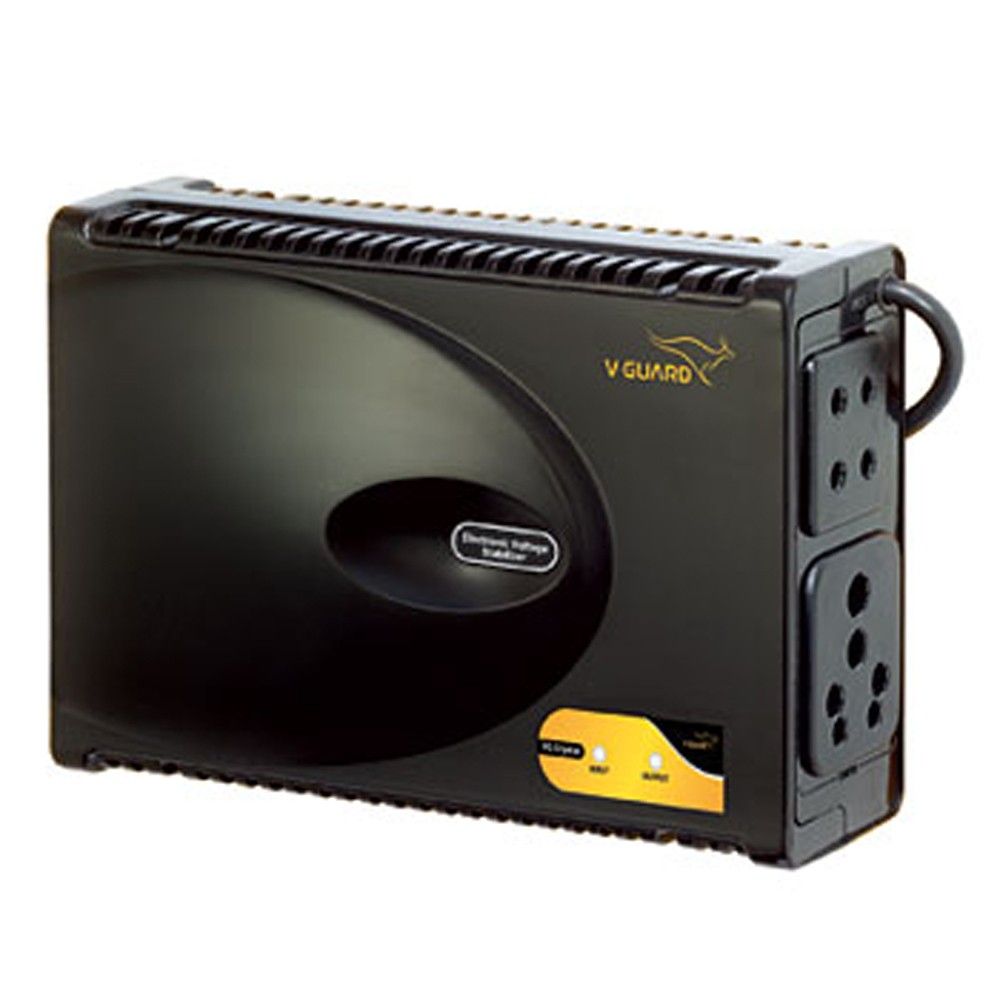
Products & Services by V Guard Industries
V Guard Industries has a variety of products and sub-products. Below are some common types of products manufactured by them:
- Voltage Stabilisers
- Inverter, Dups, Solar Power Systems and Inverter Batteries
- Electric, Solar and Heat Pump Water Heaters
- Wires and Cables
- Funs
- Kitchen Appliances
- Pumps
- Domestic Switch Gears
- Modular Switches
- Air Coolers
- Water Purifiers and
- Others
Competitors of V Guard Industries
Here are some of the most competing companies of the V Guard Industries
- Suzlon Energy
- Voltamp Trans
- Schneider Infra
- Hitachi Energy
- CG Power
Now that we have a better understanding of V Guard Industries, let’s look into the SWOT Analysis of V Guard Industries.
V-Guard's evolution from a voltage stabiliser manufacturer to a full-range home electrical brand closely mirrors the journey of larger peers. The marketing strategy of Havells India, for instance, shows how an Indian electrical brand can build aspirational equity across fans, wires, and switchgear while competing with global names on home turf.
SWOT analysis of V‑Guard Industries
A SWOT analysis helps explain a company’s current business position. It shows internal strengths and weaknesses, along with external opportunities and threats.
For V-Guard, this gives a clearer view of how the brand performs in India’s electrical appliance market. V‑Guard balances strong brand equity and diversification with challenges like debt and global competition.
So let us go ahead and first have a glance at the strengths of V Guard Industries from the SWOT analysis of V Guard Industries.
Strengths of V Guard Industries
The strength of an organisation is the special abilities that make it stand out and create its own space in the market. Here are some strengths of V Guard Industries:
- Diversified Portfolio: From stabilisers to kitchen appliances, V‑Guard covers multiple consumer needs.
- Strong Brand Equity: Trusted name in South India, now expanding nationally.
Distribution Network: 500+ distributors, 40,000 retailers, and 31 branches across India. - Skilled Workforce: Continuous training and development programs.
- CSR Initiatives: Eight pillars, including education, health, sanitation, environment, and child welfare.
- Sustainability Focus: Commitment to energy‑efficient products and reducing CO₂ emissions.
- V-Guard's national expansion mirrors the path taken by peers like Havells. Read the marketing strategy of Havells India to see how Indian electrical brands build a pan-India recall.
Weaknesses of V Guard Industries
Weaknesses are the areas of an organisation where improvement or attention is needed the most. Some major flaws of V Guard Industries are listed below:
- High Debt Ratio: Limits financial flexibility.
- Small Global Market Share: Overshadowed by global competitors like Samsung and Philips.
- Operational Complexity: Managing a wide product range increases challenges.
- Weak Switchgear Segment: Less competitive in industrial electricals.
- Sensitivity to Global Slowdowns: Vulnerable to international market fluctuations.
- V-Guard has the product quality. What's still building is the global brand language. Curious what that looks like at scale? Our Marketing Strategy of the Samsung case study is a good place to start.
Opportunities for V Guard Industries
Opportunities refer to convenient external factors that could grant the organisation a competitive advantage. Some of the opportunities for V Guard Industries are listed below:
- Emerging Global Markets: Expansion into Europe, South Africa, the US, and the UK.
- Technology Adoption: Digital advertising, differential pricing, and innovation.
- Market Leadership: Potential to acquire smaller competitors in India.
- Strengthening Weak Segments: Focus on industrial switchgear and global branding.
- Free Trade Agreements: Easier entry into new markets.
Threats to V Guard Industries
Threats are something that can significantly affect the organisation externally. Here are some threats to V Guard Industries:
- Intense Competition: Both domestic and international rivals.
- Rapid Technological Change: Competitors innovating faster, lowering costs.
- Environmental Scrutiny: Activist pressure and lawsuits over manufacturing impact.
- Counterfeit Components: Local distributors’ practices eroding trust.
- Dependence on the Indian Market: Heavy reliance on the domestic economy.

This ends our elaborative SWOT analysis of V Guard Industries. Let us conclude our learning below.

Is Digital Marketing the Right Career for You?
Find out in a free 45-min masterclass · Career paths, roles and growth explained · By Karan Shah, Founder & CEO, IIDE

Is Digital Marketing the Right Career for You?
Find out in a free 45-min masterclass · Career paths, roles and growth explained · By Karan Shah, Founder & CEO, IIDE
Want to Know Why 2,50,000+ Students Trust Us?
Dive into the numbers that make us the #1 choice for career success



MBA - Level
Post Graduate in Digital Marketing & Business Strategy

Best For
Fresh Graduates

Mode of Learning
On Campus (Mumbai & Delhi)

Starts from
Nov 27, 2026

Duration
11 Months

Live & Online
Advanced Online Digital Marketing Course
Best For
Working Professionals
Mode of Learning
Online
Starts from
Nov 2, 2026
Duration
4-6 Months

Offline
Top AI Courses to Make You Future Ready!
Best For
AI Enthusiasts
Mode of Learning
2–5 Month Program
Starts from
Nov 24, 2026
Duration
Flexiable
Offline
Undergraduate Program in Digital Business & Entrepreneurship
Best For
12th Passouts
Mode of Learning
On Campus (Mumbai)
Duration
3 Years
Offline
Degree In 2026 ≠ Enough Degree + Digital Skills = Future-Ready
Best For
12th Passouts
Mode of Learning
At IIDE Campus
Duration
3 Years
Recent Post

Lead Trainer & Business Development Head at IIDE
Aditya Shastri leads the Business Development segment at IIDE and is a seasoned Content Marketing expert. With over a decade of experience, Aditya has trained more than 20,000 students and professionals in digital marketing, collaborating with prestigious institutions and corporations such as Jet Airways, Godrej Professionals, Pfizer, Mahindra Group, Publicis Worldwide, and many others. His ability to simplify complex marketing concepts, combined with his engaging teaching style, has earned him widespread admiration from students and professionals alike.
Aditya has spearheaded IIDE’s B2B growth, forging partnerships with over 40 higher education institutions across India to upskill students in digital marketing and business skills. As a visiting faculty member at top institutions like IIT Bhilai, Mithibai College, Amity University, and SRCC, he continues to influence the next generation of marketers.
Apart from his marketing expertise, Aditya is also a spiritual speaker, often traveling internationally to share insights on spirituality. His unique blend of digital marketing proficiency and spiritual wisdom makes him a highly respected figure in both fields.