
Students Centric
Placements Report
Trackable results, real numbers
Reviews
Proven success, real voices
Trainers
Expert-led, Industry-Driven Training
Life at IIDE
Vibrant Spirit student life
Alumni
Successful Journeys, Inspiring Stories
Learning Centre
Webinars
Blogs
Case studies
Live, Interactive Masterclasses
Fresh Insights, quick reads
Real-life, Industry relevant
More
Hire from us
Hire Top Digital Marketing Talent
Work with us
Join Our Team, Make an Impact
Customised Training
Personalised digital marketing training for your company
Refer & earn
Simple, easy rewards
Contact us
Get the answers you need
About us
Know more about IIDE
Explore all course options

FOR FRESH GRADUATES
Post Graduation Program in Digital Marketing & Business Strategy- Ideal for Age: 20–25 Years

Can’t decide? Explore all our
Digital Marketing Courses
COMPARE BOTH OUR PROGRAMSOffline
Offline AI Courses with Dual CertificationsIndustry-Aligned TRACKMost Popular
UG Program in Digital Business & Entrepreneurship- Ideal for 12th Pass out / FY Degree Student

PARTNER PROGRAMS






Can’t decide? Explore all
BBA In Digital Marketing Colleges
Orginally Written by Aditya Shastri
Updated on May 13, 2026
Share on:


Urban Ladder started with a deceptively simple idea: buying furniture should not feel like a compromise between design, budget, and waiting three weeks for delivery.
What followed was twelve years of building an online-first brand from scratch, surviving the IKEA entry shock of 2018, and ultimately landing inside one of the most powerful retail ecosystems in India. The Reliance acquisition in 2020 looked like a rescue at the time.
But the market Urban Ladder operates in today is not the same one it grew up in. Wakefit completed its IPO in December 2025. Pepperfry was sold in a distress acquisition.
IKEA is opening a new Gurugram store this year with Noida already on the roadmap for 2028. And from February 2026, the government's Furniture Quality Control Order has come into force, reshaping compliance standards across the entire industry.
The question was never whether Urban Ladder would survive. That battle is behind it. The real question now is whether it can lead.
Before diving into the article, I would like to acknowledge that the research and initial analysis for this piece were conducted by Bhumika Sarna, a current student of IIDE’s Post Graduation in Digital Marketing and Business Strategy, August Batch 2025.
If you found this helpful, feel free to reach out to Bhumika Sarna to send a quick note of appreciation for her fantastic research, She will appreciate the kudos!
About Urban Ladder

Urban Ladder was founded in 2012 by Ashish Goel and Rajiv Srivatsa with a clear vision to modernise the way Indians buy furniture.
At a time when furniture shopping in India was largely unorganised, offline, and often inconvenient, Urban Ladder identified a gap in the market for well-designed, reliable, and professionally managed furniture retail.
The brand focused primarily on urban consumers who wanted more than just functional furniture. It targeted buyers looking for stylish, design-led products that combined aesthetics, comfort, and convenience for modern homes.
Urban Ladder built its identity around curated collections, better shopping experiences, easy online browsing, home delivery, and installation support, making furniture buying simpler for a new generation of Indian consumers.
Over the years, the company expanded beyond digital channels into physical retail stores, creating an omnichannel model where customers could browse online and also experience products offline.
By 2025, Urban Ladder had scaled to over 50 stores and experience centres across major metro cities in India, incorporating AR visualisation tools and tech-enabled showrooms.
Today, backed by Reliance Retail with a 96% majority stake acquired in November 2020 for ₹182.12 crore, Urban Ladder operates through its website and stores across multiple Indian cities, giving it stronger access to supply chain support, retail expansion, and long-term scale through Reliance's network of over 19,000 stores.
In India's organised furniture market, it competes with brands such as IKEA, Wakefit, HomeLane, Saraf Furniture, WoodenStreet, and Livspace.
Why This SWOT Matters in 2026
India’s furniture market is changing rapidly.
Earlier, furniture buying was driven mainly by utility and local availability.
Today buyers also look for:
- Modern design
- Better durability
- Affordable pricing
- Faster delivery
- Space-saving products
- Trusted after-sales service
At the same time:
- Competition is intense
- Raw material costs fluctuate
- Consumers compare online easily
- Delivery expectations are higher
- Brand loyalty is limited
That makes 2026 an important year for organised furniture brands like Urban Ladder.

Is Digital Marketing the Right Career for You?
Find out in a free 45-min masterclass · Career paths, roles and growth explained · By Karan Shah, Founder & CEO, IIDE

Is Digital Marketing the Right Career for You?
Find out in a free 45-min masterclass · Career paths, roles and growth explained · By Karan Shah, Founder & CEO, IIDE
SWOT Analysis of Urban Ladder
1.Strengths
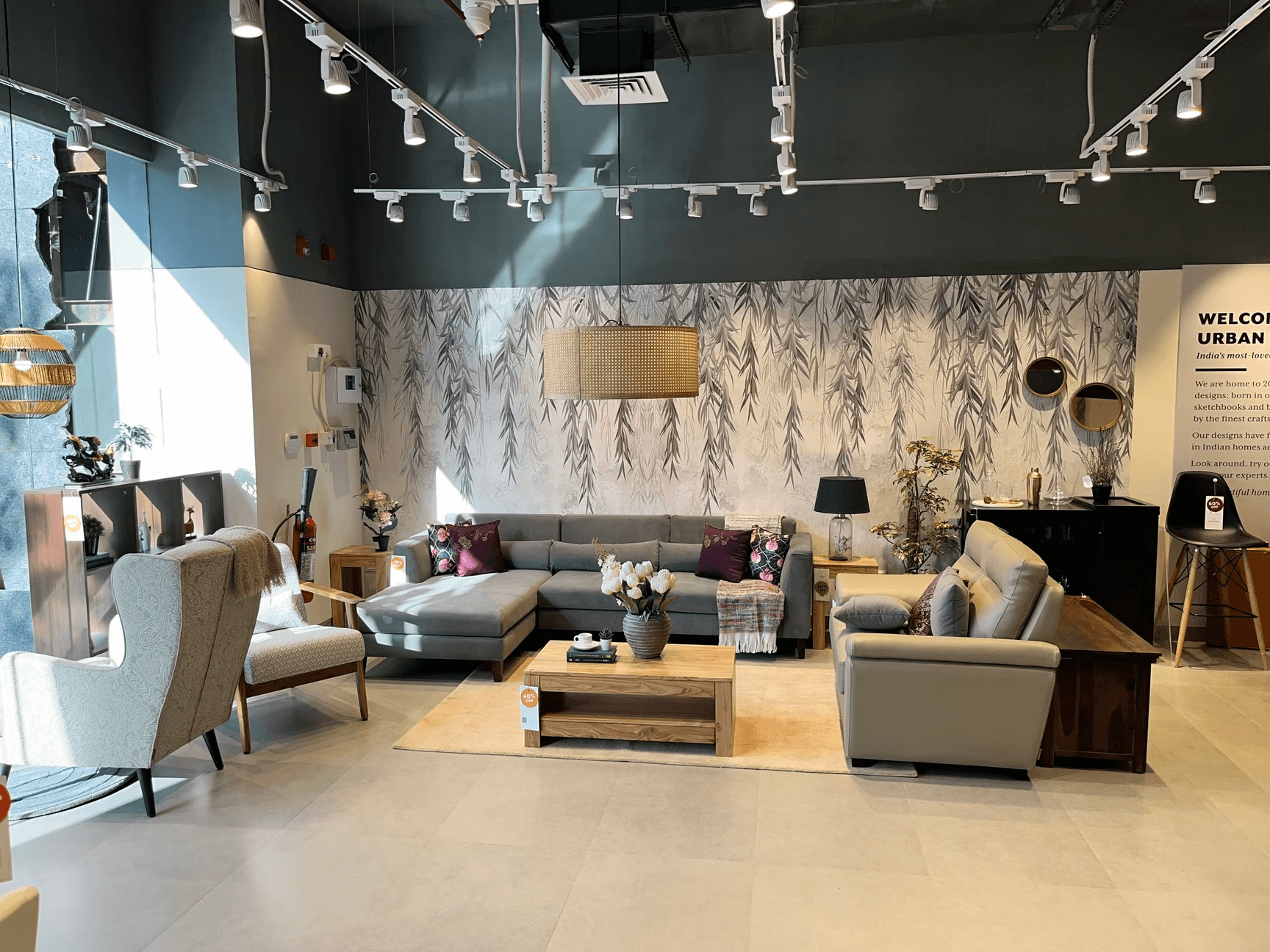
If you had to describe Urban Ladder in one line, it would be this: it brought premium online furniture shopping to Indian homes.
Its strongest advantage today is the combination of brand trust, corporate backing, and an expanding omnichannel footprint.
Key Strengths:
- Backed by Reliance Retail (96% stake): Strong parent support improves scale, logistics, and expansion ability.
- Strong brand recall: Urban Ladder remains a known name in organised furniture retail across Indian metros.
- Omnichannel presence: Over 50 stores and experience centres by 2025, plus a strong online platform, improve buying confidence.
- Design-led positioning: Stylish and modern products appeal to urban buyers seeking aspirational home solutions.
- Technology integration: AR visualisation tools and app-based store locators bridge online browsing with offline experience.
- Strong metro appeal: The brand performs strongly in urban and premium markets, especially among buyers aged 28–45.
- Financial performance: FY2024 net revenue stood at around ₹154–165 crore, while estimated GMV for 2025 is approximately ₹950 crore. This GMV figure is clearly separate from revenue and reflects overall sales volume. With projected online GMV growth of 10–15% heading into 2025, the brand continues to show strong market relevance and steady momentum.
2.Weaknesses
Now this is where the challenge appears. Furniture is a difficult category with high logistics costs, long purchase cycles, and heavy comparison behaviour.
That means even strong brands face pressure.
Key Weaknesses:
- Premium pricing limits reach: Higher prices reduce appeal among budget-conscious buyers in smaller cities.
- Limited mass-market penetration: The brand is stronger in urban premium segments than value markets.
- Dependence on third-party vendors: Outsourced manufacturing can affect margins and consistency.
- Limited customisation options: Players like WoodenStreet and HomeLane offer stronger personalisation for buyers.
- Slower purchase frequency: Furniture is not bought regularly like daily-use products.
- Brand identity dilution risk: Reliance ownership may reduce the startup-era emotional distinctiveness that original fans valued.
- High logistics complexity: Delivery and installation across 83+ cities create ongoing operational challenges.
3.Opportunities
Now here's the interesting part, Urban Ladder still has major room to grow. India's organised furniture market, valued at approximately USD 22 billion, remains underpenetrated, while more consumers are shifting online.
That creates strong future demand.
Key Opportunities:
- Tier-2 and tier-3 expansion: Smaller cities offer a rapidly growing furniture customer base with rising disposable incomes.
- Affordable product lines: Lower-price offerings can unlock wider audiences beyond the premium urban segment.
- Modular furniture growth: Urban homes increasingly need smart and space-saving solutions.
- Premium home decor expansion: Adjacent décor categories can grow average basket size significantly.
- Sustainability demand: Eco-friendly products can strengthen premium appeal among conscious consumers.
- Faster delivery innovation: Better fulfillment can improve conversion rates in a high-AOV category.
- Reliance Smart Bazaar leverage: Cross-promotion within Reliance's hypermarkets can accelerate national growth.
4.Threats
Of course, not everything is in Urban Ladder's control. The furniture category is highly competitive and price-sensitive. Even strong brands can lose market share quickly.
Key Threats:
- IKEA expansion: Global scale and affordable pricing create major sustained pressure in India's metros.
- Wakefit and HomeLane growth: D2C efficiency and interior design services help offer competitive pricing and deeper customer solutions.
- Saraf Furniture and WoodenStreet: Solid wood customisation and competitive pricing attract buyers seeking durable, personalised options.
- Price wars: Heavy discounting across the category can rapidly reduce margins for all players.
- Economic slowdowns: Furniture demand often drops during uncertain periods as it is a discretionary big-ticket purchase.
- Rising raw material costs: Wood, foam, and logistics inflation continue to impact profitability across the sector.
- Customer comparison behaviour: Buyers compare many brands and platforms extensively before committing to a purchase.
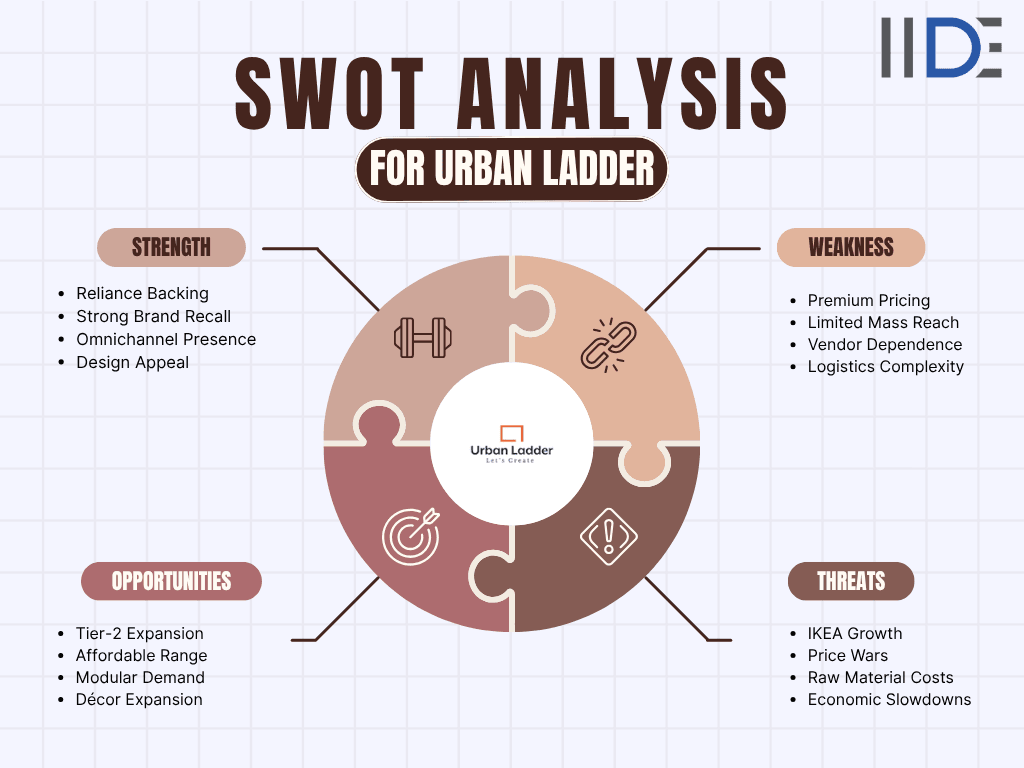
SWOT Summary Chart
Key Insight, Final Thoughts and Conclusion
2026 Insight
Urban Ladder has already built solid recognition in India’s organised furniture market and benefits from strong customer trust.
Modern buyers now expect more than just a known brand. They want attractive designs, practical pricing, reliable delivery, and a hassle-free purchase experience.
If Urban Ladder depends only on its existing reputation, future growth could slow.
But if the Business Model of Urban Ladder evolves to serve wider customer segments while preserving its premium perception, the brand can scale far more effectively.
To understand how the company creates value in today’s market, read the Business Model of Urban Ladder for deeper insights into its revenue streams, customer strategy, and growth potential.
That is the difference between staying familiar and becoming bigger in 2026.
Final Thoughts
Urban Ladder remains one of India's strongest furniture brands in organised retail. Its biggest strength is trust, design appeal, and the operational muscle of the Reliance ecosystem behind it.
It's biggest risk is being squeezed between premium global players like IKEA and value-driven local challengers like Saraf Furniture and Wakefit. Notably, Pepperfry once its closest rival went through a distress sale in late 2025, reshaping the competitive landscape and creating both an opportunity and a warning for Urban Ladder.
If the brand scales wisely while protecting its identity, growth can continue strongly. If not, it may remain respected but lose market share. And in retail, relevance matters more than reputation.
Final Question: Can Urban Ladder become India's most complete furniture brand in the years ahead? Time will do the talking.
Want to Know Why 2,50,000+ Students Trust Us?
Dive into the numbers that make us the #1 choice for career success



MBA - Level
Post Graduate in Digital Marketing & Business Strategy

Best For
Fresh Graduates

Mode of Learning
On Campus (Mumbai & Delhi)

Starts from
Nov 27, 2026

Duration
11 Months

Live & Online
Advanced Online Digital Marketing Course
Best For
Working Professionals
Mode of Learning
Online
Starts from
Nov 2, 2026
Duration
4-6 Months

Offline
Top AI Courses to Make You Future Ready!
Best For
AI Enthusiasts
Mode of Learning
2–5 Month Program
Starts from
Nov 24, 2026
Duration
Flexiable

Offline
Undergraduate Program in Digital Business & Entrepreneurship
Best For
12th Passouts
Mode of Learning
On Campus (Mumbai)
Duration
3 Years

Offline
Degree In 2026 ≠ Enough Degree + Digital Skills = Future-Ready
Best For
12th Passouts
Mode of Learning
At IIDE Campus
Duration
3 Years
Recent Post
SWOT analysis helps understand how Urban Ladder competes in the furniture and home decor market. It shows where the brand performs well and where improvements are needed. It also highlights future growth areas and market risks. This helps in smarter business planning and decision-making.
SWOT analysis helps the company identify opportunities such as new cities, product categories, and customer segments. It also helps fix internal gaps like delivery issues or pricing concerns. By understanding threats early, the brand can prepare better strategies. This creates a stronger path for long-term growth.
Investors use SWOT analysis to understand the company’s market position and future potential. It gives a clear picture of brand value, operational risks, and expansion chances. It also shows how well the company can handle competition. This makes evaluation easier before investment decisions.
A company should review its SWOT analysis regularly, especially when market trends change. For a retail brand like Urban Ladder, annual or half-yearly reviews can be useful. It should also be updated during major business changes such as acquisitions or new launches. Regular reviews help the brand stay competitive.
The five points of SWOT analysis are Strengths, Weaknesses, Opportunities, Threats, and Action Plan. The first four areas help identify internal and external business factors. The action plan focuses on how to use strengths, improve weaknesses, capture opportunities, and reduce risks. It is a practical framework for better strategy planning.
A SWOT analysis for urban planning is used to study a city or area’s current condition and future potential. Strengths may include infrastructure, transport, or economic activity, while weaknesses can be congestion or poor housing. Opportunities may involve smart city development, green spaces, or investment growth. Threats often include pollution, overpopulation, and climate risks.
Urban Ladder is an Indian furniture and home decor brand known for modern designs and online shopping convenience. It offers products such as sofas, beds, dining sets, storage, and decor items. The company became popular for bringing organized furniture retail online in India. It later expanded through offline stores and larger retail partnerships.
The four types of SWOT analysis are Strengths, Weaknesses, Opportunities, and Threats. Strengths and weaknesses are internal factors related to the business itself. Opportunities and threats come from external market conditions like trends, competition, and the economy. Together, they help businesses plan growth and reduce risks.

Lead Trainer & Business Development Head at IIDE
Aditya Shastri leads the Business Development segment at IIDE and is a seasoned Content Marketing expert. With over a decade of experience, Aditya has trained more than 20,000 students and professionals in digital marketing, collaborating with prestigious institutions and corporations such as Jet Airways, Godrej Professionals, Pfizer, Mahindra Group, Publicis Worldwide, and many others. His ability to simplify complex marketing concepts, combined with his engaging teaching style, has earned him widespread admiration from students and professionals alike.
Aditya has spearheaded IIDE’s B2B growth, forging partnerships with over 40 higher education institutions across India to upskill students in digital marketing and business skills. As a visiting faculty member at top institutions like IIT Bhilai, Mithibai College, Amity University, and SRCC, he continues to influence the next generation of marketers.
Apart from his marketing expertise, Aditya is also a spiritual speaker, often traveling internationally to share insights on spirituality. His unique blend of digital marketing proficiency and spiritual wisdom makes him a highly respected figure in both fields.