Newly Launched: Post Graduation Program in Digital Marketing & Business Strategy.

Students Centric
Placements Report
Trackable results, real numbers
Reviews
Proven success, real voices
Trainers
Expert-led, Industry-Driven Training
Life at IIDE
Vibrant Spirit student life
Alumni
Successful Journeys, Inspiring Stories
Learning Centre
Webinars
Blogs
Case studies
Live, Interactive Masterclasses
Fresh Insights, quick reads
Real-life, Industry relevant
More
Hire from us
Hire Top Digital Marketing Talent
Work with us
Join Our Team, Make an Impact
Customised Training
Personalised digital marketing training for your company
Refer & earn
Simple, easy rewards
Contact us
Get the answers you need
About us
Know more about IIDE
Explore all course options

FOR FRESH GRADUATES
Post Graduation Program in Digital Marketing & Business Strategy- Ideal for Age: 20–25 Years

Can’t decide? Explore all our
Digital Marketing CoursesTrending

Professional Certification in AI Strategy
- Ideal for AI Enthusiast










Orginally Written by Aditya Shastri
Updated on Jan 6, 2026
Share on:


La Poste, France’s historic state-owned postal and logistics leader, remains central to national services in 2025. Once dominated by traditional mail, today La Poste generates most revenue from parcels, banking, insurance, digital services, and local missions evolving far beyond stamps and envelopes.
But how well equipped is La Poste to navigate fierce competition, digital disruption, and public service obligations in a transforming global landscape? This detailed SWOT analysis reveals key insights you need to know whether you’re a business student, strategist, or entrepreneur exploring legacy service providers in a digital age.
Before diving into the article, I would like to inform you that the research and initial analysis for this piece were conducted by Bharat Singh. He is a current student in IIDE's Online Digital Marketing Course, July Batch 2025.
If you find this helpful, feel free to reach out to Bharat Singh send a quick note of appreciation for his fantastic research; he will appreciate the kudos!
About La Poste
Founded in the 16th century and headquartered in Paris, La Poste Groupe is France’s primary postal and logistics operator. It delivers mail, parcels, and local services nationwide, while also operating La Banque Postale and Docaposte digital units.
In 2024, it reported €34 billion in revenue and shoulders universal service duties alongside profit-driven operations. La Poste is transitioning from mail-centric activities toward diversified, tech-embedded services to stay relevant in 2026.
Overview Table
| Attribute | Details |
|---|---|
| Official Name | Le Groupe La Poste |
| Founded | 16th Century (public postal origins) |
| Headquarters | Paris, France |
| Industries |
Postal, Logistics, Financial & Digital Services |
| Revenue | €34 billion (2023) |
| Net Income | €514-719 million (2023-2025) |
| Employees | 226,000+ |
| Major Competitors |
DHL, UPS, FedEx, Chronopost, Private Couriers |
Why SWOT Analysis of La Poste Matters in 2026?
The postal and logistics industry has changed faster in the last decade than in the previous century. Mail volumes are falling by double-digit percentages. At the same time, e-commerce parcels, digital contracts, fintech, and AI-driven logistics are booming.
In 2025, La Poste faces a unique challenge: How to combine its public service mission with commercial competition and profitability?
La Poste stands at an inflection point. Traditional mail volumes have shrunk dramatically; parcels now dominate revenue streams, and digital service offerings grow. Meanwhile, private logistics players, digital banks, and tech-driven platforms challenge incumbents with flexibility and speed.
A SWOT analysis helps identify areas where La Poste can leverage its strengths, address systemic weaknesses, pursue profitable opportunities, and mitigate emerging threats crucial for strategy in 2026 and beyond.

Learn Digital Marketing for FREE


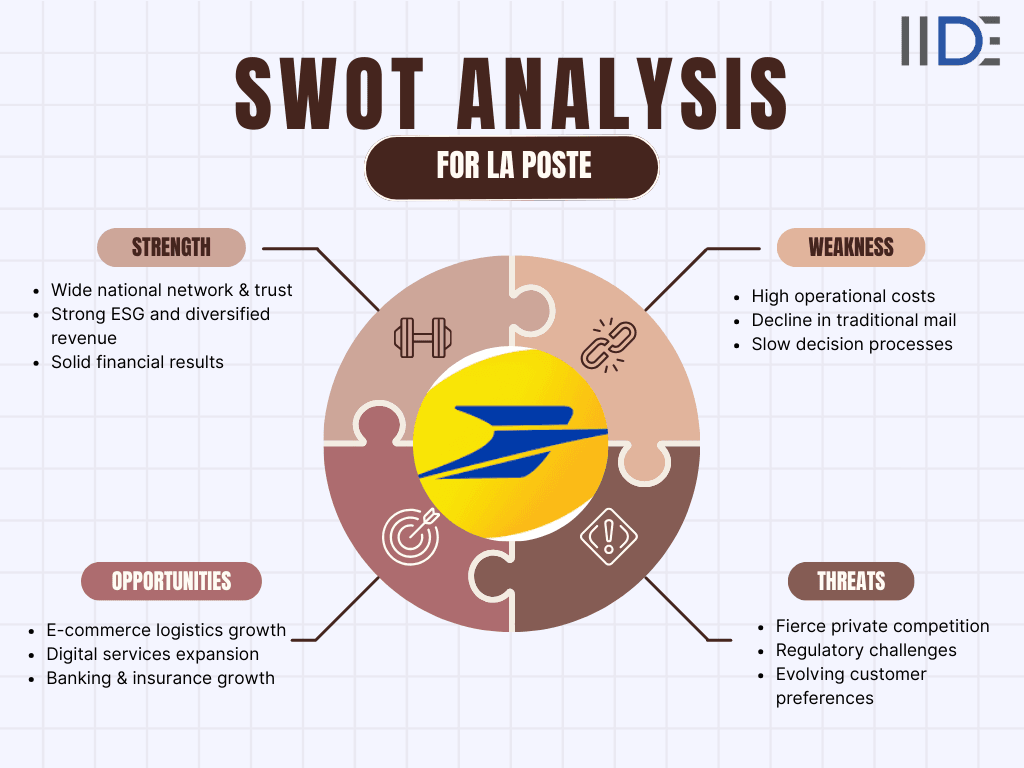
SWOT Analysis of La Poste
1. La Poste’s Strengths: Core capabilities and competitive advantages
- Extensive nationwide network: La Poste has one of Europe’s largest physical service networks, with thousands of post offices and local branches. This allows for strong last-mile reach, especially in rural areas where private players often avoid delivering due to high costs.
- Strong brand trust and public mission: As France’s long-established postal operator, La Poste holds high brand recognition and trust. Its long history gives it institutional credibility, particularly essential services like mail security, banking, and public administration support.
- Diversification beyond mail: La Poste operates across mail, parcels, banking (La Banque Postal), insurance, digital services, and logistics (Geo Post/DPD group). This diversification helps the company reduce dependence on declining mail volumes and grow through profitable divisions, especially parcels and banking.
- ESG leadership and sustainability commitments: La Poste is one of the leaders in green logistics, with a growing electric fleet and strong environmental commitments. This positions the company positively as Europe tightens regulations on emissions and sustainable operations.
- Strong Presence in European Parcel Market: Through DPDgroup, La Poste is a major parcel and express delivery player in Europe. This gives it access to a booming e-commerce market and helps it remain relevant despite traditional mail decline.
2. La Poste’s Weaknesses: Internal challenges that constrain competitiveness
- Heavy Dependence on Declining Mail Services: Even though parcels are growing, a significant part of La Poste's identity and infrastructure still depends on traditional letter mail, which is declining every year due to digitalization.
- High Operating Costs: Maintaining a large network of physical post offices and staff creates high fixed costs. This makes La Poste less agile compared to leaner private competitors.
- Bureaucratic Structure: As a partly state-owned institution, La Poste faces slow decision-making, rigid procedures, and administrative layers, reducing its ability to adapt quickly in fast-changing logistics markets.
- Customer Service Complaints: La Poste often faces public criticism regarding delivery delays, lost parcels, inconsistent customer support, and long wait times at local offices, which affects brand perception.
- Limited Global Expansion Beyond Europe: Unlike DHL, UPS or FedEx, La Poste's international footprint is mainly concentrated in Europe. This restricts its exposure to fast-growing logistics markets in Asia, Africa, or the Middle East.
Deepen your La Poste insights by exploring our exclusive marketing strategy of La Poste analysis - revealing digital campaigns, parcel growth tactics, and customer engagement mastery.
3. La Poste’s Opportunities: External prospects La Poste can pursue
- Increasing E-Commerce Parcel Demand: Online shopping continues to grow rapidly in Europe. This boosts the demand for fast, reliable parcel delivery - an area where La Poste can strengthen DPD group and last-mile services.
- Expansion in Digital Services: La Poste is investing in digital identity, e-signature, cybersecurity, and trusted digital services. These tech domains offer strong future growth potential with governments and enterprises.
- Growth in Urban Logistics Solutions: Cities need sustainable, low-emission delivery systems such as cargo bikes, micro-hubs, and electric vans. La Poste can lead these changes thanks to its sustainability commitments.
- Strategic Partnerships with E-Commerce & Tech Players: Collaborations with major retailers, marketplaces, and logistics startups can increase parcel volume and allow innovation in tracking, automation, and delivery.
- Healthcare & Senior Services: France’s ageing population opens opportunities in health logistics (medical deliveries) and home-based services, such as wellness checks performed by postal workers.
4. La Poste’s Threats: External factors posing risks or constraints
- Intense Competition in Parcel Delivery: Global players like DHL, Amazon Logistics, UPS, FedEx, as well as local private carriers, offer faster and sometimes cheaper delivery options. This reduces La Poste’s market share and pricing power.
- Declining Traditional Mail Demand: Digitalization is causing a double-digit decline in letter mail volumes, which threatens the profitability of the postal division despite diversification efforts.
- Rising Fuel, Labor, and Operational Costs: Inflation and energy price fluctuations increase operational expenses. At the same time, regulatory pressure for higher wages and better working conditions increases labor costs.
- Regulatory and Political Pressures: As a public service operator, La Poste must comply with strict regulations regarding: universal service, obligations pricing controls, employment standards. These can limit its strategic flexibility.
- Reputation and Service Quality Risks: Negative headlines about delivery issues, labor strikes, or compliance problems can damage public trust and push customers toward private competitors.
Gain deeper strategic insights by exploring our comprehensive SWOT analysis of Poste Italiane - revealing strengths, threats, and growth opportunities in Italy's postal giant.
IIDE Student Takeaway & Recommendations
The SWOT Analysis of La Poste reveals how a legacy national postal operator is reinventing itself in an era where traditional mail is declining, and digital-first logistics players dominate.
Key learnings:
- Diversification is not optional for its survival: La Poste’s strategic move into banking, parcels, digital trust services, and green logistics shows how companies can reduce risk by building multiple revenue pillars. When one segment declines (like mail), others help maintain long-term stability.
- Legacy assets can be turned into competitive advantages: Its a massive network of physical branches and delivery staff once seen as a cost burden now gives La Poste a unique edge in last-mile delivery, local services, and government partnerships.
- Sustainability is becoming a business differentiator: LA Poste’s investment in electric vehicles and low-carbon logistics shows how environmental leadership is now part of a competitive strategy, not just CSR.
- Customer experience must evolve with market expectations: Even strong organizations lose relevance if they don’t keep up with fast delivery, transparent tracking, and digital-first service expectations. La Poste’s weaknesses highlight how critical CX is in modern logistics.
- Public institutions can innovate, but they must balance speed with responsibility: La Poste operates under state regulation, social obligations, and public scrutiny. This creates constraints but also opportunities for trust-building, inclusion, and community impact.
Recommendations:
- Boost digital services: Invest in a user-friendly app for tracking parcels, digital stamps, and e-commerce integrations to attract younger customers who prefer online shopping over traditional mail.
- Expand green logistics: Switch to more electric vehicles and eco-friendly packaging to cut emissions, appealing to environmentally conscious consumers and meeting EU sustainability goals.
- Diversify into new areas: Grow the parcel delivery side (like Colissimo) by partnering with Amazon or local startups, reducing reliance on declining letter mail.
- Improve customer experience: Add 24/7 chat support and faster rural delivery options to fix complaints about long waits and poor service in smaller towns.
- Upskill employees: Offer training in tech tools and customer service to modernize the workforce, helping older staff adapt to automation and drones for deliveries.
- Leverage data analytics: Use customer data to predict demand and personalize offers, like targeted promotions for businesses, to increase loyalty and revenue.
La Poste is a real-world case of how traditional service organizations transform, diversify, and modernize in a competitive global market.
Want to Know Why 2,50,000+ Students Trust Us?
Dive into the numbers that make us the #1 choice for career success


MBA - Level
Post Graduate in Digital Marketing & Business Strategy

Best For
Fresh Graduates

Mode of Learning
On Campus (Mumbai & Delhi)

Starts from
May 29, 2026

Duration
11 Months
Live & Online
Advanced Online Digital Marketing Course
Best For
Working Professionals
Mode of Learning
Online
Starts from
Apr 6, 2026
Duration
4-6 Months

Online
Professional Certification in AI Strategy
Best For
AI Enthusiasts
Mode of Learning
Online
Duration
5 Months

Offline
Undergraduate Program in Digital Business & Entrepreneurship
Best For
12th Passouts
Mode of Learning
On Campus (Mumbai)
Duration
3 Years
Recent Post
You May Also Like
La Poste is France's national postal operator, officially established in 1991 from the former PTT monopoly, with roots tracing back to 1477 as a royal courier service.
It offers mail delivery, parcel logistics via GeoPost/Colissimo, banking through La Banque Postale, and digital solutions like email and e-commerce platforms.
Headquartered in Boulogne-Billancourt near Paris, it employs around 260,000 people and operates 17,000+ outlets across France and internationally.
Facing digital decline in mail, it expanded into parcels, banking in 2006, and logistics, becoming Europe's second-largest parcel operator by revenue.
It's a public limited company majority-owned by the French government (73%) and Caisse des Dépôts et Consignations (26%).

Aditya Shastri
Lead Trainer & Business Development Head at IIDE
Aditya Shastri leads the Business Development segment at IIDE and is a seasoned Content Marketing expert. With over a decade of experience, Aditya has trained more than 20,000 students and professionals in digital marketing, collaborating with prestigious institutions and corporations such as Jet Airways, Godrej Professionals, Pfizer, Mahindra Group, Publicis Worldwide, and many others. His ability to simplify complex marketing concepts, combined with his engaging teaching style, has earned him widespread admiration from students and professionals alike.
Aditya has spearheaded IIDE’s B2B growth, forging partnerships with over 40 higher education institutions across India to upskill students in digital marketing and business skills. As a visiting faculty member at top institutions like IIT Bhilai, Mithibai College, Amity University, and SRCC, he continues to influence the next generation of marketers.
Apart from his marketing expertise, Aditya is also a spiritual speaker, often traveling internationally to share insights on spirituality. His unique blend of digital marketing proficiency and spiritual wisdom makes him a highly respected figure in both fields.