
Students Centric
Placements Report
Trackable results, real numbers
Reviews
Proven success, real voices
Trainers
Expert-led, Industry-Driven Training
Life at IIDE
Vibrant Spirit student life
Alumni
Successful Journeys, Inspiring Stories
Learning Centre
Webinars
Blogs
Case studies
Live, Interactive Masterclasses
Fresh Insights, quick reads
Real-life, Industry relevant
More
Hire from us
Hire Top Digital Marketing Talent
Work with us
Join Our Team, Make an Impact
Customised Training
Personalised digital marketing training for your company
Refer & earn
Simple, easy rewards
Contact us
Get the answers you need
About us
Know more about IIDE
Explore all course options

FOR FRESH GRADUATES
Post Graduation Program in Digital Marketing & Business Strategy- Ideal for Age: 20–25 Years

Can’t decide? Explore all our
Digital Marketing Courses
COMPARE BOTH OUR PROGRAMSOffline
Offline AI Courses with Dual CertificationsIndustry-Aligned TRACKMost Popular
UG Program in Digital Business & Entrepreneurship- Ideal for 12th Pass out / FY Degree Student

PARTNER PROGRAMS





Can’t decide? Explore all
BBA In Digital Marketing Colleges
Orginally Written by Kushagra Munjal
Updated on Sep 8, 2026
Intel has been a pioneer in the semiconductor industry for over 50 years and remains a key player in PC processors and advanced chip manufacturing. But can it regain its leadership in the AI era amid growing competition from other key players like NVIDIA, AMD, and TSMC? This SWOT analysis of Intel explores the company’s strengths, weaknesses, opportunities, and threats to understand its future growth potential.
Before diving into the article, I would like to inform you that the research and initial analysis for this piece were conducted by Kushagra Munjal. She is a current student in IIDE's PG Program in Digital Marketing & Business Strategy, January batch 2026.
If you found this helpful, feel free to reach out to Kushagra Munjal to send a quick note of appreciation for her fantastic research, she will appreciate the kudos!
About Intel
Intel Corporation was founded in 1968 by Gordon Moore and Robert Noyce. They have since then become one of the foremost semiconductor manufacturing companies, dealing in processors, AI chips, and advanced technologies that power millions of devices worldwide.
Intel’s iconic slogan, “Intel Inside," has become a symbol of performance, reliability, and innovation that encouraged the consumers to choose computers powered by Intel processors and build one of the most trusted technology brands globally.
As of 2026, Intel continues to play a key role in the semiconductor industry through its IDM 2.0 strategy, AI innovations, and global manufacturing expansion.
| Particular | Details |
| Official Name | Intel Corporation |
| Founded | 1968 |
| Founders | Robert Noyce & Gordon Moore |
| Headquarters | Santa Clara, California, USA |
| CEO (2026) | LipBu Tan |
| Industry | Semiconductors & Artificial Intelligence |
| Products | CPUs, GPUs, AI Accelerators, networking solutions, and Foundry Services |
| Revenue | $52.853 billion |
| Employees | 100,000+ |
| Net Income | $267 million |
| Global Presence | 175+ Countries |
| Major Competitors | NVIDIA, AMD, Qualcomm, Apple, TSMC, Samsung |
Why This SWOT Analysis Is Essential for Intel in 2026
Today, the semiconductor industry is entering one of its most competitive and transformative eras. The demand for advanced semiconductor technologies has dramatically increased due to artificial intelligence, cloud computing, autonomous vehicles, and edge computing. Here are the key reasons why Intel's SWOT analysis is more relevant than ever:
- The competition in this semiconductor market is intensifying, with NVIDIA, AMD, TSMC, and Samsung challenging Intel's leadership.
- Customer demand is shifting from traditional PCs to AI powered devices, cloud computing, and data centers.
- Rapid AI innovation and improved chip manufacturing are changing the semiconductor landscape.
- Rising manufacturing costs and economic uncertainty are putting pressure on Intel’s profits.
- Government policies and changes in the global supply chain are creating both opportunities and challenges for Intel.
This SWOT analysis helps to decode where Intel has an edge, the risks it faces, and how its strategy might influence its future in this AI driven market.

Is Digital Marketing the Right Career for You?
Find out in a free 45-min masterclass · Career paths, roles and growth explained · By Karan Shah, Founder & CEO, IIDE

Is Digital Marketing the Right Career for You?
Find out in a free 45-min masterclass · Career paths, roles and growth explained · By Karan Shah, Founder & CEO, IIDE
SWOT Analysis of Intel (2026)
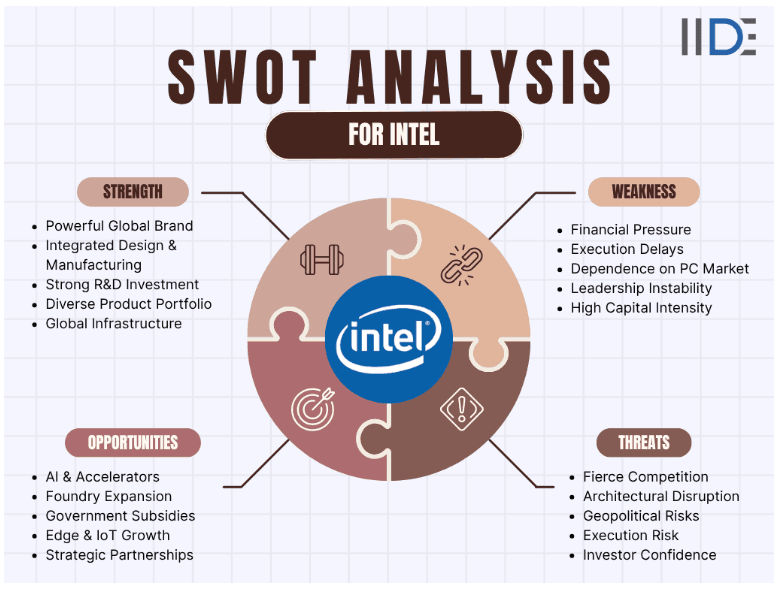
The SWOT analysis of Intel helps evaluate the company’s strengths, weaknesses, opportunities, and threats in the rapidly evolving semiconductor industry. As Intel competes with AI leaders, this analysis provides valuable insights into how the company is leveraging its strengths, addressing its challenges, and preparing for future growth.
Strengths of Intel in 2026
Intel’s strengths lie in its strong brand recognition, integrated manufacturing model, and decades of innovation. These strengths continue to support its position despite growing competition in this semiconductor industry.
1. Strong Brand Recognition & Market Leadership
- Intel's "Intel Inside" campaign made it one of the world's most recognized technology brands.
- Over 55 years of innovation has built strong trust among consumers and enterprises.
- Partnerships with Dell, HP, Lenovo, ASUS, and Acer strengthen its global market presence.
2. Integrated Manufacturing (IDM 2.0)
- Intel both designs and manufactures its own chips through the IDM 2.0 strategy.
- The company is expanding Intel Foundry with new fabrication plants in the U.S. and Europe.
- Government incentives such as the U.S. CHIPS Act support its manufacturing expansion.
3. Strong R&D and AI Innovation
- Intel invests around US$16 billion annually in research and development.
- Products like Gaudi 3, Core Ultra, and Xeon 6 strengthen its AI portfolio.
- A large patent portfolio supports continuous product innovation.
4. Strong Enterprise Ecosystem
- Intel has long term partnerships with cloud providers, OEMs, and enterprise customers.
- Xeon processors remain widely used in enterprise servers and data centres.
- These relationships provide recurring demand and stable revenue.
5. Government Support & Future Growth
- Intel benefits from funding under the U.S. CHIPS and Science Act.
- Expansion across the U.S. and Europe strengthens supply chain resilience.
- Government backing supports Intel's long-term AI and semiconductor strategy.
Weaknesses of Intel in 2026
Intel’s weaknesses arise from increasing competition, high capital expenditure, and manufacturing challenges. These issues could slow its growth and affect its global brand recognition if not addressed timely.
1. Manufacturing Execution Challenges
- Delays in advanced process technologies have allowed TSMC and AMD to gain a competitive edge.
- Scaling Intel Foundry and executing the IDM 2.0 strategy remains complex.
- Product delays can impact customer confidence and market share.
2. Intense Competition in AI
- NVIDIA dominates AI accelerators, while AMD continues to expand its AI and data center portfolio.
- Intel is still strengthening its AI software ecosystem and developer adoption.
- Losing ground in AI could limit future revenue growth.
3. High Capital Investment
- Intel is investing billions in new fabs and advanced manufacturing facilities.
- High capital expenditure continues to pressure profitability and cash flow.
- Long payback periods make successful execution critical.
4. Dependence on the PC Market
- A significant portion of Intel's revenue still comes from PCs and traditional CPUs.
- Weak PC demand directly impacts sales and earnings.
- Diversifying into AI and foundry services remains a key challenge.
5. Turnaround Execution Risk
- Intel's recovery depends on successfully delivering its AI and Foundry roadmap.
- Any delays could reduce investor confidence and competitive positioning.
- Strong execution will determine its long term success.
Opportunities for Intel in 2026
Intel can significantly grow with opportunities available, such as AI and semiconductor advancements and the rise in manufacturing of domestic chips. By leveraging these trends, the company can strengthen its competitive position and future growth.
1. Growing AI and Data Centre Market
- Rising demand for generative AI is creating new opportunities for Gaudi AI accelerators and Xeon 6 processors.
- Enterprises are increasing investments in AI infrastructure and cloud computing.
- Intel can expand its presence in enterprise AI and high performance computing.
2. Expansion of Intel Foundry Services
- Intel Foundry can attract third party chip designers looking for advanced manufacturing.
- Government incentives under the U.S. CHIPS Act support new fabrication facilities.
- Expanding foundry services can diversify Intel's revenue beyond processors.
3. Rising Demand for AI PCs and Edge Computing
- The growing adoption of AI PCs creates demand for Intel Core Ultra processors.
- Edge computing, IoT, and autonomous technologies offer new growth opportunities.
- Intel can leverage its existing PC leadership to drive AI enabled device adoption.
4. Sustainability and Advanced Manufacturing
- Demand for energy efficient chips is increasing among enterprises and governments.
- Intel's investments in sustainable manufacturing align with global ESG goals.
- Advanced packaging and next generation chip technologies can strengthen its competitive advantage.
5. Strategic Partnerships and Global Expansion
- Collaborations with cloud providers, OEMs, and AI companies can accelerate innovation.
- Expansion across the U.S. and Europe reduces supply chain risks.
- Intel's global presence enables it to capture demand in emerging semiconductor markets.
Threats to Intel in 2026
Intel is on its way to achieve growth and maintain its leadership position; it faces several external threats such as rapid technological change and geopolitical uncertainties. To remain competitive, they must continue innovating in the semiconductor industry.
1. Intense Competition in AI and Semiconductors
- NVIDIA dominates the AI accelerator market, while AMD continues to gain CPU and server market share.
- TSMC and Samsung maintain leadership in advanced semiconductor manufacturing.
- Increased competition could reduce Intel's market share and pricing power.
2. Rapid Technological Advancements
- The semiconductor industry is evolving rapidly with AI, advanced chip designs, and next generation manufacturing.
- Delays in adopting new technologies could weaken Intel's competitive position.
- Faster innovation from rivals may affect customer demand and product adoption.
3. Geopolitical and Supply Chain Risks
- Global trade tensions and export restrictions continue to impact semiconductor businesses.
- Supply chain disruptions may delay manufacturing and increase production costs.
- Heavy dependence on global operations exposes Intel to geopolitical uncertainty.
4. High Manufacturing Costs and Economic Uncertainty
- Building advanced fabrication plants requires billions of dollars in investment.
- Inflation and rising operating costs could pressure profit margins.
- Weak economic conditions may reduce enterprise and consumer spending on technology.
5. Execution Risks in Turnaround Strategy
- Intel's future depends on the successful execution of its IDM 2.0 and Intel Foundry strategy.
- Delays in AI product launches or manufacturing expansion could reduce investor confidence.
- Failure to achieve turnaround goals may affect longterm growth and profitability.
IIDE Student Takeaway & Conclusion
Key Takeaway
The SWOT analysis of Intel shows that even market leaders keep evolving to stay competitive. Intel’s strong brand recognition, manufacturing expertise, and innovation remain its biggest strengths, while AI competition and execution challenges continue to test its growth.
Intel simply teaches how long term success depends not just on innovation but also on adapting to market changes and executing strategies effectively.
IIDE Student Recommendations
As an IIDE student, I'd recommend Intel to:
Accelerate AI innovation by expanding its AI hardware and software ecosystem to compete more effectively with NVIDIA and AMD.
Strengthen Intel Foundry Services by attracting more global chip designers and building strategic manufacturing partnerships.
Enhance brand positioning by promoting Intel as an AI and advanced computing company rather than only a PC processor manufacturer.
Invest in sustainable manufacturing and communicate its ESG initiatives more effectively to attract environmentally conscious customers and investors.
Improve execution speed by reducing product launch delays and ensuring the successful
implementation of its IDM 2.0 strategy.
However, Intel has the resources to strengthen its position in the semiconductor industry. Its long term success, however, will depend on executing its AI strategy and adapting quickly to changing market needs.
Conclusion
Intel remains one of the world's most influential semiconductor companies in 2026, backed by decades of innovation, a globally recognized brand, and strong manufacturing expertise. While challenges such as intense competition, execution risks, and changing market dynamics continue to delay its growth, opportunities in AI, foundry services, and next generation computing present a strong path forward.
Overall, this SWOT analysis of Intel shows that Intel's future depends on balancing innovation with execution. By leveraging its strengths, addressing its weaknesses, capitalizing on emerging opportunities, and effectively overcoming external threats, Intel can strengthen its leadership position in the rapidly evolving semiconductor industry.
Want to Know Why 2,50,000+ Students Trust Us?
Dive into the numbers that make us the #1 choice for career success


Courses Recommended for you

MBA - Level
Post Graduate in Digital Marketing & Business Strategy

Best For
Fresh Graduates

Mode of Learning
On Campus (Mumbai & Delhi)

Starts from
Nov 27, 2026

Duration
11 Months

Live & Online
Advanced Online Digital Marketing Course
Best For
Working Professionals
Mode of Learning
Online
Starts from
Nov 2, 2026
Duration
4-6 Months

Offline
Top AI Courses to Make You Future Ready!
Best For
AI Enthusiasts
Mode of Learning
2–5 Month Program
Starts from
Nov 24, 2026
Duration
Flexiable
Offline
Undergraduate Program in Digital Business & Entrepreneurship
Best For
12th Passouts
Mode of Learning
On Campus (Mumbai)
Duration
3 Years

Offline
Degree In 2026 ≠ Enough Degree + Digital Skills = Future-Ready
Best For
12th Passouts
Mode of Learning
At IIDE Campus
Duration
3 Years
Recent Post

Student at IIDE
I am an aspiring digital marketing professional driven by curiosity, creativity, and a strong interest in how brands build meaningful digital presence. I am deeply motivated by the intersection of strategy, storytelling, and data - and how together they create measurable business impact.
I hold a BBA with a specialization in Digital Marketing, where I developed a strong foundation in business management, consumer behaviour, brand communication, and digital strategy. Through internships and hands-on projects, I gained practical exposure to campaign execution, content planning, and cross-platform marketing initiatives, understanding how digital strategies move from planning to performance.
Securing placement in February 2025 marked a significant milestone in my journey and reinforced my readiness to step confidently into industry roles.
Currently, I am pursuing a Post Graduate Programme in Digital Marketing & Strategy at IIDE The Digital School, where I am strengthening my expertise in social media marketing, content strategy, performance marketing, search engine optimisation (SEO), campaign planning, and marketing analytics.
My interests lie in understanding how brands grow digitally, how different channels contribute to overall business objectives, and how creativity, data, and strategy come together to drive measurable impact.