Application Deadline for 3-Year UG Program closes on 31st Aug. Book a Counselling to know more

Students Centric
Placements Report
Trackable results, real numbers
Reviews
Proven success, real voices
Trainers
Expert-led, Industry-Driven Training
Life at IIDE
Vibrant Spirit student life
Alumni
Successful Journeys, Inspiring Stories
Learning Centre
Webinars
Blogs
Case studies
Live, Interactive Masterclasses
Fresh Insights, quick reads
Real-life, Industry relevant
More
Hire from us
Hire Top Digital Marketing Talent
Work with us
Join Our Team, Make an Impact
Customised Training
Personalised digital marketing training for your company
Refer & earn
Simple, easy rewards
Contact us
Get the answers you need
About us
Know more about IIDE
Explore all course options

FOR FRESH GRADUATES
Post Graduation Program in Digital Marketing & Business Strategy- Ideal for Age: 20–25 Years

Can’t decide? Explore all our
Digital Marketing Courses
COMPARE ALL 3 PROGRAMSOnline & Offline
Explore Top AI CoursesIndustry-Aligned TRACKMost Popular
UG Program in Digital Business & Entrepreneurship- Ideal for 12th Pass out / FY Degree Student

PARTNER PROGRAMS







Can’t decide? Explore all
BBA In Digital Marketing Colleges
Orginally Written by Aditya Shastri
Updated on Dec 12, 2025
Share on:


Xbox remains one of the premier names in video gaming, delivering powerful consoles, exclusive franchises, and innovative cloud gaming experiences in 2026. As the market evolves with new technology and increased competition, Xbox’s strategic decisions shape its future. What gives Xbox an edge, and where does it face challenges?
This SWOT analysis reveals actionable insights for entrepreneurs, marketers, and gaming enthusiasts.
Before diving into the article, I would like to inform you that the research and initial analysis for this piece were conducted by Ujjwal Chatkara. She is a current student in IIDE's PG in Digital Marketing, March Batch 2025.
If you found this helpful, feel free to reach out to Ujjwal Chatkara to send a quick note of appreciation for her fantastic research; she will appreciate the kudos!
About Xbox
Launched in 2001, Xbox is Microsoft’s flagship gaming brand, offering cutting-edge consoles, digital services, and a growing games catalogue. Known for its “Power Your Dreams” slogan, Xbox is a pioneer in online multiplayer and game subscriptions

By 2026, Xbox will boast millions of users globally and will continue to compete fiercely with Sony and Nintendo. SWOT stands for Strengths, Weaknesses, Opportunities, and Threats a proven framework for analysing Xbox’s position in the gaming world.
| Attribute | Details |
|---|---|
| Official Name | Xbox (Microsoft Corporation) |
| Founded Year | 2001 |
| Website URL | www.xbox.com |
| Industries Served | Video Games, Online Services |
| Geography | Global (primary in US, Europe, Japan) |
| Revenue (2024) | ~$20 billion |
| Employees | (See Microsoft: 220,000) |
| Main Competitors | PlayStation (Sony), Nintendo, Epic Games, Steam |

Is Digital Marketing the Right Career for You?
Find out in a free 45-min masterclass · Career paths, roles and growth explained · By Karan Shah, Founder & CEO, IIDE

Is Digital Marketing the Right Career for You?
Find out in a free 45-min masterclass · Career paths, roles and growth explained · By Karan Shah, Founder & CEO, IIDE
SWOT Analysis of Xbox
Xbox’s Brand Strengths
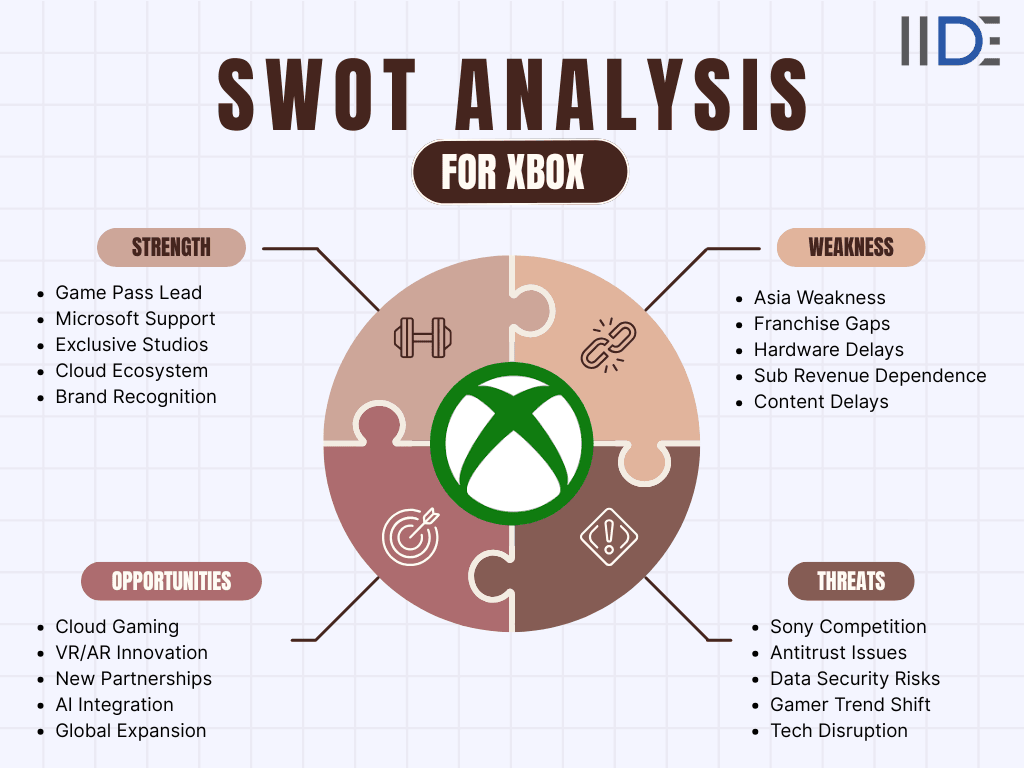
- Strong global brand awareness, backed by Microsoft’s resources and technology ecosystem.
- Leading position in subscription gaming via Xbox Game Pass, which offers a massive library and new releases on day one.
- Powerful hardware (Xbox Series X/S) and seamless integration of cloud gaming via xCloud.
- Exclusive first-party franchises like Halo, Forza, Gears of War, and notable recent studio acquisitions.
- User-friendly cross-platform support and robust online multiplayer infrastructure (Xbox Live).
Xbox’s Brand Weaknesses
- Subpar performance and limited popularity in the Japanese market and parts of Asia.
- Ongoing reliance on subscription revenue, which is vulnerable to market saturation and price competition.
- Fewer global exclusive blockbuster titles compared to PlayStation’s flagship franchises.
- Occasional hardware supply chain disruptions and delayed first-party software launches.
- Public and legal scrutiny over large studio acquisitions potentially impacting brand reputation or regulatory approvals.
Xbox’s Opportunities
- Expansion of Game Pass and cloud gaming access to emerging markets and low-hardware environments.
- Growing demand for cross-play and device-agnostic gaming opens up collaboration and user base.
- The development of immersive VR/AR gaming and the integration of AI-driven personalised experiences.
- Strategic partnerships with indie developers and streaming platforms for unique content.
- Leveraging Microsoft’s advancements in AI, Azure cloud, and hardware to outpace competition.
Xbox’s Threats
- Aggressive competition from Sony’s PlayStation, Nintendo Switch, and PC platforms like Steam.
- Regulatory risks, antitrust actions, and shifting international policy on digital monopolies.
- Cybersecurity threats and threats to user data in the large online network ecosystem.
- Changes in gamer preferences and loyalty, including a shift toward mobile or casual gaming over console.
- Tech disruptions or failures in launching new hardware/services may impact consumer trust.
Summary Table – SWOT of XBox
IIDE Student Takeaway, Conclusion & Recommendations
Key Takeaways:
Xbox’s greatest asset is its transition toward a service-first approach, with Game Pass and cloud gaming leading its strategic edge, anchored by Microsoft’s vast resources and technology.
This shift offers a resilient and scalable revenue model, distinguishing Xbox from hardware-dependent competitors.
However, Xbox faces significant risks from rising hardware costs, complex content acquisition, and the ongoing challenge of maintaining exclusive appeal while embracing openness with multi-platform publishing.
Core Strategic Tension:
The most critical decision for Xbox is balancing exclusivity (with high-profile game launches and perks) against openness (making select titles and services available beyond Xbox hardware).
Navigating this tightrope determines how the brand can retain loyal users and entice new gamers globally.
Actionable Recommendations:
- Intensify focus on recurring revenue models like Game Pass and cloud streaming, shifting away from hardware dependence for financial stability.
- Streamline studio investments, prioritising fewer but higher-quality blockbuster titles, and ensure robust governance and pipeline oversight.
- Utilise Microsoft’s tech infrastructure, AI analytics, and Azure to enhance player experiences, retention, and backend efficiency.
- Drive aggressive regional expansion in emerging markets with tailored pricing and content localisation for India, Southeast Asia, and Latin America.
- Even as Xbox expands cross-platform presence, it maintains distinctive perks, features, and experiences to reward and grow its core ecosystem.
Future Outlook:
Xbox’s evolution signals a bold move from product sales to a broader entertainment platform focused on recurring engagement. Its future hinges on sustaining service growth, managing content costs, and innovating cloud-first gaming.
With strategic investment and unique differentiation, Xbox is poised to be a dominant force in the global gaming landscape through 2026 and beyond.
Want to Know Why 5,00,000+ Students Trust Us?
Dive into the numbers that make us the #1 choice for career success



MBA - Level
Post Graduate in Digital Marketing & Business Strategy

Best For
Fresh Graduates

Mode of Learning
On Campus (Mumbai & Delhi)

Starts from
Oct 1, 2026

Duration
11 Months

Live & Online
Advanced Online Digital Marketing Course
Best For
Working Professionals
Mode of Learning
Online
Starts from
Sep 4, 2026
Duration
4-6 Months

Online
Professional Certification in AI Strategy
Best For
AI Enthusiasts
Mode of Learning
Online
Starts from
Sep 8, 2026
Duration
5 Months

Online or Offline
Top AI Courses to Make You Future Ready!
Best For
AI Enthusiasts
Mode of Learning
2–5 Month Program
Starts from
Sep 8, 2026
Duration
Flexiable

On Campus
Advanced Certification in Artificial Intelligence
Best For
AI Enthusiasts
Mode of Learning
On Campus (Mumbai)
Starts from
Sep 1, 2026
Duration
3 Months
Offline
Degree In 2026 ≠ Enough Degree + Digital Skills = Future-Ready
Best For
12th Passouts
Mode of Learning
At IIDE Campus
Starts from
Aug 31, 2026
Duration
3 Years
Offline
Undergraduate Program in Digital Business & Entrepreneurship
Best For
12th Passouts
Mode of Learning
On Campus (Mumbai)
Starts from
Aug 31, 2026
Duration
3 Years
Recent Post

Lead Trainer & Business Development Head at IIDE
Aditya Shastri leads the Business Development segment at IIDE and is a seasoned Content Marketing expert. With over a decade of experience, Aditya has trained more than 20,000 students and professionals in digital marketing, collaborating with prestigious institutions and corporations such as Jet Airways, Godrej Professionals, Pfizer, Mahindra Group, Publicis Worldwide, and many others. His ability to simplify complex marketing concepts, combined with his engaging teaching style, has earned him widespread admiration from students and professionals alike.
Aditya has spearheaded IIDE’s B2B growth, forging partnerships with over 40 higher education institutions across India to upskill students in digital marketing and business skills. As a visiting faculty member at top institutions like IIT Bhilai, Mithibai College, Amity University, and SRCC, he continues to influence the next generation of marketers.
Apart from his marketing expertise, Aditya is also a spiritual speaker, often traveling internationally to share insights on spirituality. His unique blend of digital marketing proficiency and spiritual wisdom makes him a highly respected figure in both fields.