Application Deadline for 3-Year UG Program closes on 31st Aug. Book a Counselling to know more

Students Centric
Placements Report
Trackable results, real numbers
Reviews
Proven success, real voices
Trainers
Expert-led, Industry-Driven Training
Life at IIDE
Vibrant Spirit student life
Alumni
Successful Journeys, Inspiring Stories
Learning Centre
Webinars
Blogs
Case studies
Live, Interactive Masterclasses
Fresh Insights, quick reads
Real-life, Industry relevant
More
Hire from us
Hire Top Digital Marketing Talent
Work with us
Join Our Team, Make an Impact
Customised Training
Personalised digital marketing training for your company
Refer & earn
Simple, easy rewards
Contact us
Get the answers you need
About us
Know more about IIDE
Explore all course options

FOR FRESH GRADUATES
Post Graduation Program in Digital Marketing & Business Strategy- Ideal for Age: 20–25 Years

Can’t decide? Explore all our
Digital Marketing Courses
COMPARE ALL 3 PROGRAMSOnline & Offline
Explore Top AI CoursesIndustry-Aligned TRACKMost Popular
UG Program in Digital Business & Entrepreneurship- Ideal for 12th Pass out / FY Degree Student

PARTNER PROGRAMS







Can’t decide? Explore all
BBA In Digital Marketing Colleges
Orginally Written by Aditya Shastri
Updated on Jun 2, 2026
Share on:


Taco Bell, a fast-food giant known for its Mexican-inspired menu, remains a major player in the global market. But what sets Taco Bell apart from its competitors and where does it face challenges? Read on to explore Taco Bell’s SWOT analysis for 2026, offering insights into the brand’s future and competitive position in the fast-food industry.
About Taco Bell

Taco Bell was founded on March 21, 1962, by Glen William Bell Jr., a former U.S. Marine and self-taught entrepreneur from Southern California. He opened the very first Taco Bell in Downey, California, a tiny 400-square-foot walk-up restaurant serving affordable Mexican-inspired food to everyday Americans. The idea took off fast. Within two years, Glen had opened eight more locations and began franchising the brand in 1964. The company went public in 1969, and by 1978, PepsiCo acquired Taco Bell for $125 million. In 1997, PepsiCo spun off its restaurant businesses into what eventually became Yum! Brands Inc. the parent company that owns Taco Bell to this day.
Today, Taco Bell runs over 9,030 restaurants across 30+ countries and serves more than 40 million customers every week in the US alone. About 94% of its restaurants are franchise-operated, one of the most scalable models in the quick-service restaurant industry. The menu covers Mexican-inspired favourites like tacos, burritos, quesadillas, and fan-favourite items like the Crunchwrap Supreme, along with a growing vegetarian range and new beverage options through its Live Más Café concept. What makes Taco Bell stand out is its bold brand personality, which connects deeply with Millennials and Gen Z through irreverent marketing, pop-culture collaborations, and its "Live Más" philosophy that goes well beyond just food.
In 2024, Taco Bell hit a historic milestone of $1 billion in operating profit for the very first time, with digital sales growing 32% to $6 billion. By the end of 2025, system-wide sales reached $18.36 billion, growing 8% year-on-year. Under CEO Sean Tresvant, Taco Bell launched its bold 2025 growth strategy called R.I.N.G. The Bell Relentlessly Innovative Next-Generation Growth focused on doubling food innovation, boosting digital engagement, and expanding international locations from 1,150 to 3,000+ by 2030. With same-store sales growth in every quarter of 2024 and strong momentum continuing into 2025, Taco Bell is clearly one of the most exciting brands in global fast food right now.
| Official Company Name | Taco Bell |
|---|---|
| Founded | 1962 |
| Website URL | www.tacobell.com |
| Industries Served | Fast Food |
| Geographic Areas Served | Global, primarily North America |
| Revenue | $2.2 Billion (2025) |
| Net Income | $300 Million (2025) |
| Employees | Approx. 200,000 |
| Main Competitors | Chipotle, Wendy's, McDonald's |

Is Digital Marketing the Right Career for You?
Find out in a free 45-min masterclass · Career paths, roles and growth explained · By Karan Shah, Founder & CEO, IIDE

Is Digital Marketing the Right Career for You?
Find out in a free 45-min masterclass · Career paths, roles and growth explained · By Karan Shah, Founder & CEO, IIDE
SWOT Analysis of Taco Bell
Brand Strengths
Strong Brand Recognition:
- Taco Bell enjoys high brand recognition, bolstered by its distinct menu items like the Doritos Locos Tacos and creative marketing campaigns.
- Taco Bell operates over 8,000 locations worldwide and generates $12 billion in annual revenue as of 2025.
Innovation in Menu:
- Taco Bell is known for its unique and innovative menu items that appeal to a wide audience.
- For example, Taco Bell’s breakfast menu, launched in 2014, now contributes to approximately 10% of its total sales.
- The addition of new flavours and products regularly keeps consumers engaged, with over 25 new menu items introduced each year.
Loyal Customer Base:
- Taco Bell has cultivated a strong and loyal customer base, thanks to its value-driven offerings and consistent engagement with social media and digital platforms.
- Taco Bell Rewards, launched in 2021, has over 20 million members by 2025.
Financial Backing:
- Taco Bell benefits from being a part of Yum! Brands is a large conglomerate, which provides it with the financial strength to withstand market pressures.
- Yum! Brands posted $8.5 billion in revenue in 2024, with Taco Bell accounting for about 40% of that figure.
SWOT analysis of Pizza Hut highlights how menu innovation and global presence contribute to its market strength.
Brand Weaknesses
Health-Related Criticism:
- As consumers become more health-conscious, Taco Bell's reputation for high-calorie, fast-food items may pose a risk.
- Over 70% of Taco Bell's menu is considered high-calorie, contributing to criticism and challenges to its brand image.
Dependence on the North American Market:
- While Taco Bell is expanding internationally, the brand’s largest revenue comes from North America, making it vulnerable to regional economic shifts.
- In 2024, 75% of Taco Bell’s revenue came from the U.S. market, making it heavily reliant on North American economic trends.
Perception of Unhealthy Food:
- Many of Taco Bell’s products are considered unhealthy, which could limit its appeal among health-conscious consumers or those avoiding fast food.
- According to surveys, 45% of Taco Bell's customers cite the need for healthier menu options as a key concern.
Marketing strategy of Dunkin Donuts reveals how brand consistency and product diversity support its appeal.
Brand Opportunities
Health-Conscious Menu Expansion:
- There’s an opportunity to introduce more plant-based and lower-calorie items to cater to the growing demand for healthier fast food.
- Taco Bell's Beyond Taco, introduced in 2021, accounted for 5% of total sales in plant-based options by 2024, showing strong demand.
Geographic Expansion:
- Taco Bell can expand further into international markets like Asia and Europe, where demand for fast-food offerings is rising.
- Taco Bell has already expanded into 30+ countries, with plans to open an additional 1,000 locations globally by 2027.
Sustainability Initiatives:
- There is a growing trend towards eco-friendly packaging and sustainable sourcing, which Taco Bell could tap into to improve its brand image.
- In 2024, Taco Bell committed to 100% sustainable packaging by 2025, aligning with the broader trend in fast-food sustainability.
Tech Innovations:
- The brand could benefit from adopting more AI and digital platforms to enhance the customer experience and personalisation, especially through Taco Bell’s app.
- Mobile orders account for 35% of Taco Bell’s total sales, and the brand continues to invest in improving its digital channels.
Brand Threats
Intense Competition:
- Taco Bell faces stiff competition from global fast-food giants like McDonald’s, as well as newer entrants like Chipotle and Shake Shack, which may pose a threat to its market share.
- McDonald’s, which operates over 39,000 locations worldwide, remains the dominant fast-food player, controlling 40% of the global fast-food market.
Rising Costs:
- The increasing costs of raw ingredients and labor could lead to higher prices, potentially driving customers to cheaper alternatives.
- Taco Bell has seen food costs increase by 8% in 2024 due to global supply chain disruptions, impacting its pricing strategy.
Changing Consumer Preferences:
- A shift towards fresher, healthier, and organic food options could reduce demand for Taco Bell’s typical offerings, especially among younger consumers.
- 45% of Millennials and Gen Z are increasingly prioritising healthy, organic food, challenging Taco Bell’s traditional offerings.
Economic Challenges:
- In times of economic downturn or recession, Taco Bell could face challenges as consumers cut back on discretionary spending.
- The U.S. fast-food market saw a 4.5% decline in revenue during the 2020 recession, and Taco Bell must remain prepared for similar economic downturns.
The Business Model of McDonald's explores how scale and standardisation form the backbone of its global dominance.
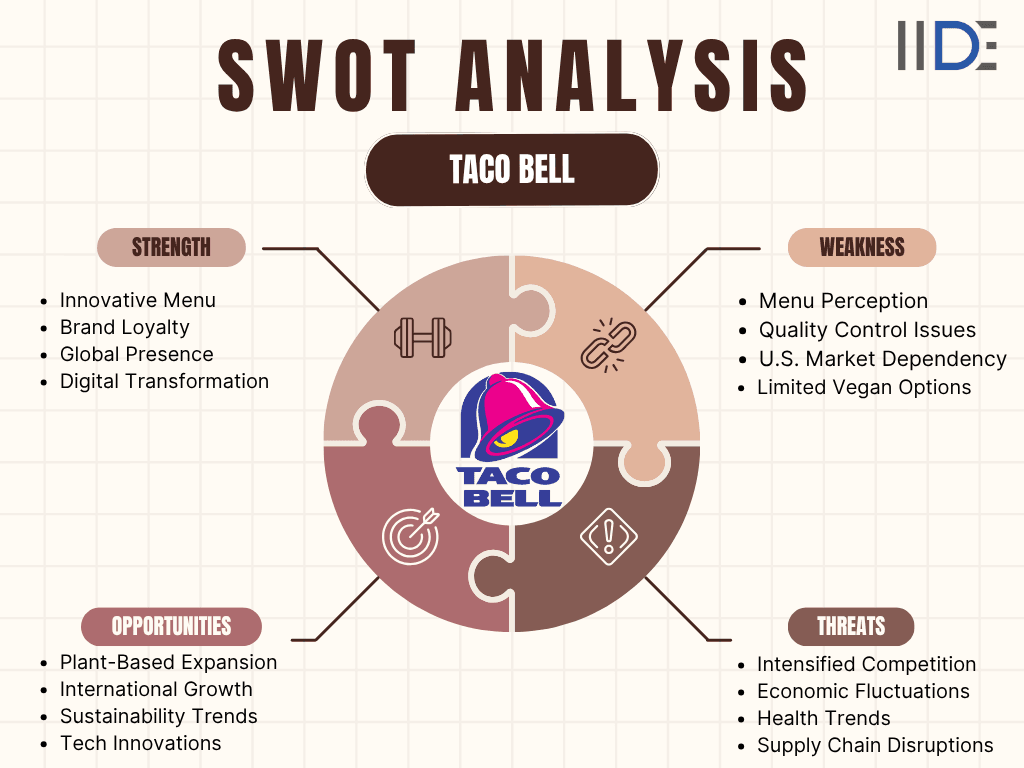
SWOT Summary Table
IIDE Student Takeaway
Taco Bell’s SWOT analysis reveals a company that thrives on innovation, strong brand recognition, and a loyal customer base, but faces significant challenges in its over-reliance on North American markets and perceptions around unhealthy food offerings. Its strengths lie in a unique menu, creative marketing strategies, and financial backing from Yum! Brands. However, the brand’s weaknesses, chiefly its dependence on the U.S. market and health-conscious criticisms, create tension as Taco Bell navigates evolving consumer preferences.
Core Tension:
The core tension for Taco Bell lies in balancing its status as a leader in innovative fast food with the growing demand for healthier, more sustainable menu options. While Taco Bell’s strength is its ability to regularly introduce new and exciting menu items, the shift toward plant-based diets and healthier food options presents both an opportunity and a challenge.
The question remains: Can Taco Bell maintain its position as a market leader while adapting to these shifts without alienating its core audience?
Future Outlook:
Taco Bell is well-positioned for growth, given its global presence and strong brand equity. However, the brand's ability to continue its success will depend on its adaptation to market changes, particularly in terms of sustainability and health-conscious trends.
Expanding its product lines to include healthier options, further enhancing digital engagement, and tapping into new global markets are key to securing its future. If Taco Bell can innovate in line with shifting consumer demands while maintaining its loyal customer base, it will solidify its position in the competitive fast-food industry.
Actionable Recommendations:
- Diversification: Taco Bell should further diversify its menu by incorporating more plant-based, lower-calorie, and healthier items to meet the growing demand for nutritious fast food options.
- Global Expansion: The company should continue expanding into underrepresented international markets, particularly in Asia and Europe, where demand for fast food is on the rise.
- Enhanced Digital Strategy: Invest further in digital platforms, including AI and personalisation features, to improve customer experience and loyalty. A focus on digital orders can drive revenue and customer engagement.
- Sustainability: Taco Bell must increase its focus on sustainability by committing to eco-friendly packaging and responsible sourcing, aligning with global trends towards environmental consciousness.
Conclusion
Taco Bell’s future will depend on how well it balances innovation with consumer health trends and sustainability practices. The brand has the potential to lead the charge in the fast-food sector if it can remain agile and responsive to evolving market dynamics.
By embracing healthier offerings, expanding globally, and leveraging digital innovation, Taco Bell can continue to grow and adapt, securing its competitive advantage in the years to come.
Want to Know Why 2,50,000+ Students Trust Us?
Dive into the numbers that make us the #1 choice for career success



MBA - Level
Post Graduate in Digital Marketing & Business Strategy

Best For
Fresh Graduates

Mode of Learning
On Campus (Mumbai & Delhi)

Starts from
Oct 1, 2026

Duration
11 Months

Live & Online
Advanced Online Digital Marketing Course
Best For
Working Professionals
Mode of Learning
Online
Starts from
Sep 4, 2026
Duration
4-6 Months

Online
Professional Certification in AI Strategy
Best For
AI Enthusiasts
Mode of Learning
Online
Starts from
Sep 8, 2026
Duration
5 Months

Online or Offline
Top AI Courses to Make You Future Ready!
Best For
AI Enthusiasts
Mode of Learning
2–5 Month Program
Starts from
Sep 8, 2026
Duration
Flexiable

On Campus
Advanced Certification in Artificial Intelligence
Best For
AI Enthusiasts
Mode of Learning
On Campus (Mumbai)
Starts from
Sep 1, 2026
Duration
3 Months

Offline
Degree In 2026 ≠ Enough Degree + Digital Skills = Future-Ready
Best For
12th Passouts
Mode of Learning
At IIDE Campus
Starts from
Aug 31, 2026
Duration
3 Years

Offline
Undergraduate Program in Digital Business & Entrepreneurship
Best For
12th Passouts
Mode of Learning
On Campus (Mumbai)
Starts from
Aug 31, 2026
Duration
3 Years
Recent Post
No. Taco Bell and KFC are owned by the same parent company, called Yum! Brands. The Yum! Brands also owns The Habit Burger Grill and Pizza Hut.
Sean Tresvant is the Chief Executive Officer of the Taco Bell Division, reporting directly to the Yum! Brands.
Burman Hospitality Private Limited (BHPL) is the exclusive Master Franchisee for the Taco Bell chain of quick service restaurants in India. Currently, they are operating more than 136 Taco Bell Restaurants in over 28 cities across India.

Lead Trainer & Business Development Head at IIDE
Aditya Shastri leads the Business Development segment at IIDE and is a seasoned Content Marketing expert. With over a decade of experience, Aditya has trained more than 20,000 students and professionals in digital marketing, collaborating with prestigious institutions and corporations such as Jet Airways, Godrej Professionals, Pfizer, Mahindra Group, Publicis Worldwide, and many others. His ability to simplify complex marketing concepts, combined with his engaging teaching style, has earned him widespread admiration from students and professionals alike.
Aditya has spearheaded IIDE’s B2B growth, forging partnerships with over 40 higher education institutions across India to upskill students in digital marketing and business skills. As a visiting faculty member at top institutions like IIT Bhilai, Mithibai College, Amity University, and SRCC, he continues to influence the next generation of marketers.
Apart from his marketing expertise, Aditya is also a spiritual speaker, often traveling internationally to share insights on spirituality. His unique blend of digital marketing proficiency and spiritual wisdom makes him a highly respected figure in both fields.