
Students Centric
Placements Report
Trackable results, real numbers
Reviews
Proven success, real voices
Trainers
Expert-led, Industry-Driven Training
Life at IIDE
Vibrant Spirit student life
Alumni
Successful Journeys, Inspiring Stories
Learning Centre
Webinars
Blogs
Case studies
Live, Interactive Masterclasses
Fresh Insights, quick reads
Real-life, Industry relevant
More
Hire from us
Hire Top Digital Marketing Talent
Work with us
Join Our Team, Make an Impact
Customised Training
Personalised digital marketing training for your company
Refer & earn
Simple, easy rewards
Contact us
Get the answers you need
About us
Know more about IIDE
Explore all course options

FOR FRESH GRADUATES
Post Graduation Program in Digital Marketing & Business Strategy- Ideal for Age: 20–25 Years

Can’t decide? Explore all our
Digital Marketing Courses
COMPARE BOTH OUR PROGRAMSOffline
Offline AI Courses with Dual CertificationsIndustry-Aligned TRACKMost Popular
UG Program in Digital Business & Entrepreneurship- Ideal for 12th Pass out / FY Degree Student

PARTNER PROGRAMS





Can’t decide? Explore all
BBA In Digital Marketing Colleges
Orginally Written by Aditya Shastri
Updated on May 13, 2026
Share on:


SK Telecom has been around since 1984. For most of those four decades, the job was straightforward: keep South Koreans connected.
That version of the company is gone. What exists today is something the company has been quietly but aggressively building toward for years. SK Telecom is no longer just selling mobile plans and managing cell towers.
It is deep into a full-scale push into AI infrastructure, cloud computing, and building its own large language models from scratch.
The question worth asking honestly: Is any of this actually working, or is the AI story just a way to dress up a company that still lives and dies by its telecom subscriber count?
Before diving into the article, I would like to acknowledge that the research and initial analysis for this piece were conducted by Pranav Valecha, a current student of IIDE’s Post Graduation in Digital Marketing and Business Strategy, August Batch 2025.
If you found this helpful, feel free to reach out to Pranav Valecha to send a quick note of appreciation for his fantastic research, he will appreciate the kudos!
About Sk Telecom
SK Telecom was founded in 1984 and is headquartered in Seoul, South Korea. It spent decades becoming the country's dominant mobile carrier, building a reputation on network quality, consistent service, and a level of domestic market penetration that most telecom operators globally never achieve.
The early bet on 5G infrastructure turned out to be the right one. South Korea became one of the most digitally advanced countries in the world, and by early 2026, over 82% of subscribers were on 5G.
That number matters because no AI or IoT product roadmap works without the network layer underneath it. The financials from FY2025 tell a mixed but instructive story. Consolidated revenue came in at KRW 17.0992 trillion with operating income of KRW 1.0732 trillion.
AI Data Center revenue hit KRW 519.9 billion, up 34.9% year on year. The A dot AI assistant platform crossed 11.2 million users by Q4 2025. These are real numbers, not projections.
Behind all of it sits SK Group, which gives the company a level of financial backing that allows it to make long, expensive bets on infrastructure without flinching.
The tagline "Connect the Future" sounds like standard corporate branding. In SK Telecom's case, it is actually a reasonable description of what the company is trying to become..
Why This SWOT Matters in 2026
The telecom industry is not going through a rough patch. It is going through a structural change that does not reverse. A few years ago, the playbook was simple. Build the best network, price competitively, grow subscriber numbers.
Today, companies are competing on entirely different ground:
- AI services and building proprietary models in-house
- Data infrastructure and digital platform businesses
- Enterprise cloud and automation contracts
- AI data center capacity and utilization rates
- Personalized, AI-driven customer experiences at scale
The environment companies operate in has also gotten harder in ways that were not fully anticipated:
- Cybersecurity is no longer an IT department concern. It sits at board level because the business consequences of a failure are now catastrophic.
- Regulators across South Korea and broader Asia are moving fast on data privacy and AI governance.
- Infrastructure costs, particularly for AI, are climbing.
- Customers want transparency, not just compensation, when things go wrong.
- The competition is no longer limited to KT and LG U+. It now includes global giants like AWS, Google Cloud, and Microsoft Azure.
For SK Telecom specifically, 2026 is not just another year of executing a strategy.
It is the year where the gap between its AI ambitions and its ability to recover subscriber trust either closes or widens.

Is Digital Marketing the Right Career for You?
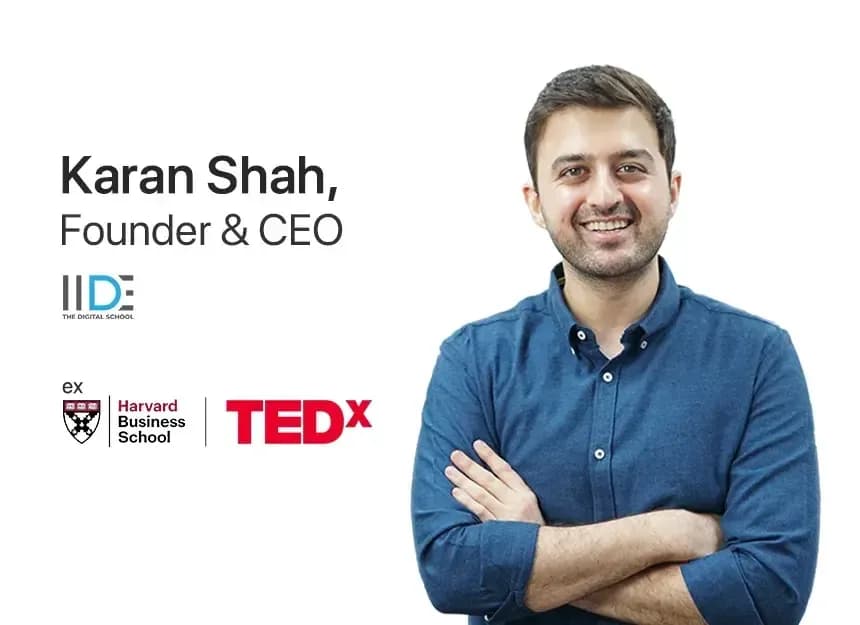
Find out in a free 45-min masterclass · Career paths, roles and growth explained · By Karan Shah, Founder & CEO, IIDE

Is Digital Marketing the Right Career for You?
Find out in a free 45-min masterclass · Career paths, roles and growth explained · By Karan Shah, Founder & CEO, IIDE
SWOT Analysis of SK Telecom
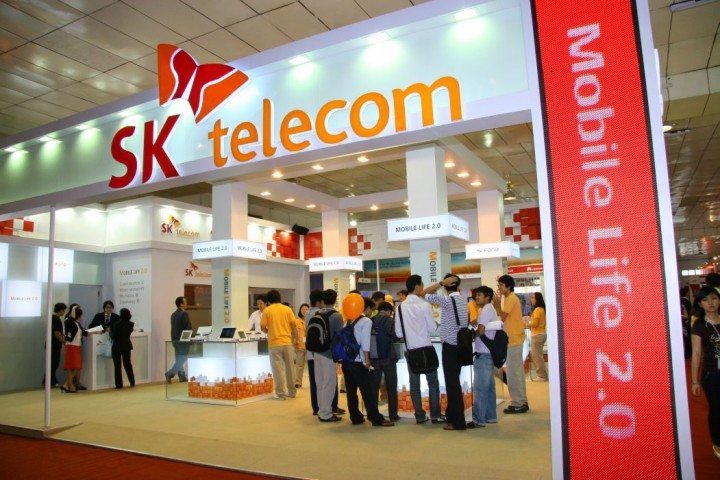
1. Strengths
SK Telecom has the scale of a market leader and the infrastructure to compete seriously in AI, and it has already produced results that prove it. The AI progress is not theoretical at this point. The numbers are in.
Key Strengths:
Dominant domestic position: Four decades of market leadership means SK Telecom has subscriber trust and brand recognition that competitors cannot replicate overnight. Even after the 2025 breach, it remains South Korea's largest carrier.
Industry-leading 5G infrastructure: 82% 5G penetration is not a vanity metric. It is the foundation every AI and IoT service the company sells is built on. That infrastructure is already paid for and operational.
Proven AI revenue growth: AIDC revenue grew 34.9% year on year in FY2025 to KRW 519.9 billion. That growth came from real utilization increases at the Gasan and Yangju facilities and the acquisition of the Pangyo data center, not accounting adjustments.
Proprietary AI capability: A.X K1 is South Korea’s first hyperscale AI model with over 500 billion parameters, built entirely in-house rather than licensed. At MWC 2026, SK Telecom announced plans to expand it beyond 1 trillion parameters while adding multimodal capabilities.
Product-level AI traction: A dot crossed 11.2 million users in [Quarter 4 2025]. Consumer AI products at that scale show the platform has real utility beyond enterprise demos.
Strategic global partnerships: The Ulsan AI Data Center joint venture with AWS broke ground in September 2025. Beyond that, SK Telecom has active collaboration discussions with Singtel, Deutsche Telekom, NTT, and Orange for shared AI infrastructure development.
Strong financial backing: SK Group-level support means SK Telecom can allocate roughly 33% of its total capital expenditure to AI-related investments without endangering the core business.
Restructured AI organisation: The AI CIC structure creates a standalone, accountable AI business unit. Combined with the appointment of a compliance-focused CEO following the breach, the organizational changes signal that leadership understands what went wrong and why.
2. Weaknesses
This is where the challenge becomes real and in 2025, it became very public. Legacy telecom organisations often struggle with transformation speed.
SK Telecom faced something more acute, a major operational failure that exposed not just technical vulnerabilities, but governance ones.
Key Weaknesses:
April 2025 data breach: Malware targeting SK Telecom's Home Subscriber Server compromised the USIM data of approximately 25 million subscribers, making it one of South Korea's most severe telecom security incidents on record.
Severe financial impact: [Quarter 3 2025] operating profit fell 90% year-on-year to KRW 48.4 billion, directly attributed to breach-related compensation, remediation costs, and subscriber losses.
Record regulatory fine: In August 2025, South Korea’s Personal Information Protection Commission imposed a record KRW 134.8 billion ($97.2 million) fine, citing basic security failures and inadequate breach reporting.
Significant subscriber churn: Nearly 933,509 users switched carriers in May 2025 alone a 77% spike over the monthly average with KT Corporation and LG U+ among the primary beneficiaries.
Heavy domestic revenue dependency: A disproportionate share of revenue still originates from one market, limiting resilience and global relevance.
High simultaneous capital demands: AI infrastructure expansion, a KRW 700 billion five-year cybersecurity overhaul, and ongoing telecom operations all require capital at the same time.
Transformation execution risk: Reorganising into an AI-native business while managing reputational recovery is operationally complex, and execution gaps remain a realistic concern.
Limited global brand footprint: Relative to global tech giants competing in AI and cloud, SK Telecom's international presence is still developing.
3. Opportunities
Here is where SK Telecom's story becomes genuinely compelling because several of its largest opportunities are not theoretical. They are already in progress.
Key Opportunities:
Rapid AI revenue scaling: AI revenue share is projected to exceed 22% of total revenue in 2026, up from just 9% in 2024. That rate of shift is structurally significant.
Sovereign AI leadership: SK Telecom advanced to Phase 2 of South Korea's government-led Sovereign AI Foundation Model project in January 2026, positioning it for expanded government AI contracts and national infrastructure roles.
New data center capacity: A new Seoul AI Data Center is planned for groundbreaking in 2026, building on existing facilities in Gasan, Yangju, and the newly acquired Pangyo site.
AWS synergy expansion: The Ulsan AIDC joint venture with Amazon Web Services creates a platform for enterprise cloud and hybrid AI workloads that few domestic competitors can replicate.
Submarine cable business: SK Telecom is expanding into submarine cable operations to generate strategic synergies with its growing AI data center portfolio a calculated move into high-value digital infrastructure.
AI-native telecom operations: Planned deployment of AI across network design, deployment, operations, marketing, and customer management in 2026 promises both productivity gains and improved customer retention.
Personalised customer lifetime value modelling: AI-powered CLV tools will enable targeted product offers and loyalty programmes, directly improving subscriber retention economics.
Trust as a competitive asset: If SK Telecom's post-breach reforms are executed transparently and consistently, it can differentiate itself as the most accountable and secure carrier in South Korea a meaningful positioning in a market where trust has been shaken.
4. Threats
Not everything is within the company's control and 2025 demonstrated that some threats arrive without warning.
Key Threats:
Persistent trust deficit: The April 2025 breach caused reputational damage that financial compensation and SIM replacement programmes alone cannot fully reverse. Rebuilding consumer confidence is a long-cycle challenge.
Escalating cybersecurity exposure: As SK Telecom handles increasing volumes of sensitive AI, cloud, and enterprise data, the business consequences of any future security incident grow proportionally larger.
Regulatory intensification: South Korean regulators have significantly increased scrutiny across all major carriers following the breach. Stricter data governance requirements and mandatory disclosure timelines are likely to follow.
Domestic competition: KT Corporation and LG U+ directly benefited from the 2025 subscriber migration and are now better resourced to compete for the customers SK Telecom lost.
Global tech encroachment: Hyperscalers such as AWS, Google Cloud, and Microsoft Azure are expanding aggressively into enterprise AI services in Asia, competing directly with SK Telecom's AIDC and AIX business lines.
Fast-moving AI landscape: The AI infrastructure market evolves rapidly. Delays in model development, data center deployment, or enterprise go-to-market execution can erode competitive positioning quickly.
Rising infrastructure and energy costs: AI data centers are energy-intensive. Increasing operational costs, particularly for GPU infrastructure and power supply, will pressure margins over time.
Economic sensitivity: A slowdown in domestic or regional enterprise spending would directly impact SK Telecom's highest-margin, fastest-growing AI business segments.
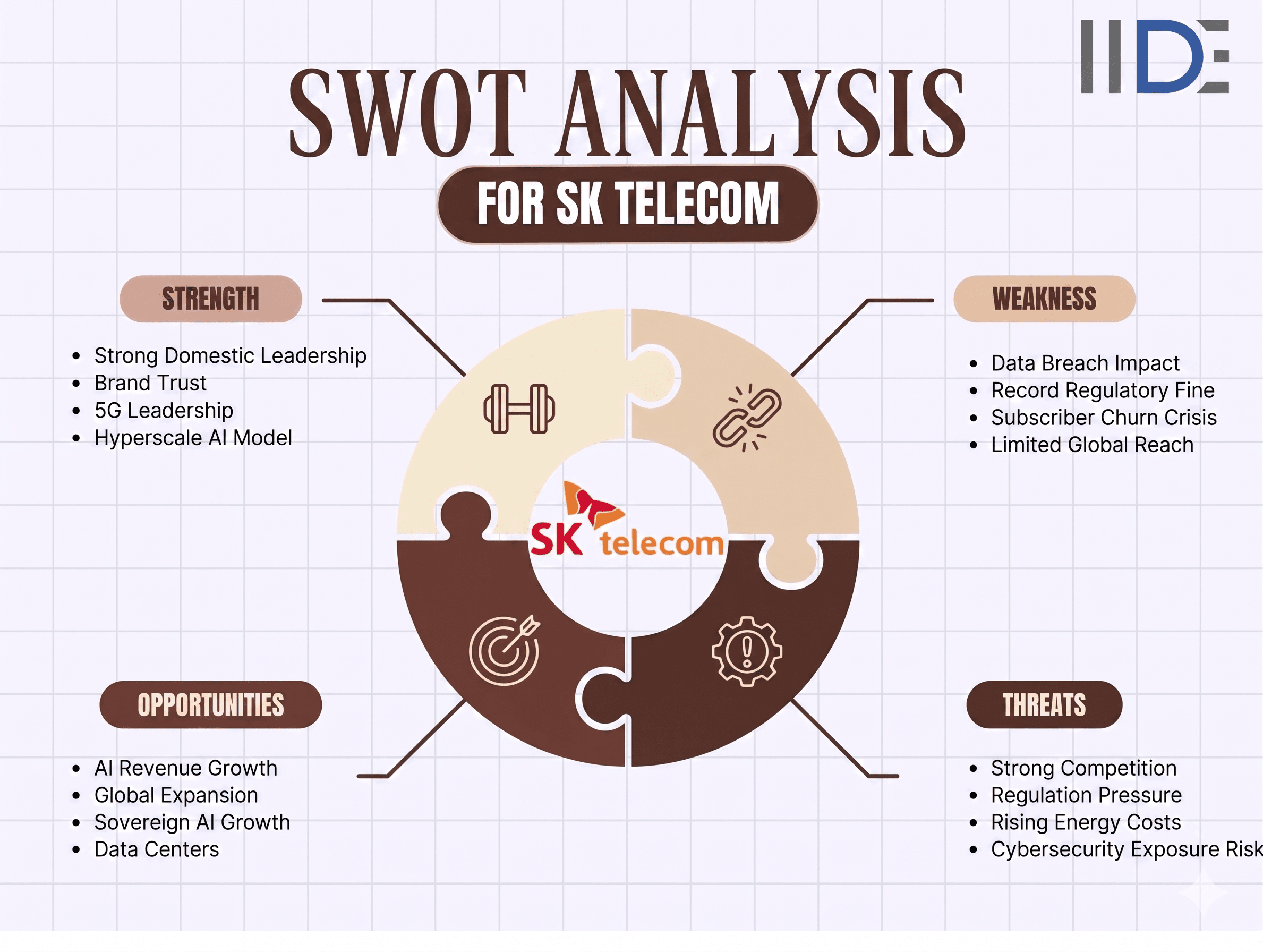
SWOT Summary Chart of SK Telecom
Key Insight, Final Thoughts and Conclusion
2026 Insights
SK Telecom enters 2026 carrying two distinct narratives simultaneously and which one defines the company will depend almost entirely on execution.
The first narrative is momentum. AI Data Center revenues growing nearly 35%. A proprietary 500-billion-parameter model. 11 million AI assistant users. A sovereign AI project advancing through government phases. These are not aspirational goals they are delivered results.
The second narrative is recovery. Nearly a million subscribers left in a single month. Operating profit fell by 90%. A record regulatory fine followed. A data breach exposed the personal information of almost the entire subscriber base.
Consumers and enterprises today evaluate telecom providers on a broader set of criteria than ever before: AI capability, data security, service personalisation, and transparent communication. SK Telecom is now competing on all four dimensions at once.
If the Marketing Strategy of SK Telecom successfully repositions the company as both an AI-innovation leader and a trustworthy data custodian, it unlocks a genuinely differentiated market position
For a contrasting view on how telecom brands build mass-market relevance and customer connection, read the Marketing Strategy of Vodafone to understand how strong branding, accessibility, and everyday utility create long-term consumer appeal.
That is the difference between defending market share and creating new markets.
Final Thoughts
SK Telecom is at one of the most consequential points in its four-decade history. Its strengths are clear, a proven 5G infrastructure base, growing AI revenues, a proprietary hyperscale AI model, and one of Asia-Pacific’s most significant telecom-to-AI pivots.
Its challenges are equally real: a data breach that shook public trust, financial results that reflected the true cost of that failure, and the operational complexity of executing a full business transformation while managing reputational repair.
The KRW 700 billion, five-year security investment signals that the company understands the stakes. The Sovereign AI Phase 2 advancement signals that it is competing at a national infrastructure level.
The A dot user growth signals that consumers are willing to re-engage. What remains unproven is whether SK Telecom can do all of this simultaneously, at scale, and faster than its competitors.
In today's market, vision matters only when backed by disciplined execution.
The defining question for 2026: Can SK Telecom rebuild trust and lead in AI at the same time or will the weight of one slow down the other?
Want to Know Why 2,50,000+ Students Trust Us?
Dive into the numbers that make us the #1 choice for career success



MBA - Level
Post Graduate in Digital Marketing & Business Strategy

Best For
Fresh Graduates

Mode of Learning
On Campus (Mumbai & Delhi)

Starts from
Nov 27, 2026

Duration
11 Months

Live & Online
Advanced Online Digital Marketing Course
Best For
Working Professionals
Mode of Learning
Online
Starts from
Nov 2, 2026
Duration
4-6 Months

Offline
Top AI Courses to Make You Future Ready!
Best For
AI Enthusiasts
Mode of Learning
2–5 Month Program
Starts from
Nov 23, 2026
Duration
Flexiable

Offline
Undergraduate Program in Digital Business & Entrepreneurship
Best For
12th Passouts
Mode of Learning
On Campus (Mumbai)
Starts from
-
Duration
3 Years
Offline
Degree In 2026 ≠ Enough Degree + Digital Skills = Future-Ready
Best For
12th Passouts
Mode of Learning
At IIDE Campus
Starts from
-
Duration
3 Years
Recent Post
SK Telecom is considered a leader because of its strong presence in South Korea and trusted network quality.
The company was also an early mover in 5G technology.
Its large customer base gives it scale and stability.
Strong brand recognition adds to its competitive advantage.
Yes, SK Telecom has been actively expanding into AI and digital services.
The company sees AI as a major future growth engine beyond telecom.
This includes enterprise tools, smart services, and platform innovation.
AI investments can help diversify long-term revenue.
SK Telecom competes with KT Corporation and LG Uplus in South Korea.
It also competes indirectly with global tech firms in AI and digital services.
Competition is strong in telecom pricing and innovation.
Constant upgrades are needed to stay ahead.
SK Telecom stands out for combining telecom infrastructure with future technology investments.
It is expanding into AI, cloud, data, and smart platforms.
The company benefits from strong domestic trust and advanced networks.
This gives it advantages beyond traditional telecom services.
South Korea remains its biggest and most important market.
However, the company is trying to expand through partnerships and digital businesses.
AI and enterprise services may reduce domestic dependence over time.
Diversification is an important future goal.
Regulatory pressure can affect telecom pricing and margins.
High infrastructure costs may reduce profitability.
Fast technology changes can make investments outdated quickly.
Strong competition also creates constant pressure.
5G helped SK Telecom strengthen its innovation image.
It also supports faster data services and enterprise solutions.
The technology creates opportunities in gaming, smart cities, and automation.
It remains a key pillar of future growth.
The future outlook remains positive if transformation continues well.
Telecom stability gives it a strong base to invest further.
AI and digital ecosystems can unlock new revenue streams.
Execution will decide how large that opportunity becomes.

Lead Trainer & Business Development Head at IIDE
Aditya Shastri leads the Business Development segment at IIDE and is a seasoned Content Marketing expert. With over a decade of experience, Aditya has trained more than 20,000 students and professionals in digital marketing, collaborating with prestigious institutions and corporations such as Jet Airways, Godrej Professionals, Pfizer, Mahindra Group, Publicis Worldwide, and many others. His ability to simplify complex marketing concepts, combined with his engaging teaching style, has earned him widespread admiration from students and professionals alike.
Aditya has spearheaded IIDE’s B2B growth, forging partnerships with over 40 higher education institutions across India to upskill students in digital marketing and business skills. As a visiting faculty member at top institutions like IIT Bhilai, Mithibai College, Amity University, and SRCC, he continues to influence the next generation of marketers.
Apart from his marketing expertise, Aditya is also a spiritual speaker, often traveling internationally to share insights on spirituality. His unique blend of digital marketing proficiency and spiritual wisdom makes him a highly respected figure in both fields.