Application Deadline for 3-Year UG Program closes on 31st Aug. Book a Counselling to know more

Students Centric
Placements Report
Trackable results, real numbers
Reviews
Proven success, real voices
Trainers
Expert-led, Industry-Driven Training
Life at IIDE
Vibrant Spirit student life
Alumni
Successful Journeys, Inspiring Stories
Learning Centre
Webinars
Blogs
Case studies
Live, Interactive Masterclasses
Fresh Insights, quick reads
Real-life, Industry relevant
More
Hire from us
Hire Top Digital Marketing Talent
Work with us
Join Our Team, Make an Impact
Customised Training
Personalised digital marketing training for your company
Refer & earn
Simple, easy rewards
Contact us
Get the answers you need
About us
Know more about IIDE
Explore all course options

FOR FRESH GRADUATES
Post Graduation Program in Digital Marketing & Business Strategy- Ideal for Age: 20–25 Years

Can’t decide? Explore all our
Digital Marketing Courses
COMPARE ALL 3 PROGRAMSOnline & Offline
Explore Top AI CoursesIndustry-Aligned TRACKMost Popular
UG Program in Digital Business & Entrepreneurship- Ideal for 12th Pass out / FY Degree Student

PARTNER PROGRAMS







Can’t decide? Explore all
BBA In Digital Marketing Colleges
Orginally Written by Aditya Shastri
Updated on Dec 11, 2025
Share on:


W have heard about Sony’s marketing strategies and competitors, but now, we have a blog on one of its star products - PlayStation which has been a game changer in the gaming world. Let’s uncover its strengths, weaknesses, opportunities, and threats to understand where it really stands in the gaming industry today.
I would like to inform you that the research and initial analysis for this piece were conducted by Anshika Dhingra. She is a current student in IIDE's PG in Digital Marketing, March Batch 2025.
If you found this helpful, feel free to reach out to Anshika Dhingra to send a quick note of appreciation for her fantastic research, she will appreciate the kudos!
About PlayStation

PlayStation, launched by Sony Interactive Entertainment in 1994, is one of the most iconic names in the gaming industry. Over the years, it has become synonymous with cutting-edge technology, powerful gaming consoles, and immersive entertainment experiences.
PlayStation’s slogan, ‘Play Has No Limits’ is more than just a marketing phrase; it embodies the brand’s strategy to innovate, expand into cloud and VR gaming, and engage players across the globe. From the legendary PS1 to the latest PS5, PlayStation has consistently set benchmarks in graphics, gameplay, and performance. Its exclusive titles, such as God of War, The Last of Us, and Spider-Man, have not only won awards but have also built a loyal global fanbase of millions of gamers.
Did you know that the PlayStation 2 still holds the record as the best-selling gaming console of all time, with over 155 million units sold? From its iconic startup sound to its record-breaking sales, PlayStation has shaped the gaming industry like no other brand.
When it comes to the global gaming industry, few names carry as much weight as Sony’s PlayStation. In 2025, it continues to dominate the gaming console market while competing fiercely with Xbox, Nintendo, and the growing wave of cloud gaming.
But what really gives PlayStation its power, and where does it face challenges? To answer this, let’s dive into a detailed SWOT analysis of PlayStation in 2025, exploring its strengths, weaknesses, opportunities, and threats in today’s fast-changing gaming landscape.

Is Digital Marketing the Right Career for You?
Find out in a free 45-min masterclass · Career paths, roles and growth explained · By Karan Shah, Founder & CEO, IIDE

Is Digital Marketing the Right Career for You?
Find out in a free 45-min masterclass · Career paths, roles and growth explained · By Karan Shah, Founder & CEO, IIDE
What is the SWOT Analysis of PlayStation?
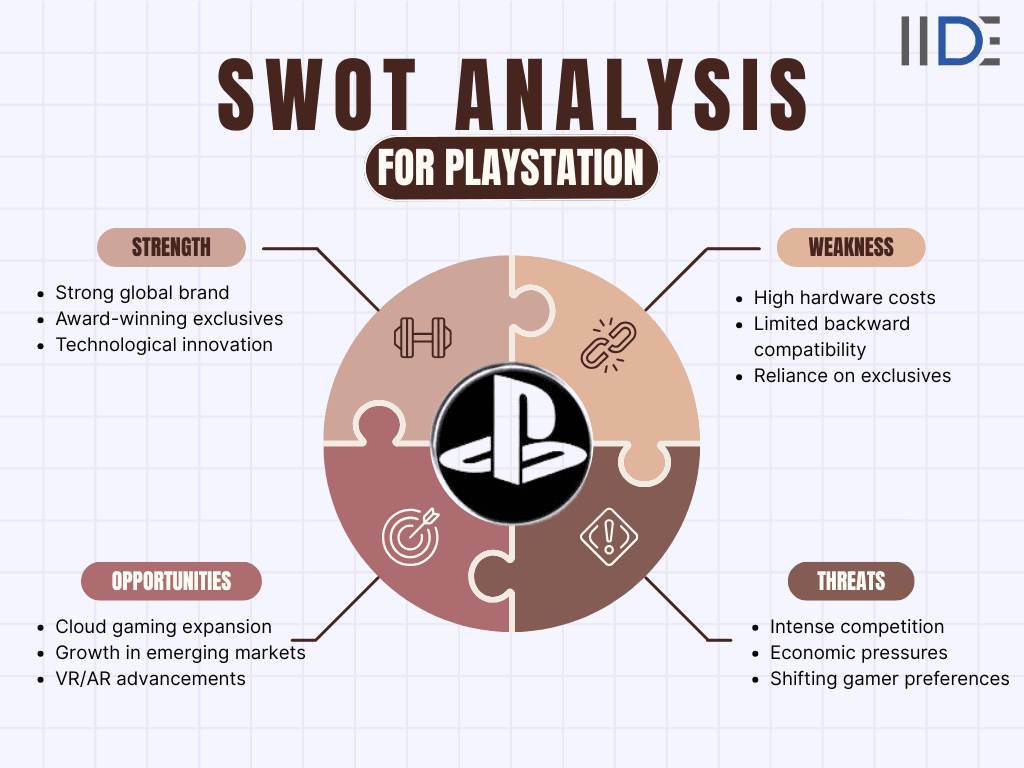
A SWOT analysis offers a comprehensive, 360° view of PlayStation’s position in 2025, helping us understand how the brand maintains its leadership in the ever-evolving gaming industry. This framework examines a brand’s Strengths, Weaknesses, Opportunities, and Threats, providing a clear picture of its standing in the market. For a gaming giant like PlayStation, this analysis is crucial, as the gaming world is constantly changing.
PlayStation’s strengths include features like VR compatibility, haptic feedback, and subscription-based gaming services that align with what players want today.
To put PlayStation’s market position into perspective, we’ll first look at Sony’s case study, which highlights its innovations, exclusive titles, and global strategies.
Why Does SWOT Analysis Matter for PlayStation in 2026?
- Competition: Tracks PlayStation’s position against rivals like Xbox, Nintendo, and new disruptors such as cloud gaming platforms and Apple.
- Customer Preferences: Shows how PlayStation adapts to demands for cross-play, free-to-play models, VR/AR integration, and community-driven features.
- Technology: Highlights PlayStation’s use of AI, VR, AR, and cloud technology to drive innovation and efficiency.
- Economy: Assists in planning pricing, bundles, and subscription models during periods of rising costs or economic downturns.
- Regulations & Sustainability: Identifies risks and opportunities related to global regulations and the growing trend toward eco-friendly gaming.
SWOT Analysis of PlayStation
Strengths of PlayStation: Market Leader in Gaming
As one of the most recognizable names in the global gaming industry, PlayStation continues to dominate the market in 2025 through innovation, exclusivity, and community-driven experiences. These key strengths define PlayStation’s ongoing success:
1. Global Market Leadership & Brand Loyalty
- Over 500 million consoles have been sold worldwide since PlayStation’s inception, making it a true market leader.
- PlayStation remains the fastest-selling console brand to date, consistently outperforming competitors.
- Strong brand equity and a loyal fan base ensure steady sales and high engagement across generations.
2. Exclusive Titles & Award-Winning Franchises
- Blockbuster exclusives such as The Last of Us Part II, Spider-Man: Miles Morales, and God of War: Ragnarok have won critical acclaim and industry awards.
- Exclusive games give PlayStation a competitive edge over rivals like Xbox and Nintendo.
- A robust game library keeps players invested in the PlayStation ecosystem, driving long-term loyalty.
3. Technological Innovation & Immersive Experiences
- The PS5 DualSense controller, featuring adaptive triggers and haptic feedback, combined with ray-tracing graphics, delivers an unmatched gaming experience.
- Advanced graphics with ray tracing provide realistic and visually stunning gameplay.
- Continued focus on VR (PSVR2) and AR integration enhances player immersion and sets industry standards.
- Consistent investment in innovation reinforces PlayStation’s premium identity and market leadership.
Weaknesses of PlayStation: Challenges in a Shifting Market
While PlayStation is a dominant force in the gaming industry, it is important to recognize its vulnerabilities. Understanding these weaknesses highlights challenges that could affect its market position, profitability, and ability to adapt to changing consumer demands.
1. High Hardware Costs Compared to Competitors
- The PlayStation 5 carries a high retail price, making it less accessible for some consumers.
- Expensive accessories, such as controllers and VR headsets, further increase the total cost of gaming.
- These factors limit affordability, especially in price-sensitive markets.
2. Limited Backward Compatibility & Ecosystem Lock-In
- PlayStation supports fewer older titles compared to services like Xbox Game Pass, reducing its appeal to long-time players.
- This limitation can decrease loyalty among veteran gamers.
- It also restricts flexibility for users who wish to move across different gaming platforms.
3. Recent Controversies and Consumer Backlash
- Restrictions on third-party retailers for PlayStation digital codes in 2023 led to negative consumer reactions.
- Price increases for PlayStation Plus subscriptions have also sparked criticism.
- Such controversies can harm brand trust and slow subscription growth.
4. Heavy Reliance on Exclusive Titles
- Blockbuster games like The Last of Us and Spider-Man are crucial for driving sales.
- However, there is a risk if major exclusives are delayed or fail to meet expectations, which could impact overall performance.
Discover how PlayStation’s top rival, Xbox, is shaping the future of gaming - explore the Xbox SWOT Analysis to see what sets it apart and how it’s challenging industry leaders.
Opportunities for PlayStation: Expansion in Emerging Markets
PlayStation has several promising opportunities to strengthen its market position and drive future growth in 2025.
1. Cloud Gaming & Subscription Growth
- Expanding PlayStation Plus and PS Now can help Sony rival services like Xbox Game Pass.
- Introducing mobile-cloud gaming and “play anywhere” features will attract a broader audience.
- Leveraging exclusive titles can make PlayStation’s subscription offerings even more appealing.
2. Immersive Technology (VR & AR)
- The launch of PSVR2 positions Sony at the forefront of next-generation gaming experiences.
- Bringing exclusive games into VR can set new industry benchmarks and attract tech-savvy players.
- Competing with Meta’s Quest and Apple’s Vision Pro will drive innovation and expand PlayStation’s reach.
3. Growth in Emerging Markets
- There is significant untapped potential in regions like India, Brazil, and Southeast Asia.
- Introducing local pricing, forming regional partnerships, and offering affordable bundles can boost adoption in these markets.
Threats to PlayStation
Despite its strong brand presence, PlayStation faces several external threats that could impact its long-term growth and market position.
1. Aggressive Competition from Xbox and Nintendo
- Xbox Game Pass provides an affordable subscription model with integrated cloud gaming, challenging PlayStation’s value proposition.
- Nintendo continues to dominate the portable and family-friendly gaming segments, appealing to a broad audience.
- These competitors threaten PlayStation’s market share in both premium and casual gaming sectors.
2. Rapid Rise of Cloud Gaming & Cross-Platform Ecosystems
- Services like Xbox Cloud Gaming and Nvidia GeForce Now offer “play anywhere” experiences, attracting users who prefer flexibility.
- Mobile-first platforms are drawing gamers away from traditional console-centric ecosystems.
- This shift poses a threat to PlayStation’s established console strategy.
3. Price Sensitivity & Global Economic Pressures
- High costs for consoles and accessories become a significant barrier in inflationary environments.
- Budget-friendly alternatives are increasingly appealing to cost-conscious consumers, especially in emerging markets.
4. Shifting Gen Z Gaming Preferences
- Gen Z gamers favor mobile-first, social, and free-to-play experiences such as Fortnite, Roblox, and Genshin Impact.
- The traditional premium hardware-plus-software model risks losing relevance among younger audiences.
IIDE Student Takeaway & Recommendations
- In 2025, PlayStation must balance its premium identity with the industry’s shift toward digital-first, subscription-based, and cross-platform ecosystems.
- Competitors like Xbox (Game Pass) and cloud gaming disruptors are reshaping gamer expectations, making innovation essential.
- Sony should expand PlayStation Plus to rival Xbox Game Pass, leveraging exclusives and immersive VR experiences for differentiation.
- Targeting emerging markets with localized pricing and affordable bundles can unlock significant growth.
- Embracing Gen Z’s preference for social-first, free-to-play, and esports experiences will deepen engagement and ensure relevance.
- Leading in sustainability and regulatory compliance will strengthen brand trust and future-proof PlayStation’s reputation.
- Success will depend on blending PlayStation’s legacy with strategies focused on accessibility, innovation, and community engagement.
Conclusion
PlayStation’s SWOT analysis in 2025 highlights a brand that remains a leader in the gaming industry, thanks to its powerful global presence, exclusive titles, and innovative technology. However, ongoing challenges such as high hardware costs, limited backward compatibility, and increasing competition from digital-first and cloud gaming platforms require PlayStation to adapt quickly. By leveraging its strengths, expanding into emerging markets, embracing new gaming trends, and prioritizing sustainability, PlayStation is well-positioned to maintain its dominance and redefine the future of gaming for the next generation of players.
Want to Know Why 2,50,000+ Students Trust Us?
Dive into the numbers that make us the #1 choice for career success



MBA - Level
Post Graduate in Digital Marketing & Business Strategy

Best For
Fresh Graduates

Mode of Learning
On Campus (Mumbai & Delhi)

Starts from
Oct 1, 2026

Duration
11 Months

Live & Online
Advanced Online Digital Marketing Course
Best For
Working Professionals
Mode of Learning
Online
Starts from
Sep 4, 2026
Duration
4-6 Months

Online
Professional Certification in AI Strategy
Best For
AI Enthusiasts
Mode of Learning
Online
Starts from
Sep 8, 2026
Duration
5 Months

Online or Offline
Top AI Courses to Make You Future Ready!
Best For
AI Enthusiasts
Mode of Learning
2–5 Month Program
Starts from
Sep 8, 2026
Duration
Flexiable

On Campus
Advanced Certification in Artificial Intelligence
Best For
AI Enthusiasts
Mode of Learning
On Campus (Mumbai)
Starts from
Sep 1, 2026
Duration
3 Months

Offline
Undergraduate Program in Digital Business & Entrepreneurship
Best For
12th Passouts
Mode of Learning
On Campus (Mumbai)
Starts from
Aug 19, 2026
Duration
3 Years

Offline
Degree In 2026 ≠ Enough Degree + Digital Skills = Future-Ready
Best For
12th Passouts
Mode of Learning
At IIDE Campus
Starts from
Aug 19, 2026
Duration
3 Years
Recent Post

Lead Trainer & Business Development Head at IIDE
Aditya Shastri leads the Business Development segment at IIDE and is a seasoned Content Marketing expert. With over a decade of experience, Aditya has trained more than 20,000 students and professionals in digital marketing, collaborating with prestigious institutions and corporations such as Jet Airways, Godrej Professionals, Pfizer, Mahindra Group, Publicis Worldwide, and many others. His ability to simplify complex marketing concepts, combined with his engaging teaching style, has earned him widespread admiration from students and professionals alike.
Aditya has spearheaded IIDE’s B2B growth, forging partnerships with over 40 higher education institutions across India to upskill students in digital marketing and business skills. As a visiting faculty member at top institutions like IIT Bhilai, Mithibai College, Amity University, and SRCC, he continues to influence the next generation of marketers.
Apart from his marketing expertise, Aditya is also a spiritual speaker, often traveling internationally to share insights on spirituality. His unique blend of digital marketing proficiency and spiritual wisdom makes him a highly respected figure in both fields.