
Students Centric
Placements Report
Trackable results, real numbers
Reviews
Proven success, real voices
Trainers
Expert-led, Industry-Driven Training
Life at IIDE
Vibrant Spirit student life
Alumni
Successful Journeys, Inspiring Stories
Learning Centre
Webinars
Blogs
Case studies
Live, Interactive Masterclasses
Fresh Insights, quick reads
Real-life, Industry relevant
More
Hire from us
Hire Top Digital Marketing Talent
Work with us
Join Our Team, Make an Impact
Customised Training
Personalised digital marketing training for your company
Refer & earn
Simple, easy rewards
Contact us
Get the answers you need
About us
Know more about IIDE
Explore all course options

FOR FRESH GRADUATES
Post Graduation Program in Digital Marketing & Business Strategy- Ideal for Age: 20–25 Years

Can’t decide? Explore all our
Digital Marketing Courses
COMPARE BOTH OUR PROGRAMSOffline
Offline AI Courses with Dual CertificationsIndustry-Aligned TRACKMost Popular
UG Program in Digital Business & Entrepreneurship- Ideal for 12th Pass out / FY Degree Student

PARTNER PROGRAMS






Can’t decide? Explore all
BBA In Digital Marketing Colleges
Orginally Written by Aditya Shastri
Updated on Jun 3, 2026
Share on:


About OnePlus
OnePlus was born out of frustration. In 2013, Pete Lau and Carl Pei, both former Oppo executives, left to build something different. Their idea was simple but bold: make a smartphone that matched the best in the world on performance and design, but sell it at a price that didn't require a bank loan. The "Never Settle" tagline wasn't just marketing; it was a product philosophy.
The strategy worked spectacularly in India. The invite-only launch of the OnePlus One in 2014 created a level of hype that no Indian smartphone launch had ever seen before. For years, owning a OnePlus felt like being part of an exclusive community, a brand built by enthusiasts, for enthusiasts.
But the company's journey since then has been complicated. Carl Pei left in 2020 to start Nothing. OnePlus merged closer with Oppo, diluting its independent identity. The green line display issue became a PR crisis. And competition from Samsung, Apple, and Google Pixel in the premium segment intensified sharply.
Today, OnePlus operates in 34+ countries, serves 130 million global users, generates $5 billion in annual revenue, and is investing Rs 2,000 crore per year in India under Project Starlight to reclaim its lost ground.
Before we get into the SWOT, here's a data-backed snapshot of where OnePlus stands today.
| Quick Stats Table | |
|---|---|
| Metric | Details |
| Founded | 2013, Shenzhen, China |
| Founders | Pete Lau & Carl Pei |
| CEO | Pete Lau |
| Headquarters | Shenzhen, China |
| Parent Company | Oppo Electronics (BBK Electronics Group) |
| Company Type | Private Subsidiary |
| Countries Present | 34+ Countries |
| Global Users | 130 Million+ |
| Annual Revenue | $5 Billion (2024) |
| India Revenue Share | 36% of Global Revenue |
| India Exclusive Stores | 200+ |
| Global Market Share | 0.9% (2025) |
| India Market Share | 2.4% (Q3 2025) |
| Project Starlight Investment | Rs 2,000 Crore/Year till 2027 |
| Key Competitors | Samsung, Apple, Xiaomi, Google Pixel, Nothing |
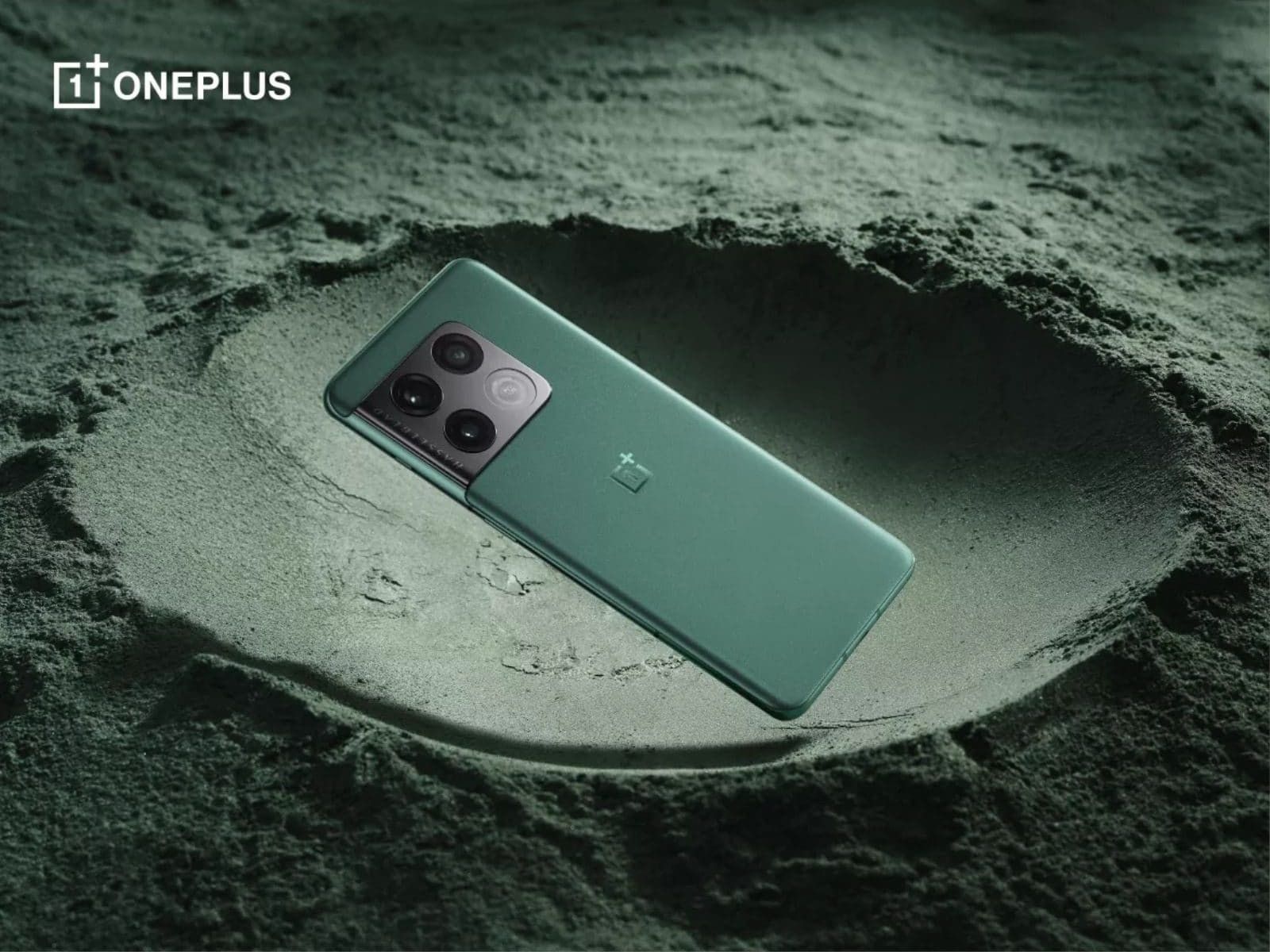
OnePlus's product lineup, from the flagship 13 series to the Nord range and Open foldable, reflects a brand still trying to cover every premium segment simultaneously, much like the strategy explored in the Marketing Strategy of Samsung, the competitor that defines the premium benchmark OnePlus is chasing.
Products of OnePlus
OnePlus is mostly engaged in producing the world’s best smartphones. But it also deals in other segments such as
- OnePlus 13 & 13R (Flagship Smartphones)
- OnePlus Nord 4 & Nord CE Series (Mid-Range Smartphones)
- OnePlus Open (Foldable Smartphone)
- OnePlus Pad 2 (Tablet)
- OnePlus Watch 2 (Smartwatch)
- OnePlus Buds Pro 2 (TWS Earbuds)
- OnePlus TV (Smart Television)
- OxygenOS (Proprietary Android Skin)
- OnePlus Accessories (Cases, Cables, Chargers)
Competitors of OnePlus
OnePlus competes on a global level with many other smartphone manufacturers. The top 5 competitors of OnePlus are
- Oppo
- Xiaomi
- Samsung
- Apple
- Lenovo
- ASUS
Competing against Samsung, Apple, and Google Pixel while battling Chinese brand perception is a multi-front challenge and understanding how Xiaomi navigates a similar battle in the same ecosystem is best explored through the SWOT Analysis of Xiaomi.
Now that we have a better understanding of OnePlus, let’s look into the SWOT Analysis of OnePlus.
SWOT Analysis of OnePlus
OnePlus built one of India's most loyal smartphone communities on three things: performance, design, and price. In 2026, it still has two of those three. This SWOT analysis breaks down what remains, what broke, and what the path forward actually looks like.
So let us go ahead and first have a glance at the strengths of OnePlus from the SWOT analysis of OnePlus.
Strengths of OnePlus
As one of the leading companies in the industry, OnePlus, Inc. It has numerous strengths that make it stand out in the market. These strengths not only help protect your market share in existing markets but also help you penetrate new markets.ion, along with the weakness of the organisation, falls under the internal factors.
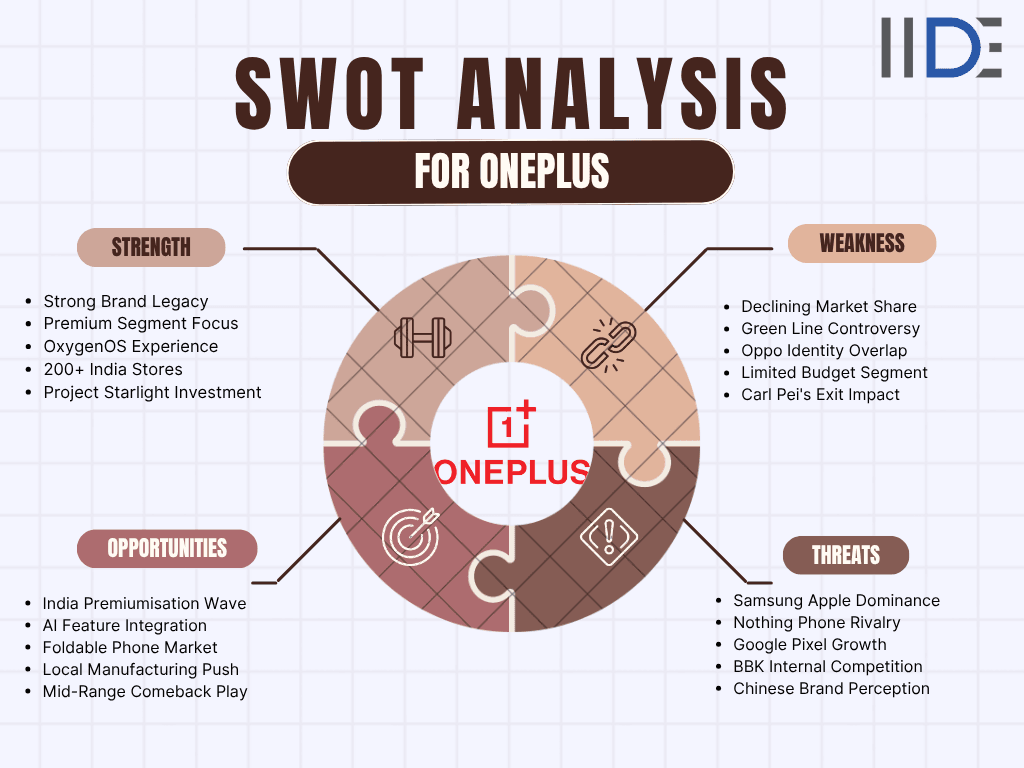
- Strong Brand Legacy - OnePlus built one of India's most passionate smartphone communities from scratch, with invite-only launches, Reddit AMAs, and a "Never Settle" philosophy that made buyers feel like insiders. That brand equity, built over a decade, still drives purchase consideration even as market share declines.
- Premium Segment Focus - OnePlus has consistently played in the Rs 30,000–60,000 premium segment, the fastest-growing price band in India's smartphone market. India's premiumisation wave is real, with premium smartphones now accounting for 17% of all shipments in 2024, and OnePlus is structurally positioned to benefit.
- OxygenOS Experience - OxygenOS remains one of the cleanest, fastest Android skins available on any smartphone. For power users and enthusiasts who have tried Samsung's One UI or Xiaomi's MIUI, OxygenOS's minimal, smooth experience is a genuine differentiator that builds loyalty beyond hardware specs.
- 200+ India Exclusive Stores - From just 30 stores in 2020 to 200+ exclusive experience stores in 2024, OnePlus has built a meaningful offline retail presence in India, reaching Tier 2 and Tier 3 cities where premium smartphone buyers increasingly want to touch and feel before buying.
- Project Starlight Investment - OnePlus is committing Rs 2,000 crore per year until 2027 in India, focused on sturdier devices, better customer service, and India-specific features. That level of investment signals genuine commitment to the market, not a slow retreat disguised as optimisation.
Weaknesses of OnePlus
Strategy is all about choices, and weaknesses are areas where companies can improve through SWOT analysis and leverage their competitive advantage and strategic positioning.
- Declining Market Share - OnePlus's global market share fell from 1.5% in 2023 to 0.9% in 2025, with a further dip to 0.8% forecast for 2026. In India its most importan,t market; shipments dropped 30.5% year-on-year in Q3 2025. Three consecutive years of decline are not a blip; it is a trend.
- Green Line Controversy -The green line display defect, where a permanent vertical green line appeared on OnePlus screens, became one of the brand's most damaging PR crises. Despite a Lifetime Display Warranty launched in 2024, TechInsights analysts confirm the negative sentiment had already done significant damage to purchase intent.
- Oppo Identity Overlap - As OnePlus merged closer with Oppo under the BBK umbrella, its independent identity blurred. Consumers increasingly struggle to differentiate OnePlus from Oppo, especially in the mid-range, which dilutes the premium, enthusiast-first brand image OnePlus spent years building.
- Limited Budget Segment Presence - While Xiaomi, Realme, and Vivo dominate India's high-volume sub-Rs 15,000 segment, OnePlus has no meaningful play there. That keeps its total addressable market narrow, and any softness in premium demand hits OnePlus harder than diversified rivals.
- Carl Pei's Exit Impact - Carl Pei's departure in 2020 to found Nothing removed one of OnePlus's most charismatic brand voices. Worse, Nothing Phone is now directly competing for the same enthusiast audience with a fresher identity, and Carl's personal following is still intact.
Opportunities for OnePlus
Opportunities are potential areas for companies to focus on to improve results, increase sales, and ultimately profit.
- India Premiumisation Wave - Premium smartphones (Rs 30,000+) now account for 17% of India's total smartphone shipments, up from 9% in 2020. As Indian consumers trade up, OnePlus's core positioning directly aligns with where the market is heading. Capturing even a modest share of this growth reverses the decline narrative entirely.
- AI Feature Integration - OnePlus 13 already ships with Google Gemini integration and on-device AI features. As AI becomes the primary smartphone battleground in 2026, OnePlus's partnership with Google gives it access to cutting-edge AI capabilities that smaller rivals cannot easily replicate, a genuine differentiator for premium buyers.
- Foldable Phone Market - The OnePlus Open received strong critical acclaim for its display quality and multitasking software. India's foldable market is still nascent but growing fast. Establishing an early, credible position in foldables before Samsung locks in the segment could be one of OnePlus's most important long-term moves.
- Local Manufacturing Push - OnePlus is aligning with India's PLI scheme for electronics manufacturing. Local production reduces import duties, lowers device costs, and strengthens the "Made in India" narrative, directly addressing the Chinese brand perception problem that has cost OnePlus sales in a market where sentiment matters.
- Mid-Range Comeback Play - The OnePlus Nord series has the brand recognition and OxygenOS advantage to compete effectively in the Rs 20,000–35,000 segment. Aggressively expanding the Nord lineup with India-specific features, better cameras, longer software support, and stronger after-sales could recapture volume without abandoning the premium identity.
Threats to OnePlus
Threats are environmental factors that can harm a company’s development. Here are some of OnePlus’s threats:
- Samsung & Apple Dominance - Samsung and Apple together control India's premium smartphone segment with distribution depth, brand trust, and ecosystem lock-in that OnePlus cannot match. Every iPhone buyer Apple converts from Android is a potential OnePlus customer permanently lost to the ecosystem.
- Nothing Phone Rivalry - Nothing Phone, founded by OnePlus co-founder Carl Pei, directly targets OnePlus's core audience of design-conscious, tech-savvy enthusiasts. With a distinctive aesthetic, strong community, and Carl's personal credibility, Nothing is the most psychologically damaging competitor OnePlus faces.
- Google Pixel Growth - Google Pixel is quietly building a loyal premium user base in India on the strength of its camera, clean Android experience, and AI features. Every strength Pixel gains directly erodes OnePlus's positioning; both brands are fishing in the same premium enthusiast pond.
- BBK Internal Competition - OnePlus competes within its own parent group against Oppo, Realme, and Vivo, all BBK Electronics subsidiaries. Realme targets OnePlus's mid-range buyers, Oppo targets its premium segment, and internal resource allocation decisions at BBK inevitably create conflicts that an independent brand would never face.
Now that you have OnePlus's complete strategic picture, see how India's most disruptive tech brand built its ecosystem from scratch. The SWOT Analysis of Jio offers a fascinating parallel in how Indian consumers were won over through bold pricing and product strategy.
This ends our elaborative SWOT analysis of OnePlus. Let us conclude our learning below.

Is Digital Marketing the Right Career for You?
Find out in a free 45-min masterclass · Career paths, roles and growth explained · By Karan Shah, Founder & CEO, IIDE

Is Digital Marketing the Right Career for You?
Find out in a free 45-min masterclass · Career paths, roles and growth explained · By Karan Shah, Founder & CEO, IIDE
Want to Know Why 2,50,000+ Students Trust Us?
Dive into the numbers that make us the #1 choice for career success


MBA - Level
Post Graduate in Digital Marketing & Business Strategy

Best For
Fresh Graduates

Mode of Learning
On Campus (Mumbai & Delhi)

Starts from
Nov 27, 2026

Duration
11 Months

Live & Online
Advanced Online Digital Marketing Course
Best For
Working Professionals
Mode of Learning
Online
Starts from
Nov 2, 2026
Duration
4-6 Months

Offline
Top AI Courses to Make You Future Ready!
Best For
AI Enthusiasts
Mode of Learning
2–5 Month Program
Starts from
Nov 23, 2026
Duration
Flexiable
Offline
Undergraduate Program in Digital Business & Entrepreneurship
Best For
12th Passouts
Mode of Learning
On Campus (Mumbai)
Duration
3 Years
Offline
Degree In 2026 ≠ Enough Degree + Digital Skills = Future-Ready
Best For
12th Passouts
Mode of Learning
At IIDE Campus
Duration
3 Years
Recent Post

Lead Trainer & Business Development Head at IIDE
Aditya Shastri leads the Business Development segment at IIDE and is a seasoned Content Marketing expert. With over a decade of experience, Aditya has trained more than 20,000 students and professionals in digital marketing, collaborating with prestigious institutions and corporations such as Jet Airways, Godrej Professionals, Pfizer, Mahindra Group, Publicis Worldwide, and many others. His ability to simplify complex marketing concepts, combined with his engaging teaching style, has earned him widespread admiration from students and professionals alike.
Aditya has spearheaded IIDE’s B2B growth, forging partnerships with over 40 higher education institutions across India to upskill students in digital marketing and business skills. As a visiting faculty member at top institutions like IIT Bhilai, Mithibai College, Amity University, and SRCC, he continues to influence the next generation of marketers.
Apart from his marketing expertise, Aditya is also a spiritual speaker, often traveling internationally to share insights on spirituality. His unique blend of digital marketing proficiency and spiritual wisdom makes him a highly respected figure in both fields.