
Students Centric
Placements Report
Trackable results, real numbers
Reviews
Proven success, real voices
Trainers
Expert-led, Industry-Driven Training
Life at IIDE
Vibrant Spirit student life
Alumni
Successful Journeys, Inspiring Stories
Learning Centre
Webinars
Blogs
Case studies
Live, Interactive Masterclasses
Fresh Insights, quick reads
Real-life, Industry relevant
More
Hire from us
Hire Top Digital Marketing Talent
Work with us
Join Our Team, Make an Impact
Customised Training
Personalised digital marketing training for your company
Refer & earn
Simple, easy rewards
Contact us
Get the answers you need
About us
Know more about IIDE
Explore all course options

FOR FRESH GRADUATES
Post Graduation Program in Digital Marketing & Business Strategy- Ideal for Age: 20–25 Years

Can’t decide? Explore all our
Digital Marketing Courses
COMPARE BOTH OUR PROGRAMSOffline
Offline AI Courses with Dual CertificationsIndustry-Aligned TRACKMost Popular
UG Program in Digital Business & Entrepreneurship- Ideal for 12th Pass out / FY Degree Student

PARTNER PROGRAMS






Can’t decide? Explore all
BBA In Digital Marketing Colleges
Orginally Written by Aditya Shastri
Updated on May 13, 2026
Share on:


Marlboro is one of the most iconic consumer brands ever created. What started as a low-share cigarette brand quietly sitting on the fringes of the tobacco market eventually became the world's leading tobacco name through powerful positioning, premium perception, and unmatched consumer loyalty.
It is a brand-building story that marketing textbooks still reference today. Even after decades of heavy regulations, advertising bans, rising prices, and growing social stigma, Marlboro continues to stand tall as a globally dominant force in its category.
So the real question worth asking in 2026 is this: Is Marlboro still winning purely because of the brand power it accumulated in the past, or does it have the strategic strength to genuinely evolve for the future?
Before diving into the article, I would like to acknowledge that the research and initial analysis for this piece were conducted by Sakshi Bajaj, a current student of IIDE’s Post Graduation in Digital Marketing and Business Strategy, August Batch 2025.
If you found this helpful, feel free to reach out to Sakshi Bajaj to send a quick note of appreciation for her fantastic research, She will appreciate the kudos!
About Marlboro
Marlboro was launched in 1924 by Philip Morris International and was originally positioned as a niche filtered cigarette, primarily targeted at women under the Tagline "Mild As May."
The brand's most significant turning point came in the 1950s when a rising wave of health concerns about smoking pushed Philip Morris to take a bold creative risk. They repositioned Marlboro entirely as a rugged, masculine product through the now-legendary Marlboro Man advertising campaign, developed by the Leo Burnett agency.
That single strategic decision transformed Marlboro from a small, struggling player into a global tobacco powerhouse that would go on to define an entire category.
Over the following decades, Marlboro built extraordinary recognition through premium pricing, iconic packaging, and unwavering brand consistency. Its famous red-and-white packaging and bold visual identity became some of the most recognised design elements in the history of consumer goods.
Today, Marlboro retains its position as the world's most valuable tobacco brand for the tenth consecutive year, with a commercial presence spanning more than 180 countries across every major global region.
Its major strength lies not just in product volumes or sales figures, but in the deep generational brand equity it has built steadily over a century of consistent identity.
Why This SWOT Matters in 2026
The tobacco category is changing more rapidly now than at any other point in its history. Earlier, scale and distribution were enough for a brand like Marlboro to maintain its dominance without much strategic disruption.
Today the industry also faces:
- Health awareness growth
- Regulatory restrictions
- Ad bans
- Smoke-free innovation
- Alternative nicotine products
- Changing younger consumer habits
At the same time:
- Premium loyalty still exists
- Pricing power remains strong
- Emerging markets continue growing
- Brand heritage still influences purchase decisions
That makes 2026 a defining year for legacy brands like Marlboro.

Is Digital Marketing the Right Career for You?
Find out in a free 45-min masterclass · Career paths, roles and growth explained · By Karan Shah, Founder & CEO, IIDE


Is Digital Marketing the Right Career for You?
Find out in a free 45-min masterclass · Career paths, roles and growth explained · By Karan Shah, Founder & CEO, IIDE
SWOT Analysis of Marlboro
1. Strengths
If you had to summarise Marlboro's core advantage in a single line, it would be this: it is one of the most extraordinary brand-building stories in the entire history of modern business.
Its fundamental strength is a level of brand power and consumer recognition that competitors have tried for decades to replicate, and consistently failed to match.
Strong Global Brand Equity
- Marlboro maintains the top position as the world's most valuable tobacco brand for the tenth consecutive year, leading the sector by a significant margin over its nearest competitor.
- This is not just a ranking. It reflects a century of disciplined brand management, consistent messaging, and consumer trust that no rival has come close to building at the same scale.
Deep Customer Loyalty
- Many Marlboro users stay with the brand for years, and in many cases for decades, once they make their first choice. This depth of loyalty is extraordinarily rare in any consumer category.
- It is the direct result of building a brand around an identity rather than just a product, something Marlboro executed better than almost any other consumer goods brand of the twentieth century.
Strong Pricing Power
- The brand has consistently sustained major price increases year after year while retaining its core consumer base, showing exceptional pricing power.
- Even with an 8% decline in U.S. cigarette volumes in 2025, Marlboro still holds roughly 40.5% market share and nearly 60% of the premium segment, reinforcing how deeply its premium perception is embedded in consumer behavior.
Premium Perception
- Marlboro is consistently perceived as a higher-status cigarette brand across key global markets.
- This aspirational quality has proven remarkably durable even as total category volumes decline, allowing the brand to charge a premium that competitors simply cannot justify with their own positioning.
Global Presence and Scale
- The brand is a leader in over 180 countries, giving it an unmatched distribution footprint and consumer visibility that most tobacco competitors and virtually all new entrants could never hope to replicate.
- That kind of scale creates compounding commercial advantages across pricing, logistics, and retail negotiation.
Iconic Packaging Identity
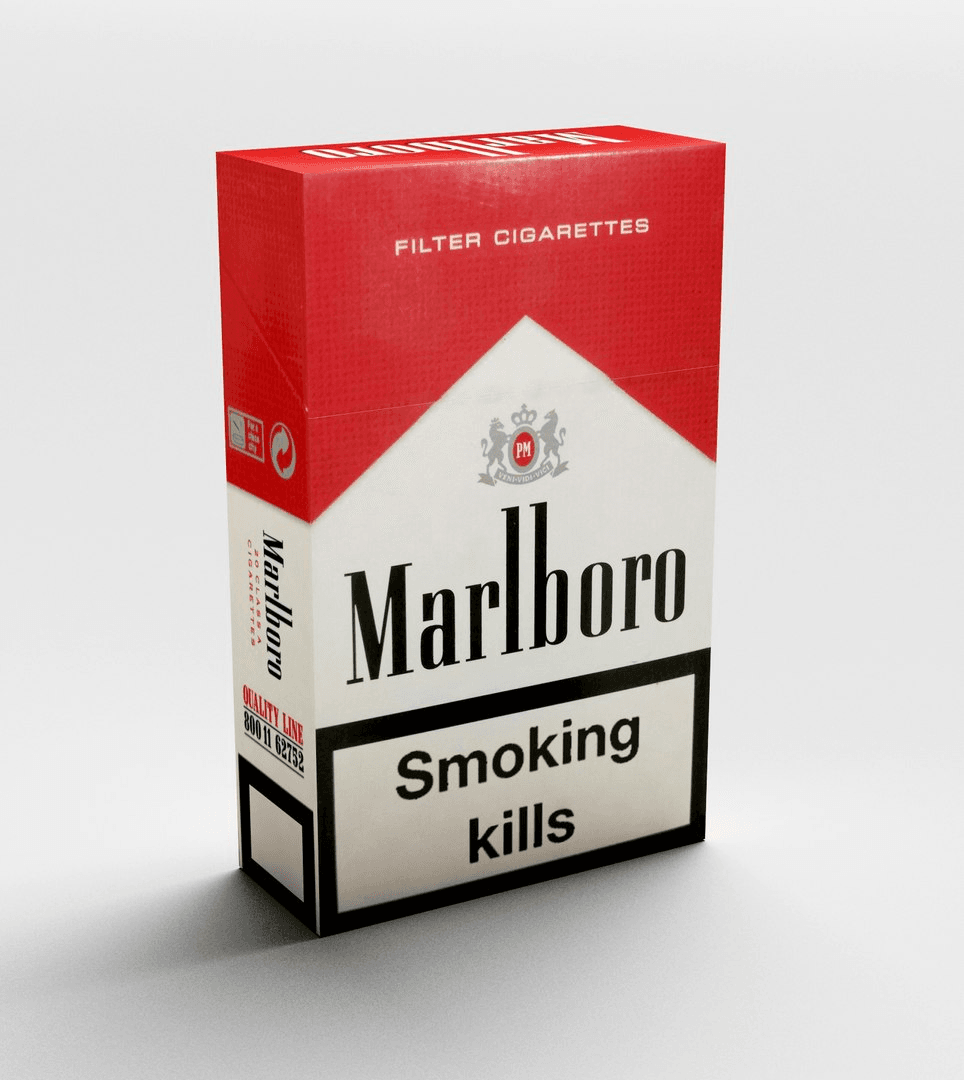
- The red-and-white pack remains one of the most instantly recognisable pieces of packaging in the world, cutting across language barriers, cultural differences, and generational changes.
- Very few consumer brands in history have maintained this level of consistent visual equity across more than a century of commercial existence.
2. Weaknesses
Even the strongest brand in the world cannot fully escape the structural decline of the category it was built on. This is precisely where Marlboro's long-term challenge becomes most visible and most difficult to ignore.
Strong Health-Risk Association
- The link between smoking and serious health consequences is now universally understood.
- This permanent association significantly limits the brand's potential audience and creates a ceiling on growth that no marketing strategy, no matter how sophisticated, can truly break through.
- Every new health study and public awareness campaign further reinforces this barrier.
Advertising Restrictions
- Strict and increasingly comprehensive rules across most major global markets have dramatically reduced the brand-building tools available to Marlboro.
- The wide-open advertising environment that created the Marlboro Man and built decades of brand equity simply no longer exists.
- Sustaining brand salience without traditional advertising channels is a growing structural challenge.
Dependence on a Declining Core Category
- While Marlboro's revenue remains stable through price increases and premium brand equity, the broader trend is described as mature and declining in volume.
- Relying heavily on a contracting category for the majority of revenue creates a long-term commercial vulnerability that pricing power alone cannot indefinitely offset.
Limited Youth Pipeline
- Younger consumers are increasingly choosing alternatives such as vapes, nicotine pouches, and heated tobacco products instead of traditional cigarettes.
- Without meaningful recruitment of younger adult consumers into the brand, Marlboro's loyal base will naturally age out over time, creating a slow but serious pipeline problem.
Reputation Pressure
- Social perception of smoking has shifted profoundly and negatively across most developed markets over the past two decades.
- Being associated with combustible tobacco carries reputational costs that extend beyond health concerns into broader social acceptability, particularly among urban and educated demographic groups who represent premium market segments.
Regulatory Dependence
- The brand's growth potential in any given market depends heavily on the prevailing regulatory environment, which continues to tighten in regions including Europe, Australia, and Southeast Asia.
- New plain packaging mandates, flavour bans, and point-of-sale display restrictions continue to constrain Marlboro's ability to reinforce brand identity at the retail level.
Legacy Identity Challenge in New Formats
- With IQOS now overtaking Marlboro in combined nicotine volume across key markets, the brand's traditional rugged and analogue identity faces growing tension with the technology-driven, design-forward direction that the smoke-free nicotine category demands.
- Bridging that identity gap without diluting the brand's heritage is one of the most complex challenges Marlboro faces today.
3. Opportunities
Despite the pressures it faces, Marlboro still has meaningful and concrete pathways to evolve, grow, and remain relevant. Its biggest opportunity lies clearly beyond the traditional cigarette format.
Smoke-Free Products Growth
- PMI's smoke-free products were available for sale in 106 markets as of December 31, 2025, and that footprint is expanding rapidly.
- This creates a growing runway where Marlboro's established brand equity, premium positioning, and consumer trust can actively support heated tobacco adoption and accelerate consumer transition within PMI's broader portfolio strategy.
Emerging Market Expansion
- In the Indian market, Marlboro is a key driver of growth, particularly popular among younger urban smokers and in corporate circles for its smooth flavour and international appeal.
- Similar dynamics are playing out across parts of Southeast Asia, the Middle East, and Sub-Saharan Africa, where premium demand for aspirational international brands continues to grow.
Premium Pricing Continuation
- Strong and deeply embedded consumer loyalty can continue to support healthy margins even as overall volumes plateau or decline.
- Premium positioning remains one of Marlboro's most commercially durable and defensible advantages, giving the brand room to grow revenue even in a shrinking category.
Ritual-Based Alternatives
- Social-use nicotine-free or low-risk formats may open entirely new demand channels, particularly among consumers who value the social ritual and sensory experience of smoking but are genuinely open to reduced-risk alternatives.
- This represents a transition opportunity that Marlboro's heritage of ritualistic brand identity could be well positioned to lead.
Brand Migration to New Categories
- Marlboro’s century-long trust with consumers is a powerful transferable asset that extends beyond traditional cigarettes.
- That trust can lower the psychological barrier for existing consumers to adopt reduced-risk products within PMI’s portfolio, making Marlboro’s brand equity a strategic accelerant for the company’s smoke-free transition.
International Scale as a Launchpad
- Marlboro’s global distribution infrastructure, retail relationships, and supply chain capabilities give PMI a major strategic advantage, enabling it to launch smoke-free innovations faster, more efficiently, and at a lower cost than competitors starting from scratch.
Data-Driven Personalisation
- New nicotine formats and their digital touchpoints create opportunities for smarter, more targeted retention strategies, allowing PMI to build personalized consumer engagement and strengthen loyalty in ways traditional mass advertising never could.
4. Threats
Not everything is within Marlboro's control, and several external forces are creating real and growing headwinds. Few industries face the level of sustained regulatory, social, and competitive pressure that tobacco does in 2026.
Rising and Expanding Regulations
- Packaging restrictions, point-of-sale display bans, flavour prohibitions, and excise tax escalations continue to tighten simultaneously across multiple major markets.
- Each new regulatory measure further constrains the brand's visibility, accessibility, and consumer recruitment potential, creating cumulative pressure that compounds year over year.
Alternative Nicotine Products Growing at Speed
- PMI's ZYN nicotine pouch brand sold 204.9 million cans in the United States during Q3 2025 alone, representing a 37% increase over the prior year.
- This kind of explosive growth in non-cigarette nicotine formats powerfully illustrates how rapidly consumer attention and spending are shifting away from combustible tobacco toward more convenient, discreet, and socially acceptable alternatives.
Youth Behaviour Shifts
- New generations of adult consumers are increasingly likely to avoid cigarettes entirely, choosing other nicotine formats or no nicotine product at all.
- Without meaningful long-term consumer recruitment, even the most powerful brand faces an inevitable volume decline as its existing loyal base naturally contracts over time.
Excise Tax Increases
- Governments across both developed and developing markets continue to use excise tax as a tool to reduce cigarette consumption.
- Sustained tax increases compress volume in price-sensitive segments and can simultaneously encourage the growth of illicit trade, which undermines legitimate brand performance and revenue reporting.
ESG and Institutional Investor Pressure
- Tobacco companies face growing resistance from institutional investors, pension funds, and ESG-focused capital allocators.
- Divestment campaigns and exclusion from sustainability indices are becoming increasingly widespread, adding financial and reputational pressure that operates entirely outside the brand's direct control.
Identity Conflict in the Smoke-Free Era
- Marlboro's heritage, rooted in rugged masculinity, open landscapes, and the analogue ritual of lighting a cigarette, does not translate naturally or intuitively to the technology-driven, app-connected, sleekly designed world of smoke-free nicotine.
- With IQOS now surpassing Marlboro as the number one nicotine brand in markets where both products are present, the question of how Marlboro positions itself in a post-cigarette world becomes increasingly pressing and strategically complex.
Ongoing Litigation Risks
- Tobacco companies remain exposed to significant and ongoing legal challenges across multiple jurisdictions worldwide.
- Liability exposure from historical and future litigation continues to represent a meaningful financial risk and a persistent reputational overhang that the industry has never fully escaped.
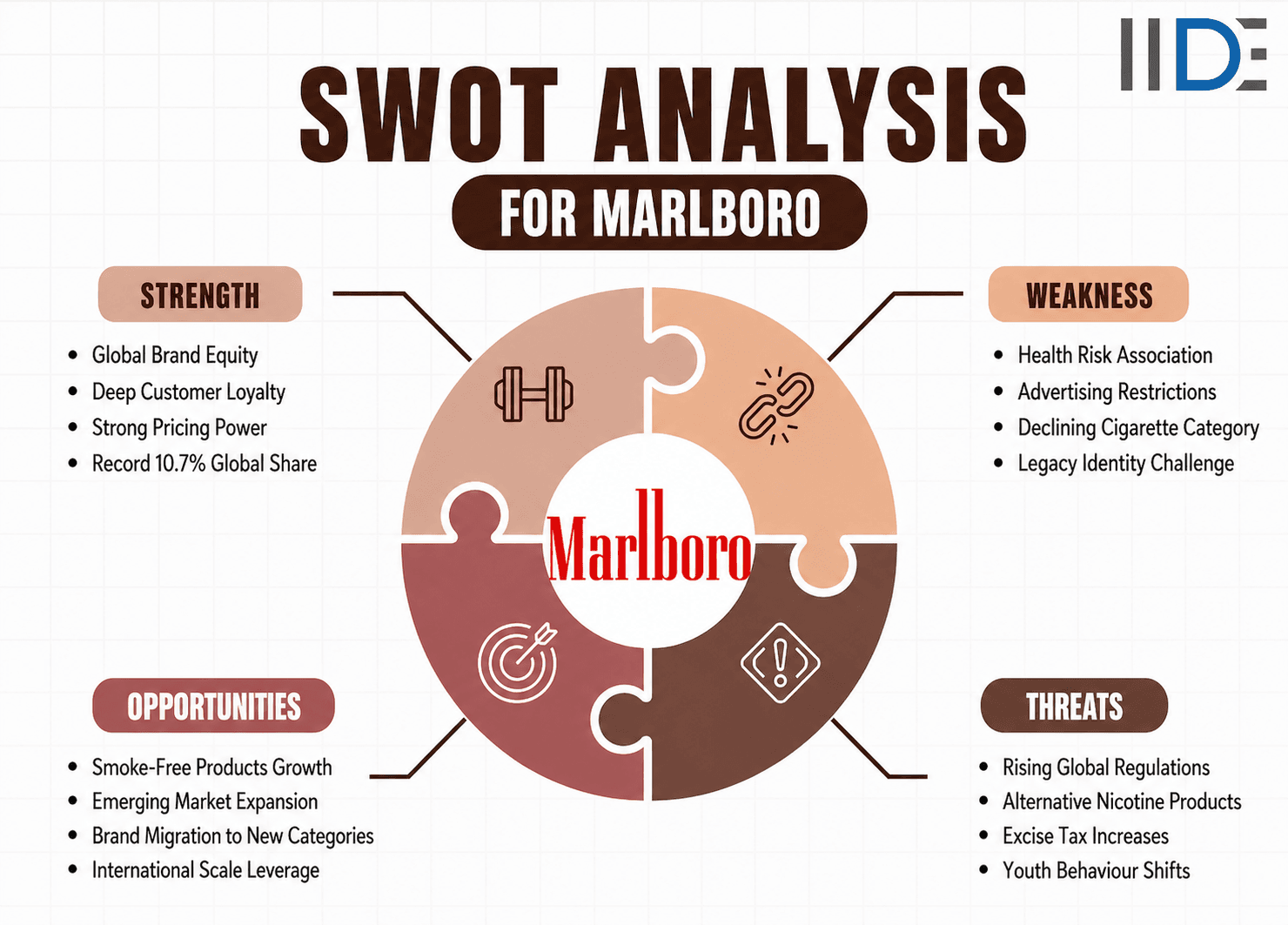
SWOT Analysis Chart of Marlboro
Key Insight, Final Thoughts and Conclusion
2026 insight
Marlboro built its way to becoming one of the world's most iconic brands by crafting a powerful identity, establishing deep premium perception, and earning long-term consumer loyalty that outlasted generations of competitors, regulatory challenges, and cultural shifts.
But in 2026, legacy strength alone is no longer a guarantee of future relevance. The category is moving, consumer preferences are evolving, and the competitive landscape is being reshaped by innovation rather than heritage.
IQOS passing Marlboro in combined nicotine volume validates PMI's thesis that product substitution at scale is achievable, not just directionally promising. Today, sustainable growth depends on how successfully and how boldly tobacco brands can adapt to smoke-free formats, reduced-risk products, and the genuinely different expectations of the next generation of nicotine consumers.
To understand how the brand is navigating change in today’s market, read the Marketing Strategy of Marlboro for deeper insights into its positioning, transition strategy, and future growth direction.
That is the difference between being iconic and staying important.
Final Thoughts
Marlboro remains one of the most powerful and instructive brand-building case studies in the entire history of consumer marketing. Its greatest asset is unmatched equity and deeply embedded consumer loyalty.
Its greatest vulnerability is being structurally tied to a category that faces relentless external pressure from regulators, public health advocates, and shifting consumer behaviour simultaneously.
With smoke-free products now accounting for 43% of PMI's total net revenues in Q1 2026, the company is sending a clear and unambiguous signal that the future it is building is one that moves decisively beyond cigarettes.
Whether Marlboro's brand identity can travel successfully into that future, or whether it remains anchored to its combustible past, will determine whether this iconic brand continues to lead or gradually fades into a symbol of a category the world has left behind.
In business, even the most legendary brands must earn their relevance in every new era. Marlboro is no exception.
Final Question: Can Marlboro remain dominant in a world that is actively moving beyond cigarettes?
Want to Know Why 2,50,000+ Students Trust Us?
Dive into the numbers that make us the #1 choice for career success



MBA - Level
Post Graduate in Digital Marketing & Business Strategy

Best For
Fresh Graduates

Mode of Learning
On Campus (Mumbai & Delhi)

Starts from
Nov 27, 2026

Duration
11 Months

Live & Online
Advanced Online Digital Marketing Course
Best For
Working Professionals
Mode of Learning
Online
Starts from
Nov 2, 2026
Duration
4-6 Months

Offline
Top AI Courses to Make You Future Ready!
Best For
AI Enthusiasts
Mode of Learning
2–5 Month Program
Starts from
Nov 24, 2026
Duration
Flexiable

Offline
Undergraduate Program in Digital Business & Entrepreneurship
Best For
12th Passouts
Mode of Learning
On Campus (Mumbai)
Duration
3 Years

Offline
Degree In 2026 ≠ Enough Degree + Digital Skills = Future-Ready
Best For
12th Passouts
Mode of Learning
At IIDE Campus
Duration
3 Years
Recent Post
The standard SWOT model has four points: Strengths, Weaknesses, Opportunities, and Threats.
Some people add a fifth point called Strategy or Conclusion after analysis.
This step focuses on using insights to create action plans.
It helps turn findings into practical business decisions.
Marlboro’s marketing strategy was built around strong identity, premium image, and emotional branding.
Its famous rugged positioning created one of the most recognisable brand personalities globally.
The brand focused on loyalty, pricing power, and consistent packaging.
Today, strategy also includes adapting to changing consumer preferences.
The main SWOT analysis is a framework used to study a business or brand strategically.
It looks at internal strengths and weaknesses first.
Then it examines external opportunities and threats in the market.
This helps organisations make smarter business decisions.
The 3 C’s are not part of SWOT directly, but another business framework.
They stand for Company, Customers, and Competitors.
Businesses often use both SWOT and the 3 C’s together.
This gives a broader understanding of strategy and market position.
The future outlook is mixed with both strength and pressure.
Brand equity remains powerful, but regulations are increasing globally.
Growth depends on how well it adapts beyond cigarettes.
Reinvention will be key to long-term relevance.
Yes, but relevance may depend on reduced-risk and smoke-free categories.
The brand already has recognition and trust in many markets.
If it evolves successfully, it can remain important longer.
If not, traditional demand may continue declining.
Pricing power allows Marlboro to raise prices while keeping loyal buyers.
This helps protect profitability even if volumes decline.
Premium perception supports this strategy strongly.
Few brands can maintain margins like this.
Strict regulations can limit marketing and packaging freedom.
Higher taxes may reduce demand or increase illicit trade.
Health awareness can shrink the customer base over time.
New nicotine products also create strong competition.

Lead Trainer & Business Development Head at IIDE
Aditya Shastri leads the Business Development segment at IIDE and is a seasoned Content Marketing expert. With over a decade of experience, Aditya has trained more than 20,000 students and professionals in digital marketing, collaborating with prestigious institutions and corporations such as Jet Airways, Godrej Professionals, Pfizer, Mahindra Group, Publicis Worldwide, and many others. His ability to simplify complex marketing concepts, combined with his engaging teaching style, has earned him widespread admiration from students and professionals alike.
Aditya has spearheaded IIDE’s B2B growth, forging partnerships with over 40 higher education institutions across India to upskill students in digital marketing and business skills. As a visiting faculty member at top institutions like IIT Bhilai, Mithibai College, Amity University, and SRCC, he continues to influence the next generation of marketers.
Apart from his marketing expertise, Aditya is also a spiritual speaker, often traveling internationally to share insights on spirituality. His unique blend of digital marketing proficiency and spiritual wisdom makes him a highly respected figure in both fields.