Linkedin SWOT Analysis 2025 – Deep Dive into Strengths, Weaknesses, Opportunities & Threats

By Aditya Shastri

Updated on Nov 18, 2025

Share on:

Whatsapp Logo
Thread Logo
LinkedIn Logo
Twitter Logo
Facebook Logo

Founded in 2003 by Reid Hoffman and others, LinkedIn is now headquartered in Sunnyvale, California, and is a subsidiary of Microsoft. In 2024–25, it remains the go-to platform for professionals worldwide for networking, job hunting, skill building, and thought leadership. Its mission is “connect the world’s professionals to make them more productive and successful.” A striking stat: in 2024, LinkedIn generated over US$ 16.37 billion in revenue.

About Linkedin

LinkedIn was founded in 2003 by Reid Hoffman and officially launched on May 5, 2003. It connects professionals globally, aiming to create economic opportunity for every member of the workforce. Its slogan, “Connect the world’s professionals to make them more productive and successful,” reflects its mission. 

Linkedin- SWOT Analysis of Linkedin | IIDE

In 2025, LinkedIn boasts over 1 billion members and is a key player in digital recruitment and professional learning. SWOT stands for Strengths, Weaknesses, Opportunities, and Threats.

Overview Table

Official Company Name LinkedIn Corporation
Founded Year 2003
Website URL linkedin.com
Industries Served Professional Networking, Recruitment, Learning, B2B Marketing
Geographic Areas 200+ countries
Revenue (2025) $15.2 billion
Net Income (2025) $3.1 billion
Employees 22,000+
Main Competitors Facebook, Indeed, Glassdoor, Xing, Viadeo
IIDE's Free Digital Marketing Masterclass Banner

Learn Digital Marketing for FREE

  • 45 Mins Masterclass
  • Watch Anytime, Anywhere
  • 1,00,000+ Students Enrolled
Karan Shah - Founder & CEO at IIDE

What Does SWOT Stand For in LinkedIn’s Case?

SWOT stands for Strengths, Weaknesses, Opportunities, and Threats. By analyzing these aspects, we can understand how LinkedIn maintains its leadership in professional networking, recruitment, and corporate learning while navigating challenges in 2025.

Why SWOT Analysis Matters for LinkedIn in 2025

  • Competitive Landscape: LinkedIn faces competition from both professional job boards and mainstream social media integrating professional features.
  • Shifts in User Preferences: Professionals are seeking hybrid networking, upskilling opportunities, and personalized job recommendations.
  • Technology and Innovation: AI-driven recommendations, analytics, and Microsoft integration are critical for LinkedIn’s growth.
  • Economic Impact: Recruitment and advertising budgets fluctuate with economic cycles, impacting revenue.
  • Regulations and Privacy: Handling sensitive professional data requires strict compliance with international privacy laws.

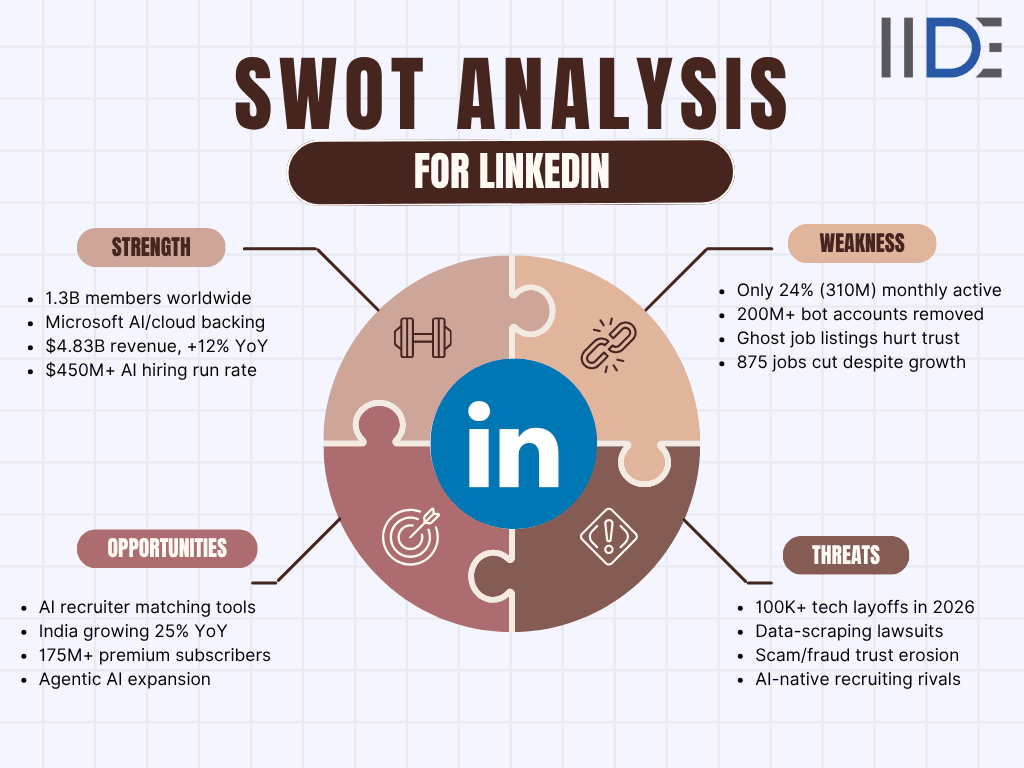
LinkedIn SWOT Analysis (2025)

Strengths of LinkedIn: Global Leadership and Market Dominance

1. Exceptional Brand Recognition and Global Trust

LinkedIn has established itself as the undisputed leader in professional networking, setting industry standards for authenticity, data integrity, and user credibility. With over 1.15–1.2 billion registered members across 200+ countries, the platform represents nearly every professional sector, from early-career job seekers to senior executives.

This enormous reach gives LinkedIn unparalleled brand equity. Unlike other social networks, LinkedIn’s environment is built on trust and professionalism, where users share verified information, genuine insights, and career-related content. The platform’s credibility also attracts top global employers, making it the first choice for recruitment, personal branding, and B2B engagement.

Its consistent focus on career development, community building, and thought leadership reinforces its identity as the “digital headquarters” for global professionals, a distinction that competitors like X (Twitter), Meta, or Indeed struggle to match.

2. Strategic Synergy with Microsoft Ecosystem

Since its acquisition by Microsoft in 2016, LinkedIn has benefited from deep integration with Microsoft’s software suite, including Office 365, Teams, and Azure-based AI tools. This partnership extends LinkedIn’s capabilities far beyond networking, transforming it into a productivity and intelligence platform.

For example:

  • Microsoft Teams integration allows professionals to connect seamlessly during meetings and view LinkedIn profiles directly.
  • AI-driven insights (powered by Microsoft Cloud) enhance job recommendations, skill matching, and personalised content feeds.
  • Data analytics from both platforms enable recruiters and businesses to make data-informed hiring and marketing decisions.

This synergy also positions LinkedIn as a strategic player in the future of work, where digital collaboration, hybrid workplaces, and AI-assisted learning dominate the professional landscape.

3. Expansive User Base and Powerful Network Effects

LinkedIn’s scale is its superpower. With more than one billion members, every additional user increases the value of the network, a classic network effect that strengthens engagement and utility for all participants.

This massive community drives:

  • Recruitment efficiency: Employers have access to the world’s largest verified talent pool.
  • B2B growth: Marketers can target niche audiences by industry, role, and skill level.
  • Professional engagement: Users gain from mutual learning, mentorship, and industry insights.

Unlike other social media platforms, LinkedIn’s algorithm prioritises professional relevance over virality, ensuring higher-quality interactions. This results in a more meaningful and trust-driven experience, which keeps both users and advertisers loyal to the platform.

4. Strong and Diversified Revenue Model

LinkedIn’s financial health is a major competitive strength. In 2024, the platform generated around US$16.37 billion in revenue, driven by multiple business verticals, a clear indication of balanced income streams and resilience against market volatility.

Its key revenue pillars include:

  • LinkedIn Talent Solutions: Job postings, recruiting tools, and hiring insights used by millions of companies globally.
  • LinkedIn Marketing Solutions: Advertising services targeting professionals, B2B audiences, and decision-makers.
  • Premium Subscriptions: Paid plans offering advanced insights, messaging options, and visibility tools for individuals.
  • LinkedIn Learning: A rapidly growing e-learning platform offering thousands of professional courses to upskill users.

This diversified model ensures consistent profitability while allowing LinkedIn to reinvest in AI innovation, new content formats, and user experience enhancements.

5. Premier Hub for Thought Leadership, Learning, and Industry Insights

LinkedIn has transformed from a job-hunting platform into a powerful ecosystem for knowledge sharing and leadership visibility. Every day, millions of professionals and companies publish articles, insights, and case studies, shaping industry narratives and global business discussions.

This shift towards content-driven engagement has made LinkedIn the preferred destination for:

  • Thought leaders and CEOs sharing perspectives and brand stories.
  • Companies promoting employer branding and culture.
  • Professionals building credibility and expanding influence through authentic storytelling.

Moreover, features like LinkedIn Newsletters, Live Events, Audio Rooms, and LinkedIn Learning foster ongoing engagement and skill development. The platform now plays a dual role, serving both as a knowledge hub and a career accelerator, enhancing user loyalty and time spent on site.

Weaknesses of LinkedIn: Challenges in a Shifting Market (2025)

1. Limited Engagement Among Casual Users

Despite having over one billion registered members, a significant portion of LinkedIn’s user base remains passive; they log in infrequently or use the platform primarily for job searches rather than daily engagement.

Many professionals perceive LinkedIn as a “job-seeking” site rather than a community for continuous networking and learning. This perception limits its ability to generate consistent user interaction compared to high-engagement platforms like X (Twitter) or Instagram, where users spend more time consuming and creating content.

Maintaining user activity beyond job hunting is an ongoing challenge for LinkedIn as it seeks to position itself as a daily professional hub rather than a platform used only during career transitions.

2. Premium Pricing and Accessibility Barriers

LinkedIn’s premium plans, advertising tools, and recruitment services are powerful but often expensive, particularly for small businesses, freelancers, or users from developing markets.

This creates a barrier to entry and limits adoption among audiences who could benefit from premium insights, InMail credits, or advanced analytics but cannot justify the cost.

As a result, a majority of users remain on the free tier, where the features are comparatively limited, affecting revenue scalability and user experience equality. The platform must explore more flexible pricing models to remain inclusive and competitive in emerging markets.

3. Content Saturation and Decline in Quality

As more professionals and brands publish content to boost visibility, LinkedIn faces growing content clutter.

The platform’s feed increasingly features promotional posts, low-value motivational quotes, and engagement bait, which can reduce the authenticity and informational value that originally distinguished LinkedIn from other social media sites.

This over-commercialisation risks alienating serious professionals seeking high-quality industry insights. Maintaining a balance between algorithmic reach and content credibility is crucial to sustain user trust and engagement.

4. Algorithm Transparency and Organic Reach Issues

Many users and businesses express frustration with LinkedIn’s opaque algorithm. Organic reach for company pages and creators often fluctuates unpredictably, making it difficult to build consistent engagement without resorting to paid promotion.

This lack of clarity has led to complaints of unequal visibility, where posts from influencers or large organisations dominate while smaller voices struggle to be seen.

Without better transparency or creator support, LinkedIn risks being perceived as pay-to-play, undermining its value proposition as an open and merit-based professional community.

5. Competitive Pressure and Platform Overlap

While LinkedIn dominates professional networking, it faces increasing competition from emerging niche platforms like Indeed, Glassdoor, Handshake, and specialised learning or hiring apps.

Additionally, platforms like X (Twitter), YouTube, and even TikTok are evolving as spaces for thought leadership and professional storytelling, areas LinkedIn once owned exclusively.

This platform overlap challenges LinkedIn to innovate rapidly and retain its distinct positioning. It must evolve its content formats, personalisation features, and creator tools to keep pace with dynamic user expectations.

6. Data Privacy and Trust Concerns

As a data-rich platform containing personal information, job histories, and professional networks, LinkedIn is under continuous scrutiny for data security and privacy.

Although Microsoft’s backing offers strong infrastructure, past incidents of phishing, fake job scams, and impersonation have affected user trust.

Any large-scale data breach or misuse could severely damage LinkedIn’s reputation as a trusted professional space, making robust data governance and user protection a top priority.

7. Limited Appeal to Younger Demographics

LinkedIn struggles to fully capture Gen Z and younger professionals, who often prefer more visual, interactive, and less formal digital environments.

While older demographics value LinkedIn’s structured networking model, younger users lean towards platforms that offer quick content formats (like short videos, interactive Q&As, or casual communities).

If LinkedIn fails to adapt its tone, design, and engagement style to attract these emerging professionals, it risks becoming too traditional in a market that increasingly values creativity and personality in professional expression.

Opportunities for LinkedIn: Embracing the Future of Professional Networking (2025)

1. Expanding into AI-Powered Career and Recruitment Solutions

Artificial intelligence represents one of LinkedIn’s biggest growth frontiers. By leveraging Microsoft’s AI capabilities and massive data ecosystem, LinkedIn can deliver more personalised, predictive, and intelligent career experiences.

Future opportunities include:

  • AI career coaches that analyse skills, career goals, and job trends to recommend personalised career paths.
  • Smarter job-matching algorithms that improve candidate-employer fit through behavioural and skill-based data.
  • Automated recruitment tools that help organisations identify, screen, and hire talent more efficiently.

As hiring processes become more data-driven, LinkedIn can solidify its position as the world’s most intelligent talent marketplace, blending human connection with machine precision.

2. Growth of LinkedIn Learning and Upskilling Ecosystem

The demand for continuous learning and digital upskilling has surged globally. LinkedIn Learning is uniquely positioned to lead this revolution by integrating real-time job market data with learning pathways.

Opportunities include:

  • Expanding its course library in high-demand areas like AI, cybersecurity, data analytics, sustainability, and leadership.
  • Partnerships with universities and corporations to offer accredited professional certifications.
  • Personalised learning journeys based on a user’s career aspirations, performance, and skill gaps.

By connecting learning outcomes directly to job opportunities, LinkedIn can become a comprehensive career development ecosystem, not just a job search tool.

3. Deeper Integration with Microsoft Ecosystem and Workplace Tools

LinkedIn can further strengthen its role within Microsoft’s suite of products, transforming the way professionals communicate, collaborate, and connect.

Potential integrations include:

  • Enhanced LinkedIn insights within Microsoft Teams and Outlook, offering instant professional context during meetings or emails.
  • AI-based meeting summaries, insights, and content recommendations drawn from LinkedIn data.
  • Integration with Copilot and Dynamics 365, allowing businesses to combine CRM data with professional intelligence for smarter sales and marketing decisions.

These synergies can make LinkedIn an indispensable part of the modern hybrid workplace, seamlessly connecting productivity and professional identity.

4. Strengthening Presence in Emerging Markets

With developed markets nearing saturation, LinkedIn has significant room for growth in emerging economies such as India, Southeast Asia, Africa, and Latin America, regions where the workforce is young and digital adoption is accelerating.

LinkedIn can:

  • Offer localised content, languages, and regional job data.
  • Introduce affordable premium plans to attract freelancers, entrepreneurs, and small businesses.
  • Partner with governments, educational institutions, and NGOs to support workforce development programmes.

Expanding in these markets not only increases user growth but also helps LinkedIn play a transformative social and economic role in skill building and employment.

5. Enhancing Creator and Thought Leadership Economy

LinkedIn’s evolution into a content platform presents a huge opportunity to nurture a vibrant creator ecosystem focused on professional storytelling and expertise sharing.

By investing in creator tools, monetisation programmes, and analytics dashboards, LinkedIn can empower professionals to:

  • Build personal brands through newsletters, videos, and live sessions.
  • Monetise their expertise via sponsored content or learning collaborations.
  • Participate in industry thought leadership programmes that highlight niche voices and subject-matter experts.

This will help LinkedIn compete with platforms like YouTube and Substack while maintaining its professional integrity.

6. Leveraging Data for Business Intelligence and Insights

LinkedIn’s rich data repository, covering global workforce trends, skills, industries, and hiring patterns, can be turned into powerful analytics products for governments, companies, and educators.

Opportunities include:

  • LinkedIn Economic Graph Expansion, offering real-time insights into labour markets and skill gaps.
  • Providing customised workforce reports for policy-makers and business leaders.
  • Using AI to forecast future job roles and emerging skills, guiding both professionals and organisations in planning ahead.

This would position LinkedIn not just as a networking site, but as a strategic intelligence platform shaping the future of work.

7. Building Community Through Events, Audio, and Virtual Networking

As remote and hybrid work redefine connection, LinkedIn can expand its virtual engagement offerings.

Features like LinkedIn Live, Audio Rooms, and Events can evolve into immersive experiences where professionals host webinars, conferences, or networking sessions directly within the platform.

By investing in interactive, community-driven spaces, LinkedIn can create more reasons for users to return daily, strengthening both engagement and loyalty.

8. Promoting Sustainability, Inclusion, and Ethical Leadership

In an era where professionals and businesses value purpose-driven growth, LinkedIn has the opportunity to become a leader in promoting sustainability, inclusion, and ethical leadership.

It can spotlight organisations with strong ESG practices, offer learning content on responsible business, and support diversity in recruitment and leadership representation.

This aligns with the global movement towards conscious professional ecosystems, positioning LinkedIn as a socially responsible and future-forward platform.

Threats to LinkedIn: Navigating Industry Challenges in 2025

1. Intensifying Competition from Niche and Emerging Platforms

The professional networking space is no longer LinkedIn’s exclusive domain.

Specialised platforms such as Indeed, Glassdoor, Handshake, AngelList, and Wellfound (formerly AngelList Talent) are growing rapidly, offering more targeted and user-friendly solutions for recruitment and career development.

Simultaneously, traditional social networks like X (Twitter), YouTube, and TikTok are evolving into spaces for professional thought leadership and personal branding, threatening LinkedIn’s dominance in content-based networking.

This platform diversification means professionals now split their time and content across multiple channels, reducing LinkedIn’s share of attention and engagement. If LinkedIn doesn’t evolve faster, it risks losing relevance among younger, tech-savvy professionals.

2. User Fatigue and Decline in Content Authenticity

With more users and brands competing for visibility, LinkedIn’s feed has become increasingly saturated with repetitive, self-promotional, or low-value content.

This can lead to content fatigue, where professionals disengage due to excessive promotional posts or motivational clutter that lacks substance.

As a result, genuine knowledge-sharing and authentic professional storytelling can be drowned out, eroding the trust and thought leadership reputation that once set LinkedIn apart. If this trend continues, it could push high-value creators and industry experts toward alternative platforms with cleaner, curated environments.

3. Rising Data Privacy, Security, and Compliance Risks

LinkedIn stores vast amounts of personal and professional data, making it a prime target for cyberattacks, data breaches, and phishing scams.

As global data protection regulations (such as GDPR, CCPA, and emerging AI laws) become more stringent, LinkedIn faces increasing compliance burdens and reputational risks.

Even minor incidents of data misuse or account compromise can lead to significant trust erosion. Given that LinkedIn’s core value lies in being a trusted professional identity platform, maintaining airtight security and transparent data practices is critical to avoiding regulatory and brand damage.

4. Algorithm Bias and Ethical AI Concerns

As LinkedIn integrates more AI-driven tools for recruitment, content delivery, and career recommendations, it faces the growing challenge of algorithmic bias.

Unintended biases in job-matching or visibility algorithms could lead to claims of discrimination or unequal opportunity, impacting the platform’s credibility and inclusivity efforts.

Moreover, the use of AI-generated content and bots on the platform raises concerns about authenticity and manipulation.

To stay ahead, LinkedIn must invest in ethical AI governance, transparent algorithms, and clear policies that protect fairness and trust across its ecosystem.

5. Slowing User Growth in Mature Markets

LinkedIn’s major user bases in regions like North America and Western Europe are approaching saturation. With most professionals already onboarded, new user growth is flattening in these markets.

This limits expansion opportunities and places greater pressure on emerging markets to sustain growth.

However, economic disparities, language barriers, and infrastructure challenges in developing regions can slow adoption.

If LinkedIn fails to localise its offerings and pricing effectively, it may struggle to maintain the high growth rates that investors and parent company Microsoft expect.

6. Evolving Nature of Work and Employment Models

The rise of freelancing, gig work, and decentralised careers poses a strategic threat to LinkedIn’s traditional structure, which has long centred on full-time professional employment.

Platforms like Upwork, Fiverr, and Toptal cater specifically to independent workers, offering project-based visibility and payments, features LinkedIn currently lacks at scale.

As more professionals shift towards flexible work and portfolio careers, LinkedIn must evolve its features and monetisation strategies to remain relevant to this growing workforce segment.

7. Macroeconomic and Advertising Market Volatility

Like most digital platforms, LinkedIn’s revenue streams, particularly advertising and talent solutions, are sensitive to economic fluctuations.

During downturns or hiring freezes, businesses cut back on ad spending and recruitment budgets, directly impacting LinkedIn’s earnings.

The global slowdown in tech hiring and B2B spending could temporarily reduce LinkedIn’s revenue growth, highlighting its dependence on corporate marketing and recruitment cycles. Diversifying into stable long-term offerings like learning, analytics, and subscriptions will be essential to offset these market risks.

8. Generational and Behavioural Shifts in Digital Communication

Younger professionals (Gen Z and beyond) are redefining how they communicate and express professional identity,  favouring short-form content, visual storytelling, and informal engagement styles.

LinkedIn’s relatively formal, text-heavy interface may appear outdated to this demographic.

If the platform doesn’t adapt to their preferences through video-first formats, gamified learning, and interactive networking tools, it risks losing future generations of professionals to more dynamic and culturally adaptive platforms.

Summary Table – SWOT of LinkedIn 2025

Recommendations & Future Outlook (2025 and Beyond)

LinkedIn remains the undisputed leader in professional networking, but sustaining its dominance in a rapidly evolving digital economy requires continuous innovation, inclusivity, and user-centric evolution. As work, learning, and communication become increasingly digital and decentralized, LinkedIn must move beyond its traditional role as a job platform to become a dynamic ecosystem for professional growth, connection, and knowledge exchange.

To achieve this, the following strategic recommendations outline the roadmap for LinkedIn’s continued success in 2025 and beyond:

1. Enhance User Engagement and Platform Experience

LinkedIn should focus on improving daily user engagement by simplifying navigation, enhancing interactivity, and minimising spam or irrelevant content in feeds. Introducing AI-assisted content moderation and smarter algorithms can help surface high-quality, relevant insights over promotional clutter.

By fostering more authentic and value-driven interactions, through live events, groups, and community spaces, LinkedIn can transform from a platform people visit occasionally into a daily professional destination for collaboration and learning.

2. Invest Heavily in Learning, Upskilling, and Career Development

With the rise of automation and AI, the demand for continuous skill development is at an all-time high. LinkedIn should strengthen LinkedIn Learning by expanding its catalogue of future-focused courses in AI, leadership, digital transformation, and sustainability.

Partnering with universities, global organisations, and governments can create accredited pathways that directly connect learning outcomes to employability.

By positioning itself as the go-to platform for both education and employment, LinkedIn can close the global skills-to-jobs gap and reinforce its mission of “creating economic opportunity for every member of the global workforce.”

3. Leverage AI, Data, and Analytics for Personalisation

LinkedIn’s integration with Microsoft’s AI and data infrastructure presents a powerful opportunity to deliver deeply personalised experiences. AI can refine job recommendations, career insights, and content suggestions, helping users discover opportunities aligned with their skills and aspirations.

For businesses, advanced analytics can provide real-time workforce intelligence, improving talent strategies and marketing decisions.

By embracing responsible AI and transparent data usage, LinkedIn can ensure that technological progress enhances, not replaces, the human element of professional networking.

4. Accelerate Global Expansion and Localisation Efforts

Emerging markets such as India, Southeast Asia, the Middle East, and Africa represent major frontiers for LinkedIn’s future growth. Localised versions of the platform, with support for regional languages, affordable premium tiers, and culturally relevant content, can drive deeper market penetration.

Collaborations with local educational and business institutions can help LinkedIn empower youth, entrepreneurs, and small businesses in these fast-growing economies, solidifying its role as a global economic connector.

5. Strengthen Security, Privacy, and Ethical Standards

As a platform built on professional credibility and trust, LinkedIn must continue investing in robust data protection and compliance frameworks. Strengthening cybersecurity, enhancing identity verification, and combating fraudulent activity will be essential to maintain user confidence.

Furthermore, as AI tools become central to the platform, LinkedIn should adopt ethical AI standards that prevent bias, promote fairness, and uphold transparency in recruitment and content algorithms.

Future Outlook: The Next Phase of LinkedIn’s Evolution

The future of LinkedIn lies in becoming more than just a professional network, it will evolve into a comprehensive professional ecosystem that unites career advancement, learning, community, and intelligence.

By balancing technology with trust, and innovation with inclusivity, LinkedIn can continue shaping how professionals connect, collaborate, and create opportunity in the digital age.

With a clear focus on engagement, education, ethics, and expansion, LinkedIn is well-positioned to remain the defining platform for the future of work, where every interaction, skill, and connection contributes to global professional progress.

By focusing on innovation, AI integration, global expansion, and trust-building, LinkedIn can maintain leadership in professional networking, learning, and recruitment. With the backing of Microsoft, LinkedIn is well-positioned to adapt to shifting user preferences, remote work trends, and emerging markets, ensuring long-term relevance and growth.

Want to Know Why 5,00,000+ Students Trust Us?

Dive into the numbers that make us the #1 choice for career success

Lock Icon
IIDE's Placement Statistics

Conclusion

LinkedIn remains the leading global professional network, powered by strong brand recognition, expansive user base, and strategic integration with Microsoft.

However, it faces challenges including limited engagement among casual users, premium pricing barriers, and growing competition. 

Opportunities lie in AI-driven career solutions, deepening Microsoft ecosystem integration, and global expansion into emerging markets. 

To sustain growth, LinkedIn must enhance user engagement, invest in upskilling, leverage AI personalization, and strengthen security and privacy.

By evolving into a comprehensive professional ecosystem, LinkedIn is well-positioned to maintain leadership and drive innovation in the future of work beyond 2025.

Courses Recommended for you

MBA - Level

Post Graduate in Digital Marketing & Strategy
Scholarship Icon

Best For

Fresh Graduates

Location Icon

Mode of Learning

On Campus (Mumbai & Delhi)

Calender icon

Starts from

Jan 5, 2026

duration

Duration

11 Months

View Course

Live & Online

Advanced Online Digital Marketing Course
Scholarship Icon

Best For

Working Professionals

Location Icon

Mode of Learning

Online

Calender icon

Starts from

Dec 19, 2025

duration

Duration

4-6 Months

View Course
Professional Certification in AI Strategy

Online

Professional Certification in AI Strategy
Scholarship Icon

Best For

AI Enthusiasts

Location Icon

Mode of Learning

Online

duration

Duration

5 Months

View Course
Undergraduate Program in Digital Business & Entrepreneurship

Offline

Undergraduate Program in Digital Business & Entrepreneurship
Scholarship Icon

Best For

12th Passouts

Location Icon

Mode of Learning

On Campus (Mumbai)

duration

Duration

3 Years

View Course

Author's Note:

I’m Aditya Shastri, and this case study has been created with the support of my students from IIDE's digital marketing courses.

The practical assignments, case studies, and simulations completed by the students in these courses have been crucial in shaping the insights presented here.

If you found this case study helpful, feel free to leave a comment below.

Aditya Shastri - Trainer at IIDE

Aditya Shastri

LinkedIn Logo

Lead Trainer & Business Development Head at IIDE

Aditya Shastri leads the Business Development segment at IIDE and is a seasoned Content Marketing expert. With over a decade of experience, Aditya has trained more than 20,000 students and professionals in digital marketing, collaborating with prestigious institutions and corporations such as Jet Airways, Godrej Professionals, Pfizer, Mahindra Group, Publicis Worldwide, and many others. His ability to simplify complex marketing concepts, combined with his engaging teaching style, has earned him widespread admiration from students and professionals alike.

Aditya has spearheaded IIDE’s B2B growth, forging partnerships with over 40 higher education institutions across India to upskill students in digital marketing and business skills. As a visiting faculty member at top institutions like IIT Bhilai, Mithibai College, Amity University, and SRCC, he continues to influence the next generation of marketers.

Apart from his marketing expertise, Aditya is also a spiritual speaker, often traveling internationally to share insights on spirituality. His unique blend of digital marketing proficiency and spiritual wisdom makes him a highly respected figure in both fields.