
Students Centric
Placements Report
Trackable results, real numbers
Reviews
Proven success, real voices
Trainers
Expert-led, Industry-Driven Training
Life at IIDE
Vibrant Spirit student life
Alumni
Successful Journeys, Inspiring Stories
Learning Centre
Webinars
Blogs
Case studies
Live, Interactive Masterclasses
Fresh Insights, quick reads
Real-life, Industry relevant
More
Hire from us
Hire Top Digital Marketing Talent
Work with us
Join Our Team, Make an Impact
Customised Training
Personalised digital marketing training for your company
Refer & earn
Simple, easy rewards
Contact us
Get the answers you need
About us
Know more about IIDE
Explore all course options

FOR FRESH GRADUATES
Post Graduation Program in Digital Marketing & Business Strategy- Ideal for Age: 20–25 Years

Can’t decide? Explore all our
Digital Marketing Courses
COMPARE BOTH OUR PROGRAMSOffline
Offline AI Courses with Dual CertificationsIndustry-Aligned TRACKMost Popular
UG Program in Digital Business & Entrepreneurship- Ideal for 12th Pass out / FY Degree Student

PARTNER PROGRAMS






Can’t decide? Explore all
BBA In Digital Marketing Colleges
Orginally Written by Aditya Shastri
Updated on Jun 5, 2026
Share on:


About Jindal Stainless,
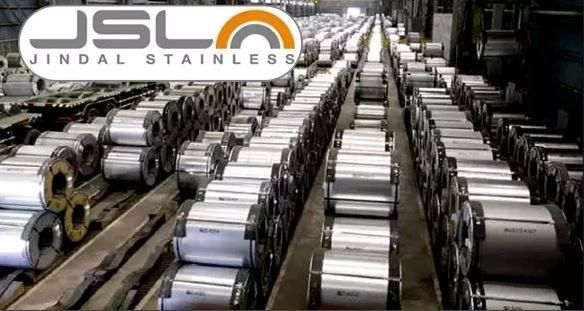
India's stainless steel story begins in Hisar. In 1970, when O.P. Jindal established the country's first stainless steel manufacturing unit in Haryana, India was almost entirely dependent on imports to meet its stainless steel needs. That single decision, to build domestic capability where none existed, laid the foundation for what is today India's largest and the world's fourth-largest stainless steel producer.
Under the leadership of Abhyuday Jindal, the company has transformed from a single-plant operation into a fully integrated stainless steel giant with manufacturing facilities in Hisar (Haryana) and Jajpur (Odisha), a combined installed capacity of 1.9 million tonnes per annum, and an export footprint spanning 130+ countries across six continents. The Jajpur facility alone, one of the most technologically advanced stainless steel plants in Asia, produces 1.1 million tonnes annually.
In FY2025, Jindal Stainless reported revenue of Rs 40,147 crore and a net profit of Rs 2,304 crore. With a market cap crossing Rs 28,000 crore and an ambitious capacity expansion to 4 million tonnes underway, the company that started in a small Haryana town is now writing its next chapter on a genuinely global stage.
| Metric | Details |
|---|---|
| Founded | 1970, Hisar, Haryana, India |
| Founder | Om Prakash Jindal |
| Current MD | Abhyuday Jindal |
| Headquarters | New Delhi, India |
| Manufacturing Units | Hisar (Haryana) + Jajpur (Odisha) |
| Installed Capacity | 1.9 Million Tonnes Per Annum |
| Employees | 8,000+ |
| Annual Revenue | Rs 40,147 Crore (FY2025) |
| Net Profit | Rs 2,304 Crore (FY2025) |
| Market Cap | Rs 28,000+ Crore (2026) |
| Export Footprint | 130+ Countries, 6 Continents |
| Listed On | NSE & BSE (Ticker: JSL) |
| Key Competitors | Tata Steel, SAIL, POSCO, Acerinox |
| Signature Products | Hot Rolled Coils, Cold Rolled Coils, Stainless Steel Slabs |
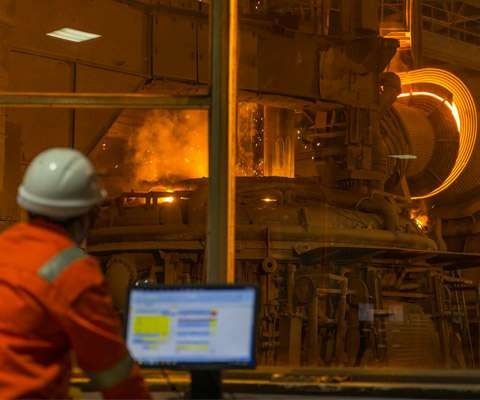
From precision strip to railway coach parts, Jindal Stainless's product range runs deeper than most people realise, much like how Tata Steel has built a similarly diversified industrial portfolio, explored in detail in the SWOT Analysis of Tata Steel.
Products By Jindal Stainless
- Stainless Steel Slabs
- Hot Rolled Coils & Sheets
- Cold Rolled Coils & Sheets
- Stainless Steel Plates
- Coin Blanks
- Precision Strip
- Blade Steel
- Railway Wagons & Coach Parts
- Architectural & Structural Products
- Stainless Steel Tubes & Pipes
Competitors of Jindal Stainless
- Tata Steel
- SAIL (Steel Authority of India Limited)
- POSCO India
- Acerinox
- APL Apollo Tubes
- Outokumpu
- KIOCL Limited
- Jindal Steel & Power (JSPL)
Competing against global giants like POSCO and Acerinox while defending domestic turf against SAIL is no small feat, a multi-front rivalry that mirrors the pressure explored in the SWOT Analysis of SAIL.
Now that we know everything we need to know about Jindal Stainless, let’s start with the SWOT analysis of Jindal Stainless.
SWOT Analysis Of Jindal Stainless
Jindal Stainless didn't reach the top of India's steel industry by accident. Behind the capacity numbers and export figures lies a business with real structural advantages, stubborn vulnerabilities, and a 2026 landscape that is forcing India's largest stainless steel maker to think harder than ever before.
Strengths of Jindal Stainless
- Integrated Steel Operations - Jindal Stainless operates one of the most fully integrated stainless steel manufacturing setups in Asia. From raw material processing to finished product delivery, the entire value chain sits under one roof at Hisar and Jajpur. That integration means lower production costs, tighter quality control, and margins that purely trading-based competitors simply cannot match.
- Global Export Reach - Exporting to 130+ countries across six continents is not a marketing claim; it is a genuine commercial moat. Jindal Stainless has built distributor networks, certifications, and customer relationships across Europe, Southeast Asia, and the Americas that took decades to establish and would take any new entrant years to replicate.
- Capacity Expansion Drive - Jindal Stainless is in the middle of one of the most ambitious capacity expansion programmes in Indian steel history, scaling from 1.9 million tonnes to 4 million tonnes per annum. When complete, it will cement its position as Asia's most significant stainless steel producer outside of China.
- Technology First Approach - Jindal Stainless was among the first Indian manufacturers to adopt SAP BW/4HANA enterprise technology, and its Jajpur plant is one of the most technologically advanced stainless steel facilities in Asia. That technology edge translates directly into production efficiency, waste reduction, and product consistency at scale.
- Strong Brand Legacy - Five decades of operation, a founding story tied to India's industrial self-reliance, and the Jindal name, which carries enormous weight across Indian business and government circles, give Jindal Stainless a brand credibility that no marketing spend can manufacture overnight.
Weaknesses of Jindal Stainless
- Raw Material Dependency - Jindal Stainless does not control enough of its own raw material supply. Nickel, chromium, and ferroalloys, the core inputs for stainless steel, are largely imported or sourced externally, leaving the company exposed to global commodity price swings that directly compress margins when input costs spike.
- Limited Product Diversification - Compared to integrated giants like Tata Steel or global players like Outokumpu, Jindal Stainless's product portfolio remains heavily concentrated in core stainless steel grades. That concentration creates revenue vulnerability when demand in specific segments like automotive or construction slows simultaneously.
- High Technology Costs - Staying at the technological frontier of steel manufacturing is expensive. Continuous investment in automation, AI-driven quality control, and plant upgrades creates a recurring cost burden that weighs on free cash flow, particularly during periods of softer steel prices.
- Thin Profit Margins - In FY2025, Jindal Stainless reported a net profit of Rs 2,304 crore on revenue of Rs 40,147 crore, a margin of under 6%. In a commodity business with volatile input costs and price-sensitive customers, that margin leaves very little room to absorb external shocks.
- Domestic Market Concentration - Despite exporting to 130+ countries, a significant portion of Jindal Stainless's revenue still depends on the Indian market. Any slowdown in domestic infrastructure spending, construction activity, or industrial output hits the company's top line disproportionately hard.
Opportunities for Jindal Stainless
- Make In India Push - The Government of India's sustained push for domestic manufacturing across infrastructure, defence, railways, and industrial sectors is creating structural long-term demand for stainless steel. Jindal Stainless, as the country's largest producer, is better positioned than anyone to be the primary beneficiary of that policy-driven demand surge.
- Automotive Sector Boom - India's automotive industry, both ICE and electric, is growing at a pace, and stainless steel demand for exhaust systems, structural components, and EV battery enclosures is rising in tandem. Jindal Stainless has existing supply relationships with major OEMs that position it well to capture this expanding demand.
- Green Steel Transition - Global buyers, particularly in Europe, are increasingly demanding low-carbon steel with verified environmental credentials. Jindal Stainless's investment in energy-efficient manufacturing and its integration of renewable energy at Jajpur give it an early mover advantage in the green steel premium segment.
- Infrastructure Demand Surge - India's National Infrastructure Pipeline targets Rs 111 lakh crore in infrastructure investment through 2025-30. Bridges, metro rail, airports, and coastal infrastructure all require significant stainless steel volumes, and Jindal Stainless's scale and certification depth make it the natural go-to supplier for large government projects.
- Strategic Global Acquisitions - With a strengthening balance sheet and growing international credibility, Jindal Stainless is well-placed to pursue strategic acquisitions in Europe or Southeast Asia, adding downstream processing capability, new customer bases, and geographic diversification that would reduce its dependence on the Indian market.
Threats to Jindal Stainless
- Chinese Steel Dumping - China produces 30+ million tonnes of stainless steel annually against domestic demand of 20 million tonnes. The surplus floods global markets at subsidised prices, directly undercutting Jindal Stainless's export realisations in markets it has spent decades building.
- Rising Input Costs - Nickel, the most critical input for stainless steel, has swung from $10,000 to $48,000 per tonne in recent years. Any sustained spike directly compresses margins in a business already operating on under 6% net profit.
- Strict Environmental Norms - Regulatory pressure on emissions, water usage, and carbon compliance is tightening across India and export markets. The EU's Carbon Border Adjustment Mechanism (CBAM) alone could materially increase costs on Jindal's European export volumes.
- Intense Domestic Competition - Tata Steel, SAIL, and rising imports from Indonesia and Vietnam are squeezing Jindal Stainless's domestic pricing power. As Asian capacity expands, the premium it commands in the Indian market faces sustained downward pressure.
- Rupee Volatility Risk - Jindal imports raw materials in USD but sells largely in INR. Any sharp rupee depreciation raises input costs without proportional domestic price increases a currency mismatch that creates earnings volatility, difficult to fully hedge
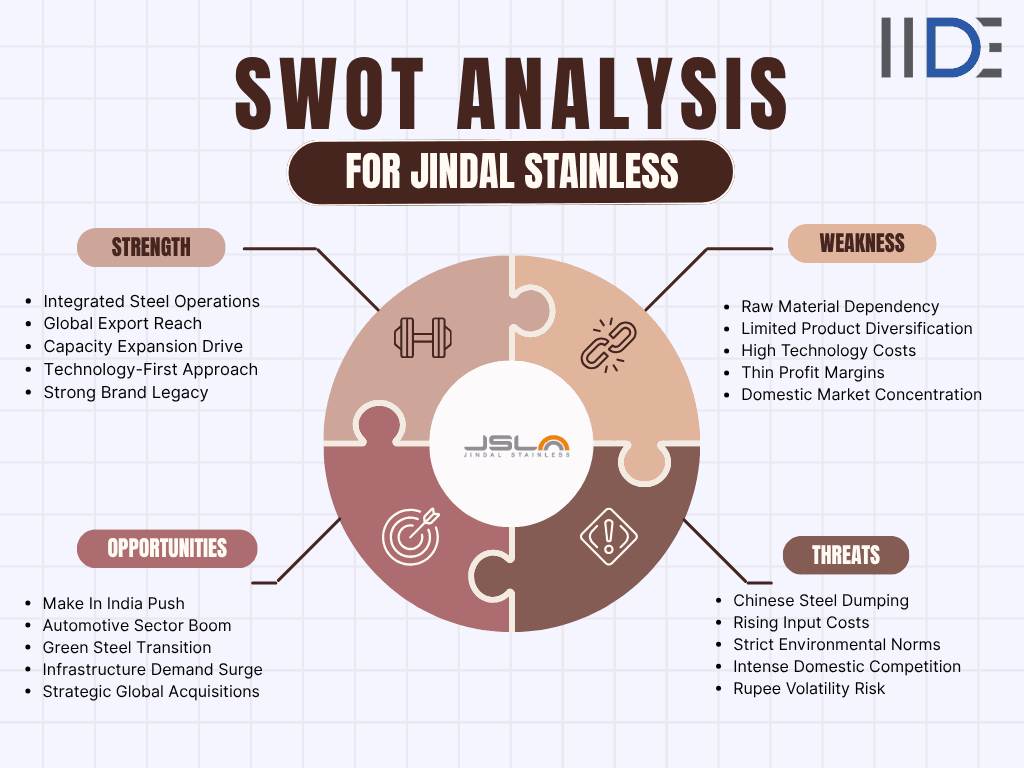
This ends our extensive SWOT analysis of Jindal Stainless. Let us conclude our learning below.

Is Digital Marketing the Right Career for You?
Find out in a free 45-min masterclass · Career paths, roles and growth explained · By Karan Shah, Founder & CEO, IIDE
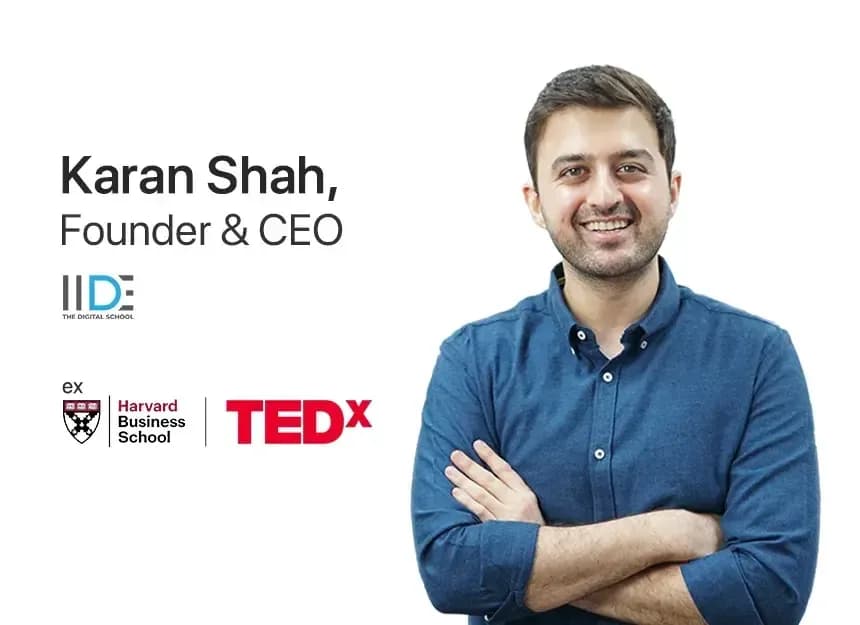

Is Digital Marketing the Right Career for You?
Find out in a free 45-min masterclass · Career paths, roles and growth explained · By Karan Shah, Founder & CEO, IIDE
Want to Know Why 2,50,000+ Students Trust Us?
Dive into the numbers that make us the #1 choice for career success


MBA - Level
Post Graduate in Digital Marketing & Business Strategy

Best For
Fresh Graduates

Mode of Learning
On Campus (Mumbai & Delhi)

Starts from
Nov 27, 2026

Duration
11 Months

Live & Online
Advanced Online Digital Marketing Course
Best For
Working Professionals
Mode of Learning
Online
Starts from
Nov 2, 2026
Duration
4-6 Months

Offline
Top AI Courses to Make You Future Ready!
Best For
AI Enthusiasts
Mode of Learning
2–5 Month Program
Starts from
Nov 24, 2026
Duration
Flexiable
Offline
Undergraduate Program in Digital Business & Entrepreneurship
Best For
12th Passouts
Mode of Learning
On Campus (Mumbai)
Duration
3 Years
Offline
Degree In 2026 ≠ Enough Degree + Digital Skills = Future-Ready
Best For
12th Passouts
Mode of Learning
At IIDE Campus
Duration
3 Years
Recent Post
Jindal Stainless is India's largest and the world's fourth-largest stainless steel producer, founded in 1970 by O.P. Jindal in Hisar, Haryana. It is famous for establishing India's first stainless steel manufacturing unit, ending the country's dependence on imports. Today, it produces 1.9 million tonnes annually and exports to 130+ countries across six continents.
Jindal Stainless operates two major manufacturing facilities, one in Hisar, Haryana, and one in Jajpur, Odisha. The Jajpur plant is one of the most technologically advanced stainless steel facilities in Asia, producing 1.1 million tonnes per annum. The combined installed capacity across both plants stands at 1.9 million tonnes per annum.
Jindal Stainless exports to 130+ countries across six continents, making it one of the most globally distributed stainless steel producers in the world. Its export network spans Europe, Southeast Asia, the Americas, Africa, and the Middle East, built over five decades of international trade relationships and quality certifications.
Jindal Stainless supplies stainless steel to a broad range of industries, including automotive, railways, architecture and construction, consumer goods, kitchenware, pharmaceuticals, chemical processing, oil and gas, and infrastructure. Its diversified end-user base across both consumer and industrial segments provides some protection against sector-specific demand slowdowns.

Lead Trainer & Business Development Head at IIDE
Aditya Shastri leads the Business Development segment at IIDE and is a seasoned Content Marketing expert. With over a decade of experience, Aditya has trained more than 20,000 students and professionals in digital marketing, collaborating with prestigious institutions and corporations such as Jet Airways, Godrej Professionals, Pfizer, Mahindra Group, Publicis Worldwide, and many others. His ability to simplify complex marketing concepts, combined with his engaging teaching style, has earned him widespread admiration from students and professionals alike.
Aditya has spearheaded IIDE’s B2B growth, forging partnerships with over 40 higher education institutions across India to upskill students in digital marketing and business skills. As a visiting faculty member at top institutions like IIT Bhilai, Mithibai College, Amity University, and SRCC, he continues to influence the next generation of marketers.
Apart from his marketing expertise, Aditya is also a spiritual speaker, often traveling internationally to share insights on spirituality. His unique blend of digital marketing proficiency and spiritual wisdom makes him a highly respected figure in both fields.