
Students Centric
Placements Report
Trackable results, real numbers
Reviews
Proven success, real voices
Trainers
Expert-led, Industry-Driven Training
Life at IIDE
Vibrant Spirit student life
Alumni
Successful Journeys, Inspiring Stories
Learning Centre
Webinars
Blogs
Case studies
Live, Interactive Masterclasses
Fresh Insights, quick reads
Real-life, Industry relevant
More
Hire from us
Hire Top Digital Marketing Talent
Work with us
Join Our Team, Make an Impact
Customised Training
Personalised digital marketing training for your company
Refer & earn
Simple, easy rewards
Contact us
Get the answers you need
About us
Know more about IIDE
Explore all course options

FOR FRESH GRADUATES
Post Graduation Program in Digital Marketing & Business Strategy- Ideal for Age: 20–25 Years

Can’t decide? Explore all our
Digital Marketing Courses
COMPARE BOTH OUR PROGRAMSOffline
Offline AI Courses with Dual CertificationsIndustry-Aligned TRACKMost Popular
UG Program in Digital Business & Entrepreneurship- Ideal for 12th Pass out / FY Degree Student

PARTNER PROGRAMS






Can’t decide? Explore all
BBA In Digital Marketing Colleges
Orginally Written by Aditya Shastri
Updated on Jun 29, 2026
Share on:


InterGlobe Aviation's SWOT in 2026 tells the story of a company that built India's most dominant airline from scratch and is now navigating its biggest operational crisis alongside its most exciting growth phase. It controls 64% of India's skies but just went through a leadership change, a flight cancellation disaster, and its first long-haul flight. It. It bets all at the same time.
Before diving into the article, I'd like to inform you that the research and initial analysis for this piece were conducted by Bishal Saha, a current student in the IIDE's Online Digital Marketing Course batch, December 2025. If you found this helpful, feel free to send Bishal Saha a quick note of appreciation it will mean a lot!
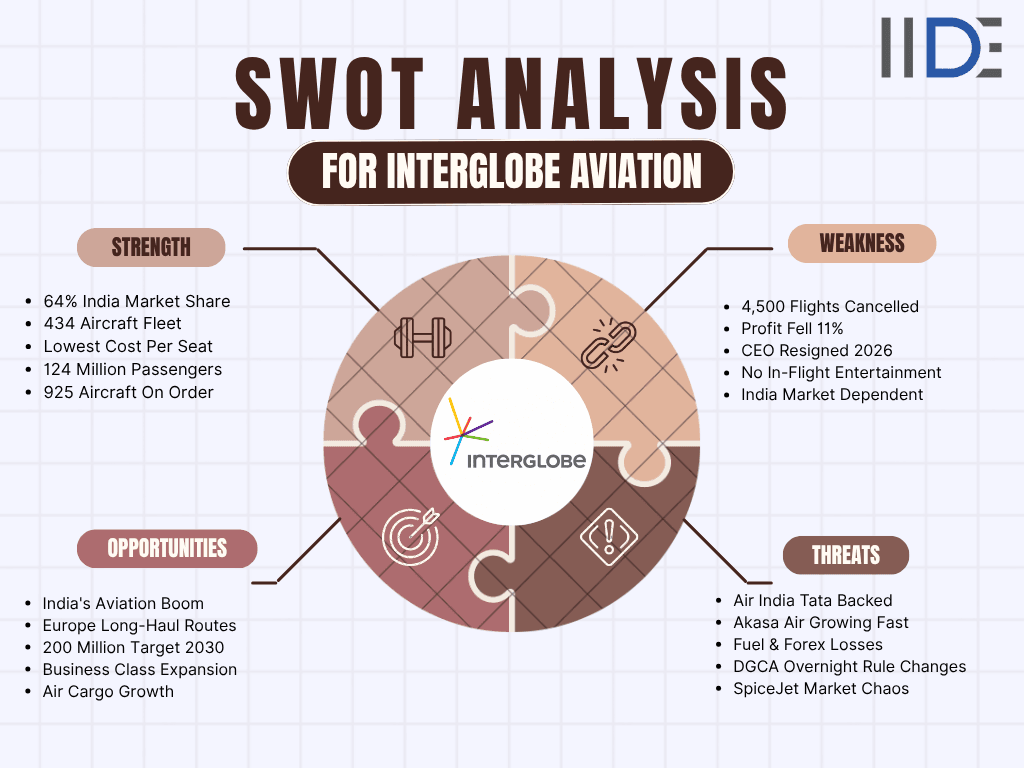
SWOT Quadrant
Before we break each factor down, here is a quick snapshot:
| STRENGTHS | WEAKNESSES |
|---|---|
| 64% of India's domestic flight market. | December 2025 4,500 flights cancelled, trust hit. |
| 434 aircraft 6th busiest airline in the world. | Net profit fell 11% in FY2025 despite revenue growth. |
| Lowest cost per seat among Indian airlines. | CEO resigned March 2026 leadership uncertainty. |
| Carried 124 million passengers in 2025. | No in-flight entertainment in economy class. |
| 925 aircraft on order secured till 2030. | Heavy dependence on India's domestic market. |
| Best Airline in India & South Asia Skytrax 2025. | Income tax penalty of ₹944 crore in March 2025. |
| OPPORTUNITIES | THREATS |
| India to become world's 3rd largest aviation market. | Air India growing fast after Vistara merger. |
| Long-haul Europe routes just launched. | Akasa Air expanding rapidly with lower costs. |
| 200 million passenger target by 2030. | Fuel prices and forex fluctuations hitting profits. |
| Business class IndiGoStretch growing demand. | DGCA regulations can disrupt operations overnight. |
| IndiGo CarGo dedicated freight business. | SpiceJet's uncertain recovery could flood market. |
| Willie Walsh new CEO brings global expertise. | New pilot rest rules creating scheduling complexity. |

Is Digital Marketing the Right Career for You?
Find out in a free 45-min masterclass · Career paths, roles and growth explained · By Karan Shah, Founder & CEO, IIDE

Is Digital Marketing the Right Career for You?
Find out in a free 45-min masterclass · Career paths, roles and growth explained · By Karan Shah, Founder & CEO, IIDE
Strengths of InterGlobe Aviation
IndiGo did not get to 64% market share by accident. It built a very specific way of running an airline, cheap, fast, and reliable and stuck to it for 20 years while everyone else changed plans. These strengths are real and hard to copy.
1. 64% of India's Domestic Flights No One Comes Close
- IndiGo holds 64.2% of India's domestic airline market as of August 2025, more than all other Indian airlines combined.
- It operates 2,700+ daily flights to 94 cities across India.
- It has been India's largest airline by market share since December 2012.
- Carried 118.6 million domestic passengers in FY2025 alone.
Why it matters: When you control 64% of a market, you get the best airport slots, the most loyal corporate clients, and the most data on what Indian passengers want. No new airline can build this overnight.
2. One of the Cheapest Airlines to Run in the World
- IndiGo flies only one type of aircraft, the Airbus A320 family. This means pilots, engineers, and spare parts are all interchangeable.
- Planes are turned around in 20 minutes o, one of the fastest in the world, so each aircraft flies about 12 hours every day.
- Staff share multiple roles, check-in staff also handle baggage, keeping headcount low.
- This gives IndiGo the lowest cost per available seat among Indian airlines.
Why it matters: Low costs mean IndiGo can offer cheaper tickets than rivals and still make money. This is the core reason it has dominated India's price-sensitive aviation market for nearly two decades.
3. The Largest Aircraft Order Book in Aviation History
- IndiGo has 925 aircraft on order, the largest order book of any airline in the world.
- It placed a landmark order for 500 Airbus aircraft in 2023, to be delivered between 2030 and 2035.
- It also ordered 60 Airbus A350-900 wide-body aircraft for long-haul routes, with deliveries starting in 2027.
Why it matters: This order book locks in aircraft at today's prices and guarantees IndiGo's growth for the next decade. Rivals trying to match its scale will pay more per plane and wait longer to get them.
4. Best Airline in India, Skytrax 2025 & 6th Busiest Globally
- IndiGo was named the Best Airline in India and South Asia at the Skytrax World Airline Awards 2025.
- It is the 6th busiest airline in the world by daily departures, according to RadarBox data.
- It ranked as the 6th most punctual airline in Asia-Pacific in 2025, according to aviation analytics firm Cirium.
Why it matters: Awards and punctuality rankings are not just for marketing. Corporate clients and frequent flyers choose airlines based on reliability. IndiGo's on-time record is a genuine competitive edge.
5. IndiGo CarGo: A Separate Freight Business
- IndiGo runs a dedicated cargo subsidiary called IndiGo Cargo, operating three Airbus A321 freighter aircraft.
- This gives IndiGo a revenue stream completely separate from passenger tickets.
- India's air freight market is growing as e-commerce and pharmaceutical exports increase.
Why it matters: Cargo revenue is steady and does not depend on seat sales or passenger demand. It makes IndiGo's overall business more stable during slow travel seasons.
6. First Long-Haul Flights to Europe: A Historic Step
- In July 2025, IndiGo launched its first direct flights from Mumbai to Manchester and Amsterdam.
- It added Copenhagen and London Heathrow in October 2025.
- It uses wet-leased Boeing 787 aircraft from Norse Atlantic for these routes.
- Athens was added in early 2026, making IndiGo the first Indian low-cost carrier to fly to Greece.
Why it matters: Europe routes open up an entirely new type of passenger, the high-spending international traveller. These tickets are worth 5-10x a domestic fare. IndiGo is going after a segment it has never served before.
To understand how IndiGo's business model and strategy have evolved over the years, read our detailed SWOT Analysis of IndiGo Airlines.
Weaknesses of InterGlobe Aviation
IndiGo is India's largest airline, but 2025 and early 2026 showed that even the biggest player can stumble badly. These weaknesses are real problems, not small complaints.
1. December 2025 Flight Crisis 4,500 Flights Cancelled
- In December 2025, IndiGo cancelled nearly 4,500 flights over 10 days after failing to prepare for new pilot rest rules introduced by DGCA.
- Over 10 lakh passengers were stranded or disrupted.
- IndiGo was fined ₹22.2 crore, had to give ₹50 crore as a bank guarantee, and paid approximately ₹5 billion in refunds.
- Pilot unions publicly blamed IndiGo for a hiring freeze and pilot pay freeze that made the crisis worse.
Why it matters: This was the worst operational failure in IndiGo's history. It damaged passenger trust, attracted heavy regulatory scrutiny, and directly contributed to the CEO's resignation. The damage to IndiGo's reputation for reliability, its biggest selling point, was significant.
2. CEO Resigned, New Leader Not Yet in Place
- CEO Pieter Elbers resigned on March 10, 2026, directly following the December flight crisis.
- Rahul Bhatia, the founder, stepped in as interim CEO.
- New CEO Willie Walsh is only expected to join in August 2026, leaving IndiGo without a permanent CEO for nearly 5 months.
Why it matters: Airlines are complex businesses. A 5-month gap at the top during a period of international expansion, fleet transition, and regulatory scrutiny is a real management risk. Decisions get delayed. Teams lose direction.
3. Net Profit Fell 11% Despite Revenue Growing 17%
- IndiGo's revenue grew 17% to ₹80,803 crore in FY2025 but net profit actually fell by 11% to ₹7,258 crore.
- The reasons: higher fuel costs, foreign exchange losses, and increased operating expenses.
- Revenue is going up, but the money left after expenses is going down.
Why it matters: Growing revenue but falling profit is a warning sign. It means costs are rising faster than earnings. If fuel prices stay high or the rupee weakens further, this gap could widen.
4. No In-Flight Entertainment in Economy Class
- IndiGo's economy class has no screens, no in-flight entertainment system, and no hot meals.
- Passengers must bring their own devices or use the SonyLIV tie-up on their phones.
- Hot drinks and snacks are available to buy, but not included in the base fare.
Why it matters: As IndiGo moves into international long-haul routes and starts competing with full-service airlines, this gap becomes very noticeable. A 9-hour flight to London with no entertainment is a different experience from a 2-hour Delhi-Mumbai hop.
5. Too Dependent on India's Domestic Market
- Despite recent international expansion, the large majority of IndiGo's revenue still comes from domestic India routes.
- International routes are still a small fraction of total operations.
- Any slowdown in India's economy, a rise in fuel taxes, or a domestic travel demand drop hits IndiGo very hard.
Why it matters: Having one main market is a risk. If something goes wrong in India's economic slowdown, travel restrictions, or fuel price shock, IndiGo has very few other markets to fall back on.
6. ₹944 Crore Income Tax Penalty
- In March 2025, India's Income Tax Department imposed a ₹9.44 billion penalty on InterGlobe Aviation for the assessment year 2021 - 22.
- This is a significant financial and reputational burden that adds to the pressure of falling profits.
Why it matters: A nearly ₹1,000 crore tax penalty signals compliance issues and puts additional strain on finances that were already tighter in FY2025.
Opportunities for InterGlobe Aviation
India's aviation market is one of the fastest-growing in the world. And IndiGo, already the dominant player, is in the best position to capture that growth. Here is where the real upside lies.
1. India Is Becoming the World's 3rd Largest Aviation Market
- India is on track to become the third-largest aviation market in the world, behind only the US and China.
- Air passenger traffic in India is growing at a rapid pace as more Indians fly for the first time.
- IndiGo, as the airline with the most flights, destinations, and the lowest fares, is the natural beneficiary of this growth.
Why it matters: You do not need to take passengers from rivals when the total market is growing this fast. India is creating millions of new first-time flyers every year, and most of them will fly IndiGo.
2. Long-Haul International Routes: A Completely New Revenue Stream
- IndiGo has launched flights to Manchester, Amsterdam, Copenhagen, and London in 2025.
- It has 60 Airbus A350-900 wide-body aircraft on order, with deliveries from 2027.
- Willie Walsh, the incoming CEO, has decades of experience running long-haul international airlines.
Why it matters: A Mumbai-London ticket earns IndiGo roughly 8-10x more than a Mumbai-Delhi ticket. International long-haul is where the highest margins are. IndiGo is just getting started here.
3. Target of 200 Million Passengers by 2030
- IndiGo has publicly stated its goal to carry 200 million passengers per year by 2030, nearly double its 2025 volume.
- To support this, it has 925 aircraft on order, with one new plane arriving almost every week through 2030.
- India's airport infrastructure is also expanding to support this growth.
Why it matters: If IndiGo hits even 80% of this target, it will be among the top 5 airlines globally by passengers carried. The infrastructure investment is already locked in; execution is the only variable.
4. IndiGoStretch Business Class Growing
- IndiGo launched IndiGoStretch in 2024, its business class product on select routes.
- It includes complimentary meals, advance seat selection, priority check-in, and extra baggage.
- It has been introduced on both domestic and select international routes.
Why it matters: Business class passengers spend 3-5x more than economy passengers per seat. As IndiGo expands internationally, adding premium seating gives it a new revenue layer without buying new aircraft.
5. IndiGo Cargo Air Freight Growing With E-Commerce
- India's air cargo market is growing fast, driven by e-commerce deliveries, pharmaceutical exports, and perishable goods.
- IndiGo CarGo already operates dedicated freighter aircraft and can expand this fleet as demand grows.
Why it matters: Cargo does not need a seat sale, a holiday season, or a last-minute deal. It is steady, recurring revenue that grows with India's economy.
6. New CEO Willie Walsh Global Expertise
- Willie Walsh ran British Airways and was the head of IATA, the global body that represents all major airlines.
- He has experience turning around large airlines and building long-haul international networks.
- His appointment signals that IndiGo is serious about becoming a global airline, not just India's biggest domestic carrier.
Why it matters: The right CEO at the right time can transform an airline. Willie Walsh has done it before, and IndiGo is at exactly the moment in its growth where that kind of global experience matters most.
To see how IndiGo's marketing strategy has helped it build India's most recognised airline brand, read our in-depth Marketing Strategy of IndiGo Airlines.
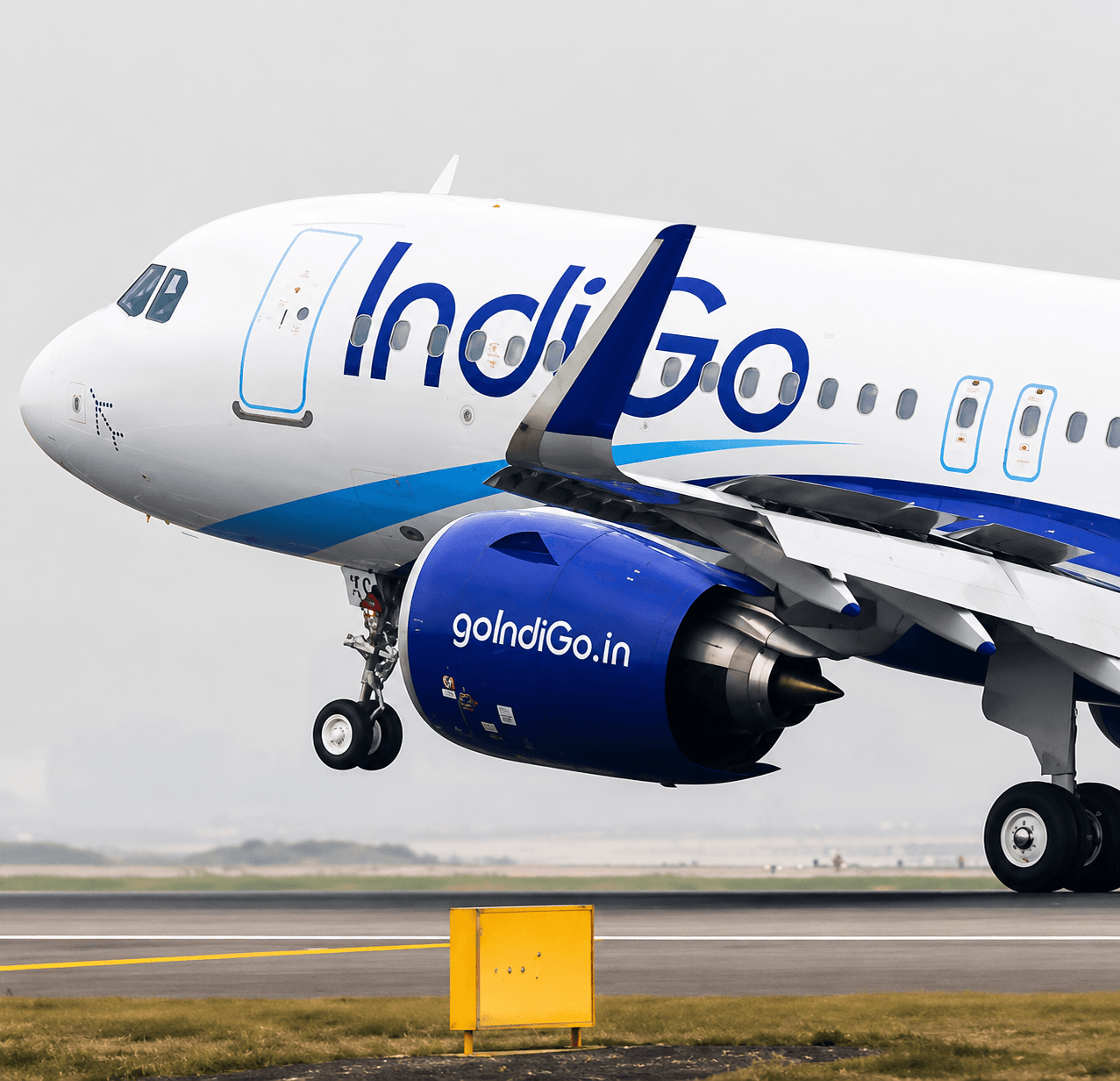
Threats to InterGlobe Aviation
IndiGo's dominance is real, but so are the threats. Several of them got bigger in 2025 - 26 and cannot be ignored.
1. Air India Is Back And Growing Fast
- Air India merged with Vistara in 2024, creating a full-service airline with a much bigger fleet and route network.
- It is backed by the Tata Group, one of India's most powerful conglomerates with deep pockets to invest in aircraft, staff, and marketing.
- Air India is targeting both domestic routes and international long-haul, exactly where IndiGo is trying to grow.
Why it matters: For years, Air India has been struggling and has not been a real threat. That has changed. A well-funded, Tata-backed Air India with a new fleet is the most serious competitive challenge IndiGo has ever faced.
2. Akasa Air Growing Fast With Low Costs
- Akasa Air, launched in 2022, is expanding rapidly with a young Boeing 737 MAX fleet and aggressive pricing.
- It adapted to the new DGCA pilot rest rules better than IndiGo, partly because it had fewer legacy scheduling problems.
- It is positioning itself as a low-cost alternative in exactly the space IndiGo owns.
Why it matters: Akasa is small today but growing fast. It does not have IndiGo's history of operational problems and is building a reputation for reliability. It could take meaningful market share in 2-3 years.
3. Fuel Prices and Forex Losses Beyond IndiGo's Control
- Jet fuel is IndiGo's biggest expense, and its price goes up and down based on global oil markets, not anything IndiGo can control.
- IndiGo also earns in rupees but pays for aircraft leases in US dollars, so a weaker rupee directly hurts profits.
- FY2025 net profit fell 11% partly because of these two factors.
Why it matters: IndiGo can control its costs inside the airline, but it cannot control oil prices or currency markets. These external factors can wipe out profit gains quickly, as FY2025 showed.
4. DGCA Regulations Rules Can Change Overnight
- The December 2025 crisis happened because the new DGCA pilot rest rules were not properly planned.
- DGCA can introduce new safety rules, fine airlines, cap fares, or order flight cuts with very little notice.
- IndiGo, as the biggest airline, gets the most scrutiny when things go wrong.
Why it matters: Being 64% of the market means you are always in the regulator's spotlight. One compliance failure in December 2025 can cost billions, damage your reputation, and cost you your CEO.
5. SpiceJet's Uncertain Future Could Cause Market Chaos
- SpiceJet has been financially struggling for years, grounding aircraft, delaying salaries, and facing multiple legal cases.
- If SpiceJet suddenly collapses, thousands of passengers would need to rebook, causing a short-term surge in demand.
- But if SpiceJet gets rescued and comes back stronger, it adds more competition to an already crowded market.
Why it matters: A collapsing competitor sounds good, but creates chaos, stranded passengers, price caps, and regulatory pressure on the remaining airlines. IndiGo, as the biggest player, always takes the most heat.
6. New Pilot Rest Rules Making Scheduling Harder
- DGCA's new Flight Duty Time Limitation rules, which require longer pilot rest periods, are now permanently in place.
- IndiGo needs more pilots to fly the same number of flights as before.
- Hiring and training enough pilots is expensive and takes time.
Why it matters: The December 2025 crisis was caused by this exact problem. It has not fully gone away. IndiGo must now permanently hire more pilots and rethink how it schedules flights, adding costs and operational complexity.
To understand how IndiGo's biggest full-service rival is rebuilding and challenging its dominance, read our complete Marketing Strategy of Air India.
About InterGlobe Aviation
InterGlobe Aviation Limited is the company behind IndiGo, the airline that changed how India flies. It was founded in 2005 by Rahul Bhatia and Rakesh Gangwal with one clear idea: make flying affordable for every Indian. IndiGo started with one plane in 2006 and today operates 434 aircraft flying to 137 destinations. It carried 124 million passengers in 2025, holds 64% of India's domestic market, and is now the sixth busiest airline in the world. It went public on the Indian stock exchange in October 2015.
Quick Stats Table
| Parameter | Details |
|---|---|
| Company Name | InterGlobe Aviation Limited (Brand: IndiGo / 6E) |
| Founded | 2005, India |
| Founders | Rahul Bhatia & Rakesh Gangwal |
| Managing Director | Rahul Bhatia (also Interim CEO as of March 2026) |
| Incoming CEO | Willie Walsh (expected August 2026) |
| Board Chairman | Vikram Singh Mehta |
| Headquarters | Gurgaon, Haryana, India |
| Listed On | NSE & BSE (Ticker: INDIGO) |
| Fleet Size | 434 aircraft (as of August 2025) |
| Daily Flights | 2,700+ daily flights |
| Destinations | 137 total, 94 domestic, 43 international |
| Passengers (CY2025) | 124 million |
| Domestic Market Share | 64% (as of August 2025) |
| Revenue (FY2025) | ₹80,803 crore (up 17% YoY) |
| Net Profit (FY2025) | ₹7,258 crore (down 11% YoY) |
| Aircraft on Order | 925 aircraft (the largest order book in aviation) |
| World Ranking | 6th busiest airline globally (RadarBox, 2025) |
| Key Competitors | Air India, Akasa Air, SpiceJet, Vistara (merged with Air India) |
What's Happening with InterGlobe Aviation in 2026?
- In December 2025, IndiGo cancelled nearly 4,500 flights over 10 days after failing to adjust to new pilot rest rules set by India's aviation regulator DGCA. Over 10 lakh passengers were affected. IndiGo was fined ₹22.2 crore and had to pay ₹5 billion in refunds.
- Following the December crisis, CEO Pieter Elbers resigned on March 10, 2026, with Rahul Bhatia stepping in as interim CEO.
- On March 31, 2026, IndiGo announced Willie Walsh, the former head of global aviation body IATA, as its new CEO. He is expected to join by August 2026.
- IndiGo launched its first long-haul, with flights to Europe in July 2025 direct flights from Mumbai to Manchester and Amsterdam, followed by Copenhagen and London Heathrow in October 2025.
- IndiGo was named the Best Airline in India and South Asia at the Skytrax World Airline Awards 2025.
- The Income Tax Department imposed a ₹9.44 billion penalty on InterGlobe Aviation in March 2025 for the assessment year 2021-22.
- IndiGo aims to carry 200 million passengers per year by 2030, double its current volume.
Key Takeaways & Conclusion
InterGlobe Aviation has built something extraordinary: the airline that made flying normal for hundreds of millions of Indians who never thought they could afford a plane ticket. From one aircraft in 2006 to 434 planes, 137 destinations, and 124 million passengers in 2025, that journey is genuinely remarkable. But 2025-26 has been the most turbulent year in IndiGo's history, not in the sky, but on the ground. Nearly 4,500 flights were cancelled in December, a ₹5 billion refund bill, a ₹22.2 crore DGCA fine, a ₹944 crore tax penalty, and a CEO resignation all happened within four months.
The good news is that the fundamentals are still strong. Revenue is at a record high, the aircraft order book is the largest in aviation history, and Willie Walsh, one of the most experienced airline leaders in the world, is joining as the new CEO. India's aviation market is also growing faster than almost anywhere else on earth. The 200 million passenger target by 2030 is ambitious, but with 925 aircraft already on order, it is not impossible.
The question for 2026 is simple: can IndiGo fix what broke in December 2025, its operational reliability while simultaneously launching long-haul international routes, onboarding a new CEO, and defending its 64% market share against a reinvigorated Air India and a fast-growing Akasa?
Recommendations:
- Fix pilot hiring and scheduling permanently, so that. Long-haul. No, the December 2025 crisis cannot happen again, and solving it requires more than a temporary DGCA exemption.
- Give Willie Walsh a clear mandate on international expansion long-haul is the biggest revenue opportunity IndiGo has ever had, and it needs focused leadership.
- Improve in-flight experience on international routes no entertainment on a 9-hour London flight is not acceptable for premium international travellers.
- Build a stronger cargo business. IndiGo Cargo is underdeveloped relative to the size of IndiGo's fleet.
- Invest in pilot retention hiring freezes and pay freezes caused the December crisis. Treating pilots well is now a business necessity, not just an HR concern.
Want to Know Why 2,50,000+ Students Trust Us?
Dive into the numbers that make us the #1 choice for career success



MBA - Level
Post Graduate in Digital Marketing & Business Strategy

Best For
Fresh Graduates

Mode of Learning
On Campus (Mumbai & Delhi)

Starts from
Nov 27, 2026

Duration
11 Months

Live & Online
Advanced Online Digital Marketing Course
Best For
Working Professionals
Mode of Learning
Online
Starts from
Nov 2, 2026
Duration
4-6 Months

Offline
Top AI Courses to Make You Future Ready!
Best For
AI Enthusiasts
Mode of Learning
2–5 Month Program
Starts from
Nov 24, 2026
Duration
Flexiable

Offline
Undergraduate Program in Digital Business & Entrepreneurship
Best For
12th Passouts
Mode of Learning
On Campus (Mumbai)
Duration
3 Years
Offline
Degree In 2026 ≠ Enough Degree + Digital Skills = Future-Ready
Best For
12th Passouts
Mode of Learning
At IIDE Campus
Duration
3 Years
Recent Post
InterGlobe Aviation Limited is the parent company of IndiGo, India's largest airline. It was founded in 2005 by Rahul Bhatia and Rakesh Gangwal. IndiGo operates 434 aircraft, flies to 137 destinations, and holds 64% of India's domestic airline market in 2025.
InterGlobe Aviation was founded in 2005 by Rahul Bhatia and Rakesh Gangwal. Rahul Bhatia is the Managing Director and currently serving as interim CEO after Pieter Elbers resigned in March 2026.
Willie Walsh, former head of British Airways and ex-Director General of IATA, was appointed as IndiGo's new CEO on March 31, 2026. He is expected to join by August 2026.
IndiGo cancelled nearly 4,500 flights over 10 days in December 2025 after failing to comply with new DGCA pilot rest rules. Over 10 lakh passengers were affected. IndiGo paid nearly ₹5 billion in refunds and was fined ₹22.2 crore by DGCA.
IndiGo operated a fleet of 434 aircraft as of August 2025 a mix of Airbus A320 family jets and ATR turboprop aircraft for regional routes. It also has 925 aircraft on order for delivery through 2030 and beyond.
IndiGo held 64.2% of India's domestic aviation market as of August 2025 more than all other Indian airlines put together.
As of early2026, IndiGo flies to 43 international destinations, including Manchester, Amsterdam, Copenhagen, London Heathrow, Athens, Dubai, Singapore, Bangkok, and cities across the Middle East and Southeast Asia.

Lead Trainer & Business Development Head at IIDE
Aditya Shastri leads the Business Development segment at IIDE and is a seasoned Content Marketing expert. With over a decade of experience, Aditya has trained more than 20,000 students and professionals in digital marketing, collaborating with prestigious institutions and corporations such as Jet Airways, Godrej Professionals, Pfizer, Mahindra Group, Publicis Worldwide, and many others. His ability to simplify complex marketing concepts, combined with his engaging teaching style, has earned him widespread admiration from students and professionals alike.
Aditya has spearheaded IIDE’s B2B growth, forging partnerships with over 40 higher education institutions across India to upskill students in digital marketing and business skills. As a visiting faculty member at top institutions like IIT Bhilai, Mithibai College, Amity University, and SRCC, he continues to influence the next generation of marketers.
Apart from his marketing expertise, Aditya is also a spiritual speaker, often traveling internationally to share insights on spirituality. His unique blend of digital marketing proficiency and spiritual wisdom makes him a highly respected figure in both fields.