
Students Centric
Placements Report
Trackable results, real numbers
Reviews
Proven success, real voices
Trainers
Expert-led, Industry-Driven Training
Life at IIDE
Vibrant Spirit student life
Alumni
Successful Journeys, Inspiring Stories
Learning Centre
Webinars
Blogs
Case studies
Live, Interactive Masterclasses
Fresh Insights, quick reads
Real-life, Industry relevant
More
Hire from us
Hire Top Digital Marketing Talent
Work with us
Join Our Team, Make an Impact
Customised Training
Personalised digital marketing training for your company
Refer & earn
Simple, easy rewards
Contact us
Get the answers you need
About us
Know more about IIDE
Explore all course options

FOR FRESH GRADUATES
Post Graduation Program in Digital Marketing & Business Strategy- Ideal for Age: 20–25 Years

Can’t decide? Explore all our
Digital Marketing Courses
COMPARE BOTH OUR PROGRAMSOffline
Explore Top AI CoursesIndustry-Aligned TRACKMost Popular
UG Program in Digital Business & Entrepreneurship- Ideal for 12th Pass out / FY Degree Student

PARTNER PROGRAMS






Can’t decide? Explore all
BBA In Digital Marketing Colleges
Orginally Written by Aditya Shastri
Updated on Mar 30, 2026
Share on:


Dabur is one of India's largest and most trusted FMCG companies, known for its Ayurvedic and natural products. With a vast portfolio that includes healthcare, personal care, and food products, Dabur holds a strong position in the market. But how does this brand sustain its edge in a competitive environment? Read on to explore Dabur's current SWOT analysis and understand why it matters for entrepreneurs and business students alike.
About Dabur
Founded in 1884, Dabur has been a leader in the Indian FMCG market, known for its natural, ayurvedic approach to healthcare, personal care, and food products. With a mission to provide "natural health care," Dabur’s iconic products such as Dabur Honey, Dabur Chyawanprash, and Dabur Amla Hair Oil have shaped the brand's identity. Today, Dabur is recognised for its wide reach across India and in global markets.

Is Digital Marketing the Right Career for You?
Find out in a free 45-min masterclass · Career paths, roles and growth explained · By Karan Shah, Founder & CEO, IIDE

Is Digital Marketing the Right Career for You?
Find out in a free 45-min masterclass · Career paths, roles and growth explained · By Karan Shah, Founder & CEO, IIDE
SWOT Analysis of Dabur
Let’s decode what’s been working for Dabur, what needs a touch-up, where the following significant growth areas lie, and what external challenges the brand faces.
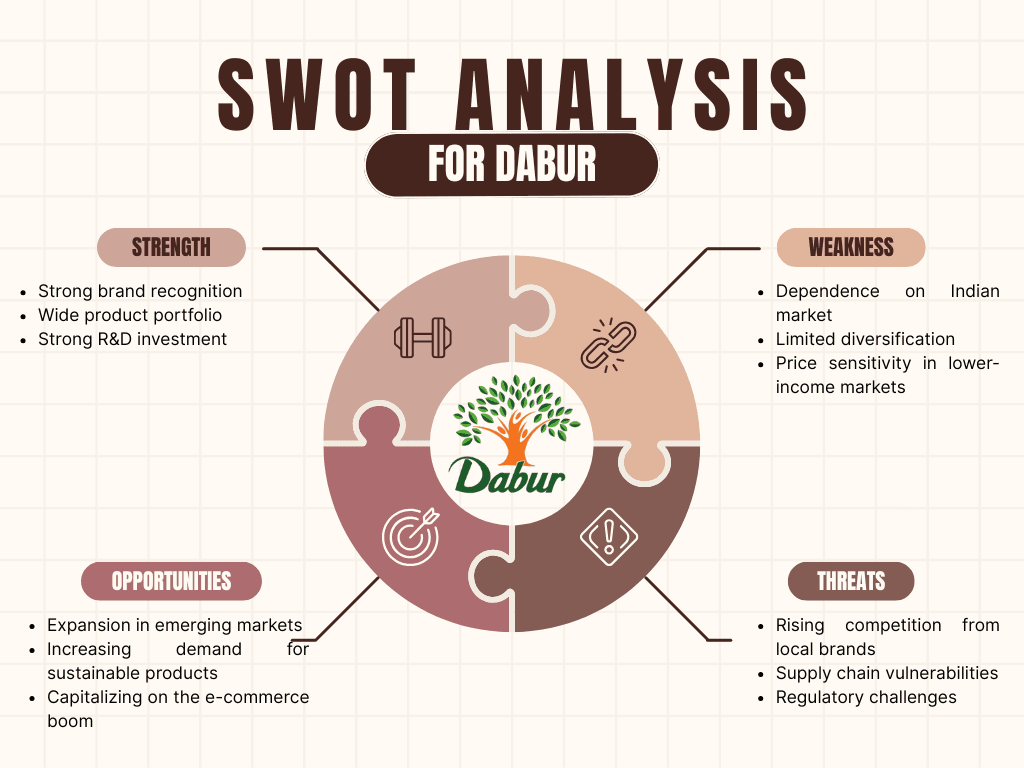
1. Strengths of Dabur
- Brand Equity & Recognition:
Dabur is a household name in India with over 100 years of market experience, providing it with significant brand loyalty.
- Diverse Product Portfolio:
Dabur has successfully diversified into multiple categories, including health, food, personal care, and home care products.
- Strong Market Position:
Dabur has a dominant presence in the Ayurvedic healthcare market, benefiting from growing consumer preference for natural products.
- Global Presence:
Dabur exports to over 100 countries, making it a truly global player in the FMCG sector.
- Research & Innovation:
The company invests in R&D, focusing on new product development and innovation, especially in natural and Ayurvedic-based products.
2. Weaknesses of Dabur
- Dependence on the Indian Market:
Despite its global presence, Dabur generates a significant portion of its revenue from India, making it vulnerable to market saturation and economic downturns within the country.
- Limited Diversification:
Compared to its competitors like Hindustan Unilever, Dabur has a relatively smaller portfolio in the non-Ayurvedic sector, limiting its appeal to broader consumer segments.
- Price Sensitivity:
Dabur’s natural products, while premium, may face pricing challenges against competitors offering similar products at lower costs, especially in price-sensitive markets.
We suggest that you read the SWOT analysis of Dove, which provides another example of how brands in the FMCG industry focus on emotional connections to drive consumer loyalty.
3. Dabur's Opportunities
- Emerging Markets:
With increasing disposable incomes in emerging markets like Africa and Southeast Asia, Dabur has the opportunity to expand its reach in these regions.
- Sustainability Initiatives:
The growing consumer shift towards sustainability presents an opportunity for Dabur to enhance its eco-friendly practices and position itself as a leader in green FMCG.
- Health & Wellness Trend:
There is a rising global demand for wellness and natural health products, which Dabur can leverage through its existing Ayurvedic product lines.
- E-commerce Growth:
Dabur can capitalise on the e-commerce boom to enhance its direct-to-consumer sales, especially in tier-2 and tier-3 cities in India.
4. Dabur's Threats
- Intensified Competition:
Brands like Patanjali and Himalaya pose serious competition to Dabur, especially in the Ayurvedic and health segments.
- Supply Chain Issues:
The reliance on natural ingredients, often sourced from rural areas, makes Dabur vulnerable to supply chain disruptions, especially in times of natural calamities.
- Regulatory Challenges:
Changes in government regulations regarding product formulations, labelling, or advertising could impact Dabur’s operations, especially in international markets.
- Economic Downturns:
In times of economic slowdown, premium-priced FMCG products are often the first to face a dip in consumer spending.
The marketing strategy of Sephora showcases a strong case of personalised experiences, which is something Dabur also taps into with its health and wellness products.
Dabur's SWOT Analysis Summed Up
The Final Thoughts
Key Highlights: Dabur’s strong brand equity and its diverse product portfolio position it as a leader in the FMCG sector. However, the company’s heavy reliance on the Indian market and the increasing competition in the natural product segment could impact its long-term growth.
Core Tension: Dabur must balance its strong market leadership with the need for diversification and global expansion.
Recommendations: Dabur should focus on further diversifying its product range into more non-Ayurvedic sectors, enhance its sustainability practices, and strengthen its online presence to combat competition and meet the needs of evolving consumer behaviour.
Want to Know Why 2,50,000+ Students Trust Us?
Dive into the numbers that make us the #1 choice for career success



MBA - Level
Post Graduate in Digital Marketing & Business Strategy

Best For
Fresh Graduates

Mode of Learning
On Campus (Mumbai & Delhi)

Starts from
Oct 1, 2026

Duration
11 Months

Live & Online
Advanced Online Digital Marketing Course
Best For
Working Professionals
Mode of Learning
Online
Starts from
Oct 16, 2026
Duration
4-6 Months

Offline
Top AI Courses to Make You Future Ready!
Best For
AI Enthusiasts
Mode of Learning
2–5 Month Program
Starts from
Sep 29, 2026
Duration
Flexiable

On Campus
Advanced Certification in Artificial Intelligence
Best For
AI Enthusiasts
Mode of Learning
On Campus (Mumbai)
Starts from
Sep 29, 2026
Duration
3 Months
Offline
Undergraduate Program in Digital Business & Entrepreneurship
Best For
12th Passouts
Mode of Learning
On Campus (Mumbai)
Starts from
-
Duration
3 Years
Offline
Degree In 2026 ≠ Enough Degree + Digital Skills = Future-Ready
Best For
12th Passouts
Mode of Learning
At IIDE Campus
Starts from
-
Duration
3 Years
Recent Post
Dabur manufactures a variety of products, including herbal medicines, health supplements, oral care products, personal care items, skin care products, hair care products, and food products. Some of its well-known brands include Dabur Honey, Dabur Chyawanprash, Dabur Red Toothpaste, and Dabur Amla.
Yes, Dabur operates in over 100 countries worldwide, with a strong presence in markets across Asia, the Middle East, Africa, and Europe. The company has become a prominent name in the global natural products market.
Yes, Dabur has a wide range of products catering to children, including health supplements like Dabur Chyawanprash for immunity and dental care products designed specifically for kids.
Dabur has taken several steps toward sustainability, including initiatives to reduce waste, water usage, and carbon footprint. The company is focused on promoting environmentally-friendly practices in its operations.
Dabur adheres to ethical practices and does not test its products on animals. The company’s products are cruelty-free.

Lead Trainer & Business Development Head at IIDE
Aditya Shastri leads the Business Development segment at IIDE and is a seasoned Content Marketing expert. With over a decade of experience, Aditya has trained more than 20,000 students and professionals in digital marketing, collaborating with prestigious institutions and corporations such as Jet Airways, Godrej Professionals, Pfizer, Mahindra Group, Publicis Worldwide, and many others. His ability to simplify complex marketing concepts, combined with his engaging teaching style, has earned him widespread admiration from students and professionals alike.
Aditya has spearheaded IIDE’s B2B growth, forging partnerships with over 40 higher education institutions across India to upskill students in digital marketing and business skills. As a visiting faculty member at top institutions like IIT Bhilai, Mithibai College, Amity University, and SRCC, he continues to influence the next generation of marketers.
Apart from his marketing expertise, Aditya is also a spiritual speaker, often traveling internationally to share insights on spirituality. His unique blend of digital marketing proficiency and spiritual wisdom makes him a highly respected figure in both fields.