
Students Centric
Placements Report
Trackable results, real numbers
Reviews
Proven success, real voices
Trainers
Expert-led, Industry-Driven Training
Life at IIDE
Vibrant Spirit student life
Alumni
Successful Journeys, Inspiring Stories
Learning Centre
Webinars
Blogs
Case studies
Live, Interactive Masterclasses
Fresh Insights, quick reads
Real-life, Industry relevant
More
Hire from us
Hire Top Digital Marketing Talent
Work with us
Join Our Team, Make an Impact
Customised Training
Personalised digital marketing training for your company
Refer & earn
Simple, easy rewards
Contact us
Get the answers you need
About us
Know more about IIDE
Explore all course options

FOR FRESH GRADUATES
Post Graduation Program in Digital Marketing & Business Strategy- Ideal for Age: 20–25 Years

Can’t decide? Explore all our
Digital Marketing Courses
COMPARE BOTH OUR PROGRAMSOffline
Offline AI Courses with Dual CertificationsIndustry-Aligned TRACKMost Popular
UG Program in Digital Business & Entrepreneurship- Ideal for 12th Pass out / FY Degree Student

PARTNER PROGRAMS






Can’t decide? Explore all
BBA In Digital Marketing Colleges
Orginally Written by Aditya Shastri
Updated on Jul 9, 2026
Share on:


20th Television’s key strengths are its strong legacy, hit franchises like *The Simpsons*, Disney’s backing, and wide distribution. Its weaknesses include high production costs, dependence on Disney, limited creative freedom, and the risk of new shows failing.
The biggest opportunity is global streaming growth, especially in markets like India. Its main threat is heavy competition from Netflix, Amazon MGM, and Warner Bros.
For business students, 20th Television shows how legacy content and corporate support can create stability, but rising costs and creative limits can affect growth.
Before diving into the article, we'd like to acknowledge the contributor behind this research. The research and initial analysis for this article were conducted by Akshay Jhunjhunwala, a current student of IIDE's Online Digital Marketing Course.
If you found this analysis insightful, feel free to connect with Akshay and send a quick note of appreciation for his fantastic research. A little encouragement always goes a long way!
| SWOT ANALYSIS TABLE | |
|---|---|
| Strengths | Weaknesses |
| 75-year legacy of award-winning franchises | Rising production costs |
| Strong backing from Disney | Dependence on Disney limits creative freedom |
| Wide distribution across Disney platforms | Many new original series fail |
| 100+ Emmy Awards showing creative excellence | Limited direct-to-consumer brand recognition |
|
Evergreen IP like The Simpsons continues to generate revenue |
High cost per premium episode |
| Opportunities | Threats |
| International streaming growth, especially in India |
Heavy competition from Netflix, Amazon MGM, and Warner Bros. |
| More Disney franchises can be expanded into TV | Consumer preferences are changing quickly |
| AI and virtual production can help reduce costs |
Production costs are rising while revenue is under pressure |
| Prestige limited series can reduce project risk | Industry strikes have increased costs and delays |
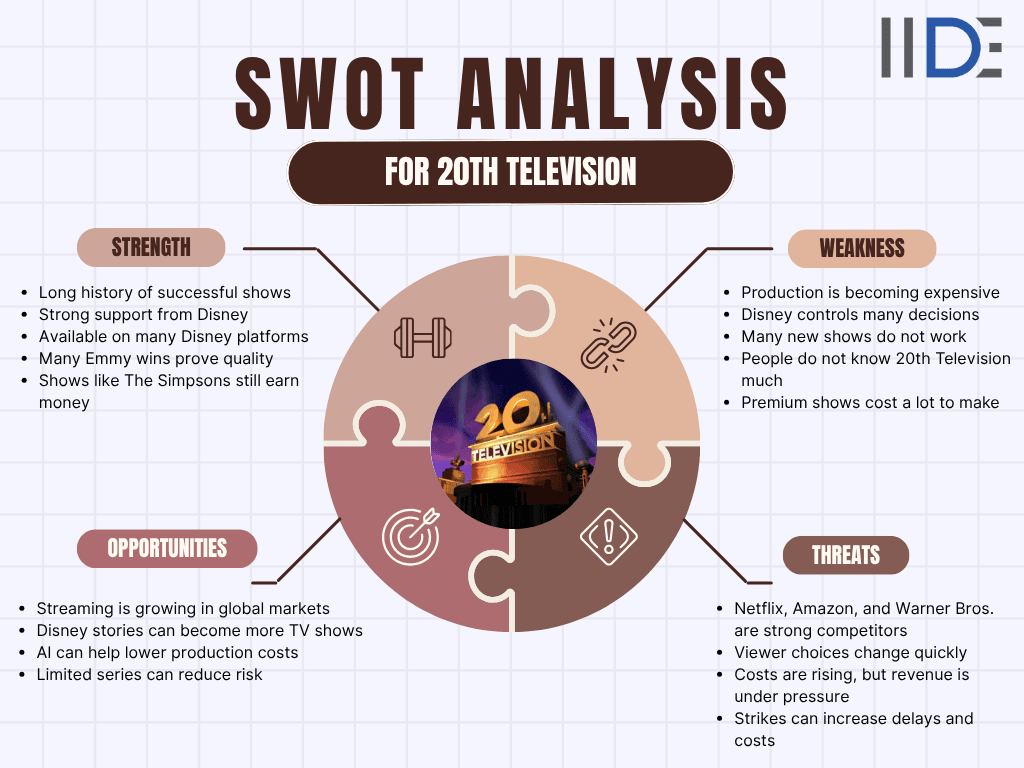
Here's a visual snapshot of 20th Television:

Is Digital Marketing the Right Career for You?
Find out in a free 45-min masterclass · Career paths, roles and growth explained · By Karan Shah, Founder & CEO, IIDE

Is Digital Marketing the Right Career for You?
Find out in a free 45-min masterclass · Career paths, roles and growth explained · By Karan Shah, Founder & CEO, IIDE
Strengths of 20th Television
20th Television's key strengths are a 75-year legacy of Emmy-winning franchises worth $10B+ in IP value, Disney's $91.3B financial backing and global distribution network (five platforms, 150M+ subscribers), and proven creative talent relationships that consistently produce global hits.
1. Iconic Content Library
- 20th Television's library of 75+ years of award-winning television franchises continues to generate revenue decades after the original release.
- The Simpsons has earned 32 Emmy Awards, produced 750+ episodes, and generated $13-15M annually in syndication revenue alone (Variety 2023).
- Modern Family earned 22 Emmy Awards and continues to license globally.
- Abbott Elementary, now in season 3, has earned 18+ Emmy nominations and maintains 9.1/10 on IMDb.
- These properties remain foundational to Disney streaming platform engagement strategies worldwide.
2. Disney's Financial Backing & Global Distribution
- 20th Television is a division of The Walt Disney Company. Disney has a market cap of around $180B and annual revenue of $91.3B, which gives 20th Television strong financial stability.
- Because of Disney’s resources, 20th Television gets access to multiple distribution platforms. These include ABC, Disney+, Hulu, FX, and international services.
- ABC reaches over 40M US households every week. Disney+ has around 110M subscribers. Hulu has around 50M subscribers, while FX reaches more than 15M viewers.
- This wide distribution network helps 20th Television reach audiences across TV, streaming, and global markets.
- This ecosystem enables loss-leader content strategies for subscriber acquisition and cross-promotional opportunities unreachable by independent studios.
3. Proven Creative Excellence
- 20th Television maintains long-standing relationships with industry-leading creators: Ryan Murphy, Seth MacFarlane, and Ava DuVernay.
- In 2024, 20th Television shows earned 40+ Emmys.
- This consistent recognition signals creative credibility, attracting A-list talent, writers, directors, and production designers who trust the studio's production standards.
4. Global Distribution Network
- 20th Television operates across the broadest distribution footprint of any Disney studio: ABC (broadcast), Disney+ (110M subs), Hulu (50M subs), FX (15M+ viewers), Netflix (licensed content), Apple TV+ (selected titles), and 150+ international territories for syndication.
- The Simpsons reaches 180+ countries in 50+ languages.
- This multi-platform presence means content reaches audiences via broadcast, SVOD, AVOD, linear cable, and syndication simultaneously.
5. Long-Term Creator Partnerships
- 20th Television's decades-long track record has established trusted relationships with A-list creators.
- Ryan Murphy's deal (valued at $300M+) has generated five Emmy-winning series.
- Seth MacFarlane's Fuzzy Door production company partnership spans 24 years.
- These relationships reduce development risk and secure preferential access to future projects from trusted creators, ensuring a steady pipeline of prestige productions.
6. Franchise Extension Capability & Spin-off Potential
- 20th Television's proven ability to extend successful franchises creates recurring revenue.
- With Disney's $200B+ IP portfolio (Marvel, Star Wars, Pixar), the studio is positioned to develop television extensions of major franchises, creating lower-risk, higher-viewership projects that leverage existing fan bases.
Weaknesses of 20th Television
20th Television's primary weaknesses are high production costs ($10-15M per premium drama episode in 2024) that erode per-show profitability, strategic dependency on Disney's corporate priorities that limits operational agility, and heavy reliance on franchise success with a 60-65% failure rate for new original series.
1. Rising Production Costs
- Premium drama episodes cost $10-15M each, up 30% from 2021.
- Actor salaries increased 25- 30%; VFX costs rose 20- 40%; international location logistics up 15-20% post-pandemic (IndieWire 2024).
- A 10-episode series costing $140M may only generate $110M in revenue, creating losses. While Disney absorbs losses for subscriber acquisition, this model becomes unsustainable as profitability metrics tighten.
- Rising costs directly impact greenlight decisions and production volume, forcing the studio to produce fewer shows within the same budget.
2. Disney's Control Over Decisions
- While Disney's backing is a strength, major strategic decisions require corporate approval.
- Content priorities, talent compensation, and platform strategy are all subject to corporate direction.
- Disney reduced television production budgets by 8–12% in 2024 (Variety 2024), forcing 20th Television to reduce greenlit pilots.
- Operating as a subsidiary reduces agility compared to independent studios in a fast-moving market.
3. Failure of New Original Series
- Industry data shows only 40-50% of greenlit shows survive season 2 (Deadline 2024).
- 20th Television's 2019-2024 track record: mega-hits (4+ seasons): Abbott Elementary, The Bear, Only Murders in the Building (~3 shows); moderate successes (2-3 seasons): Halston, Ratched (~4 shows); failures (1-2 seasons): The Politician, Hollywood, American Horror Stories (~5+ shows).
- Each failure costs $5-15M in sunk development; a 60% failure rate means $30-45M in annual sunk costs.
- High failure rates on new originals consume significant budget and mask the studio's innovation ability.
4. People Are Unaware of 20th Television
- Millions recognise The Simpsons and Modern Family, but far fewer recognise "20th Television" as a brand.
- Audiences know these shows through Disney, ABC, or Hulu, the distribution platforms, and not the production studio.
- Unlike Netflix, 20th Television operates invisibly to consumers.
- Lack of a standalone brand limits consumer loyalty, independent financing options, and merchandising revenue.
- If Disney reduces support, the studio will struggle to maintain subscriber acquisition value independently.
5. Disney Limits Creative Freedom
- As a Disney division, 20th Television operates under corporate brand guidelines that may limit creative risk-taking.
- Disney's family-friendly positioning may constrain adult-oriented, edgy content that some prestige creators prefer.
- Corporate approval requirements slow negotiations compared to Netflix/independent studios offering greater autonomy.
- Top creators increasingly prefer platforms where they retain full creative control, creating a risk of losing deal flow with the most ambitious new creators.
6. Shows Are Becoming Less Profitable
- Streaming licensing revenue declines as platforms saturate. Example: 2020 show costing $100M generated $120M revenue (profit $20M); 2024 same show costs $140M but generates $110M revenue (loss $30M).
- This cost-revenue misalignment directly threatens studio viability.
- Declining per-show profitability forces difficult choices: reduce production volume, reduce quality, or increase costs through technology adoption.
- All three options create competitive disadvantages relative to better-funded competitors.
You can also read our SWOT analysis of Zee Entertainment Enterprises to understand the strengths, weaknesses, opportunities, and threats of one of India’s leading media companies.
Opportunities for 20th Television
20th Television has three big opportunities. The first is international streaming growth. Markets like India, Southeast Asia, Latin America, and MENA are growing fast. The second opportunity is using Disney’s popular franchises for TV. This includes Marvel, Star Wars, Pixar, and National Geographic. The third opportunity is using AI and virtual production. These tools can help reduce costs while maintaining quality.
1. International Streaming Expansion
- Global streaming adoption is accelerating in underpenetrated markets.
- India's OTT market is projected to reach $5-6B by 2028, growing 18-22% annually (IAMAI 2024).
- Southeast Asia: $3–4B market, 20%+ annual growth. Latin America: 15-18% annual growth. Middle East/North Africa: 22%+ annual growth (Statista 2024).
- Production costs in India/SE Asia are 30-40% lower than US production.
- A single successful regional series reaches 50M+ viewers while maintaining higher profit margins.
- High-growth international markets offer margin expansion and subscriber acquisition at scale without competing directly with US-focused competitors.
2. Expanding Disney Franchises Into Television
- Disney owns $200B+ in franchise IP: Marvel (MCU), Star Wars, Pixar, National Geographic.
- Television extensions remain underdeveloped compared to films/streaming movies.
- A single Marvel-branded limited series attracts 100M+ viewers, drives Disney+ subscriptions, and generates $200-300M in franchise value.
- 20th Television can produce 5-8 franchise projects annually, expanding strategic relevance within Disney.
- Franchise-based content has lower creative risk (audiences already know characters), higher initial viewership, and stronger merchandising potential than original IP.
3. AI & Virtual Production Reducing Costs
- Emerging technologies meaningfully lower costs.
- AI-assisted editing reduces post-production timelines by 20-30%, saving $2-4M per series (Autodesk 2024).
- Virtual production (Volume/LED stages) reduces location costs by 40-50% (ILM Studios 2024).
- Cloud-based collaboration reduces equipment costs.
- Applied across 10-12 annual series, this delivers $150-320M in annual savings while maintaining production quality.
- Cost reduction directly increases profitability and greenlight capacity, enabling 20% more production within the same budget.
4. Prestige Limited Series
- Audience viewing behaviour is shifting toward limited series.
- Limited series represent 30% of greenlit content in 2024 vs. 15% in 2018 (Deadline 2024).
- They deliver comparable viewership to ongoing series while reducing per-project cost and creative risk.
- 20th Television can shift its portfolio toward this model, aligning production efficiency with market demand.
- Limited series have cleaner unit economics - lower total cost per project, predictable viewership ramp, and merchandising-friendly narratives, reducing financial risk while matching audience preferences.
5. International Co-Production Partnerships
- Establishing co-production partnerships with international studios (e.g., Lionsgate India, Bad Wolf Studios UK, Mediawan France) reduces upfront costs by 30-40% while gaining local talent and crew access.
- Co-production enables production at lower costs while maintaining quality and gaining local market credibility.
- Improves studio margins while scaling international content pipeline. Target: 40% of new originals as international co-productions by 2027.
6. High-Quality Documentary-Style Dramas
- Limited series format enables prestige documentary-drama hybrids with lower production costs than traditional scripted drama.
- This hybrid format appeals to both true crime and prestige audiences.
- Documentary-drama hybrids reduce production costs while maintaining high engagement and viewership, improving per-project profitability.
- Aligns with audience preference shift toward limited series and documentary content.
Threats to 20th Television
20th Television faces four major threats. First, competition is getting stronger. Streaming giants are spending heavily on new content. Second, audience preferences are changing. Viewers now prefer shorter seasons and more international content. Third, production costs are increasing. Salaries and overall costs are rising faster than revenue. Fourth, industry strikes have created extra delays and unexpected costs.
1. Intensifying Competition from Streaming Giants
- Netflix ($17B annually), Amazon MGM Studios ($10B+), and Warner Bros. ($8-9B) collectively spend $40B+ on content (Variety 2024).
- Netflix budget per series: $340M. 20th Television per series: $150–200M. Talent acquisition pressure intensifies: Five creators moved overall deals from Disney TV to Netflix/Amazon in 2023-2024, citing creative autonomy.
- Audience fragmentation: mid-tier 20th-century TV series gets 10-15M viewers; Netflix equivalent attracts 50M+.
- Competitive budget disparity directly limits 20th Television's ability to outbid competitors for top talent and trending content topics.
2. Viewer Choices Change Quickly
- 40% of Netflix users prefer weekly releases vs. binge drops (Netflix 2024 investor letter).
- Audiences prefer 6-8-episode seasons vs. traditional 13-episode seasons, reducing per-season licensing revenue.
- Engagement volatility is high: 60-70% audience drop by Week 4 (Nielsen 2024).
- Asian, Latin American, and Middle Eastern audiences prefer locally produced content over US imports (McKinsey 2024).
- Unpredictable audience behaviour makes long-term content planning difficult.
- Studios must allocate larger budgets to failed experiments, reducing overall production volume and profitability.
3. Costs Are Rising While Revenue is Falling
- Actor salaries increased 25-30% since 2021; streaming ARPU (average revenue per user) is declining as platforms saturate. Example: 2020 show costing $100M generated $120M revenue (profit $20M).
- 2024 same show: $140M cost but only $110M revenue (loss $30M).
- Cost-revenue misalignment directly threatens studio viability if unaddressed through technology adoption or content mix optimization.
- If per-show profitability declines, the studio must reduce production volume or reduce quality - both competitive disadvantages.
4. Industry Disruptions & Labor Unrest
- 2023 writers' strike and 2024 actors' strike disrupted production schedules, delayed 13+ series, and added $2-3B in unbudgeted costs industry-wide (Motion Picture Association 2024). Future strikes remain possible.
- Additionally, potential child safety regulations (COPPA 2.0) and content classification standards may increase compliance costs.
- External disruptions unpredictably reduce profitability.
- Studios must maintain financial reserves, but Disney's Wall Street pressure for consistent earnings makes reserve-building difficult.
5. More Focus on Reality Shows
- Unscripted greenlit orders increased 35% from 2022-2024 (Deadline 2024).
- Reality/competition shows now represent 22% of streaming greenlit content vs. 12% in 2020.
- If Disney deprioritizes scripted drama in favor of unscripted, 20th Television's core competency loses platform support.
- Strategic pivot by Disney toward unscripted would directly threaten 20th Television's relevance and future growth, threatening the studio's core identity and technical infrastructure.
6. Piracy Reduces Streaming Income
- BitTorrent and illegal streaming platforms distribute approximately 20% of premium television content (Motion Picture Association 2024).
- Piracy reduces subscription revenue for Disney+ and Hulu, indirectly impacting 20th Television's greenlight capacity.
- Piracy cannibalises subscription revenue without direct countermeasures available to individual studios. Industry-wide challenge that reduces overall platform revenue and content budgets.
For a deeper understanding of how the studio promotes its shows and builds audience demand, you can also explore the marketing strategy of 20th Television.
About 20th Television
20th Television, founded in 1949 by William Self and Darryl F. Zanuck, is one of Hollywood's oldest and most successful television production studios. Originally established as 20th Century Fox Television, the studio was rebranded to 20th Television in 2020 following Disney's acquisition of 21st Century Fox's entertainment assets.
Based in Los Angeles, California, the studio produces premium scripted television series for broadcast networks (ABC), streaming platforms (Hulu, Disney+, FX, Netflix, Apple TV+), and international broadcasters. Operating under Disney Television Studios, 20th Television generates an estimated $2-2.5B in annual revenue while employing approximately 800-1,000 people globally, with a portfolio spanning 75+ years of television production.
| Attribute | Details |
|---|---|
| Official Name | 20th Television |
| Former Name | 20th Century Fox Television |
| Founded | 1949 |
| Founders | William Self, Darryl F. Zanuck |
| Headquarters | Los Angeles, California, USA |
| Parent Company | The Walt Disney Company |
| CEO/Leadership | Dana Walden, Chair of Disney Television Studios |
| Industry | Television Production & Distribution |
| Estimated Annual Revenue | $2-2.5B |
| Net Income | Profitable, but per-show margins are declining due to rising costs |
| Employees | Around 800–1,000 |
| Market Cap | N/A, as it is a subsidiary of Disney |
| Primary Platforms |
ABC, Hulu, Disney+, FX, Netflix, Apple TV+, International Broadcasters |
| Geographic Presence | Global, across 150+ territories |
| Notable Productions |
The Simpsons, Modern Family, Abbott Elementary, Family Guy, Only Murders in the Building, The Bear, Pose, Halston |
| Emmy Awards | 100+ |
| Main Competitors |
Netflix Studios, Warner Bros. Television, Universal Television, Sony Pictures Television, Amazon MGM Studios |
What Is Happening With 20th Television in 2026?
In 2026, 20th Television continues to be an important studio under The Walt Disney Company. After ABC Signature was merged into it in late 2024, the studio became an even bigger supplier of primetime TV content. It focuses on producing popular long-running shows for Disney+ and Hulu, while also developing new projects.
The studio works on major TV specials, including "The Muppet Show" special starring Sabrina Carpenter, which premiered on ABC and Disney+. It also continues to produce famous animated shows for Fox, such as "The Simpsons", "Family Guy", "Bob’s Burgers", "American Dad!", and "Krapopolis".
Along with animation, 20th Television also creates new live-action comedies and returning dramas for network television. Its division, 20th Television Animation, mainly focuses on mature and animated content.
20th Television Key Takeaways & Recommendations
Core Tension:
20th Television's central challenge in 2026: balancing creative independence with corporate efficiency. The studio's Disney backing provides unmatched resources and distribution, but corporate governance limits operational agility and creative risk-taking.
Competitors like Netflix can greenlight prestige projects with below-threshold returns for brand building; 20th Television must justify every show's ROI to Disney corporate, constraining ambition and slowing decision-making.
Overall Future Outlook:
20th Television is still one of the strongest TV production studios in the entertainment industry. It has popular franchises, experienced creative teams, and strong financial support from Disney.
However, the studio also faces some serious challenges. Production costs are rising, while profits from each show are falling. Competition from Netflix and Amazon is also increasing, as they produce many original shows with bigger budgets.
Another risk is that 20th Television depends too much on its old successful franchises. If it does not control costs and create more fresh ideas, it may become a studio that only manages existing franchises instead of leading with new innovation.
Strategic Recommendations:
- Invest in AI & Virtual Production: Allocate $50-100M over 3 years to reduce per-episode costs by 15-20% by 2027.
- Establish International Production Division: Budget $300-400M annually for 8–10 regional originals in local languages; target 50M+ cumulative viewers by 2028.
- Restructure Creator Compensation: Offer profit-sharing and creative autonomy deals matching Netflix/Amazon terms to retain A-list creators.
- Shift Portfolio Toward Limited Series: Target 50% of greenlit shows as limited series by 2027 to reduce per-project risk and costs.
- Develop Franchise Spin-off Pipeline: Greenlight 5-8 Marvel, Star Wars, and Pixar television projects annually to leverage Disney's $200B+ IP portfolio.
- Build Direct Consumer Brand: Launch independent (@20thTelevision) social presence to establish 2M+ followers and position studio as a standalone brand.
- Expand International Co-Production Partnerships: Target 40% of new originals as international co-productions by 2027 to reduce costs by 30-40% while accessing local talent.
Conclusion
20th Television is one of the most successful TV studios in the entertainment industry. Its biggest strengths are its famous shows, strong creative team, Disney’s support, and wide distribution network. The studio has built a strong reputation over many years with award-winning content and valuable franchises.
However, it also faces challenges. Production costs are rising, Disney controls many decisions, and competition from streaming platforms is becoming stronger. Its creative freedom is limited, and not every new show becomes successful.
Still, 20th Television has good growth opportunities. It can expand in international markets, create more shows from Disney franchises, and use new technology to reduce costs. Overall, 20th Television has strong advantages, but it must control costs and create fresh content to stay competitive in the future.
Want to Know Why 2,50,000+ Students Trust Us?
Dive into the numbers that make us the #1 choice for career success


MBA - Level
Post Graduate in Digital Marketing & Business Strategy

Best For
Fresh Graduates

Mode of Learning
On Campus (Mumbai & Delhi)

Starts from
Nov 27, 2026

Duration
11 Months

Live & Online
Advanced Online Digital Marketing Course
Best For
Working Professionals
Mode of Learning
Online
Starts from
-
Duration
4-6 Months

Offline
Top AI Courses to Make You Future Ready!
Best For
AI Enthusiasts
Mode of Learning
2–5 Month Program
Starts from
Nov 23, 2026
Duration
Flexiable

Offline
Undergraduate Program in Digital Business & Entrepreneurship
Best For
12th Passouts
Mode of Learning
On Campus (Mumbai)
Starts from
-
Duration
3 Years
Offline
Degree In 2026 ≠ Enough Degree + Digital Skills = Future-Ready
Best For
12th Passouts
Mode of Learning
At IIDE Campus
Starts from
-
Duration
3 Years
Recent Post
Its biggest strength is its strong library of successful shows. These shows continue to earn money even years after release.
Its main weakness is rising production cost. Premium shows are becoming more expensive to make, while profits are becoming harder to maintain.
Its biggest opportunity is global streaming growth. Markets like India, Southeast Asia, Latin America, and MENA can help the studio reach new audiences.
The biggest threats are strong competition, rising costs, changing viewer habits, and delays caused by industry strikes.
20th Television has strong legacy shows and Disney support. Netflix has a much bigger content budget and produces more original shows. So, 20th Television has stronger old IP, while Netflix has more scale and flexibility.
Yes, AI and virtual production can help reduce editing, production, and location costs. This can make shows faster and cheaper to produce.

Lead Trainer & Business Development Head at IIDE
Aditya Shastri leads the Business Development segment at IIDE and is a seasoned Content Marketing expert. With over a decade of experience, Aditya has trained more than 20,000 students and professionals in digital marketing, collaborating with prestigious institutions and corporations such as Jet Airways, Godrej Professionals, Pfizer, Mahindra Group, Publicis Worldwide, and many others. His ability to simplify complex marketing concepts, combined with his engaging teaching style, has earned him widespread admiration from students and professionals alike.
Aditya has spearheaded IIDE’s B2B growth, forging partnerships with over 40 higher education institutions across India to upskill students in digital marketing and business skills. As a visiting faculty member at top institutions like IIT Bhilai, Mithibai College, Amity University, and SRCC, he continues to influence the next generation of marketers.
Apart from his marketing expertise, Aditya is also a spiritual speaker, often traveling internationally to share insights on spirituality. His unique blend of digital marketing proficiency and spiritual wisdom makes him a highly respected figure in both fields.