
Students Centric
Placements Report
Trackable results, real numbers
Reviews
Proven success, real voices
Trainers
Expert-led, Industry-Driven Training
Life at IIDE
Vibrant Spirit student life
Alumni
Successful Journeys, Inspiring Stories
Learning Centre
Webinars
Blogs
Case studies
Live, Interactive Masterclasses
Fresh Insights, quick reads
Real-life, Industry relevant
More
Hire from us
Hire Top Digital Marketing Talent
Work with us
Join Our Team, Make an Impact
Customised Training
Personalised digital marketing training for your company
Refer & earn
Simple, easy rewards
Contact us
Get the answers you need
About us
Know more about IIDE
Explore all course options

FOR FRESH GRADUATES
Post Graduation Program in Digital Marketing & Business Strategy- Ideal for Age: 20–25 Years

Can’t decide? Explore all our
Digital Marketing Courses
COMPARE ALL 3 PROGRAMSOnline & Offline
Explore Top AI CoursesIndustry-Aligned TRACKMost Popular
UG Program in Digital Business & Entrepreneurship- Ideal for 12th Pass out / FY Degree Student

PARTNER PROGRAMS







Can’t decide? Explore all
BBA In Digital Marketing Colleges
Orginally Written by Aditya Shastri
Updated on Dec 11, 2025
Share on:


Toyota’s business model thrives on lean manufacturing, global production, and a strong product portfolio. Its success stems from the Toyota Production System (TPS), diverse offerings from hybrid to luxury, and a global network of suppliers and dealerships. In 2025, it remains a leader in innovation and efficiency.
About Toyota
Toyota was founded in 1937 by Kiichiro Toyoda in Japan. The brand became a pioneer in automobile manufacturing with its Toyota Production System, known for lean efficiency and just-in-time processes.
Toyota is known for its reliable vehicles, innovative hybrids, and strong customer loyalty. As of 2024, Toyota operates in over 170 countries with annual revenue surpassing $300 billion. It employs over 370,000 people globally and holds leading positions in hybrid and fuel-efficient vehicle segments. Toyota's core philosophy emphasises sustainability, kaizen (continuous improvement), and mobility for all.
| Feature | Details |
|---|---|
| Founded | 1937 |
| Founder | Kiichiro Toyoda |
| Headquarters | Toyota City, Japan |
| Industry | Automotive Manufacturing |
| Revenue (2024) | $300+ Billion |
| Presence | 170+ countries |
| Employees | 370,000+ |
| Popular for | Reliability, hybrids, manufacturing excellence |

Is Digital Marketing the Right Career for You?
Find out in a free 45-min masterclass · Career paths, roles and growth explained · By Karan Shah, Founder & CEO, IIDE

Is Digital Marketing the Right Career for You?
Find out in a free 45-min masterclass · Career paths, roles and growth explained · By Karan Shah, Founder & CEO, IIDE
How does Toyota make money?
Revenue Stream Breakdown
- Vehicle sales (Toyota, Lexus, and Daihatsu brands)
- Financing through Toyota Financial Services
- Spare parts, accessories, and maintenance
- Licensing and technology partnerships
Revenue Contribution
- Vehicle sales contribute over 80% of total revenue
- Financial services and after-sales contribute the remaining 20%
Pricing Strategy
Toyota uses value-based and market-competitive pricing. Its strategy varies by region, vehicle segment, and brand - from entry-level pricing to premium positioning under Lexus. The aim is to balance affordability, performance, and long-term ownership value.
SWOT analysis of Tata Motors highlights regional leadership and scale challenges, themes that Toyota faces in developing markets.
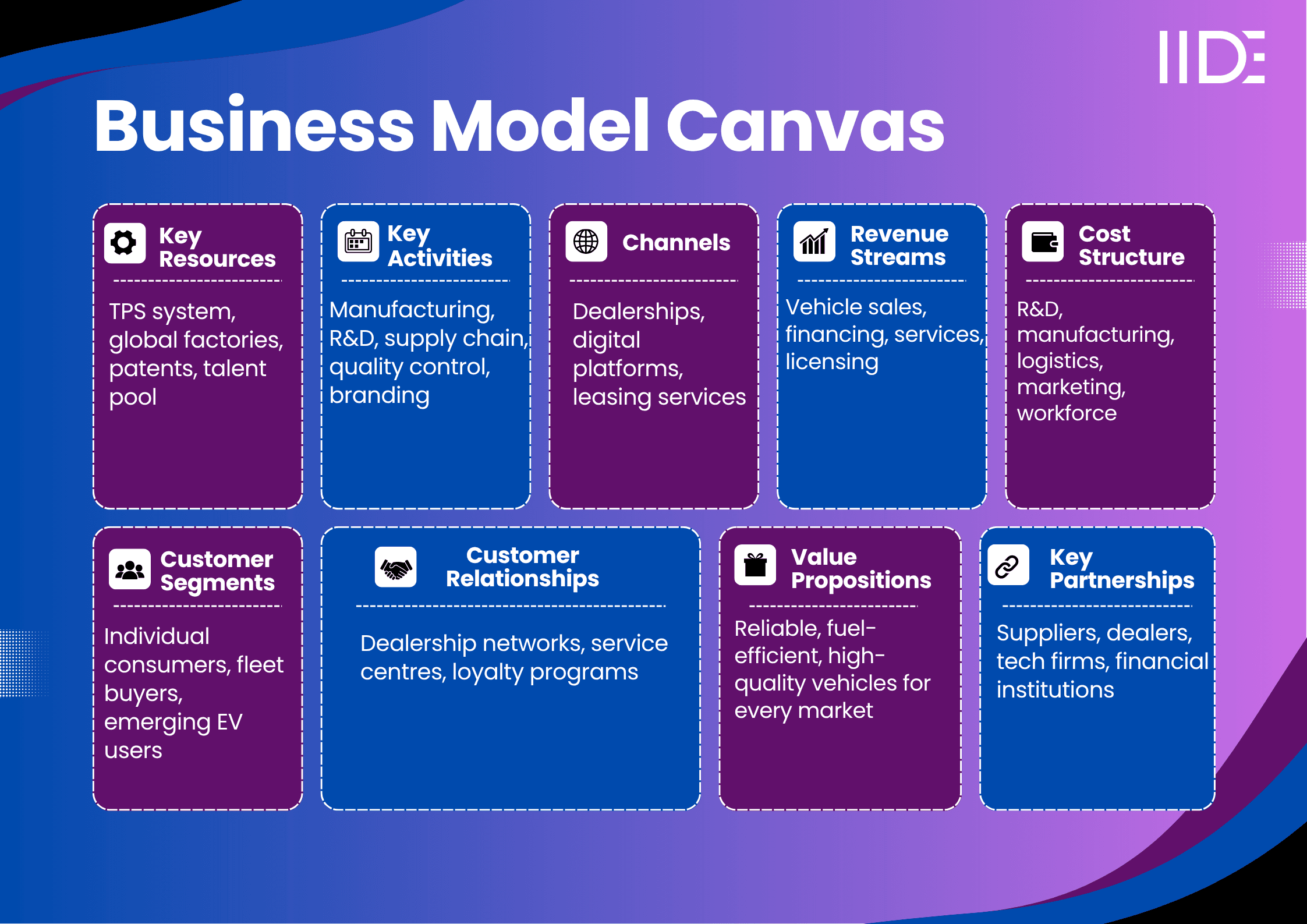
Toyota Business Model Canvas
Toyota Value Proposition
Toyota offers dependable, fuel-efficient vehicles across various segments with strong resale value. Its emphasis on quality, safety, and innovation appeals to a global customer base. Emotionally, it builds trust through brand longevity and ownership satisfaction. Toyota’s unique advantage lies in its TPS manufacturing, diverse product range, and long-term vision in hybrid and hydrogen mobility.
Cost Structure
Toyota’s major costs include manufacturing, logistics, R&D, and employee compensation. The brand reduces costs via lean production, supplier integration, and global manufacturing hubs. Its investment in electrification and automation further strengthens long-term cost control.
Customer Segment
Toyota targets a wide B2C and B2B customer base, ranging from budget-conscious individuals to luxury buyers and corporate fleets. The brand also appeals to environmentally aware consumers through its hybrid and hydrogen models. Key drivers include quality, fuel efficiency, and low maintenance.
Distribution Channels
Toyota sells through an extensive dealership network, online platforms, and leasing programs. It ensures product availability across urban, rural, and international markets. Digital showrooms, test drive bookings, and subscription services support new-age consumer demands.
Key Partnerships
Toyota collaborates with global suppliers, ride-sharing platforms, technology firms (for AI/autonomous tech), and governments (for infrastructure and sustainability initiatives). These alliances drive innovation and market adaptability.
Honda's marketing strategy demonstrates how automotive brands align tech, safety, and branding principles that Toyota employs globally.
SWOT Analysis of Toyota
| Strengths | Weaknesses | Opportunities | Threats |
|---|---|---|---|
| Manufacturing system | Limited EV market | EV and hybrid expansion | Global chip shortages |
| Brand reliability | High R&D costs | Emerging market demand | Regulatory compliance |
| Global presence | Complex supply chain | Smart mobility tech | EV competition |
Competitor Comparison
| Competitor | Pricing | Customer Experience | Channel Strategy | Market Focus | Innovation |
|---|---|---|---|---|---|
| Honda | Competitive | Functional reliability | Dealerships | Asia/Global | Hybrid systems |
| Tesla | Premium | Tech-centric | Online-first | EV segment | Autopilot & AI |
| Hyundai | Value | Feature-rich | Dealerships + Online | Global | EV platforms |
What’s New With Toyota?
Toyota is accelerating EV rollout with new battery innovations, expanding its bZ series, and investing in hydrogen fuel cell tech. It has enhanced digital integration with smart cockpit systems and AI-assisted driving. Toyota is also developing circular economy models through recyclable materials and energy-efficient factories.
Want to Know Why 2,50,000+ Students Trust Us?
Dive into the numbers that make us the #1 choice for career success



MBA - Level
Post Graduate in Digital Marketing & Business Strategy

Best For
Fresh Graduates

Mode of Learning
On Campus (Mumbai & Delhi)

Starts from
Oct 1, 2026

Duration
11 Months

Live & Online
Advanced Online Digital Marketing Course
Best For
Working Professionals
Mode of Learning
Online
Starts from
Sep 4, 2026
Duration
4-6 Months

Online
Professional Certification in AI Strategy
Best For
AI Enthusiasts
Mode of Learning
Online
Starts from
Sep 8, 2026
Duration
5 Months

Online or Offline
Top AI Courses to Make You Future Ready!
Best For
AI Enthusiasts
Mode of Learning
2–5 Month Program
Starts from
Sep 8, 2026
Duration
Flexiable

On Campus
Advanced Certification in Artificial Intelligence
Best For
AI Enthusiasts
Mode of Learning
On Campus (Mumbai)
Starts from
Sep 1, 2026
Duration
3 Months
Offline
Undergraduate Program in Digital Business & Entrepreneurship
Best For
12th Passouts
Mode of Learning
On Campus (Mumbai)
Starts from
-
Duration
3 Years
Offline
Degree In 2026 ≠ Enough Degree + Digital Skills = Future-Ready
Best For
12th Passouts
Mode of Learning
At IIDE Campus
Starts from
-
Duration
3 Years
Recent Post

Lead Trainer & Business Development Head at IIDE
Aditya Shastri leads the Business Development segment at IIDE and is a seasoned Content Marketing expert. With over a decade of experience, Aditya has trained more than 20,000 students and professionals in digital marketing, collaborating with prestigious institutions and corporations such as Jet Airways, Godrej Professionals, Pfizer, Mahindra Group, Publicis Worldwide, and many others. His ability to simplify complex marketing concepts, combined with his engaging teaching style, has earned him widespread admiration from students and professionals alike.
Aditya has spearheaded IIDE’s B2B growth, forging partnerships with over 40 higher education institutions across India to upskill students in digital marketing and business skills. As a visiting faculty member at top institutions like IIT Bhilai, Mithibai College, Amity University, and SRCC, he continues to influence the next generation of marketers.
Apart from his marketing expertise, Aditya is also a spiritual speaker, often traveling internationally to share insights on spirituality. His unique blend of digital marketing proficiency and spiritual wisdom makes him a highly respected figure in both fields.