Application Deadline for 3-Year UG Program closes on 31st Aug. Book a Counselling to know more

Students Centric
Placements Report
Trackable results, real numbers
Reviews
Proven success, real voices
Trainers
Expert-led, Industry-Driven Training
Life at IIDE
Vibrant Spirit student life
Alumni
Successful Journeys, Inspiring Stories
Learning Centre
Webinars
Blogs
Case studies
Live, Interactive Masterclasses
Fresh Insights, quick reads
Real-life, Industry relevant
More
Hire from us
Hire Top Digital Marketing Talent
Work with us
Join Our Team, Make an Impact
Customised Training
Personalised digital marketing training for your company
Refer & earn
Simple, easy rewards
Contact us
Get the answers you need
About us
Know more about IIDE
Explore all course options

FOR FRESH GRADUATES
Post Graduation Program in Digital Marketing & Business Strategy- Ideal for Age: 20–25 Years

Can’t decide? Explore all our
Digital Marketing Courses
COMPARE ALL 3 PROGRAMSOnline & Offline
Explore Top AI CoursesIndustry-Aligned TRACKMost Popular
UG Program in Digital Business & Entrepreneurship- Ideal for 12th Pass out / FY Degree Student

PARTNER PROGRAMS






Can’t decide? Explore all
BBA In Digital Marketing Colleges
Orginally Written by Aditya Shastri
Updated on Aug 9, 2025
Share on:


Amway’s business model is built on multi-level marketing, offering a wide range of health, beauty, and home care products. This strategy allows them to offer high-quality products while maintaining a broad global footprint and a large network of independent distributors.
Amway leverages a global distribution network, combining direct selling with an extensive product catalogue to create strong brand loyalty. Its unique compensation model ensures growth, while its focus on personal development drives motivation within its sales network.
In this blog, we decode Amway's revenue model and strategy, shedding light on how it has achieved market leadership.
About Amway
Amway was founded in 1959 by Richard DeVos and Jay Van Andel with the idea of providing individuals with the opportunity to run their own businesses through the sale of high-quality products.
Its unique selling proposition lies in its direct selling model, leveraging multi-level marketing (MLM), where distributors earn based on product sales and the recruitment of other distributors.
As of 2023, Amway generates annual revenue of over $8 billion and has a presence in more than 100 countries, employing over 20,000 people.
Amway is known for its commitment to sustainability, product innovation, and empowerment of its independent business owners.
Customer experience is centred around building personal relationships with distributors and customers, offering both products and business opportunities.
Amway’s secret to success is its ability to scale its direct selling model, combined with a wide array of consumer products and a strong, loyal distributor network.
| Feature | Details |
|---|---|
| Founded | 1959 |
| Founder | Richard DeVos, Jay Van Andel |
| Headquarters | Ada, Michigan, USA |
| Industry | Direct Selling, Consumer Goods |
| Revenue (2023) | $8 Billion |
| Presence | Over 100 countries |
| Employees | 20,000+ |
| Popular for | Health, Beauty, Home Care Products |

Is Digital Marketing the Right Career for You?
Find out in a free 45-min masterclass · Career paths, roles and growth explained · By Karan Shah, Founder & CEO, IIDE

Is Digital Marketing the Right Career for You?
Find out in a free 45-min masterclass · Career paths, roles and growth explained · By Karan Shah, Founder & CEO, IIDE
How does Amway make money?
1. Revenue Stream Breakdown:
- Product Sales: Health, beauty, and home care products are sold through a network of independent distributors
- Franchise Fees: Distributors pay for product inventory and training fees to become part of the network
- Subscription Fees: Recurring revenue from customers purchasing products via monthly or annual subscriptions
2. Revenue Contribution:
- Product Sales: 75% of revenue comes from product sales to end customers
- Franchise/Distributor Fees: 25% from distributor commissions and associated fees
3. Pricing Strategy:
Amway employs value-based pricing, charging premium prices for high-quality, often exclusive products. The pricing strategy helps position Amway as a luxury brand in some of its markets.
Sephora’s marketing strategy focuses on customer engagement through personalised experiences, which can also inspire direct selling brands like Amway.
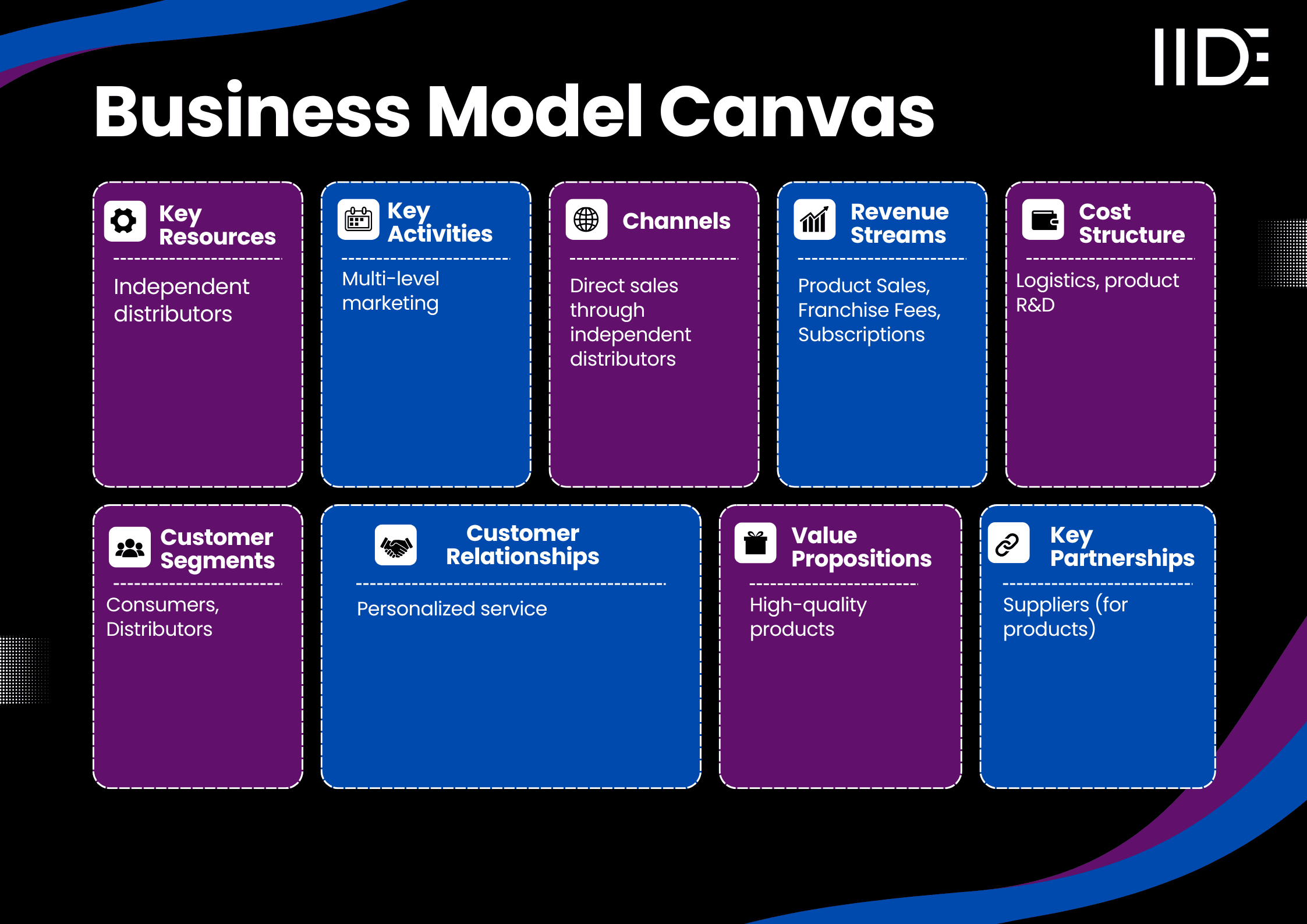
Amway Business Model Canvas
Amway Value Proposition
Amway differentiates itself by offering high-quality, health, beauty, and home care products through a unique direct selling platform.
It solves customer pain points by offering exclusive products that meet the demands of health-conscious, beauty-focused, and eco-friendly consumers.
The emotional benefits lie in the pride and confidence customers feel in supporting a brand that encourages entrepreneurship.
The functional benefits include personalised service, high product quality, and long-term durability.
What sets Amway apart is its compensation model, where customers can also become independent business owners, allowing them to earn income by selling products and recruiting others.
Amway Cost Structure
Amway’s major expenses include:
- Logistics: Shipping costs for global distribution
- R&D: Development of innovative, high-quality products
- Marketing: Costs for promoting products and supporting distributors
- Salaries: Employee compensation
To maintain healthy margins, Amway utilises economies of scale and bulk production, reducing per-unit costs.
Amway Customer Segment
Amway primarily operates on a B2C and B2B model, targeting consumers who seek premium products as well as individuals wanting to become independent distributors.
Core customers are typically middle to high-income earners, motivated by health-consciousness, beauty needs, and the desire for entrepreneurial opportunities.
Amway also appeals to eco-conscious consumers and those interested in building their own business.
Distribution Channels of Amway
- Online Channels: eCommerce website and mobile apps are used for direct sales
- Omnichannel Approach: Combines physical retail with online sales, allowing distributors to sell products through various channels
- Physical Retail: Limited presence in some regions, mainly through partner distributors
Amway Key Partnerships
Amway collaborates with:
- Suppliers for product manufacturing
- Distributors who are integral to the brand’s direct selling model
- Tech Partners for CRM and mobile app development
These partnerships help Amway maintain operational efficiency and drive growth.
Read a SWOT analysis of L'Oréal that uncovers the company's strong branding and product differentiation, which can serve as valuable lessons for Amway’s product strategy.
SWOT Analysis of Amway
| Strengths | Weaknesses | Opportunities | Threats |
|---|---|---|---|
| Global reach | Dependency on MLM | Expansion in emerging markets | Competition from online retailers |
| High-quality products | High distributor turnover | Growing demand for health & wellness | Regulatory challenges in some markets |
Amway Competitor Comparison
| Parameter | Amway | Herbalife | Avon |
|---|---|---|---|
| Pricing | Premium | Premium | Affordable |
| Customer Experience | Personalized service | Health-focused | Direct selling |
| Channel Strategy | Multi-level marketing | Direct selling | Direct selling & eCommerce |
| Market Focus | Global | Health & Wellness | Beauty & Cosmetics |
| Innovation | Product development | Nutrition-focused products | Beauty innovation |
Key Takeaways for Students / Marketers
- Scalability: Amway’s model thrives on a scalable multi-level marketing structure that drives global growth
- Replication for Small Businesses: Focus on relationship-building and personalised customer service to foster brand loyalty
- Strategic Thinking: Amway’s unique business strategy of empowering distributors with entrepreneurial opportunities has been key to its success
Want to Know Why 2,50,000+ Students Trust Us?
Dive into the numbers that make us the #1 choice for career success



MBA - Level
Post Graduate in Digital Marketing & Business Strategy

Best For
Fresh Graduates

Mode of Learning
On Campus (Mumbai & Delhi)

Starts from
Oct 1, 2026

Duration
11 Months

Live & Online
Advanced Online Digital Marketing Course
Best For
Working Professionals
Mode of Learning
Online
Starts from
Sep 4, 2026
Duration
4-6 Months

Online
Professional Certification in AI Strategy
Best For
AI Enthusiasts
Mode of Learning
Online
Starts from
Sep 8, 2026
Duration
5 Months

Online or Offline
Top AI Courses to Make You Future Ready!
Best For
AI Enthusiasts
Mode of Learning
2–5 Month Program
Starts from
Sep 8, 2026
Duration
Flexiable

On Campus
Advanced Certification in Artificial Intelligence
Best For
AI Enthusiasts
Mode of Learning
On Campus (Mumbai)
Starts from
Sep 1, 2026
Duration
3 Months

Offline
Degree In 2026 ≠ Enough Degree + Digital Skills = Future-Ready
Best For
12th Passouts
Mode of Learning
At IIDE Campus
Starts from
Aug 31, 2026
Duration
3 Years
Offline
Undergraduate Program in Digital Business & Entrepreneurship
Best For
12th Passouts
Mode of Learning
On Campus (Mumbai)
Starts from
Aug 31, 2026
Duration
3 Years
Recent Post
Amway's primary revenue source is direct sales through its network of independent business owners (IBOs).
Amway has over 1 million active IBOs worldwide.
Amway offers products in nutrition, beauty, personal care, and home care, with key brands like Nutrilite and Artistry
Amway's main competitors are Herbalife, Avon, Mary Kay, Oriflame, and Nu Skin.
Amway uses direct selling and multi-level marketing to offer diverse products through independent business owners, supported by extensive training.
Amway supports its IBOs with training, marketing materials, digital tools, and performance-based incentives.
Amway ensures product quality through stringent manufacturing processes, research and development, and partnerships with scientific institutions.
Amway's CSR initiatives focus on health, education, community development, and environmental sustainability.

Lead Trainer & Business Development Head at IIDE
Aditya Shastri leads the Business Development segment at IIDE and is a seasoned Content Marketing expert. With over a decade of experience, Aditya has trained more than 20,000 students and professionals in digital marketing, collaborating with prestigious institutions and corporations such as Jet Airways, Godrej Professionals, Pfizer, Mahindra Group, Publicis Worldwide, and many others. His ability to simplify complex marketing concepts, combined with his engaging teaching style, has earned him widespread admiration from students and professionals alike.
Aditya has spearheaded IIDE’s B2B growth, forging partnerships with over 40 higher education institutions across India to upskill students in digital marketing and business skills. As a visiting faculty member at top institutions like IIT Bhilai, Mithibai College, Amity University, and SRCC, he continues to influence the next generation of marketers.
Apart from his marketing expertise, Aditya is also a spiritual speaker, often traveling internationally to share insights on spirituality. His unique blend of digital marketing proficiency and spiritual wisdom makes him a highly respected figure in both fields.