
Students Centric
Placements Report
Trackable results, real numbers
Reviews
Proven success, real voices
Trainers
Expert-led, Industry-Driven Training
Life at IIDE
Vibrant Spirit student life
Alumni
Successful Journeys, Inspiring Stories
Learning Centre
Webinars
Blogs
Case studies
Live, Interactive Masterclasses
Fresh Insights, quick reads
Real-life, Industry relevant
More
Hire from us
Hire Top Digital Marketing Talent
Work with us
Join Our Team, Make an Impact
Customised Training
Personalised digital marketing training for your company
Refer & earn
Simple, easy rewards
Contact us
Get the answers you need
About us
Know more about IIDE
Explore all course options

FOR FRESH GRADUATES
Post Graduation Program in Digital Marketing & Business Strategy- Ideal for Age: 20–25 Years

Can’t decide? Explore all our
Digital Marketing Courses
COMPARE ALL 3 PROGRAMSOnline & Offline
Explore Top AI CoursesIndustry-Aligned TRACKMost Popular
UG Program in Digital Business & Entrepreneurship- Ideal for 12th Pass out / FY Degree Student

PARTNER PROGRAMS







Can’t decide? Explore all
BBA In Digital Marketing Colleges
Orginally Written by Aditya Shastri
Updated on Dec 11, 2025
Share on:


Yamaha is a global powerhouse renowned for motorcycles, marine engines, musical instruments, and audio products, boasting wide market penetration and innovation leadership in 2025. Despite competitive pressures and evolving consumer preferences, Yamaha maintains strong brand equity and product diversity.
How does Yamaha navigate growth and challenges to retain its leadership across multiple industries? This analysis offers valuable insights for entrepreneurs and business students.
About Yamaha
Founded in 1887, Yamaha is one of the world’s most diversified corporations, manufacturing motorcycles, marine engines, musical instruments, and audio equipment.

Known for its slogan “Revs Your Heart,” Yamaha blends engineering excellence with creative innovation. By 2025, Yamaha will operate globally with a strong presence, especially in Asia and North America.
SWOT stands for Strengths, Weaknesses, Opportunities, and Threats, which helps assess Yamaha’s strategic positioning this year.
Overview table
| Attribute | Details |
|---|---|
| Official Name | Yamaha Motor Co., Ltd. |
| Founded Year | 1887 |
| Headquarters | Iwata, Shizuoka, Japan |
| Website | global.yamaha.com |
| Industries Served | Motorcycles, Marine Engines, Musical Instruments, Audio Products |
| Geographic Reach | Worldwide, with strong Asian & N.America presence |
| Revenue (2024) | Approx. $16 billion (estimate) |
| Employees (2024) | Over 50,000 globally |
| Main Competitors | Honda, Suzuki, Yamaha in motorcycles; Bose, Fender in musical instruments |

Learn Digital Marketing for FREE

Learn Digital Marketing for FREE
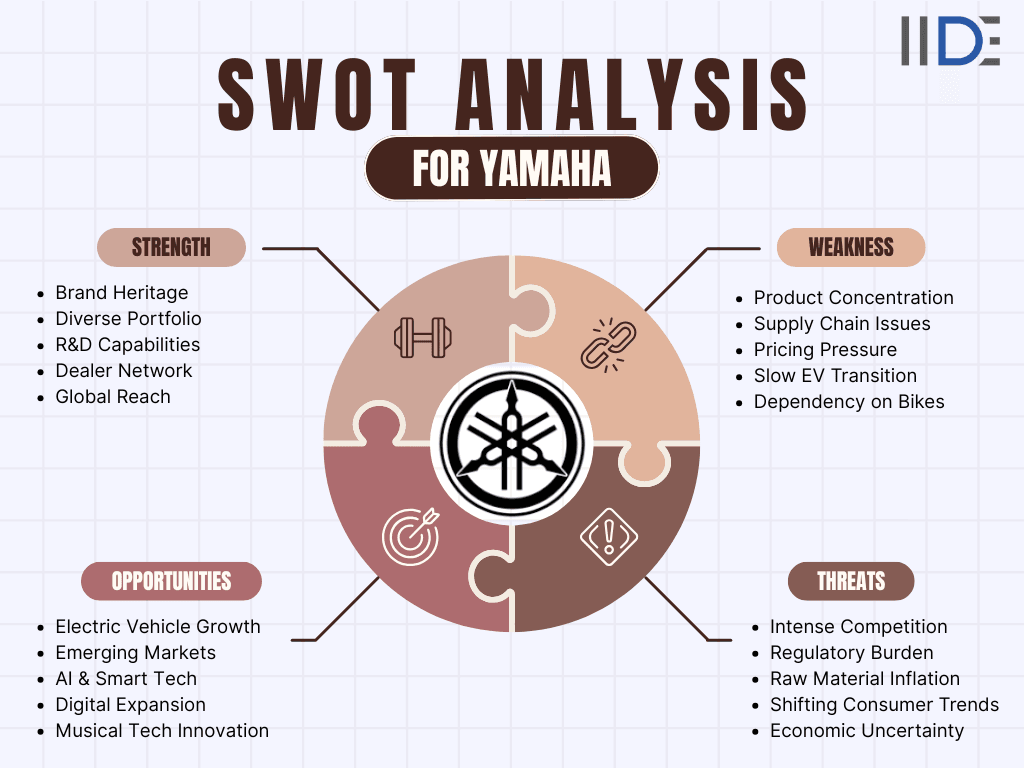
SWOT Analysis of Yamaha
Brand Strengths
Iconic global brand with over 130 years of innovation and a diversified product range:
- Yamaha’s long-standing heritage and reputation for both quality and creative engineering underpin its powerful presence.
- The Yamaha brand is recognised worldwide not just for motorcycles, but also for marine engines, ATVs, musical instruments, and audio gear, making it a symbol of reliability and technology leadership.
Leading motorcycle manufacturer with a strong presence in Asia, Europe, and America:
- Yamaha continually ranks among the top motorcycle producers globally, with particularly dominant market share in Asia (notably India, Indonesia, and Japan), Europe, and robust growth in North America.
- Its success is driven by models such as the FZ, MT, and R-series, which are favourites among consumers for style, performance, and affordability.
Pioneer in marine propulsion systems and audio equipment with high-quality manufacturing:
- Yamaha’s marine division is respected for innovative outboard motors and boat technology, frequently setting standards for efficiency and durability.
- Yamaha’s musical instruments and pro audio divisions also command authority, thanks to products that cater to beginners, professionals, and live venues alike.
Robust R&D investment drives advanced hybrid and electric vehicle technologies:
- Significant annual investments in research fuel Yamaha’s development of electric mobility, hybrid powertrains, and next-generation connectivity, ensuring the company keeps pace with industry changes and shifting consumer preferences towards cleaner, smarter vehicles.
Strong dealer network with over 1,600 dealerships in India alone (2025) and global distribution:
- A broad, reliable dealer and service network provides extensive support to customers, ensuring consistent aftersales care and accessibility.
- Globally, Yamaha's streamlined logistics and partner relationships reinforce its supply chain and strengthen consumer trust.
Brand Weaknesses
Heavy dependency on motorcycles and marine engine segments limits total revenue diversification:
- Despite product variety, a large proportion of Yamaha’s revenue comes from motorcycles and marine engines.
- This exposes the company to sector-specific risks, such as changing mobility patterns or downturns in the boating industry, limiting resilience against external shocks.
Competition from emerging electric vehicle startups and other global OEMs intensifies pressure:
- Brand prestige is challenged by agile EV startups and established rivals like Honda and Suzuki, which are rapidly innovating in electric and hybrid mobility, sometimes outpacing Yamaha’s speed to market.
Supply chain disruptions impact production and the timely delivery of new models:
- Recent years have shown that sourcing components, microchips, and raw materials for manufacturing is vulnerable to global shocks, which can delay product launches and frustrate dealers and consumers.
Brand perception in some markets struggles due to premium pricing against budget competitors:
- While Yamaha is perceived as premium thanks to its quality, this positioning sometimes backfires in developing or price-sensitive markets, where budget brands aggressively compete on cost.
Slower adaptation of the fully electric motorcycle lineup compared to some rivals:
- Although Yamaha invests in electrification, its transition to mass-market electric models lags behind some competitors, risking lost market share in regions where EV adoption is surging rapidly.
Brand Opportunities
Growing consumer demand for electric two-wheelers and sustainable mobility solutions:
- The worldwide focus on reducing emissions is driving a surge in demand for electric motorcycles, scooters, and hybrid vehicles - a field where Yamaha’s R&D can meaningfully grow its presence and capture early adopters and urban commuters.
Expansion in emerging markets such as India and Southeast Asia with tailored product launches:
- Rapid urbanisation and rising disposable incomes in these regions create prime opportunities for Yamaha to introduce affordable and efficient models, expanding its customer base beyond traditional markets.
Increasing integration of AI and IoT for smart-driving and connected vehicle features:
- Leveraging artificial intelligence and Internet of Things (IoT) can make Yamaha vehicles safer, more personalised, and more interactive, aligning with consumers' desire for high-tech mobility and differentiating its offerings from competitors.
Innovation in musical instrument technologies and digital audio products to capture new audiences:
- With growing home entertainment and digital content markets, Yamaha’s music and sound divisions can exploit trends in smart instruments, online learning, and wireless audio for both consumer and education segments.
Strategic partnerships and digital sales expansion to enhance global market penetration:
- Collaboration with tech companies, battery manufacturers, and e-commerce platforms can accelerate Yamaha’s transition toward next-gen mobility and sharpen its competitive edge; digital sales and virtual showrooms are also expanding brand reach.
Brand Threats
Intense competition from global automotive brands and low-cost manufacturers:
- Yamaha must continuously fend off both traditional heavyweights like Honda, Suzuki, and Kymco as well as new Chinese and Indian entrants who compete on price, speed, and innovation.
Increasing regulatory pressures on emissions and safety standards worldwide:
- Tougher global emissions and safety rules require ongoing product updates and investments, adding risk and cost to Yamaha’s engineering and compliance activities.
Raw material cost inflation is affecting production expenses and profit margins:
- Surges in steel, aluminium, plastics, and microchip prices can sharply increase production costs, pressuring margins unless countered by price hikes or efficiency gains.
Shifts in consumer preferences towards mobility-as-a-service, reducing private vehicle ownership:
- The global trend toward shared mobility (ride-sharing, rental, subscriptions) could reduce new vehicle sales and challenge Yamaha’s traditional business model.
Global economic slowdown or trade disputes impacting manufacturing and sales:
- International trade tensions, tariffs, or recessions may disrupt Yamaha’s export capabilities and limit demand, especially in vulnerable or unstable regions.
Buyers Persona:

Raj Rathod
Mumbai
Occupation: Web-Developer
Age: 25 years
Motivation
Interest & Hobbies
Pain Points
Social Media Presence
SWOT Analysis of Yamaha
IIDE Student Takeaway, Conclusion & Recommendations
Recap key SWOT highlights:
- Yamaha commands a global presence with strengths in product diversity, R&D, and brand legacy across motorcycles, marine, and music.
- Key weaknesses include overdependence on combustion bikes, supply chain challenges, and slower electric adoption than some rivals.
- Massive opportunities lie in the surging electric and connected mobility market, digitised sales, and smart musical technologies.
- Threats stem from new EV competitors, regulatory pressures, cost inflation, and shifting global consumer behaviours.
Identify the Core Tension:
Yamaha’s biggest challenge is balancing its world-renowned tradition in combustion engineering with the urgent need to shift to electric and smart mobility to remain relevant and competitive.
Brand’s Future Outlook:
Yamaha stands at a pivotal moment: its future success will depend on how well it can evolve - leveraging brand strengths to lead the electric and digital transformation of the industry while protecting its unique heritage.
Actionable Recommendations:
- Accelerate electric vehicle product launches, especially in Asia and Europe, where EV demand is booming.
- Deepen partnerships in battery technology, AI, and urban mobility solutions to fast-track innovation and smart features.
- Expand digital and e-commerce channels so Yamaha can directly engage consumers, especially younger, tech-savvy buyers.
- Refine sustainability practices in manufacturing and product messaging to win the trust of environmentally conscious markets.
- Innovate within the musical instruments division, emphasising tech-enabled learning, wireless connectivity, and digital creativity.
Want to Know Why 5,00,000+ Students Trust Us?
Dive into the numbers that make us the #1 choice for career success



MBA - Level
Post Graduate in Digital Marketing & Business Strategy

Best For
Fresh Graduates

Mode of Learning
On Campus (Mumbai & Delhi)

Starts from
Oct 1, 2026

Duration
11 Months

Live & Online
Advanced Online Digital Marketing Course
Best For
Working Professionals
Mode of Learning
Online
Starts from
Aug 7, 2026
Duration
4-6 Months

Online
Professional Certification in AI Strategy
Best For
AI Enthusiasts
Mode of Learning
Online
Starts from
Sep 8, 2026
Duration
5 Months

On Campus
Advanced Certification in Artificial Intelligence
Best For
AI Enthusiasts
Mode of Learning
On Campus (Mumbai)
Starts from
Sep 1, 2026
Duration
3 Months

Online or Offline
Top AI Courses to Make You Future Ready!
Best For
AI Enthusiasts
Mode of Learning
2–5 Month Program
Starts from
Sep 8, 2026
Duration
Flexiable
Offline
Undergraduate Program in Digital Business & Entrepreneurship
Best For
12th Passouts
Mode of Learning
On Campus (Mumbai)
Starts from
Aug 19, 2026
Duration
3 Years
Offline
Degree In 2026 ≠ Enough Degree + Digital Skills = Future-Ready
Best For
12th Passouts
Mode of Learning
At IIDE Campus
Starts from
Aug 6, 2026
Duration
3 Years
Recent Post

Lead Trainer & Business Development Head at IIDE
Aditya Shastri leads the Business Development segment at IIDE and is a seasoned Content Marketing expert. With over a decade of experience, Aditya has trained more than 20,000 students and professionals in digital marketing, collaborating with prestigious institutions and corporations such as Jet Airways, Godrej Professionals, Pfizer, Mahindra Group, Publicis Worldwide, and many others. His ability to simplify complex marketing concepts, combined with his engaging teaching style, has earned him widespread admiration from students and professionals alike.
Aditya has spearheaded IIDE’s B2B growth, forging partnerships with over 40 higher education institutions across India to upskill students in digital marketing and business skills. As a visiting faculty member at top institutions like IIT Bhilai, Mithibai College, Amity University, and SRCC, he continues to influence the next generation of marketers.
Apart from his marketing expertise, Aditya is also a spiritual speaker, often traveling internationally to share insights on spirituality. His unique blend of digital marketing proficiency and spiritual wisdom makes him a highly respected figure in both fields.