
Students Centric
Placements Report
Trackable results, real numbers
Reviews
Proven success, real voices
Trainers
Expert-led, Industry-Driven Training
Life at IIDE
Vibrant Spirit student life
Alumni
Successful Journeys, Inspiring Stories
Learning Centre
Webinars
Blogs
Case studies
Live, Interactive Masterclasses
Fresh Insights, quick reads
Real-life, Industry relevant
More
Hire from us
Hire Top Digital Marketing Talent
Work with us
Join Our Team, Make an Impact
Customised Training
Personalised digital marketing training for your company
Refer & earn
Simple, easy rewards
Contact us
Get the answers you need
About us
Know more about IIDE
Explore all course options

FOR FRESH GRADUATES
Post Graduation Program in Digital Marketing & Business Strategy- Ideal for Age: 20–25 Years

Can’t decide? Explore all our
Digital Marketing Courses
COMPARE BOTH OUR PROGRAMSOffline
Offline AI Courses with Dual CertificationsIndustry-Aligned TRACKMost Popular
UG Program in Digital Business & Entrepreneurship- Ideal for 12th Pass out / FY Degree Student

PARTNER PROGRAMS






Can’t decide? Explore all
BBA In Digital Marketing Colleges
Orginally Written by Aditya Shastri
Updated on May 22, 2026
Share on:


United Arab Bank, a growing mid-tier bank in the UAE, is quietly building real momentum in 2026. But what makes it stand out against giants like Emirates NBD and FAB? Are there challenges ahead?
This analysis covers UAB's strengths in Islamic banking and digital transformation, weaknesses in scale and geographic reach, opportunities in SME and Islamic finance growth, and threats from fintech disruptors.
Entrepreneurs and business students will learn how smart strategy beats size. Apply these insights to your own business or career.
Before diving in, the research and initial analysis for this piece were conducted by Ishanvi Bawari, a current student in IIDE's Online Digital Marketing Course, November Batch 2025.
If you find the article interseting feel free to connect with Ishanvi Bawari and send her a note of appreciation for her fantastic research work.
About United Arab Bank
Founded in 1975 and headquartered in Sharjah, United Arab Bank has spent five decades building a reputation for consistent service quality and sound financial management. It was never the loudest name in UAE banking, but it has always been one of the more reliable ones.
In FY2025, UAB posted a net profit of AED 438 million, up 45% year on year. Total income rose 31% to AED 797 million, driven by a 56% increase in non-interest income and 24% growth in net interest income.
Total assets reached AED 27 billion, up 26%, backed by a fully subscribed AED 1.03 billion rights issue that significantly strengthened the bank's capital base for future growth.
In April 2026, the bank launched a comprehensive corporate banking digital transformation in partnership with i-exceed, signalling a clear commitment to competing seriously in the digital era.
Today, UAB's strategic priorities are digital transformation, Islamic banking expansion, SME banking growth, and sustainable finance. Its trajectory heading into the rest of 2026 is one of the more compelling stories in UAE regional banking.
Quick Stats about United Arab Bank:
| Feature | Details |
|---|---|
| Official Name | United Arab Bank P.J.S.C. (UAB) |
| Founded | 1975 |
| Headquarters | Sharjah, UAE |
| Industry | Banking and Financial Services |
| Net Profit (FY2025) | AED 438 million (up 45% YoY) |
| Total Income (FY2025) | AED 797 million (up 31% YoY) |
| Total Assets (FY2025) | AED 27 billion (up 26% YoY) |
| Core Services | Retail Banking, Corporate Banking, Islamic Banking, Wealth Management |
| Key Competitors | Emirates NBD, First Abu Dhabi Bank, Mashreq Bank |
Why UAB's SWOT Analysis Matters in 2026
The UAE banking sector is undergoing its most significant transformation in decades. Digital disruption, fintech innovation, and shifting customer expectations are reshaping the competitive landscape faster than most banks anticipated. Here is why this analysis matters right now.
- Digital banking demand is accelerating: UAE consumers expect seamless, mobile-first banking experiences and patience for outdated systems is running out fast.
- Fintech is reshaping competition: Digital-only banks and fintech startups are targeting the same retail and SME customers that UAB has served for decades.
- Islamic finance is growing strongly: Demand for Sharia-compliant financial products continues to rise across the Middle East and the UAE sits at the centre of that growth.
- Regulatory frameworks are evolving rapidly: Open banking, Basel IV, and ESG reporting requirements are increasing compliance complexity for every UAE bank.
- Capital strength matters more than ever: UAB's successful AED 1.03 billion rights issue gives it real financial firepower for strategic investment through 2026 and beyond.

Is Digital Marketing the Right Career for You?
Find out in a free 45-min masterclass · Career paths, roles and growth explained · By Karan Shah, Founder & CEO, IIDE

Is Digital Marketing the Right Career for You?
Find out in a free 45-min masterclass · Career paths, roles and growth explained · By Karan Shah, Founder & CEO, IIDE
SWOT Analysis of United Arab Bank
A SWOT analysis breaks down a company's internal strengths and weaknesses alongside the external opportunities and threats it faces. For UAB in 2026, this framework reveals a bank that is financially stronger than many people realise and strategically clearer about where it is headed than its quiet reputation might suggest.
Strengths of United Arab Bank
UAB enters 2026 from a position of genuine financial strength. Its FY2025 results are not marketing gloss. They are hard numbers that reflect years of disciplined strategy and careful execution.
Exceptional Financial Performance:
- UAB delivered a 45% jump in net profit to AED 438 million in FY2025.
- Total assets grew 26% to AED 27 billion. The cost-to-income ratio improved from 52% to 46%.
- This is a bank that is not just growing but growing efficiently, which matters far more than raw revenue growth.
Accelerating Digital Transformation:
- The platform covers everything from account management to trade finance and treasury services.
- This is not a cosmetic upgrade.
- It is a structural shift in how UAB serves its corporate clients.
The Marketing Strategy of HDFC Bank is worth reading alongside this, given how closely it mirrors the kind of technology-led repositioning that turned a traditional bank into a digital-first market leader.
Strong Islamic Banking Franchise:
- UAB offers a complete range of Sharia-compliant products across retail, corporate, and treasury segments.
- Islamic financing grew strongly as part of UAB's overall 26% loan book expansion in FY2025.
- In a region where Islamic finance demand is accelerating, this is a real and defensible competitive advantage.
Sound Asset Quality:
- UAB recorded a net reversal of impairment charges of AED 51 million in FY2025 due to strong recoveries.
- For a bank growing this quickly, maintaining these ratios is a meaningful operational achievement.
Five Decades of Brand Trust:
- UAB has been part of the UAE's banking landscape since 1975.
- That kind of institutional trust is genuinely difficult for digital-only competitors to replicate.
- Its deep roots in Sharjah give it a loyal customer base that has stayed through multiple economic cycles.
Weaknesses of United Arab Bank
Despite its strong FY2025 results, UAB carries several structural weaknesses that limit its growth potential and competitive positioning against the UAE's larger banks.
Limited Geographic Footprint:
- UAB operates exclusively within the UAE with zero international market exposure.
- Unlike Emirates NBD or Mashreq, it has no international revenue buffer when the UAE economy faces headwinds.
- Every slowdown hits UAB harder than its more geographically diversified peers.
Scale Disadvantage:
- Emirates NBD and FAB operate with total assets several times larger than UAB's AED 27 billion balance sheet.
- Larger banks offer more competitive loan pricing, higher deposit rates, wider branch networks, and deeper product ranges.
- The scale gap is real and it shapes every competitive decision UAB makes.
Single-Market Economic Dependence:
- UAB's entire business is tied to UAE economic health.
- A slowdown in real estate, construction, or trade can quickly translate into rising NPLs and lower loan demand.
- With no international revenue to absorb that pressure, UAB is structurally more exposed than its larger peers.
Rising Cybersecurity Exposure:
- The faster UAB grows digitally, the more it becomes a target.
- Cyberattacks on UAE financial institutions are increasing in both frequency and sophistication.
- Building world-class cybersecurity on a mid-sized balance sheet is expensive, ongoing, and non-negotiable.
Opportunities for United Arab Bank
The UAE's financial ecosystem in 2026 is full of growth opportunities that align well with UAB's existing strengths and strategic direction.
UAE Digital Banking Expansion:
- The UAE has one of the world's highest smartphone penetration rates and consumers are shifting entirely to mobile-first banking.
- UAB's ongoing digital transformation positions it to capture a growing share of this audience.
- Every improvement to its digital product suite directly translates into competitive relevance.
Islamic Finance Growth:
- The global Islamic finance market is growing steadily through 2028, with the UAE positioned as one of its key hubs.
- UAB's established Sharia-compliant capabilities give it a clear runway for expanding Islamic banking revenue among both UAE nationals and the large expatriate community seeking Islamic financial products.
SME Banking:
- The UAE government's SME growth agenda is creating strong demand for business banking services.
- UAB's new corporate digital platform positions it as a genuine partner for the UAE's booming SME sector, a segment that remains underserved by traditional banks focused on large corporate clients.
Banks that have built their SME franchise through digital-first positioning show how quickly customer loyalty shifts when the onboarding experience improves, something the Marketing Strategy of RBL Bank captures well as a mid-tier bank that carved its own SME niche in a market dominated by larger players.
Sustainable Finance and ESG Banking:
- The UAE's Net Zero 2050 commitment is driving demand for green loans and ESG-aligned banking products.
- Among mid-tier UAE banks, credible ESG offerings are still scarce.
- UAB has a real first-mover opportunity here if it moves decisively.
AI and Personalisation:
- AI-driven credit scoring, fraud detection, and personalised financial recommendations are fast becoming table stakes in UAE banking.
- UAB's investment in AI solutions positions it to lower operational costs while delivering better customer experiences at scale simultaneously.
Threats to United Arab Bank
External pressures are intensifying across every dimension of UAB's competitive environment. None of these threats are unique to UAB, but all of them require a specific and deliberate response.
Fintech and Neobank Competition:
- Digital-only banks are targeting UAE retail and SME customers with faster onboarding, lower fees, and more intuitive experiences.
- Banks that fail to match fintech speed and simplicity risk losing a generation of customers permanently, not temporarily.
Regulatory Complexity and Compliance Costs:
- Basel IV, open banking requirements, enhanced AML standards, and ESG reporting frameworks are raising compliance costs across the industry.
- For a mid-sized bank like UAB, this proportional burden is heavier than for larger peers with dedicated compliance infrastructure already in place.
Macroeconomic and Geopolitical Uncertainty:
- Oil price volatility, regional geopolitical tensions, and global interest rate movements can dampen UAE economic activity quickly.
- A real estate slowdown would hit UAB's loan book directly, with no international revenue stream to provide a cushion.
Rapid Technological Change:
- AI, blockchain payments, and embedded finance are advancing faster than most traditional banks can match internally.
- Falling behind on technology adoption does not just cost customers.
- It makes a bank structurally uncompetitive over time, regardless of current financial strength.
Summary Table - SWOT of United Arab Bank
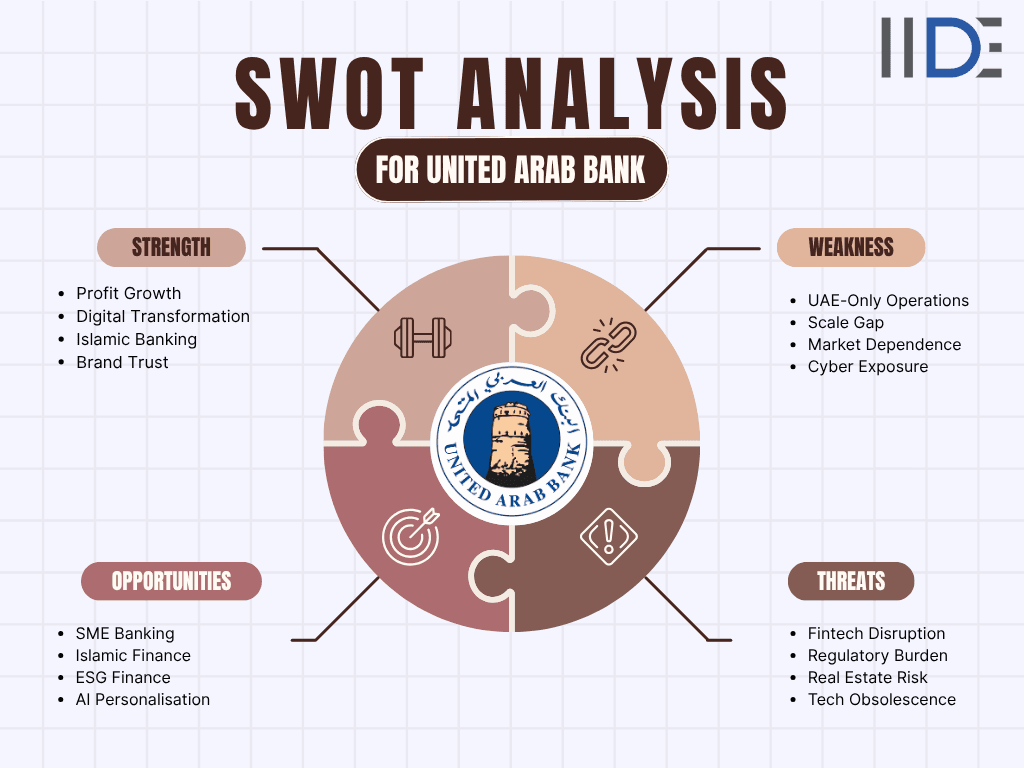
IIDE Student Takeaway, Recommendations & Conclusion for UAB in 2026 and Beyond
UAB's SWOT analysis tells the story of a bank that is building real momentum in a market that rarely gives mid-sized players the credit they deserve.
Core Tension: UAB's greatest challenge is competing for relevance in a market dominated by banks with far greater scale, while simultaneously investing enough in digital transformation to stay ahead of fintech challengers from below. Managing this two-front battle with a mid-sized balance sheet requires exceptional discipline and sharp strategic choices.
Future Outlook: UAB's long-term success rests on three clear priorities. Deepening its digital banking capabilities faster than competitors expect. Expanding its Islamic finance and SME franchises with genuine aggression. And maintaining the financial discipline that delivered a 45% profit jump in FY2025. If it executes consistently on all three, the AED 27 billion bank of 2026 could look very different by 2030.
Recommendations:
- Accelerate digital product innovation: Push the i-exceed partnership further and build retail digital features that genuinely compete with neobank offerings on speed, simplicity, and user experience.
- Expand Islamic banking aggressively: New Sharia-compliant wealth management and investment products would directly capture growing demand from younger UAE residents and the expatriate community.
- Own the SME banking segment: UAB's new corporate digital platform gives it a genuine competitive edge here. SMEs are underserved and actively looking for a banking partner that understands their needs.
- Build a credible ESG franchise: Green loans and sustainability-linked products would differentiate UAB in a market where even the largest banks are still figuring out their sustainability story.
- Stay ahead of the cybersecurity curve: As digital volumes grow, investing in cybersecurity proactively is not a cost. It is the price of maintaining customer trust and regulatory confidence.
United Arab Bank in 2026 is not a lucky story. It is a disciplined one. A 45% surge in net profit, AED 27 billion in total assets, and a full-scale corporate digital transformation do not happen by accident.
They are the result of years of consistent execution, sound financial management, and a strategy that knows its lane and stays in it.
UAB's strengths in Islamic banking, digital transformation, and brand trust give it a genuine foundation. But the road ahead demands more than consistency.
Competing on two fronts simultaneously, against the scale of Emirates NBD and FAB from above, and the speed of fintech disruptors from below, requires sharpness that a mid-sized balance sheet cannot afford to lose.
The SME opportunity is real. The Islamic finance runway is wide. The ESG space remains largely unclaimed among mid-tier UAE banks.
UAB has the platform, the capital, and the momentum to own all three. Whether it does will depend entirely on how boldly it moves in the next three years.
For students, marketers, and business strategists, UAB is one of the most instructive case studies in regional banking. Proof that in a market built on size, the right strategy still wins.
Want to Know Why 2,50,000+ Students Trust Us?
Dive into the numbers that make us the #1 choice for career success



MBA - Level
Post Graduate in Digital Marketing & Business Strategy

Best For
Fresh Graduates

Mode of Learning
On Campus (Mumbai & Delhi)

Starts from
Nov 27, 2026

Duration
11 Months

Live & Online
Advanced Online Digital Marketing Course
Best For
Working Professionals
Mode of Learning
Online
Starts from
Nov 2, 2026
Duration
4-6 Months

Offline
Top AI Courses to Make You Future Ready!
Best For
AI Enthusiasts
Mode of Learning
2–5 Month Program
Starts from
Nov 23, 2026
Duration
Flexiable
Offline
Undergraduate Program in Digital Business & Entrepreneurship
Best For
12th Passouts
Mode of Learning
On Campus (Mumbai)
Duration
3 Years
Offline
Degree In 2026 ≠ Enough Degree + Digital Skills = Future-Ready
Best For
12th Passouts
Mode of Learning
At IIDE Campus
Duration
3 Years
Recent Post
You May Also Like
UAB is a Sharjah-based UAE bank established in 1975, offering retail, business, corporate, and Islamic banking services across all seven UAE emirates.
UAB stands out for its long-standing reputation, personalised customer service, Sharjah roots, and a diverse suite of financial products including Islamic banking and wealth management.
Emirates NBD, First Abu Dhabi Bank (FAB), Mashreq Bank, Dubai Islamic Bank, and Sharjah Islamic Bank are UAB's primary competitors.
UAB has invested in online and mobile banking platforms to offer seamless digital financial services, keeping pace with the UAE's rapidly digitising financial ecosystem.

Lead Trainer & Business Development Head at IIDE
Aditya Shastri leads the Business Development segment at IIDE and is a seasoned Content Marketing expert. With over a decade of experience, Aditya has trained more than 20,000 students and professionals in digital marketing, collaborating with prestigious institutions and corporations such as Jet Airways, Godrej Professionals, Pfizer, Mahindra Group, Publicis Worldwide, and many others. His ability to simplify complex marketing concepts, combined with his engaging teaching style, has earned him widespread admiration from students and professionals alike.
Aditya has spearheaded IIDE’s B2B growth, forging partnerships with over 40 higher education institutions across India to upskill students in digital marketing and business skills. As a visiting faculty member at top institutions like IIT Bhilai, Mithibai College, Amity University, and SRCC, he continues to influence the next generation of marketers.
Apart from his marketing expertise, Aditya is also a spiritual speaker, often traveling internationally to share insights on spirituality. His unique blend of digital marketing proficiency and spiritual wisdom makes him a highly respected figure in both fields.