
Students Centric
Placements Report
Trackable results, real numbers
Reviews
Proven success, real voices
Trainers
Expert-led, Industry-Driven Training
Life at IIDE
Vibrant Spirit student life
Alumni
Successful Journeys, Inspiring Stories
Learning Centre
Webinars
Blogs
Case studies
Live, Interactive Masterclasses
Fresh Insights, quick reads
Real-life, Industry relevant
More
Hire from us
Hire Top Digital Marketing Talent
Work with us
Join Our Team, Make an Impact
Customised Training
Personalised digital marketing training for your company
Refer & earn
Simple, easy rewards
Contact us
Get the answers you need
About us
Know more about IIDE
Explore all course options

FOR FRESH GRADUATES
Post Graduation Program in Digital Marketing & Business Strategy- Ideal for Age: 20–25 Years

Can’t decide? Explore all our
Digital Marketing Courses
COMPARE BOTH OUR PROGRAMSOffline
Offline AI Courses with Dual CertificationsIndustry-Aligned TRACKMost Popular
UG Program in Digital Business & Entrepreneurship- Ideal for 12th Pass out / FY Degree Student

PARTNER PROGRAMS






Can’t decide? Explore all
BBA In Digital Marketing Colleges
Orginally Written by Aditya Shastri
Updated on Jun 30, 2026
Share on:


Sify's SWOT in [YEAR] shows a company that built India's internet from scratch in 1995 and is now trying to do the same thing for India's AI infrastructure. It has real technical leadership, the NVIDIA certification, the data centre pipeline, but it is also burning cash to get there, and a make-or-break IPO sits right in the middle of its growth story.
Before diving into the article, I'd like to inform you that the research and initial analysis for this piece were conducted by Nisha Vahora, a current student in the IIDE's Online Digital Marketing Course batch, December 2025. If you found this helpful, feel free to send Nisha Vahora a quick note of appreciation; it will mean a lot!
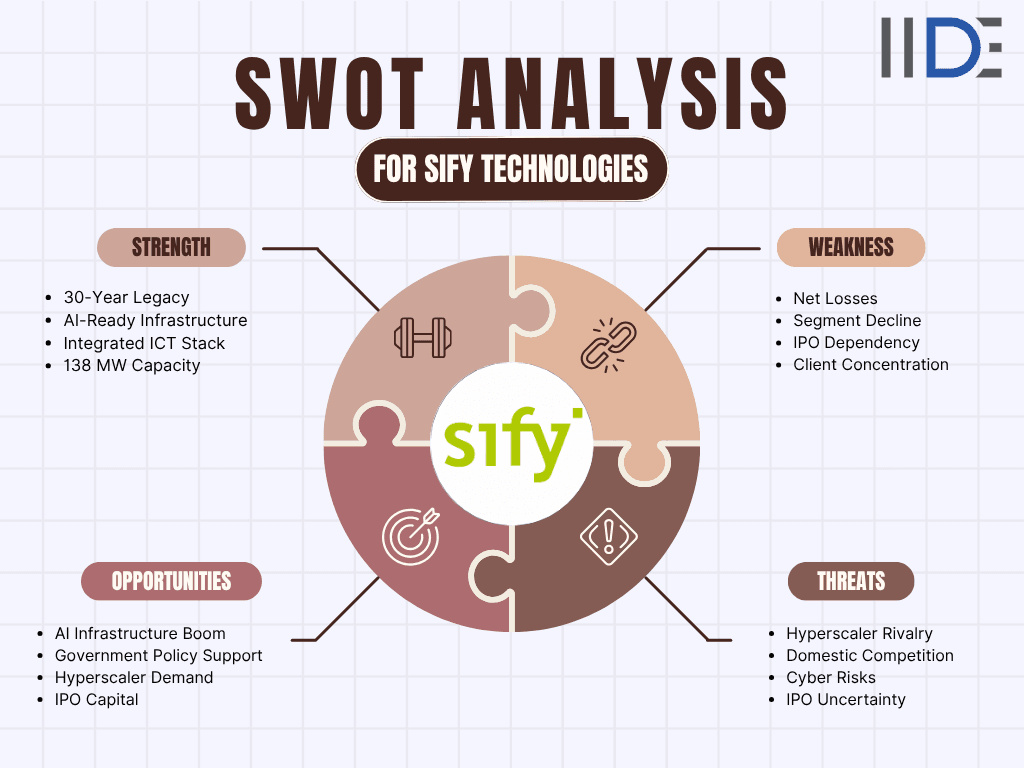
Before we break each factor down, here is a quick snapshot:
| SWOT Quadrant | |
|---|---|
| STRENGTHS | WEAKNESSES |
| India's only fully integrated ICT company. | Net loss widened to ₹1,366 million in FY26. |
| 138 MW data centre capacity, 14 facilities. | Digital Services segment results fell 67%. |
| First Indian NVIDIA DGX-Ready certification. | Heavy reliance on the upcoming IPO for growth |
| Revenue up 13%, EBITDA up 31% in FY26 | Net debt of ₹33,534 million as of March 2026. |
| 30-year legacy India's first private ISP. | Low brand visibility outside enterprise clients. |
| NASDAQ-listed since 1999, global credibility. | Over 80% of subsidiary revenue is from the top 10 clients. |
| OPPORTUNITIES | THREATS |
| India's AI infrastructure boom needs ₹90,000 crore. | AWS, Azure, and Google Cloud are expanding fast in India. |
| Government tax incentives for India-hosted cloud. | AdaniConneX, CtrlS, and Nxtra by Airtel are all expanding. |
| Sify Infinit Spaces IPO ₹3,700 crore raise | Net losses could deepen if hyperscaler deals slip. |
| Hyperscaler colocation contracts have already been won. | Cross-border rules add risk in the US, the UK, and Singapore. |
| India's cloud market still under-penetrated. | Cybersecurity risk serving 500+ enterprise clients. |

Is Digital Marketing the Right Career for You?
Find out in a free 45-min masterclass · Career paths, roles and growth explained · By Karan Shah, Founder & CEO, IIDE

Is Digital Marketing the Right Career for You?
Find out in a free 45-min masterclass · Career paths, roles and growth explained · By Karan Shah, Founder & CEO, IIDE
Strengths of Sify Technologies
Sify's strengths come from being early to the internet in India, early to integrated ICT services, and now early to NVIDIA-certified AI infrastructure. That timing has built real, hard-to-copy advantages.
1. The Only Fully Integrated ICT Company in India
- Sify offers network connectivity, data centre colocation, cloud services, and digital transformation consulting, all from one company.
- Most competitors only offer one or two of these services, forcing enterprise clients to manage multiple vendors.
- This integration becomes more valuable as companies try to simplify their technology partnerships and cut vendor management costs.
Why it matters: When a client can get network, cloud, and data centre services from one trusted partner, switching to a competitor means breaking apart a relationship that touches their entire infrastructure, not just one piece of it.
2. 138 MW of Data Centre Capacity, Growing Fast
- Sify sold 17 MW of new data centre capacity in FY2025-26, taking cumulative sold capacity to 129 MW, with 81 MW more already contracted for FY2026-27.
- Sify Infinit Spaces runs 14 colocation facilities across 6 major Indian cities: Mumbai, Chennai, Noida, Hyderabad, Bengaluru, and Kolkata.
- New campuses commissioned in Delhi and Chennai pushed total operational capacity to 138 MW.
Why it matters: Data centres take years to plan, get approved, and build. Having capacity already built and contracts already signed for next year's delivery means Sify is ahead of demand, not scrambling to catch up to it.
3. India's First NVIDIA DGX-Ready Certification
- Sify became the first Indian data centre operator certified under NVIDIA's DGX-Ready program, supporting liquid cooling for high-density GPU racks.
- This certification matters because AI workloads generate far more heat than regular servers, and most Indian data centres were not built to handle it.
- Sify's Kolo offering lets clients rent GPU capacity on a per-usage basis, without owning or maintaining any hardware themselves.
Why it matters: As Indian companies rush to adopt AI, very few data centres in the country are actually built to host the GPUs that AI needs. Sify's certification means it can host this demand today, while most competitors are still retrofitting older buildings.
4. Strong Revenue and EBITDA Growth in FY2025-26
- Revenue grew 13% to ₹44,877 million in FY2025-26, while EBITDA grew faster 31% to ₹9,871 million.
- Network services revenue grew 12%, and segment results jumped 91%; Data Centre services revenue grew 23% with segment results up 24%.
- This shows that Sify's core infrastructure businesses are not just growing in size; they are also getting more efficient.
Why it matters: EBITDA growing faster than revenue is a healthy sign. It means Sify is getting more profit out of every rupee of business it does, even while it is still investing heavily and posting a net loss overall.
5. 30-Year Legacy and NASDAQ Listing
- Sify was India's first private Internet Service Provider, launched in 1995, giving it three decades of relationships with enterprises, telecom operators, and government bodies.
- It has been listed on NASDAQ since 1999, making it one of the few Indian ICT companies with a US stock market listing.
- This combination of legacy and global listing gives international clients confidence that a smaller, newer Indian competitor cannot easily match.
Why it matters: Long-standing institutional trust is extremely hard to build quickly. When a multinational company is choosing between an Indian data centre partner with 30 years of history and one that started five years ago, the legacy matters.
To see how one of Sify's biggest domestic rivals is positioned in the same data centre race, read our detailed SWOT Analysis of Tata Communications.
Weaknesses of Sify Technologies
Sify's growth story comes with a real cost, and the numbers show exactly where the pressure is building.
1. Net Losses Are Widening, Not Shrinking
- Sify posted a net loss of ₹1,366 million in FY2025-26, wider than the ₹785 million loss the year before, even though revenue and EBITDA both grew.
- The loss is being driven by interest expenses of ₹3,950 million and depreciation of ₹7,274 million, both linked to the company's heavy spending on new infrastructure.
- Net debt climbed to ₹33,534 million as of March 31, 2026, up from ₹28,705 million the year before.
Why it matters: Growing revenue while losses widen is a pattern investors watch closely. It only makes sense if the new infrastructure being built starts generating strong returns soon, and that has not happened yet.
2. Digital Services Segment Is Struggling
- The Digital Services segment, which makes up 22% of total revenue, saw its segment results fall 67% in FY2025-26 and revenue itself declined 2%.
- This is happening because Sify is shifting this business from one-time project work to recurring, subscription-style contracts, a transition that creates a temporary revenue gap.
- Management has said this segment will not drive growth in the near term.
Why it matters: While Network and Data Centre services are growing fast, Digital Services is the one part of Sify's business actively shrinking, and it is unclear exactly when that will turn around.
3. Heavy Reliance on a Single IPO for Future Growth
- Sify's next phase of data centre expansion depends significantly on the success of the Sify Infinit Spaces IPO, which aims to raise ₹3,700 crore.
- SEBI's approval for the IPO is valid for only 12 months from January 23, 2026, creating real-time pressure.
- If stock markets turn unfavourable toward high-spending, loss-making companies during this window, the IPO could be delayed or raise less money than planned.
Why it matters: Betting an entire expansion plan on market timing is risky. No matter how well Sify executes operationally, a weak IPO market could slow everything down regardless.
4. Low Brand Visibility Beyond Large Enterprises
- Sify is well known among large enterprises and government clients, but has very little visibility among startups, developers, or everyday consumers.
- This makes it harder for Sify to attract fast-growing startups early the kind of clients who could become major accounts as they scale.
- It also limits Sify's ability to attract young technical talent who may not even know the company exists.
Why it matters: Many of today's biggest enterprise tech companies started as small startup customers. If Sify is invisible to that segment, it is missing the pipeline of tomorrow's large clients.
5. High Customer Concentration Risk
- Sify Infinit Spaces reports that over 80% of its revenue comes from just its top 10 customers.
- This means the loss of even one or two major clients could meaningfully impact the subsidiary's financial performance.
Why it matters: Concentrated client bases are efficient to manage but financially fragile. A single contract renewal going wrong has an outsized impact compared to a business with thousands of smaller customers.
Opportunities for Sify Technologies
India's digital infrastructure needs are growing faster than almost anywhere else in the world right now, and Sify is positioned closer to the centre of that growth than most of its competitors.
1. India's AI Infrastructure Boom
- India's growing AI adoption across banking, healthcare, manufacturing, and government is driving huge demand for AI-ready data centres, GPU hosting, high-density racks, and low-latency networks.
- According to ICRA, meeting India's data centre expansion needs over the next three years will require roughly ₹90,000 crore (about $10.1 billion) in investment.
- Sify's NVIDIA-certified liquid cooling and its Kolo GPU-rental model put it directly in the path of this spending wave.
Why it matters: This is not a short-term trend; it is a multi-year infrastructure build-out that India simply has to make happen. Being one of the few companies already certified to host AI workloads gives Sify a head start that is hard for new entrants to copy quickly.
2. Government Policy Support
- India's government offers tax incentives to foreign cloud companies that host their workloads inside Indian data centres, a policy that pushes more business toward operators like Sify.
- Data localisation rules in banking, healthcare, and government sectors require certain data to stay inside India, which favours domestic data centre providers.
Why it matters: When government policy actively pushes business in your direction, that is a tailwind no competitor strategy can fully offset. Sify is well placed to capture this regulatory-driven demand.
3. Sify Infinit Spaces IPO as a Growth Catalyst
- The SEBI-approved IPO of Sify Infinit Spaces aims to raise ₹3,700 crore through a mix of fresh shares and an offer for sale.
- This would be India's first-ever IPO from a company built specifically around data centres, a milestone that signals investor confidence in the sector.
- The money raised is earmarked for new campuses in Chennai and Navi Mumbai and for paying down existing debt.
Why it matters: A successful IPO would do two things at once: fund the next wave of expansion and reduce the debt load that is currently weighing on Sify's profitability. It is the single biggest lever Sify has to change its financial picture.
4. Hyperscaler Partnerships Already in Place
- Sify has already secured colocation contracts from global hyperscalers, a strong signal that its infrastructure quality and compliance already meet world-class standards.
- Expanding these relationships further could significantly improve how much of its 138 MW capacity is actually being used and paid for.
Why it matters: Hyperscalers do not sign contracts with infrastructure that does not meet their standards. Having already won this business is proof that Sify can compete at the highest level and a foundation to win more of it.
5. India's Cloud Market Still Has Room to Grow
- Sify Infinit Spaces held a 15.26% share of India's colocation data centre market by built capacity as of March 2025.
- Enterprise cloud adoption in India, especially outside the biggest cities, is still far from complete.
Why it matters: A 15% market share in a growing market means there is still a large amount of demand that has not picked a provider yet. Sify does not need to take customers away from rivals to grow; it can grow by capturing first-time cloud adopters.
To explore Sify's broader marketing and positioning approach in India's ICT space, read our Marketing Strategy of Sify Technologies.
Threats to Sify Technologies
Sify operates in one of the most contested infrastructure markets in the world right now, and the size and pockets of its rivals are only getting bigger.
1. Global Hyperscalers Are Expanding Aggressively in India
- AWS, Microsoft Azure, and Google Cloud are all investing heavily in their own India-based data centres and direct enterprise sales teams.
- These companies have far greater scale and pricing power than Sify, and their global brand names carry significant trust with enterprise buyers evaluating cloud partners.
Why it matters: When an enterprise is choosing a cloud partner, the hyperscaler name often wins by reputation alone. Sify has to win on service quality, price, and local presence, a harder fight than competing on brand recognition.
2. Domestic Competition Is Intensifying Too
- AdaniConneX, Nxtra by Airtel, CtrlS Datacenters, and Yotta Infrastructure are all expanding their Indian data centre capacity aggressively.
- This growing competition is putting direct downward pressure on colocation pricing, especially in major cities like Mumbai and Chennai.
Why it matters: More capacity entering the market at the same time creates a risk of oversupply in certain cities, which could force prices down right when Sify needs strong pricing to recover its heavy capital spending.
3. Financial Pressure Could Worsen If Growth Slows
- Sify's net debt stood at ₹33,534 million as of March 2026, and the Digital Services segment is not expected to recover until FY2026-27.
- If hyperscaler contracts take longer to close, or if the broader economy slows down, Sify's losses could widen further before the IPO money arrives.
Why it matters: Sify's entire growth plan assumes that revenue keeps climbing fast enough to outpace its debt and interest costs. Any slowdown puts that timeline and the company's financial flexibility under real pressure.
4. Cross-Border Regulatory Complexity
- Sify's operations in North America, the UK, and Singapore expose it to data sovereignty laws, trade policy shifts, and compliance requirements that vary by country and are becoming more complex.
- Any tightening of data residency rules in these markets could disrupt Sify's cross-border managed services revenue.
Why it matters: Operating across multiple countries means Sify cannot fully control its own regulatory environment. A policy shift that does not influence it, the centre could still hit its international revenue.
5. Cybersecurity Risk at Scale
- Sify holds critical infrastructure and data for hundreds of enterprise and hyperscaler clients making it a high-value target for cyberattacks.
- A major breach or extended outage could seriously damage Sify's enterprise reputation and bring regulatory penalties.
Why it matters: In data center and cloud services, trust is the entire product. One serious security failure can undo years of relationship-building with enterprise clients almost overnight.
The telecom and infrastructure sector has already seen what a major security failure can cost even at a global scale, as covered in our SWOT Analysis of AT&T.
About Sify Technologies
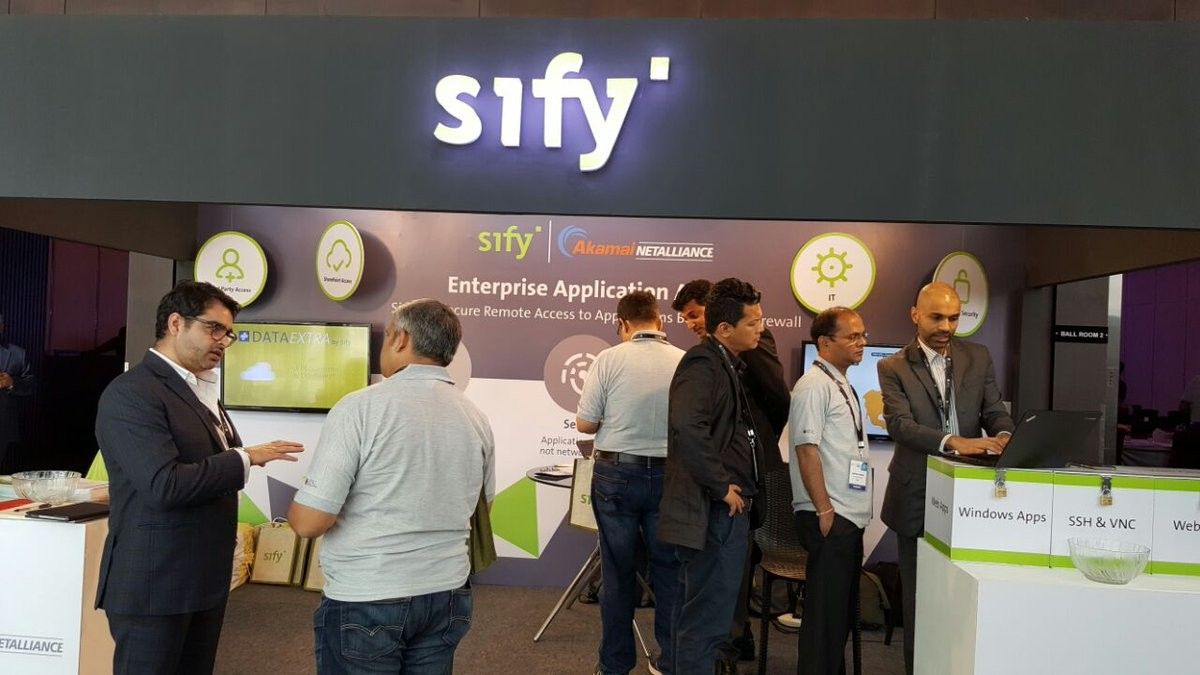
Sify Technologies was founded in 1995 by R. Ramaraj in Chennai, and it holds a special place in Indian internet history as the country's very first private Internet Service Provider. What started as an internet cafe and call-centre data company has grown, over three decades, into one of India's most complete ICT companies. Today, Sify serves over 10,000 businesses across 1,700+ Indian cities, offering Data Centre, Cloud, Network, and Digital Transformation services with an international footprint in North America, the UK, and Singapore.
| Quick Stats Table | |
|---|---|
| Parameter | Details |
| Company Name | Sify Technologies Limited |
| Founder | R. Ramaraj |
| Founded | 1995, Chennai, Tamil Nadu, India |
| Chairman | Raju Vegesna |
| Group CFO | M P Vijay Kumar (Executive Director & Group CFO) |
| Headquarters | Tharamani, Chennai, Tamil Nadu, India |
| Listed On | NASDAQ (Ticker: SIFY) |
| Business Customers | 10,000+ businesses across 1,700+ Indian cities |
| FY2025-26 Revenue | ₹44,877 million (up 13% YoY) |
| FY2025-26 EBITDA | ₹9,871 million (up 31% YoY) |
| FY2025-26 Net Loss | ₹1,366 million (vs ₹785 million loss prior year) |
| FY2025-26 CAPEX | ₹13,282 million |
| Net Debt (Mar 2026) | ₹33,534 million |
| Data Centre, Capacity | 138 MW operational; 81 MW contracted for FY2026-27 |
| Colocation Facilities | 14 facilities across 6 Indian cities |
| Key Certification | India's first NVIDIA DGX-Ready (liquid cooling) |
| IPO in Progress | Sify Infinit Spaces ₹3,700 crore (SEBI approved Jan 2026) |
| Global Presence | India, North America, UK, Singapore |
| Key Competitors | AWS, Tata Communications, Nxtra by Airtel, AdaniConneX, NTT Communications |
What's Happening with Sify Technologies in 2026?
- Sify reported FY2025-26 revenue of ₹44,877 million up 13% year-on-year with EBITDA growing 31% to ₹9,871 million, but still posted a net loss of ₹1,366 million, wider than the prior year's ₹785 million loss.
- The company sold 17 MW of new data centre capacity during the year, taking cumulative sold capacity to 129 MW, with an additional 81 MW already contracted for delivery in FY2026-27.
- Sify Infinit Spaces Limited, Sify's data centre subsidiary, received SEBI's final observations on its draft IPO prospectus in January 2026, clearing the way for India's first-ever dedicated data centre company IPO, targeting ₹3,700 crore.
- Sify became the first Indian data centre operator certified under NVIDIA's DGX-Ready program for liquid cooling, supporting GPU racks at very high density for AI workloads.
- In July 2025, Sify regained full compliance with NASDAQ listing requirements after receiving a notification letter earlier in the year.
- Sify appointed Dr Ram Sewak Sharma to its Board of Directors in June 2025, adding senior public-policy and technology governance experience.
Key Takeaways & Conclusion
Sify Technologies has earned its place at the centre of India's digital infrastructure story not through luck, but through three decades of steady, deliberate building. Revenue grew 13% to ₹44,877 million in FY2025-26, EBITDA grew 31%, and the company now runs 138 MW of data centre capacity across 14 facilities, anchored by India's first NVIDIA DGX-Ready certification for liquid cooling. These are not small wins; they are the result of getting the timing right, just as India's AI and cloud ambitions accelerate.
The pressure points are equally real. A net loss of ₹1,366 million, a Digital Services segment that shrank 67%, and a ₹3,700 crore IPO that has to land in a 12-month SEBI approval window all of this has to be managed carefully over the next year. None of these challenges erodes. Sify's underlying position, though. India genuinely needs AI-ready, fully integrated infrastructure at scale, and very few domestic companies are as well positioned to deliver it as Sify is right now.
Recommendations:
- Push hard to close the Sify Infinit Spaces IPO within the SEBI approval window delaying it risks both funding and investor confidence.
- Accelerate the recovery of Digital Services by converting more clients to recurring annuity contracts faster.
- Use the NVIDIA certification more aggressively in marketing to win hyperscaler and enterprise AI workloads before competitors catch up technically.
- Diversify the customer base for Sify Infinit Spaces beyond its current top 10 client concentration.
- Build a stronger brand presence with startups and developers to create a future enterprise client pipeline.
Want to Know Why 2,50,000+ Students Trust Us?
Dive into the numbers that make us the #1 choice for career success



MBA - Level
Post Graduate in Digital Marketing & Business Strategy

Best For
Fresh Graduates

Mode of Learning
On Campus (Mumbai & Delhi)

Starts from
Nov 27, 2026

Duration
11 Months

Live & Online
Advanced Online Digital Marketing Course
Best For
Working Professionals
Mode of Learning
Online
Starts from
Nov 2, 2026
Duration
4-6 Months

Offline
Top AI Courses to Make You Future Ready!
Best For
AI Enthusiasts
Mode of Learning
2–5 Month Program
Starts from
Nov 24, 2026
Duration
Flexiable

Offline
Undergraduate Program in Digital Business & Entrepreneurship
Best For
12th Passouts
Mode of Learning
On Campus (Mumbai)
Duration
3 Years
Offline
Degree In 2026 ≠ Enough Degree + Digital Skills = Future-Ready
Best For
12th Passouts
Mode of Learning
At IIDE Campus
Duration
3 Years
Recent Post
You May Also Like
Sify Technologies is India's first private Internet Service Provider, founded in 1995 by R. Ramaraj in Chennai. Today it is India's most comprehensive Digital ICT solutions provider, offering Data Center, Cloud, Network, and Digital Transformation services to over 10,000 businesses across 1,600 Indian cities.
Sify's strengths include a 30-year market legacy, India's only fully integrated ICT stack, NVIDIA DGX-Ready certification for liquid cooling up to 200 KW per rack, and an EBITDA of INR 9,871 million in FY 2025-26, up 31% year on year.
Sify competes with Tata Communications, Nxtra by Airtel, NTT Communications, and AdaniConneX domestically, while facing global pressure from hyperscalers like AWS, Microsoft Azure, and Google Cloud.
Sify reported revenue of INR 44,877 million in FY 2025-26, up 13%, but posted a net loss of INR 1,366 million due to capital expenditure of INR 13,282 million tied to its aggressive data center expansion.
Sify Infinit Spaces is Sify's dedicated data center subsidiary, running 14 colocation facilities across six Indian cities. It received SEBI approval in January 2026 for India's first-ever dedicated data center IPO, targeting INR 3,700 crore.
Sify became India's first data center operator certified under NVIDIA's DGX-Ready program for liquid cooling. Its Chennai and Noida facilities now support up to 200 KW per rack, enabling ultra-high-density AI workload hosting.
India's AI boom is driving demand for GPU hosting and liquid-cooled data centers. ICRA estimates the sector needs INR 90,000 crore in investment over three years, and Sify's NVIDIA-certified infrastructure places it at the heart of that wave.
Key threats include hyperscaler aggression from AWS, Azure, and Google Cloud, growing domestic competition from AdaniConneX and CtrlS, IPO execution risk, cybersecurity vulnerabilities, and cross-border regulatory complexity.
Sify Technologies is listed on NASDAQ under the ticker SIFY, making it one of the few Indian ICT companies with a US public market listing, which adds significant credibility with global enterprise clients.

Lead Trainer & Business Development Head at IIDE
Aditya Shastri leads the Business Development segment at IIDE and is a seasoned Content Marketing expert. With over a decade of experience, Aditya has trained more than 20,000 students and professionals in digital marketing, collaborating with prestigious institutions and corporations such as Jet Airways, Godrej Professionals, Pfizer, Mahindra Group, Publicis Worldwide, and many others. His ability to simplify complex marketing concepts, combined with his engaging teaching style, has earned him widespread admiration from students and professionals alike.
Aditya has spearheaded IIDE’s B2B growth, forging partnerships with over 40 higher education institutions across India to upskill students in digital marketing and business skills. As a visiting faculty member at top institutions like IIT Bhilai, Mithibai College, Amity University, and SRCC, he continues to influence the next generation of marketers.
Apart from his marketing expertise, Aditya is also a spiritual speaker, often traveling internationally to share insights on spirituality. His unique blend of digital marketing proficiency and spiritual wisdom makes him a highly respected figure in both fields.