Students Centric
Placements Report
Trackable results, real numbers
Reviews
Proven success, real voices
Trainers
Expert-led, Industry-Driven Training
Life at IIDE
Vibrant Spirit student life
Alumni
Successful Journeys, Inspiring Stories
Learning Centre
Webinars
Blogs
Case studies
Live, Interactive Masterclasses
Fresh Insights, quick reads
Real-life, Industry relevant
More
Hire from us
Hire Top Digital Marketing Talent
Work with us
Join Our Team, Make an Impact
Customised Training
Personalised digital marketing training for your company
Refer & earn
Simple, easy rewards
Contact us
Get the answers you need
About us
Know more about IIDE
Explore all course options

FOR FRESH GRADUATES
Post Graduation Program in Digital Marketing & Business Strategy- Ideal for Age: 20–25 Years

Can’t decide? Explore all our
Digital Marketing Courses
COMPARE BOTH OUR PROGRAMSOffline
Offline AI Courses with Dual CertificationsIndustry-Aligned TRACKMost Popular
UG Program in Digital Business & Entrepreneurship- Ideal for 12th Pass out / FY Degree Student

PARTNER PROGRAMS





Can’t decide? Explore all
BBA In Digital Marketing Colleges
Orginally Written by Aditya Shastri
Updated on Jun 30, 2026
Share on:


Sandhar Technologies' SWOT in 2026 tells the story of a company that quietly built itself into India's automotive backbone over nearly four decades, supplying the locks, mirrors, and structural parts that go into millions of vehicles every year. It is now at a crossroads: a well-run traditional era.
Before diving into the article, I'd like to inform you that the research and initial analysis for this piece were conducted by Aanchal Sharma, a current student in the IIDE's Online Digital Marketing Course batch, December 2025. If you found this helpful, feel free to send Aanchal Sharma a quick note of appreciation; it will mean a lot!
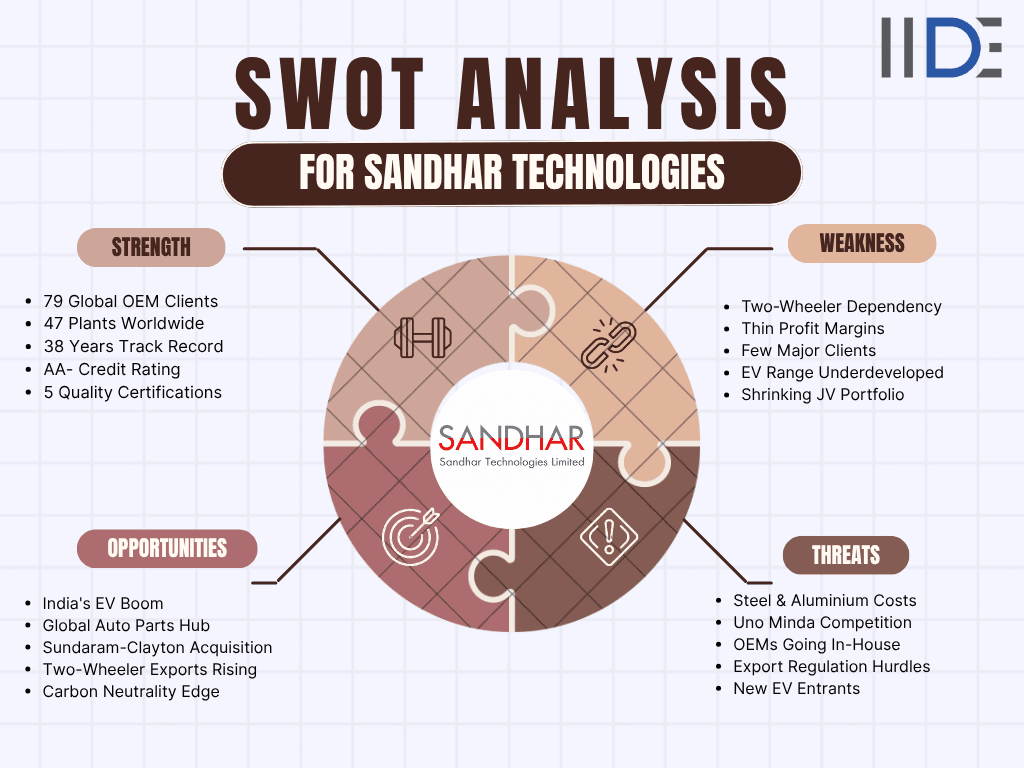
Before we look at each factor in detail, here is a quick snapshot:
| STRENGTHS | WEAKNESSES |
|---|---|
| Supplies 79 OEM brands, including Honda and Bajaj. | Heavy dependence on the two-wheeler segment |
| 47 plants across India, Europe, Mexico, and Asia. | Low profit margins: Q3 FY25 net profit ₹39.93 crore on ₹1,019 crore revenue. |
| 38+ years of trusted client relationships. | Revenue depends heavily on 2-3 big clients. |
| ₹3,900 crore revenue with 10% YoY growth. | EV product range still under development. |
| AA- credit rating from ICRA strong financials. | Limited direct consumer brand presence. |
| 5 quality certifications, including TS 16949. | Joint venture exits create portfolio gaps. |
| OPPORTUNITIES | THREATS |
| India's EV market is growing; Sandhar isis a are already in EV parts. | Steel and aluminium price swings hit margins directly. |
| India is becoming a global auto parts manufacturing hub. | Uno Minda and Motherson are competing in the same categories. |
| Sundaram-Clayton acquisition adds die-casting capacity. | OEM clients moving to in-house component manufacturing. |
| Carbon neutrality targets a green manufacturing advantage. | Country-specific rules make exports complicated. |
| Two-wheeler exports are growing from India. | New EV entrants are disrupting traditional supply chains. |
| ICRA AA- rating opens low-cost borrowing for expansion. | A slowdown in die-casting in auto sales directly reduces Sandhar's orders. |

Is Digital Marketing the Right Career for You?
Find out in a free 45-min masterclass · Career paths, roles and growth explained · By Karan Shah, Founder & CEO, IIDE

Is Digital Marketing the Right Career for You?
Find out in a free 45-min masterclass · Career paths, roles and growth explained · By Karan Shah, Founder & CEO, IIDE
Strengths of Sandhar Technologies
Sandhar has not built its position in 38 years by luck. It built it by being the kind of supplier that large vehicle brands trust with safety -critical parts: the locks on your bike, the mirror on your car, the cabin of a construction machine. Every strength below is built on that foundation.
1. Supplies 79 OEM Brands, Including Honda, Since Day One
- Sandhar supplies automotive components to 79 OEM (original equipment manufacturer) clients globally.
- It started by supplying sheet metal parts to Hero Honda in 1987 and still supplies Honda today, nearly four decades later.
- Key clients include Hero MotoCorp, Bajaj Auto, TVS, Maruti Suzuki, Honda Cars, and major tractor and construction equipment brands.
- Being the only supplier for Honda Cars in certain component categories reflects a very high level of trust.
Why it matters: Long-term OEM relationships in the auto component industry are extremely hard to build and nearly impossible to displace quickly. Once a supplier is embedded in a vehicle manufacturer's supply chain, the switching cost is enormous.
2. 47 Plants Across 4 Continents
- Sandhar runs 47 manufacturing facilities across India in cities like Gurgaon, Haridwar, Chennai, Bengaluru, Hosur, Pune, and Jamshedpur.
- It also operates internationally in Amsterdam, Barcelona, Częstochowa (Poland), Chicago, and Java.
- This global footprint allows it to serve both Indian and international OEM clients from nearby locations.
Why it matters: Being close to where a vehicle is assembled matters hugely in automotive manufacturing. Just-in-time delivery is standard in this industry, and a factory nearby is a major competitive advantage over suppliers who ship from far away.
3. 38 Years of Continuous Growth: A Rare Track Record
- Sandhar has been described as a "quality-conscious, ethical company following a consistent growth pattern for more than 3 decades."
- It started with one product (sheet metal) in 1987 and now makes 20+ product categories.
- Revenue has grown at a 10% CAGR and EBITDA at a 16% CAGR in recent years.
- Jayant Davar was awarded India's Most Respected Entrepreneurs Award 2023 by Hurun India.
Why it matters: In the automotive component industry, consistent delivery quality over decades is the most valuable asset. OEMs do not switch suppliers of safety-critical parts unless something goes seriously wrong. Sandhar's track record is its strongest sales pitch.
4. Strong Credit Rating AA- From ICRA
- ICRA assigned AA-(Stable)/A1+ ratings to ₹885 crore of Sandhar's borrowing facilities in June 2025.
- This is a very high credit rating for an Indian mid-cap manufacturing company.
- It means banks and institutions lend to Sandhar at competitive rates, lowering its cost of expansion.
Why it matters: A strong credit rating gives Sandhar cheap access to capital when it needs to build new plants, acquire businesses, or invest in EV product development. The Sundaram-Clayton acquisition in 2025 was made possible by exactly this financial strength.
5. Five Quality Certifications Covering Global Standards
- Sandhar holds TS 16949 (automotive quality management), ISO 9001 (quality management), ISO 14001 (environmental management), OHSAS 18001 (occupational health & safety), and SA 8000 (social accountability).
- These certifications are mandatory requirements for supplying to global OEM clients in Europe and North America.
Why it matters: Getting these certifications takes years and costs significant money. For any competitor trying to replace Sandhar as a supplier, these certifications are a prerequisite, not just a nice-to-have. They act as a quality moat.
6. Growing Into EV Parts Early Mover
- Sandhar incorporated a wholly owned subsidiary, Sandhar Auto Electric Solutions Private Limited, in 2022 to make EV-specific components.
- It is already developing relays, instrument clusters, gauges, fuel senders, DC-DC converters, motor controllers, and carbon canisters.
- It participated in the ACMA India Global Summit & Exhibition on EVs to showcase its "Make in India" EV product line.
Why it matters: Auto component companies that do not start building EV parts now will be left behind in 5 years. Sandhar has moved early, which gives it time to test, improve, and secure OEM contracts before EV adoption peaks in India.
To understand how one of Sandhar's biggest clients builds its own market dominance in two-wheelers, read our detailed Marketing Strategy of Bajaj Auto.
Weaknesses of Sandhar Technologies
Sandhar is a well-run company, but it has some structural gaps that become more visible as India's auto industry goes through its biggest change in decades.
1. Too Dependent on the Two-Wheeler Segment
- Sandhar's roots are in two-wheeler components: locking systems, mirrors, and handlebars for bikes.
- A large share of its revenue still comes from the two-wheeler segment, which makes it vulnerable to any slowdown in bike sales.
- When two-wheeler sales fall, as they did during economic slowdowns, Sandhar's order book shrinks with them.
Why it matters: Putting most of your eggs in one automotive segment is a risk. If EV two-wheelers start using different suppliers or if the two-wheeler market shifts faster than expected, Sandhar has less cushion than a more diversified competitor.
2. Low Profit Margins on High Revenue
- In Q3 FY2025, Sandhar reported revenue of ₹1,019 crore but net profit of only ₹39.93 crore a margin of under 4%.
- Full-year FY2025 revenue was ₹3,900 crore, but overall profitability remains thin.
- Auto component manufacturing is a low-margin business by nature, but Sandhar's margins leave little room for error.
Why it matters: Thin margins mean that any increase in raw material prices, energy costs, or logistics expenses directly squeezes profit. There is very little financial buffer when things go wrong.
3. Heavy Dependence on a Few Large Clients
- A significant share of Sandhar's revenue comes from a small number of large OEM clients: Honda, Hero MotoCorp, and Bajaj Auto.
- If any of these clients decided to source a component in-house or switch suppliers, it would have a big impact on Sandhar's revenue.
Why it matters: Customer concentration risk is real in B2B manufacturing. The same long-term relationships that are a strength also create vulnerability if one major client reduces orders, there is no quick replacement.
4. EV Product Range Still Being Developed
- Sandhar's EV components, relays, DC-DC converters, and motor controllers are still listed as "new products under development."
- It has not yet publicly announced confirmed OEM supply contracts for EV-specific parts.
- Competitors like Uno Minda and Motherson are also aggressively building EV component capabilities.
Why it matters: Being an "early mover" in EV components only helps if you actually win supply contracts before competitors do. The development phase needs to convert into confirmed orders, and that has not been publicly announced yet.
5. Joint Venture Portfolio Getting Smaller
- In November 2025, Jinyoung Electro-Mechanics acquired Jinyoung Sandhar Mechatronics, removing one JV from Sandhar's portfolio.
- Joint ventures have been a key part of Sandhar's international technology access strategy, bringing in Korean and European expertise.
- Fewer JVs could mean slower access to new technologies, particularly in electronics and EV parts.
Why it matters: Sandhar's strength in newer categories was partly built through JV partnerships. Losing a JV partner in the electronics segment is a meaningful gap, especially at a time when EV component expertise is the most valuable thing in the industry.
6. Limited Consumer Brand Recognition
- Sandhar is a B2B company; its products go inside vehicles, not on shelves. Most people have never heard of it.
- This means Sandhar has no direct pricing power with end consumers and no ability to build consumer loyalty.
- Its entire business depends on winning and keeping OEM contracts.
Why it matters: In a B2B model, if an OEM decides to change suppliers, there is no consumer loyalty to fall back on. The brand exists only as long as the OEM contract does.
Opportunities for Sandhar Technologies
India's automotive industry is going through its biggest change since the car was invented. And for a company like Sandhar, which has spent 38 years building the skills to make complex automotive parts, this change creates as many opportunities as it does challenges.
1. India's EV Market Is Growing Fast
- India's electric vehicle market is expanding rapidly; electric two-wheelers, in particular, are growing fast as fuel prices stay high and government subsidies continue.
- Sandhar already has a dedicated EV subsidiary, Sandhar Auto Electric Solutions, building the key components that EVs need but traditional vehicles do not.
- The company has invested ₹300 crore in three-wheeler EV manufacturing through joint ventures.
Why it matters: The companies that secure EV supply contracts with major OEMs in the next 2-3 years will have a decade of secure revenue ahead of them. Sandhar is already inside that race; it just needs to cross the finish line with confirmed contracts.
2. India Is Becoming a Global Auto Parts Hub
- India is being recognised as a major future destination for auto component manufacturing, driven by lower labour costs, improving quality standards, and government support through PLI schemes.
- Global OEMs are increasingly sourcing components from India for both Indian and export markets.
- Sandhar already has the certifications, client relationships, and manufacturing scale to benefit from this shift.
Why it matters: This is a rising tide that lifts Sandhar's boat regardless of what competitors do. Government policy is actively directing global auto companies toward Indian suppliers, and Sandhar is already on their approved vendor lists.
3. Sundaram-Clayton Acquisition New Die Casting Capacity
- In March 2025, Sandhar acquired Sundaram-Clayton's aluminium die casting business at Hosur.
- This adds significant high-precision casting capacity in a location that is close to major automotive OEMs in South India, including TVS and Hyundai.
- Die casting is a core competency for EV components, including motor housings, battery enclosures, and structural parts.
Why it matters: Acquisitions are faster than building from scratch. This one gives Sandhar immediate production capacity in a growing category without years of setup time and positions it better for EV component supply contracts in South India.
4. Two-Wheeler Exports Growing From India
- India is becoming one of the world's largest exporters of two-wheelers, with Hero MotoCorp, Bajaj, and TVS all growing their export volumes to Africa, Southeast Asia, and Latin America.
- As these OEMs export more bikes, they take their Indian suppliers, including Sandhar, along with them.
Why it matters: Export growth from Indian OEM clients means Sandhar's revenue grows even without winning new clients. It is automatic growth that comes from its existing relationships.
5. Carbon Neutrality Target: A Green Manufacturing Edge
- Sandhar has publicly committed to achieving carbon neutrality by 2050.
- Global OEMs, especially European car companies, are now requiring their suppliers to meet sustainability targets as a condition of doing business.
- Sandhar's early commitment gives it a compliance edge over competitors who have not made this commitment yet.
Why it matters: In 5 years, European auto supply contracts will require sustainability reporting as standard. Sandhar is building that capability now, which means it stays eligible for European business while others scramble to catch up.
6. ICRA AA- Rating Opens Cheap Capital for Expansion
- Sandhar's AA-(Stable) credit rating means it can borrow at lower interest rates than most competitors.
- This gives it a funding advantage when it needs to build new EV plants, acquire businesses, or expand internationally.
Why it matters: In a capital-intensive business like auto component manufacturing, access to cheap money is a genuine competitive edge. Sandhar can invest more for less, and that compounds over time.
To see how India's largest automaker is navigating the same EV transition that Sandhar is supplying parts for, read our in-depth SWOT Analysis of Tata Motors.
Threats to Sandhar Technologies
The threats Sandhar faces in 2026 are a mix of things it cannot control, such as raw material prices, global trade rules and things its competitors are actively doing to chip away at its market.
1. Steel and Aluminium Prices Can Wipe Out Margins Overnight
- Sandhar's products- locks, mirrors, stampings, and die castings are made mostly from steel and aluminium.
- Global metal prices move based on geopolitical events, trade tariffs, and energy costs, all completely outside Sandhar's control.
- When steel or aluminium prices spike, Sandhar's cost of production goes up, but OEM clients do not immediately agree to pay more.
Why it matters: With profit margins already thin, a sharp rise in metal prices can turn a profitable quarter into a loss-making one very quickly. This is the single biggest external risk Sandhar faces every year.
2. Uno Minda and Motherson Are Strong Competitors
- Uno Minda and Motherson Group compete directly with Sandhar in locking systems, mirrors, and electrical components for vehicles.
- Both are larger companies with more resources, bigger client bases, and deeper EV component development programmes.
- Uno Minda, in particular, overlaps significantly with Sandhar's core product categories.
Why it matters: Competing with larger, better-funded rivals in the same product categories is a constant pressure. If Uno Minda wins a Honda contract in a category Sandhar currently holds, replacing that revenue is extremely difficult.
3. OEM Clients Moving to In-House Manufacturing
- Large vehicle companies like Tata Motors and Mahindra have been increasing their own in-house component manufacturing capabilities.
- When an OEM decides to make a component itself instead of buying it from a supplier, that revenue disappears for the supplier permanently.
Why it matters: Sandhar has no control over this decision. It can only try to be so deeply embedded in an OEM's supply chain that switching to in-house production is more expensive than continuing to buy from Sandhar.
4. Country-Specific Regulations Making Exports Complicated
- Sandhar operates in multiple countries, each with its own rules on product safety standards, import duties, labour laws, and environmental regulations.
- A rule change in one country can make a product category harder to sell or manufacture there, adding cost and complexity.
Why it matters: Managing compliance across India, Spain, Poland, Mexico, and the US simultaneously is expensive. Any new regulatory requirement in an export market adds cost that must be absorbed or passed on, both of which are difficult in a low-margin business.
5. New EV Entrants Disrupting Traditional Supply Chains
- New EV companies Ola Electric, Ather Energy, and others are building their supply chains differently from traditional OEMs.
- Some are sourcing EV-specific components directly from Chinese suppliers or building them in-house.
- Sandhar's existing OEM relationships were built with traditional vehicle companies, not necessarily with the new EV-first brands.
Why it matters: If India's fastest-growing vehicle brands are not buying from Sandhar, it misses the highest-growth segment of the market at exactly the wrong time. Building relationships with new EV OEMs is a separate challenge from maintaining existing ones.
6. Auto Sales Slowdown Directly Hits Orders
- Sandhar does not sell to end consumers; it sells to vehicle manufacturers. So when vehicle sales slow down, manufacturers make fewer vehicles and order fewer parts.
- India's two-wheeler market has seen periodic slowdowns linked to rural income pressures, fuel price rises, and financing costs.
Why it matters: Sandhar has no way to buffer against this. When the market slows, its revenue slows with it, with no direct-to-consumer channel to fall back on.
To understand how one of Sandhar's biggest global competitors operates in the Indian auto component space, read our complete SWOT Analysis of Bosch.
About Sandhar Technologies
Sandhar Technologies Limited started in 1987 as a small supplier of sheet metal parts to Hero Honda motorcycles in New Delhi. Today, it is one of India's biggest automotive component companies, making everything from door locks and rearview mirrors to EV parts and operator cabins for tractors. It runs 47 factories across India, Spain, Poland, Mexico, and more, serves 79 global car and bike brands, and employs over 11,500 people. Its founder, Jayant Davar, still leads the company as Chairman, MD, and CEO.
Quick Stats Table
| Parameter | Details |
|---|---|
| Company Name | Sandhar Technologies Limited |
| Founded | 1987, New Delhi, India |
| Founder & CEO | Jayant Davar (Chairman, MD & CEO) |
| CFO | Yashpal (CFO & Company Secretary) |
| Headquarters | Plot No. 13, Sector-44, Gurugram, Haryana, India |
| Listed On | NSE & BSE (Ticker: SANDHAR) Listed April 2, 2018 |
| Employees | 11,500+ |
| Plants | 47 manufacturing facilities globally |
| OEM Clients | 79 OEMs globally |
| Revenue (FY2025) | ₹3,900 crore |
| Revenue CAGR | 10% (1-year); EBITDA CAGR 16% |
| Net Profit (Q3 FY2025) | ₹39.93 crore |
| Market Cap | ₹4,261 crore |
| Subsidiaries | 3 subsidiaries, 10 joint ventures |
| International Presence | Spain, Poland, Mexico, Amsterdam, Chicago, Java |
| Key Certifications | ISO 9001, ISO 14001, TS 16949, OHSAS 18001, SA 8000 |
| Key Clients | Honda, Hero MotoCorp, Bajaj Auto, TVS, Maruti Suzuki |
| Key Competitors | Uno Minda, Motherson Group, Bosch India, Endurance Tech |
What's Happening with Sandhar Technologies in 2026?
- In March 2025, Sandhar's subsidiary Sandhar Ascast Private Limited acquired the high-pressure and low-pressure aluminium die casting business of Sundaram-Clayton Limited at its Hosur plant, a significant capacity expansion move.
- In November 2025, Jinyoung Electro-Mechanics acquired Jinyoung Sandhar Mechatronics, one of Sandhar's joint ventures, marking a change in its JV portfolio.
- Sandhar reported revenue of ₹3,900 crore for FY2025, a 10% year-on-year growth with EBITDA growing at a faster 16% CAGR, showing improving operational efficiency.
- The company is actively developing EV-specific parts through its subsidiary Sandhar Auto Electric Solutions Private Limited, including DC-DC converters, motor controllers, relays, instrument clusters, and carbon canisters.
- Sandhar Technologies has committed to achieving carbon neutrality by 2050, aligning with global automotive sustainability trends.
- ICRA assigned AA-(Stable)/A1+ ratings to ₹885 crore of Sandhar's borrowing facilities in June 2025, a strong credit confidence signal.
Key Takeaways & Conclusion
Sandhar Technologies has done something that very few Indian companies manage: it has stayed relevant, stayed profitable, and kept growing for nearly four decades in one of the world's most demanding industries. It's 47 plants, 79 OEM clients, an AA- credit rating, and ₹3,900 crore revenue are not luck. They are the result of consistent quality, long-term client relationships, and smart geographic expansion.
The road ahead has one big fork in it: electric vehicles. Sandhar has seen this coming: the EV subsidiary, the ₹300 crore JV investment, the EV product development pipeline, but confirmed OEM contracts have not yet been announced publicly. The Sundaram-Clayton acquisition in 2025 adds die-casting, a capacity that is directly relevant to EV manufacturing, which is a smart move. But the window to lock in EV supply agreements with India's fastest-growing vehicle brands is open right now, not in three years.
The company that Jayant Davar built in 1987 by supplying sheet metal to Hero Honda is capable of making the EV transition. The question is whether it moves fast enough to make it on its own terms before competitors like Uno Minda or new Chinese entrants define what the next generation of Indian auto components looks like.
Recommendations:
- Secure confirmed EV component supply contracts urgently; development without contracts is investment without return
- Reduce two-wheeler revenue concentration by actively growing in the passenger vehicles and commercial vehicle segments
- Rebuild JV partnerships in the electronics and EV space to replace the technology access lost with the Jinyoung exit
- Lock in metal price hedging contracts to protect thin margins from raw material volatility
- Build direct relationships with new EV-first brands like Ola Electric and Ather Energy they are the fastest-growing OEM clients in India right now
Want to Know Why 2,50,000+ Students Trust Us?
Dive into the numbers that make us the #1 choice for career success


MBA - Level
Post Graduate in Digital Marketing & Business Strategy

Best For
Fresh Graduates

Mode of Learning
On Campus (Mumbai & Delhi)

Starts from
Nov 27, 2026

Duration
11 Months

Live & Online
Advanced Online Digital Marketing Course
Best For
Working Professionals
Mode of Learning
Online
Starts from
Nov 2, 2026
Duration
4-6 Months
Offline
Top AI Courses to Make You Future Ready!
Best For
AI Enthusiasts
Mode of Learning
2–5 Month Program
Starts from
-
Duration
Flexiable
Offline
Undergraduate Program in Digital Business & Entrepreneurship
Best For
12th Passouts
Mode of Learning
On Campus (Mumbai)
Duration
3 Years
Offline
Degree In 2026 ≠ Enough Degree + Digital Skills = Future-Ready
Best For
12th Passouts
Mode of Learning
At IIDE Campus
Duration
3 Years
Recent Post
Sandhar Technologies Limited is an Indian automotive component manufacturer founded in 1987 by Jayant Davar. It makes locking systems, rearview mirrors, die castings, stampings, and EV parts for 79 OEM clients across 47 plants in India, Europe, Mexico, and Asia.
Sandhar Technologies was founded by Jayant Davar in 1987 in New Delhi. He continues to lead the company today as its Chairman, Managing Director, and CEO.
Sandhar makes automotive locking systems, rearview mirrors, door handles, sheet metal stampings, aluminium and zinc die castings, operator cabins for off-highway vehicles, helmets, fuel pumps, and EV components like relays, instrument clusters, and motor controllers.
Sandhar Technologies reported revenue of ₹3,900 crore for FY2025 a 10% year-on-year increase with EBITDA growing at a 16% CAGR.
Its deepest strength is its 38-year track record of supplying safety-critical components to 79 OEM brands, including Honda, Bajaj, Hero MotoCorp, and TVS from 47 plants across 4 continents.
Heavy dependence on the two-wheeler segment and thin profit margins: Q3 FY2025 net profit was ₹39.93 crore on ₹1,019 crore revenue, leaving very little buffer when costs rise.
Yes. Sandhar Technologies is listed on both NSE and BSE under the ticker symbol SANDHAR. It was listed on April 2, 2018. Its current market cap is approximately ₹4,261 crore.
Sandhar's main competitors are Uno Minda, Motherson Group, Bosch India, and Endurance Technologies all of whom compete in overlapping automotive component categories.

Lead Trainer & Business Development Head at IIDE
Aditya Shastri leads the Business Development segment at IIDE and is a seasoned Content Marketing expert. With over a decade of experience, Aditya has trained more than 20,000 students and professionals in digital marketing, collaborating with prestigious institutions and corporations such as Jet Airways, Godrej Professionals, Pfizer, Mahindra Group, Publicis Worldwide, and many others. His ability to simplify complex marketing concepts, combined with his engaging teaching style, has earned him widespread admiration from students and professionals alike.
Aditya has spearheaded IIDE’s B2B growth, forging partnerships with over 40 higher education institutions across India to upskill students in digital marketing and business skills. As a visiting faculty member at top institutions like IIT Bhilai, Mithibai College, Amity University, and SRCC, he continues to influence the next generation of marketers.
Apart from his marketing expertise, Aditya is also a spiritual speaker, often traveling internationally to share insights on spirituality. His unique blend of digital marketing proficiency and spiritual wisdom makes him a highly respected figure in both fields.