
Students Centric
Placements Report
Trackable results, real numbers
Reviews
Proven success, real voices
Trainers
Expert-led, Industry-Driven Training
Life at IIDE
Vibrant Spirit student life
Alumni
Successful Journeys, Inspiring Stories
Learning Centre
Webinars
Blogs
Case studies
Live, Interactive Masterclasses
Fresh Insights, quick reads
Real-life, Industry relevant
More
Hire from us
Hire Top Digital Marketing Talent
Work with us
Join Our Team, Make an Impact
Customised Training
Personalised digital marketing training for your company
Refer & earn
Simple, easy rewards
Contact us
Get the answers you need
About us
Know more about IIDE
Explore all course options

FOR FRESH GRADUATES
Post Graduation Program in Digital Marketing & Business Strategy- Ideal for Age: 20–25 Years

Can’t decide? Explore all our
Digital Marketing Courses
COMPARE BOTH OUR PROGRAMSOffline
Offline AI Courses with Dual CertificationsIndustry-Aligned TRACKMost Popular
UG Program in Digital Business & Entrepreneurship- Ideal for 12th Pass out / FY Degree Student

PARTNER PROGRAMS






Can’t decide? Explore all
BBA In Digital Marketing Colleges
Orginally Written by Aditya Shastri
Updated on Jun 24, 2026
Share on:


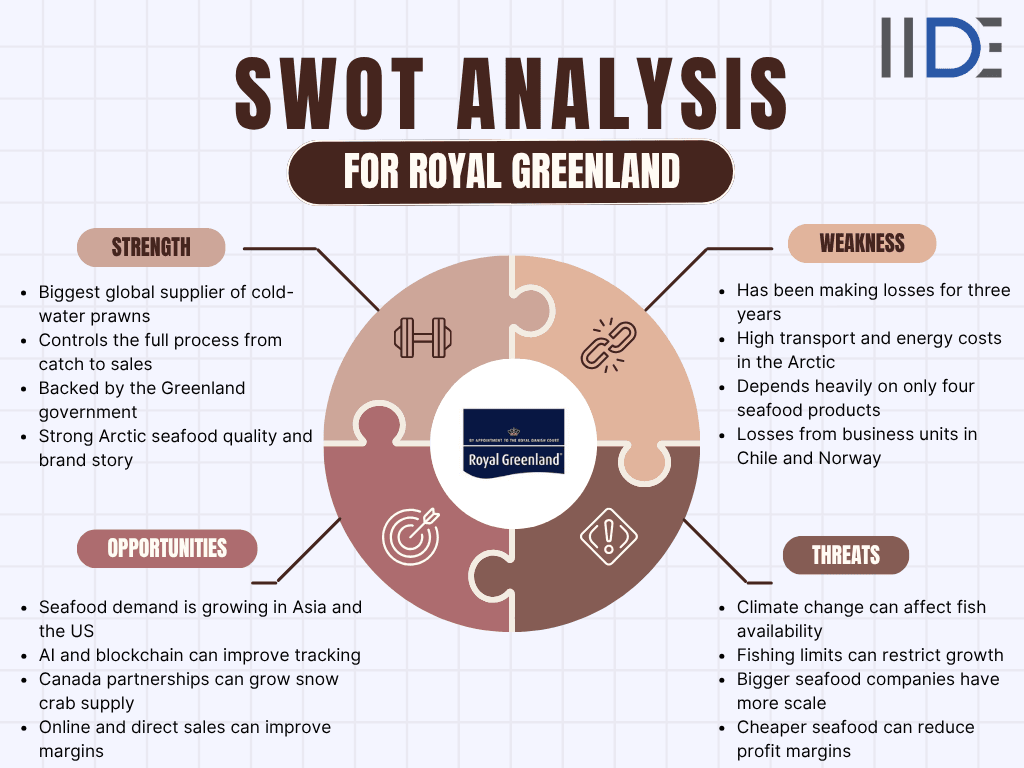
Royal Greenland's key strengths are its position as the world's largest cold-water prawn supplier, full vertical integration, and 100% government backing. Its main weaknesses are three straight years of net losses and high Arctic logistics costs. The biggest opportunity is rising demand for certified sustainable seafood in Asia, while climate-driven stock decline and tighter fishing quotas are its threats. Founded in 1774, the company earned DKK 5.6 billion in 2024.
Before diving into the article, I'd like to inform you that the research and initial analysis for this piece were conducted by Aditi Bhartia. She is a student of IIDE's Online Digital Marketing Course, December 2025 Batch.
If you found this helpful, feel free to reach out to Aditi Bhartia to send a quick note of appreciation for her fantastic research. She will appreciate the kudos!
| SWOT TABLE | |
|---|---|
| STRENGTHS | WEAKNESSES |
| World’s largest cold-water prawn supplier | Three straight years of net losses |
| Full catch-to-customer supply chain control | High Arctic logistics and energy costs |
| Greenland’s largest company and employer | 83% revenue dependence on four wild species |
| 100% Government of Greenland ownership | Overseas losses in Chile and Norway |
| Premium Arctic seafood and heritage story | Leadership instability during turnaround |
| OPPORTUNITIES | THREATS |
| Rising seafood demand in Asia and the US | Climate change shifting wild fish stocks |
| Premium pricing for certified sustainable seafood | Fishing quotas limit volume growth |
| AI and blockchain for traceability | Larger seafood rivals have scale advantage |
| Snow crab partnerships in Atlantic Canada | Cheap competing supply pressures margins |
| DTC and e-commerce seafood growth | Trade, tariff and currency uncertainty |

Is Digital Marketing the Right Career for You?
Find out in a free 45-min masterclass · Career paths, roles and growth explained · By Karan Shah, Founder & CEO, IIDE

Is Digital Marketing the Right Career for You?
Find out in a free 45-min masterclass · Career paths, roles and growth explained · By Karan Shah, Founder & CEO, IIDE
What are the Strengths of Royal Greenland?
Royal Greenland's strengths come from scale in a narrow niche, control of its supply chain, and stable ownership. It is the world's largest cold-water prawn supplier and Greenland's biggest company, with full control from catch to customer and the backing of the Greenlandic state. These give it pricing power and staying power that newer rivals cannot easily copy.
1. World's largest supplier of cold-water prawns
- Royal Greenland is the single biggest supplier of cold-water prawns globally, and cold-water prawns are one of its four core species that together make up 83% of revenue.
- This is a leadership position in a specific, high-value category rather than a strong brand in general.
2. Full vertical integration
- The company controls the entire chain - nine offshore trawlers, around 49 processing factories across Greenland, Canada, and Germany, and its own global sales network reaching 48 countries.
- It also buys catch from independent fishers, giving it volume on top of its own fleet.
3. Greenland's largest company and biggest employer
- Royal Greenland is the largest company in Greenland and one of its most important private employers. It had 2,087 staff in 2024, of which 1,306 were based in Greenland itself.
- The business is woven into the national economy, which gives it a local standing no foreign competitor can match
4. 100% government ownership and stable backing
- The company is fully owned by the Government of Greenland, which it describes as roughly 56,000 citizen-owners.
- This ownership has carried the business through three loss-making years without forcing asset sales or emergency restructuring.
- A state owner can also take a longer view than shareholders chasing quarterly returns.
5. Premium Arctic product range
- Cold-water prawns, Greenland halibut, snow crab, and cod from clean Arctic waters all sit at the premium end of the seafood market.
- The company holds recognised food-safety certifications such as HACCP, BRC, and IFS, which large retailers often require before they will buy.
- Together these let it position its catch as high quality and traceable.
6. Long heritage and sustainability story
- With roots going back to 1774 and a model built around local Greenlandic fishing communities, the company has a provenance story that rivals find hard to copy.
- Its catch is wild, traceable, and tied to a specific place and people.
- That combination of heritage and sustainability carries real weight with buyers who care where their seafood comes from.
If you want to see how a much larger food company handles similar pressures, our swot analysis of Tyson breaks down the strengths, weaknesses, and risks facing one of the world's biggest protein producers.
What are the Weaknesses of Royal Greenland?
Royal Greenland's weaknesses are mostly financial and structural. It has lost money three years running, its Arctic base makes it a high-cost producer, and it leans heavily on four wild species and a handful of overseas units that have underperformed. Recent leadership churn adds to the uncertainty while the turnaround runs.
1. Three straight years of net losses
- The company reported a net loss of DKK 265 million in 2024, which was worse than its DKK 211 million loss the year before.
- Its pre-tax loss for 2024 was DKK 196 million, and revenue slipped from DKK 5.8 billion to DKK 5.6 billion.
- Three loss-making years in a row point to a problem that is structural rather than a one-off.
2. High Arctic logistics and energy costs
- Operating from remote Greenland means long shipping distances, harsh weather, and high energy costs that sit on top of every product.
- These costs are the reason the company launched its "Back to Black" turnaround, which is built specifically around cutting them.
- It stripped out DKK 52 million of costs in 2024, but the underlying base is still high.
3. Heavy dependence on four wild species
- Cold-water prawns, Greenland halibut, snow crab, and cod together make up 83% of revenue.
- All four are wild-caught, so they are exposed to fishing quotas and natural stock swings the company cannot control.
- A weak year in any one of them flows straight to the bottom line.
4. Loss-making overseas operations
- The company's Chilean business led to a DKK 220 million impairment in 2024 after the returns it expected never materialised, and it has since started reviewing the unit's future.
- In Norway, its partner Maniitsoq lost its snow crab licence in 2024, which triggered a further DKK 57 million write-down.
- These two events together were a major reason an otherwise improving year still ended in a loss.
5. A destroyed Canadian factory
- A fire in March 2024 destroyed the company's shrimp and crab factory in Matane, Quebec, and the site was permanently closed.
- The insurance claim was still being settled at the time the annual report was published. Losing a whole plant removed processing capacity the company had been relying on.
6. Leadership instability during the turnaround
- The company went through three CEOs in roughly a year.
- Susanne Arfelt Rajamand left in February 2025, Preben Sunke stepped in as interim CEO, and Toke Binzer took over permanently on 1 December 2025.
- That much change at the top during a recovery creates real execution risk.
What are the Opportunities for Royal Greenland?
Royal Greenland's opportunities are external and tied to where the seafood market is heading. Demand for premium, traceable, sustainable seafood is rising in Asia and the US. Certification commands higher prices, and new partnerships in Atlantic Canada open up snow crab supply. These play to the company's strengths in provenance and cold-water species.
1. Rising seafood demand in Asia and the US
- Demand for Greenland halibut is strong in China, Japan, and Taiwan, and the company's sales to the US are growing.
- Global seafood consumption keeps climbing, with Asia leading the increase.
- These are premium export markets where Royal Greenland already has both products and a price position.
2. Premium pricing on certified sustainable seafood
- Buyers are increasingly willing to pay more for eco-certified seafood, and certification such as MSC is becoming a condition of sale with major retailers.
- Royal Greenland's wild-caught, traceable Arctic catch fits this demand closely.
- Leaning further into certification could lift prices across its whole range.
3. AI and blockchain for traceability and efficiency
- Adopting AI for demand forecasting and blockchain for catch-to-shelf traceability can cut waste and improve planning.
- Traceability also lets the company prove the origin of its catch, which premium buyers increasingly ask for.
- Both work on the same problem from two sides, lifting prices while lowering costs.
4. Snow crab partnerships in Atlantic Canada
- Royal Greenland entered a joint venture with the First Nation group Wagmatcook, which took a 51% stake in snow crab activity in Nova Scotia, Canada.
- The deal expands the company's crab supply in a region with established fisheries.
- Sharing ownership also spreads the risk in a species that has been volatile for the business.
5. Direct-to-consumer and e-commerce growth
- E-commerce and direct-to-consumer seafood channels are growing across the company's markets.
- Selling closer to the end customer earns higher margins than going through wholesalers and large retailers.
- For a premium brand with a strong provenance story, this is a natural fit.
6. Recovering core categories
- Cod, halibut, and cooked-and-peeled prawns all returned to profitability in 2024.
- Land-based cod production in Greenland reached balance for the first time that year.
- A core business that is healthy again is the platform any future growth has to stand on.
What are the Threats to Royal Greenland?
Royal Greenland faces external risks it cannot fully control. Climate change is reshaping fish stocks, government quotas cap how much it can catch, larger rivals out-scale it, cheap competing supply pressures prices, and Greenland's wider trade situation adds uncertainty. Any one of these can hit a company that depends on wild Arctic catch and exports.
1. Climate change shrinking and shifting fish stocks
- Warming and shifting Arctic waters are changing where target species are found and how much can be caught.
- Because the company's catch is entirely wild, it has no way to offset a poor natural year through farming.
- Less predictable stocks mean less predictable supply and revenue.
2. Tighter government fishing quotas
- Catch volumes are capped by government quotas that are tied to the health of wild stocks.
- When a quota is cut, the company cannot make up the difference no matter how strong demand is.
- This puts a hard ceiling on how much it can grow through volume alone.
3. Strong, larger competitors
- Royal Greenland competes against much larger seafood groups as well as direct rivals in its own species.
- Mowi, the world's biggest seafood company by revenue, and Thai Union both have scale and cost advantages it cannot match.
- Closer to its categories, Clearwater Seafoods competes directly in snow crab and cold-water shrimp, and Espersen competes in cod.
4. Cheap competing supply
- The company's cod sales were hurt by low-priced imported Russian cod, alongside caution among industrial buyers.
- As a high-cost producer, Royal Greenland feels this kind of price pressure more sharply than its larger rivals.
- When cheaper supply floods its categories, its margins are the first to suffer.
5. Greenland trade and tariff uncertainty
- Greenland has drawn growing international political attention, and seafood trade can be affected by tariffs and shifting US-China trade conditions.
- Most of the company's revenue comes from exports, so trade barriers and currency swings hit it directly.
- These are forces it has no control over.
6. Operational risk in remote, single-site operations
- Royal Greenland harvests and processes across remote Arctic locations where weather, fuel costs, and thin logistics can disrupt supply at short notice.
- In many places a single plant handles a whole product line, so losing one site has an outsized effect.
- The 2024 Matane factory fire showed exactly how damaging the loss of one plant can be.
To explore how a premium, sustainability-focused food brand competes in a crowded market, take a look at our swot analysis of Whole Foods and see what sets its strengths and challenges apart.
About Royal Greenland
Royal Greenland A/S is a Greenlandic seafood company headquartered in Nuuk and fully owned by the Government of Greenland. Its heritage dates to 1774, when the Danish State established the Royal Greenlandic Trade Department, and the modern fishing company was formed in 1990. Led by CEO Toke Binzer, it is the world's largest cold-water prawn supplier and Greenland's biggest company, selling Arctic seafood across Europe, Asia, and North America.
Quick stats of Royal Greenland:
| Parameter | Details |
|---|---|
| Company name | Royal Greenland A/S |
| Founded | Heritage to 1774; modern company formed in 1990 |
| Headquarters | Nuuk, Greenland |
| CEO | Toke Binzer |
| Board Chair | Niels Søren Thomsen |
| Industry | Wild-caught seafood |
| Revenue | DKK 5.6 billion (2024) |
| Net income | Loss of DKK 265 million (2024) |
| Employees | 2,087 (2024); 1,306 in Greenland |
| Market cap | Not listed (100% state-owned) |
| Main competitors | Mowi, Thai Union, Clearwater Seafoods, Espersen |
What is Happening With the Brand?
Royal Greenland is in the middle of a turnaround it calls "Back to Black," aimed at cutting costs and returning to profit after three loss-making years. It is targeting a 5% EBIT margin by 2027.
In 2024, it took large write-downs on its Chilean business and a Norwegian snow crab partnership, permanently closed its fire-damaged Matane factory in Canada, and reduced net interest-bearing debt by DKK 264 million.
Leadership has also changed, with Toke Binzer becoming CEO on 1 December 2025. The company says its core categories of cod, halibut, and cooked-and-peeled prawns returned to profit in 2024.
Royal Greenland Key Takeaways & Recommendations
Recap: Royal Greenland leads the world in cold-water prawns, controls its full supply chain, and has stable state ownership. Against that, it has lost money three years running, carries a high Arctic cost base, depends on four volatile wild species, and faces climate and quota risks it cannot control.
The core tension: Sustainability and local responsibility raise the company's costs, but it needs higher margins to survive. The whole strategy has to reconcile those two facts.
Recommendations:
- Lead on premium and certification. Position every core species as premium, wild-caught, and certified to justify higher prices.
- Cut the cost base hard. Keep driving the "Back to Black" savings through logistics, energy, and processing.
- Grow value-added and D2C. Push into higher-margin value-added products and direct channels rather than commodity volume.
- Fix or exit weak overseas units. Resolve the Chilean business and avoid repeating the write-downs seen in Chile and Norway.
- Invest in traceability technology. Use AI and blockchain to support premium pricing and attack waste.
Future outlook:
The next three to five years are decisive. The company has guided toward a return to profit and a 5% EBIT margin by 2027. If the turnaround holds and core categories stay profitable, Royal Greenland can stabilise as a premium Arctic seafood leader. If costs and overseas losses persist, the pressure on a state-owned, loss-making business will keep building.
Want to Know Why 2,50,000+ Students Trust Us?
Dive into the numbers that make us the #1 choice for career success



MBA - Level
Post Graduate in Digital Marketing & Business Strategy

Best For
Fresh Graduates

Mode of Learning
On Campus (Mumbai & Delhi)

Starts from
Nov 27, 2026

Duration
11 Months

Live & Online
Advanced Online Digital Marketing Course
Best For
Working Professionals
Mode of Learning
Online
Starts from
Nov 2, 2026
Duration
4-6 Months

Offline
Top AI Courses to Make You Future Ready!
Best For
AI Enthusiasts
Mode of Learning
2–5 Month Program
Starts from
-
Duration
Flexiable

Offline
Undergraduate Program in Digital Business & Entrepreneurship
Best For
12th Passouts
Mode of Learning
On Campus (Mumbai)
Duration
3 Years
Offline
Degree In 2026 ≠ Enough Degree + Digital Skills = Future-Ready
Best For
12th Passouts
Mode of Learning
At IIDE Campus
Duration
3 Years
Recent Post

Lead Trainer & Business Development Head at IIDE
Aditya Shastri leads the Business Development segment at IIDE and is a seasoned Content Marketing expert. With over a decade of experience, Aditya has trained more than 20,000 students and professionals in digital marketing, collaborating with prestigious institutions and corporations such as Jet Airways, Godrej Professionals, Pfizer, Mahindra Group, Publicis Worldwide, and many others. His ability to simplify complex marketing concepts, combined with his engaging teaching style, has earned him widespread admiration from students and professionals alike.
Aditya has spearheaded IIDE’s B2B growth, forging partnerships with over 40 higher education institutions across India to upskill students in digital marketing and business skills. As a visiting faculty member at top institutions like IIT Bhilai, Mithibai College, Amity University, and SRCC, he continues to influence the next generation of marketers.
Apart from his marketing expertise, Aditya is also a spiritual speaker, often traveling internationally to share insights on spirituality. His unique blend of digital marketing proficiency and spiritual wisdom makes him a highly respected figure in both fields.