
Students Centric
Placements Report
Trackable results, real numbers
Reviews
Proven success, real voices
Trainers
Expert-led, Industry-Driven Training
Life at IIDE
Vibrant Spirit student life
Alumni
Successful Journeys, Inspiring Stories
Learning Centre
Webinars
Blogs
Case studies
Live, Interactive Masterclasses
Fresh Insights, quick reads
Real-life, Industry relevant
More
Hire from us
Hire Top Digital Marketing Talent
Work with us
Join Our Team, Make an Impact
Customised Training
Personalised digital marketing training for your company
Refer & earn
Simple, easy rewards
Contact us
Get the answers you need
About us
Know more about IIDE
Explore all course options

FOR FRESH GRADUATES
Post Graduation Program in Digital Marketing & Business Strategy- Ideal for Age: 20–25 Years

Can’t decide? Explore all our
Digital Marketing Courses
COMPARE BOTH OUR PROGRAMSOffline
Offline AI Courses with Dual CertificationsIndustry-Aligned TRACKMost Popular
UG Program in Digital Business & Entrepreneurship- Ideal for 12th Pass out / FY Degree Student

PARTNER PROGRAMS






Can’t decide? Explore all
BBA In Digital Marketing Colleges
Orginally Written by Aditya Shastri
Updated on May 18, 2026
Share on:


Pepsi, backed by parent company PepsiCo, is valued at $19.4 billion and ranks 29th on Forbes' Most Valuable Brands list with a presence spanning 200+ countries. Its diverse portfolio, from Slice and Tropicana to Lay's and Doritos, gives it a significant edge over single-category competitors.
Yet the brand isn't without its pressure points. The long-standing battle with Coca-Cola, shifting health-conscious consumer trends, and a heavy reliance on celebrity endorsements remain persistent vulnerabilities that the brand continues to navigate.
The upside? Healthier alternatives like Diet Pepsi and Stevia-based drinks signal a promising and timely shift in strategy. That said, economic slowdowns and tightening government regulations across global markets continue to pose real threats to Pepsi's growth ambitions.
About Pepsi
Pepsi isn't just a cola, it's a cultural icon that has shaped youth identity, pop music, and sports marketing for over a century. As the flagship beverage brand of Pepsi, the world's second-largest food and beverage company, Pepsi sits at the centre of a portfolio that spans snacks, juices, energy drinks, and breakfast foods.
But the brand itself, the one in the blue, can carry a distinct identity that goes well beyond its parent company's balance sheet. Its real competitive edge is deceptively simple: Pepsi has always positioned itself as the brand of the young, the bold, and the unconventional.
Where Coca-Cola owns nostalgia and tradition, Pepsi owns ambition and culture. That positioning, sustained across decades of Super Bowl halftime shows, celebrity campaigns, and product launches, has kept it relevant in a market that keeps changing around it.
Why SWOT Analysis Matters for a Brand Like Pepsi
Pepsi operates in 200+ countries, manages dozens of brands, and constantly battles both global giants and emerging local challengers. At that scale, gut instinct isn't a strategy,
and that's exactly where a SWOT analysis becomes indispensable. It gives Pepsi a structured way to look inward and outward simultaneously surfacing what's working and what needs fixing, all at once.
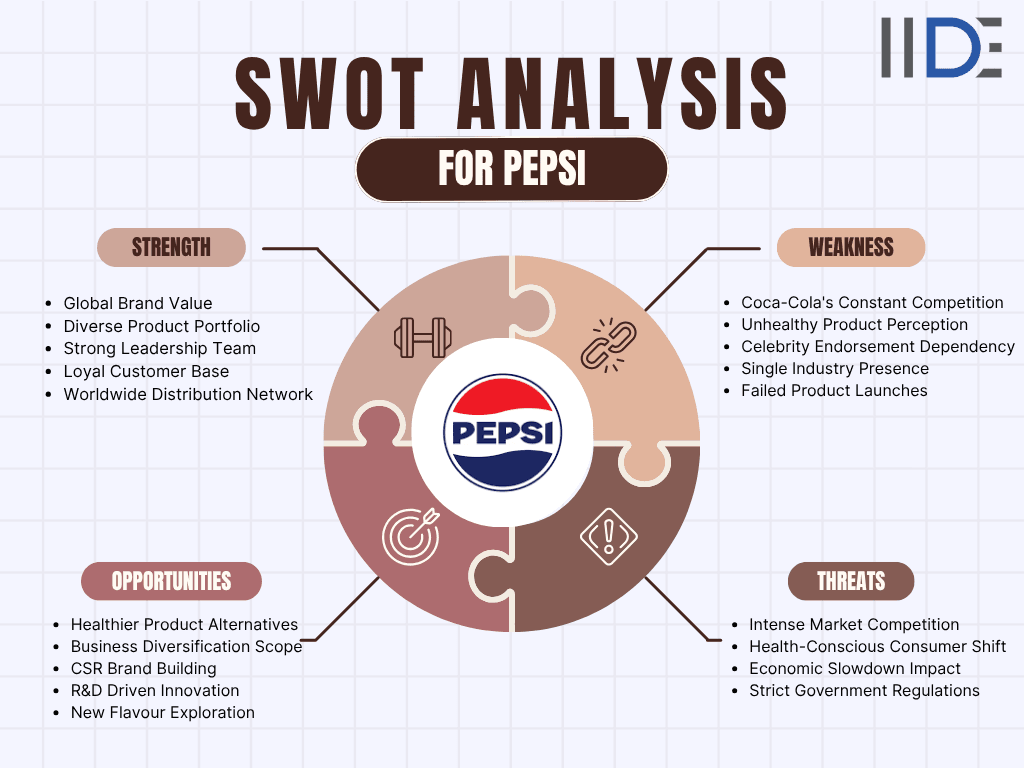
Internally, it highlights strengths like its diversified portfolio and cultural marketing edge, while flagging vulnerabilities like celebrity endorsement dependency and unhealthy product perception. Externally, it tracks rising health consciousness, flavour trends, and untapped markets while keeping Coca-Cola's dominance and economic slowdowns firmly in view.
Pepsi isn't the only legacy brand navigating these shifts. The marketing strategy of Coca-Cola is a masterclass in how emotional storytelling can insulate a brand from category headwinds, something Pepsi actively studies. In short, a SWOT analysis helps Pepsi stop reacting and start planning, turning raw market data into a sharper, more focused brand strategy.
Pepsi isn't the only FMCG giant navigating shifting consumer preferences. The Cadbury marketing strategy is a great example of how a legacy food brand successfully repositioned itself around evolving tastes without losing its core identity.
In short, a SWOT analysis helps Pepsi stop reacting and start planning, turning raw market data into a smarter, more focused business strategy.
Swot Analysis Of Pepsi
Pepsi has spent decades proving it's more than just a drink, it's a culture, a lifestyle, and a global brand. Here's an honest breakdown of where it stands today.
Strengths of Pepsi
- Brand Equity: Pepsi is one of the most recognised beverage brands on the planet, valued at $19.7 billion and ranked among Forbes' Most Valuable Brands. Known as the brand of youth, it has built its identity through decades of sports, music, and pop culture, including Super Bowl halftime sponsorships that reached 103.4 million viewers in 2022.
- Product Portfolio Performance: In India, Pepsi holds two of the top five selling drinks, Slice (6%) and Tropicana (6%), demonstrating that even as cola sales soften, the wider Pepsi ecosystem continues to perform. Its 23 billion-dollar brands, including Mountain Dew, Gatorade, Lay's, and Doritos, give it a diversified buffer most competitors simply can't match.
- Youth-First Marketing Identity: Pepsi has always owned the younger consumer. From Michael Jackson to Dua Lipa, its celebrity-led campaigns consistently position it as the bold, culturally relevant challenger, an identity built over decades that no rival can manufacture overnight.
- Strong Distribution: Pepsi has a global presence in 200+ countries, backed by a Direct Store Delivery (DSD) network that ensures faster restocking, maximum in-store visibility, and deep retail penetration across both developed and emerging markets.
- Innovation Capability: In July 2025, Pepsi launched Pepsi Prebiotic Cola, the first major cola innovation in 20 years, combining classic taste with prebiotic fibre. It signals a genuine strategic pivot toward functional beverages and health-conscious consumers.
- Brand Loyalty: Pepsi enjoys a deeply loyal consumer base built on long-term market stability. Pepsi trails only Nestlé in the global food and beverage space. The SWOT analysis of Nestlé offers a useful benchmark for understanding what sustained leadership across diverse categories actually demands.
Weaknesses of Pepsi
- Competition: Pepsi faces relentless pressure from Coca-Cola in its core soft drinks category, and in 2023, Dr Pepper overtook Pepsi as the second-largest soda brand in the U.S. The brand is losing ground on two fronts simultaneously.
- Products Perceived as Unhealthy: Pepsi's core products, colas, sodas, and fried snacks, carry an increasingly negative health perception. As consumers shift toward cleaner options, Pepsi is seen as part of the problem, not the solution.
- Celebrity Endorsement Risk: Pepsi's marketing leans heavily on celebrity partnerships. One controversy, like the widely pulled Kendall Jenner ad in 2017, can become a brand crisis overnight. Over-dependence on famous faces is a structural vulnerability.
- Failed Products: Crystal Pepsi, Pepsi A.M., Pepsi Kona, a long list of failed launches has repeatedly dented brand credibility and given competitors room to grow.
- North America Dependence: Approximately 60% of Pepsi's revenue comes from North America. Any domestic slowdown, regulatory shift, or consumer behaviour change hits disproportionately hard.
- Emotional Brand Gap: Coca-Cola wins hearts with timeless storytelling. Pepsi wins campaigns. That gap in emotional depth, built over generations, remains one of Pepsi's most persistent and hardest-to-close weaknesses.
Opportunities of Pepsi
- Healthy Options: Pepsi should double down on health-forward innovation. Diet Pepsi and Pepsi Zero Sugar are strong moves, and the 2025 launch of Pepsi Prebiotic Cola shows the brand is finally taking functional beverages seriously. More investment here is essential.
- Diversification: Business diversification through acquisitions is a massive opportunity. Pepsi's $1.95 billion acquisition of Poppi in 2025 shows the appetite is there, and the financial muscle to execute it.
- CSR: Pepsi's pep+ sustainability agenda, covering regenerative farming, water conservation, and plastic reduction, can rebuild brand goodwill and differentiate on values, not just taste. More visible CSR activity would help counter its unhealthy image.
- R&D: Pepsi Prebiotic Cola is a game-changer in the making. More such research, into Stevia-based drinks, protein-enhanced beverages, and low-sugar reformulations, needs to be accelerated. The functional beverage category is growing fast, and Pepsi has the scale to lead it.
- Flavour Innovation: Regional challengers like Paperboat in India have proven that locally rooted flavours, raw mango, watermelon, and kokum, resonate deeply with consumers. Pepsi, with its global manufacturing reach, can bring this flavour-forward thinking into carbonated formats and win new market segments.
Threats to Pepsi
- Competitors: Pepsi's primary competitors are Coca-Cola, Dr Pepper, Kraft Foods, Nestlé, and Mondelez, alongside fast-rising challenger brands like Olipop and Liquid Death that are capturing Gen Z's attention with health-first positioning.
- Health Factor: Declining soda consumption is a structural shift, not a blip. As health-conscious consumers move toward water, kombucha, and functional drinks, Pepsi's core cola category faces long-term volume erosion that marketing alone cannot reverse.
- Economic Slowdown: Pepsi expects a 3% EPS decline in 2025, partly driven by consumer belt-tightening. Recession, inflation, and cash-crunched households cut discretionary beverage spending first, and Pepsi feels that directly.
- Government Norms: Sugar taxes, advertising restrictions on high-calorie products, and mandatory nutrition labelling are expanding globally. Navigating 200+ different regulatory environments is a constant compliance burden, and any new sugar legislation hits Pepsi's core lineup hard.
Pepsi's biggest threat has always been Coca-Cola. Understanding the marketing strategy of Coca-Cola reveals how deeply the brand has built emotional loyalty across generations, making it a formidable rival that goes far beyond just price and distribution.

Is Digital Marketing the Right Career for You?
Find out in a free 45-min masterclass · Career paths, roles and growth explained · By Karan Shah, Founder & CEO, IIDE

Is Digital Marketing the Right Career for You?
Find out in a free 45-min masterclass · Career paths, roles and growth explained · By Karan Shah, Founder & CEO, IIDE
Conclusion:
Pepsi's strength lies in its cultural relevance, diversified portfolio, and a loyal consumer base that spans generations and geographies, making it far more than just a cola brand.
However, declining soda volumes, the loss of its number two U.S. soda spot to Dr Pepper, and an over-reliance on celebrity-driven marketing are challenges it cannot afford to ignore. By doubling down on functional beverages, flavour innovation, and strategic acquisitions like Poppi, Pepsi has all the tools to not just defend its position but reclaim it.
The brand's resilience over decades proves one thing clearly: Pepsi knows how to reinvent itself, and the next reinvention may be its most important yet.
Want to Know Why 2,50,000+ Students Trust Us?
Dive into the numbers that make us the #1 choice for career success



MBA - Level
Post Graduate in Digital Marketing & Business Strategy

Best For
Fresh Graduates

Mode of Learning
On Campus (Mumbai & Delhi)

Starts from
Nov 27, 2026

Duration
11 Months

Live & Online
Advanced Online Digital Marketing Course
Best For
Working Professionals
Mode of Learning
Online
Starts from
Nov 2, 2026
Duration
4-6 Months

Offline
Top AI Courses to Make You Future Ready!
Best For
AI Enthusiasts
Mode of Learning
2–5 Month Program
Starts from
Nov 24, 2026
Duration
Flexiable
Offline
Undergraduate Program in Digital Business & Entrepreneurship
Best For
12th Passouts
Mode of Learning
On Campus (Mumbai)
Duration
3 Years
Offline
Degree In 2026 ≠ Enough Degree + Digital Skills = Future-Ready
Best For
12th Passouts
Mode of Learning
At IIDE Campus
Duration
3 Years
Recent Post
In total revenue, PepsiCo surpasses Coca-Cola due to its diversified food and snack portfolio. However, in beverages alone, Coca-Cola dominates with approximately 50% global market share compared to Pepsi's 20%.
Pepsi's primary competitors are Coca-Cola, Dr Pepper, Kraft Foods, Nestlé, and Mondelez. In recent years, challenger brands like Olipop and Liquid Death have also emerged as threats, particularly among younger, health-conscious consumers.
Pepsi has launched Diet Pepsi, Pepsi Zero Sugar, and most recently Pepsi Prebiotic Cola in 2025, the first major cola innovation in 20 years, combining classic taste with prebiotic fibre to tap into the growing functional beverage market.
Pepsi was created in 1893 by pharmacist Caleb Bradham in New Bern, North Carolina, originally called Brad's Drink. It was renamed Pepsi-Cola in 1898 and has since grown into one of the world's most recognised beverage brands.

Lead Trainer & Business Development Head at IIDE
Aditya Shastri leads the Business Development segment at IIDE and is a seasoned Content Marketing expert. With over a decade of experience, Aditya has trained more than 20,000 students and professionals in digital marketing, collaborating with prestigious institutions and corporations such as Jet Airways, Godrej Professionals, Pfizer, Mahindra Group, Publicis Worldwide, and many others. His ability to simplify complex marketing concepts, combined with his engaging teaching style, has earned him widespread admiration from students and professionals alike.
Aditya has spearheaded IIDE’s B2B growth, forging partnerships with over 40 higher education institutions across India to upskill students in digital marketing and business skills. As a visiting faculty member at top institutions like IIT Bhilai, Mithibai College, Amity University, and SRCC, he continues to influence the next generation of marketers.
Apart from his marketing expertise, Aditya is also a spiritual speaker, often traveling internationally to share insights on spirituality. His unique blend of digital marketing proficiency and spiritual wisdom makes him a highly respected figure in both fields.