
Students Centric
Placements Report
Trackable results, real numbers
Reviews
Proven success, real voices
Trainers
Expert-led, Industry-Driven Training
Life at IIDE
Vibrant Spirit student life
Alumni
Successful Journeys, Inspiring Stories
Learning Centre
Webinars
Blogs
Case studies
Live, Interactive Masterclasses
Fresh Insights, quick reads
Real-life, Industry relevant
More
Hire from us
Hire Top Digital Marketing Talent
Work with us
Join Our Team, Make an Impact
Customised Training
Personalised digital marketing training for your company
Refer & earn
Simple, easy rewards
Contact us
Get the answers you need
About us
Know more about IIDE
Explore all course options

FOR FRESH GRADUATES
Post Graduation Program in Digital Marketing & Business Strategy- Ideal for Age: 20–25 Years

Can’t decide? Explore all our
Digital Marketing Courses
COMPARE BOTH OUR PROGRAMSOffline
Offline AI Courses with Dual CertificationsIndustry-Aligned TRACKMost Popular
UG Program in Digital Business & Entrepreneurship- Ideal for 12th Pass out / FY Degree Student

PARTNER PROGRAMS






Can’t decide? Explore all
BBA In Digital Marketing Colleges
Orginally Written by Aditya Shastri
Updated on May 22, 2026
Share on:


About Nokia
Nokia's story is one of resilience, reinvention, and long-term relevance. Founded as a paper mill in Finland in 1865, Nokia evolved through rubber and cable manufacturing before becoming the world's most recognisable mobile phone brand in the late 1990s and early 2000s.
After losing its smartphone dominance to Apple and Android in the late 2000s, Nokia made one of the boldest pivots in corporate history. It shifted its entire focus to telecom infrastructure, 5G network solutions, and digital technology.
Today, Nokia is not a phone company. It is a technology powerhouse that powers the networks the world runs on. In 2026, Nokia operates in over 100 countries, is headquartered in Espoo, Finland, and is led by CEO Justin Hotard, who took over in April 2025.
The company reported annual net sales of €19.89 billion in FY2025 and employs approximately 74,000 people worldwide.
Its strategic priorities include 5G expansion, AI-integrated networks, and early-stage 6G research, positioning it as a critical architect of the future of global connectivity.
Quick Stats about Nokia:
| Feature | Details |
|---|---|
| Founded | 1865, Finland |
| CEO | Justin Hotard (since April 2025) |
| Headquarters | Espoo, Finland |
| Global Presence | 100+ countries |
| Employees | ~74,000 (FY2025) |
| Annual Revenue | €19.89 billion (FY2025) |
| Core Business | 5G infrastructure, telecom networks, AI solutions |
| 2026 Strategic Focus | 5G scaling, AI-powered networks, 6G development |
| Key Competitors | Huawei, Ericsson, Samsung Networks |
Competitors of Nokia
While Nokia once competed with Samsung, Apple, Motorola, Vivo, and Xiaomi in the smartphone market, its 2026 competitors are a completely different league.
Today Nokia competes head-to-head with Huawei, Ericsson, Samsung Networks, Cisco, and ZTE in the global telecom infrastructure and 5G space.
Why Does Nokia's SWOT Analysis Matter in 2026?
The telecom industry in 2026 is at an inflection point. The global rollout of 5G is accelerating, AI is being embedded into network infrastructure, and early 6G research is already underway.
Understanding Nokia's position in this landscape is essential for anyone tracking the future of technology and connectivity.
Here is why this SWOT matters:
- Global 5G Race: With over 50 countries actively deploying 5G at scale in 2026, Nokia's role as a core infrastructure provider makes it central to this transformation.
- AI-Driven Networks: Telecom companies are rapidly integrating AI into network management and Nokia estimates this AI and Cloud serviceable addressable market at €60 billion by 2028.
- 6G on the Horizon: Nokia Bell Labs is among the few institutions globally already investing in 6G R&D, giving it a potential first-mover advantage in the next decade.
- Geopolitical Shifts: Western governments restricting Huawei have created a significant opening for Nokia to expand across North America, Europe, and allied markets.
- Sustainability Demands: Enterprises and governments are demanding greener network infrastructure, pushing Nokia to innovate in energy-efficient solutions.
- Private Wireless Boom: Nokia surpassed 1,001 private wireless network deployments globally in Q4 2025, a testament to explosive enterprise demand.

Is Digital Marketing the Right Career for You?
Find out in a free 45-min masterclass · Career paths, roles and growth explained · By Karan Shah, Founder & CEO, IIDE

Is Digital Marketing the Right Career for You?
Find out in a free 45-min masterclass · Career paths, roles and growth explained · By Karan Shah, Founder & CEO, IIDE
SWOT Analysis of Nokia
A SWOT Analysis provides a structured framework to evaluate a company's internal capabilities and external environment.
For Nokia in 2026, this analysis reveals a brand that has successfully repositioned itself from a consumer hardware giant to a B2B technology leader, but one that still faces significant headwinds in an intensely competitive landscape.
Strengths of Nokia: What Makes It a Global Telecom Leader in 2026
Nokia's transformation over the past decade has been extraordinary. Its strengths today are built not on nostalgia, but on genuine technological leadership and global infrastructure dominance.
Iconic Brand Trust and Global Recognition:
- Nokia's brand carries decades of trust, which is a rare and invaluable asset in the B2B technology space.
- While consumers associate Nokia with durable, reliable phones, telecom operators and enterprises associate it with reliable, enterprise-grade network infrastructure.
- This dual brand perception gives Nokia credibility at both the awareness level and the enterprise sales level.
- Nokia's Finnish heritage further reinforces associations with precision, quality, and engineering excellence.
5G Infrastructure Leadership:
- Nokia is one of only three global vendors, alongside Ericsson and Huawei, capable of delivering end-to-end 5G network infrastructure at scale.
- Its AirScale platform and ReefShark chipset technology have significantly improved network performance and energy efficiency for operators worldwide.
- Nokia was named a Leader in the 2025 Gartner Magic Quadrant for CSP 5G Core Network Infrastructure for the fifth consecutive year.
- Nokia's 5G Standalone architecture deployments are among the most advanced and widely deployed in the industry.
World-Class R&D Capabilities:
- Nokia invested €4.9 billion in R&D in FY2025, representing one of the most aggressive innovation investments in the telecom sector.
- Nokia Bell Labs, one of the world's most prestigious research institutions, is driving breakthrough innovation in 6G, quantum networking, and AI-native network architecture.
- Bell Labs developed key technologies like cellular networks, Unix, and the C programming language, and still shapes the future of global connectivity.
- Nokia holds tens of thousands of patent families, making it one of the most IP-rich companies in the technology sector.
Strong Positioning in the Post-Huawei Geopolitical Landscape:
- As several Western countries move away from Huawei equipment, Nokia has secured major network deals across the US, UK, Australia, Canada, India, and other markets.
- The company is also investing $4 billion in US R&D and manufacturing, showing strong confidence in its North American growth.
- This momentum is likely to continue beyond 2026 as Open RAN adoption increases demand for trusted telecom vendors.
- This geopolitical shift didn't happen overnight Huawei spent years undercutting rivals on price while aggressively locking in government contracts across Asia, Africa, and Europe.
A deeper look at the marketing strategy of Huawei shows exactly how it built that kind of reach, and why Western nations eventually grew uncomfortable with its dominance in critical infrastructure.
Diversified Business Portfolio:
- Nokia operates across four key business groups: Network Infrastructure, Mobile Networks, Cloud and Network Services, and Nokia Technologies.
- This diversification protects the company from over-reliance on any single revenue stream or customer segment.
- Its Nokia Technologies licensing division generates steady royalty income from its vast patent portfolio, providing resilient revenue even during telecom spending downturns.
Weaknesses of Nokia: Challenges That Still Hold It Back
Despite its impressive transformation, Nokia carries several structural and strategic weaknesses that continue to constrain its growth and profitability in 2026.
Marginalised Consumer Brand Presence:
- Nokia's exit from the premium smartphone market has made it largely invisible to younger, digitally native consumers.
- HMD Global, which licenses the Nokia brand for smartphones, produces mid-range and budget devices that fail to compete meaningfully against Apple, Samsung, or emerging Chinese brands.
- This lack of consumer-facing innovation means Nokia misses out on the brand-building benefits that come with direct consumer engagement.
- Younger enterprise decision-makers in 2026 do not instinctively associate Nokia with cutting-edge technology, and that is a perception gap the company has yet to fully bridge.
Profitability and Margin Pressure:
- Nokia's operating margins consistently face pressure, partly due to a higher cost base and intense price competition in emerging markets.
- Nokia announced cuts of Approximately 14,000 jobs starting in 2023 as part of a restructuring programme.
- Price wars in markets where Nokia competes directly with Huawei on cost continue to squeeze margins.
- The shift toward Open RAN, while strategically important, also introduces margin risk by commoditising parts of the network hardware stack.
Heavy Dependence on Telecom Operator Spending Cycles:
- Nokia's B2B-only model means its revenue is directly tied to the capital expenditure cycles of telecom operators globally.
- When operators pause or cut spending during economic downturns, Nokia's order book suffers disproportionately, as seen during the 2023 to 2024 operator spending pause following initial 5G build-outs.
- This cyclical vulnerability makes Nokia's revenue inherently difficult to predict and manage quarter to quarter.
Legacy of Slow Strategic Execution:
- Nokia's delayed response to the smartphone revolution in the late 2000s remains one of the most studied strategic failures in business history.
- Even in the 5G era, Nokia faced technical setbacks and product delays in its early 5G portfolio that temporarily cost it market share to Ericsson.
- While the company has largely recovered, this history creates lingering concerns among investors and operators about Nokia's ability to execute swiftly during critical technology transitions.
Opportunities for Nokia: Where Growth Comes From in 2026 and Beyond
The global technology landscape in 2026 presents Nokia with several compelling growth opportunities that align directly with its core competencies.
6G Development and Early-Mover Advantage:
- 6G is expected to begin commercial deployment between 2030 and 2035, and the foundational groundwork is being laid right now.
- Nokia Bell Labs is at the forefront of global 6G research, exploring terahertz spectrum usage, intelligent network surfaces, and sub-millisecond latency capabilities.
- Securing early patents and actively shaping global 6G standards today will give Nokia a decisive competitive advantage when the technology commercialises.
- Governments in the EU, US, South Korea, and Japan are already funding 6G research programmes and Nokia is an active participant in several of these initiatives.
AI and Automation Integration in Networks:
- Nokia estimates its AI and Cloud serviceable addressable market at €60 billion by 2028, making this the single largest growth opportunity in its portfolio.
- Nokia's AVA platform and AI-native network architecture position it as a tier-one provider of intelligent network solutions for telecom operators worldwide.
- Telecom operators are under enormous pressure to reduce operational costs while improving network quality, and AI-powered automation directly addresses both needs simultaneously.
- The demand for self-healing, self-optimising networks is rapidly becoming a baseline expectation rather than a premium feature.
Private Wireless Networks for Enterprises:
- The enterprise private wireless network market, where factories, airports, ports, and campuses deploy their own dedicated 5G or LTE networks, is one of the fastest-growing segments in enterprise technology.
- Nokia surpassed 1,001 private wireless network deployments globally in Q4 2025, confirming its leadership position in this high-margin segment.
- Industries including manufacturing, logistics, healthcare, mining, and defence are all accelerating private network adoption and Nokia is positioned as the preferred global vendor.
- Private networks command significantly higher margins than carrier infrastructure contracts, making this segment crucial to Nokia's long-term profitability improvement.
Nokia's 5G dominance does not exist in a vacuum. The telecom sector is full of players competing for the same infrastructure budgets, and the SWOT analysis of Globe Telecom puts that competitive intensity into sharp perspective.
Expansion into Emerging Markets:
- Africa, Southeast Asia, and Latin America represent massive, underpenetrated opportunities for telecom infrastructure investment
- Rising smartphone adoption, government-backed digital connectivity programmes, and growing enterprise demand in these regions are driving significant telecom capital expenditure.
- Nokia's established presence in over 100 countries gives it a strong platform to deepen its footprint in these high-growth markets.
- Localised pricing strategies and partnerships with regional operators and governments could unlock substantial new revenue streams.
Sustainability-Driven Infrastructure Modernisation:
- Governments and enterprises worldwide are mandating reductions in the energy consumption of digital infrastructure.
- Nokia's focus on energy-efficient network solutions, including AirScale base stations that consume significantly less power than previous generations, positions it well to win contracts from sustainability-conscious operators.
- The EU's Green Deal and similar regulatory frameworks globally are accelerating demand for eco-efficient telecom infrastructure, directly benefiting Nokia's product roadmap.
Threats to Nokia: Risks That Could Derail Its Growth
Nokia operates in an environment full of external pressures that demand constant strategic vigilance.
Intense Competition from Huawei, Ericsson and Samsung:
- Huawei, despite geopolitical restrictions in Western markets, remains dominant across Asia, Africa, and the Middle East, which are regions Nokia needs for meaningful growth.
- Ericsson continues to compete fiercely for the same North American and European contracts, often with comparable technology and aggressive pricing strategies.
- Samsung Networks is emerging as a credible 5G RAN vendor, particularly in the US and South Korean markets, adding a formidable third competitor to an already crowded field.
- Price-based competition in emerging markets can erode Nokia's margins and challenge its premium market positioning.
Rapid Pace of Technological Disruption:
- The telecom industry is evolving faster than almost any other sector, with Open RAN, network virtualisation, cloud-native architectures, and AI integration simultaneously reshaping the competitive landscape.
- Falling behind on any of these fronts, even temporarily, could cost Nokia significant contract wins and long-term market share.
Even the most dominant enterprise technology companies are not immune to this pressure. The SWOT analysis of SAP shows how quickly market leadership can be challenged when the technology landscape shifts faster than a company can respond.
Macroeconomic and Geopolitical Uncertainty:
- Global economic slowdowns and rising interest rates reduce telecom operator capital expenditure, directly and immediately impacting Nokia's order book.
- Trade wars, export restrictions, and international sanctions, particularly in the context of ongoing US-China tensions, create operational and supply chain risks for a company with truly global operations.
- Currency fluctuations affect Nokia's reported revenue significantly, given it operates across 100+ countries with diverse monetary environments.
Cybersecurity and Network Integrity Risks:
- As a provider of critical national infrastructure for dozens of governments worldwide, Nokia faces heightened scrutiny around cybersecurity and network integrity.
- Any major security vulnerability in Nokia's network equipment could have catastrophic reputational and financial consequences, far beyond what most technology companies face.
- Nation-state-level cyberattacks targeting telecom infrastructure are increasing in frequency and sophistication in 2026, adding material operational risk to Nokia's business model.
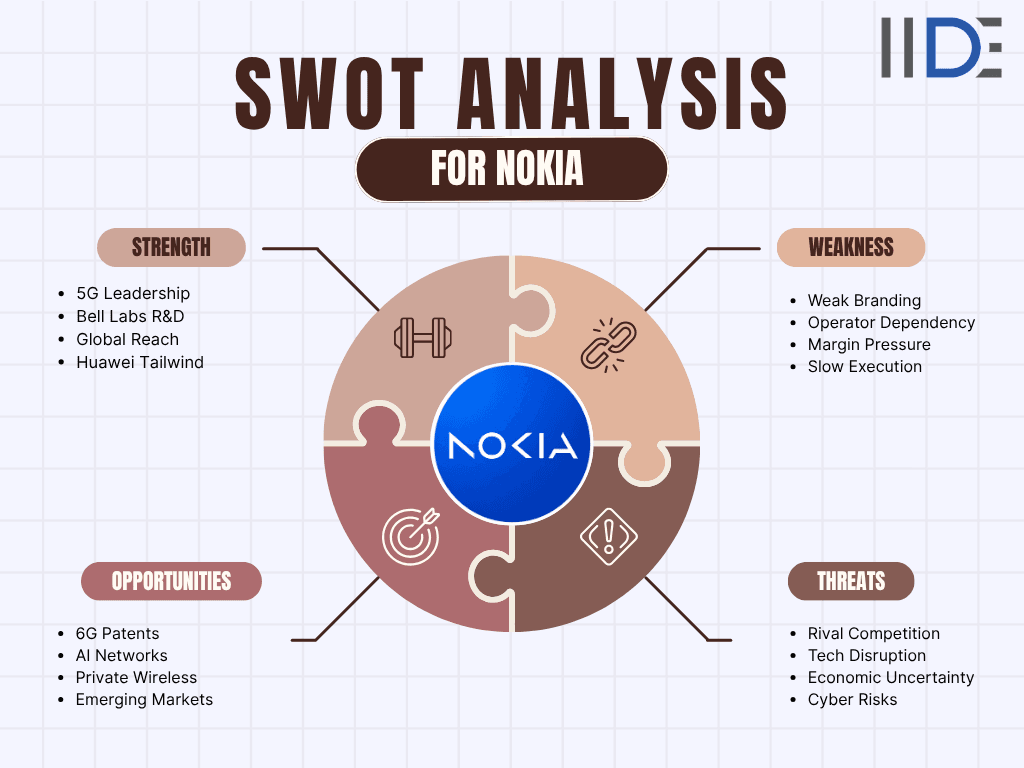
Summary Table - SWOT of Nokia
 IIDE Student Takeaway, Recommendations & Conclusion for Nokia in 2026 and Beyond
Nokia's SWOT analysis paints the picture of a brand that has successfully navigated one of the most dramatic transformations in corporate history, but one that cannot afford to rest on that achievement.
Core Tension: Nokia's greatest strength, its deep integration into global telecom infrastructure, is also its greatest vulnerability. Its revenue is almost entirely dependent on the capital expenditure decisions of a relatively small number of large telecom operators, making it acutely sensitive to macroeconomic cycles.
Future Outlook: Nokia's long-term success hinges on three pillars. Winning the 6G standards race, scaling its AI and Cloud network solutions faster than competitors, and dominating the enterprise private wireless market. If it executes on all three, it has a genuinely compelling case for sustained growth through 2030 and beyond.
Recommendations:
- Accelerate 6G R&D and Patent Leadership: Nokia Bell Labs should double down on 6G research and aggressively build its patent portfolio to ensure it shapes and commercially benefits from the next generation of wireless standards.
- Scale Enterprise Private Networks Aggressively: With 1,001+ deployments already in the books and a massive untapped market ahead, Nokia should invest heavily in vertical-specific solutions for manufacturing, healthcare, logistics, and defence.
- Strengthen AI and Cloud-Native Portfolio: Nokia must continue evolving from a hardware-first to a software-and-AI-first company to protect margins and remain relevant as networks virtualise.
- Invest in Brand Modernisation: Nokia needs to update its brand narrative for the next generation of enterprise decision-makers. Storytelling around Bell Labs innovation, AI leadership, and 6G vision can help shift perceptions meaningfully.
- Deepen Presence in High-Growth Markets: Southeast Asia, India, and Africa represent the next wave of major telecom infrastructure investment. Nokia should prioritise these markets with competitive pricing, local partnerships, and government engagement.
Nokia in 2026 is proof that even the most iconic fallen giants can reinvent themselves.
From a paper mill in 1865 to the world's most recognisable phone brand, and now to a global 5G infrastructure powerhouse, Nokia's story is not a comeback. It is a complete reinvention built on relentless execution, world-class R&D, and the boldness to walk away from what once made it famous.
Its strengths in 5G leadership, Bell Labs innovation, and geopolitical tailwinds give it a genuine competitive edge. But consumer invisibility, margin pressure, and dependence on telecom spending cycles remain real vulnerabilities.
The €60 billion AI network opportunity is enormous, but Huawei, Ericsson, and Samsung will not make it easy.
Nokia's next decade will be defined by how fast it can scale AI-driven networks, win the 6G standards race, and dominate the enterprise private wireless market.
For students, marketers, and business strategists, Nokia remains one of the most powerful case studies of our time. Long-term brand resilience is never built on nostalgia. It is built on relentless relevance.
Want to Know Why 2,50,000+ Students Trust Us?
Dive into the numbers that make us the #1 choice for career success



MBA - Level
Post Graduate in Digital Marketing & Business Strategy

Best For
Fresh Graduates

Mode of Learning
On Campus (Mumbai & Delhi)

Starts from
Nov 27, 2026

Duration
11 Months

Live & Online
Advanced Online Digital Marketing Course
Best For
Working Professionals
Mode of Learning
Online
Starts from
Nov 2, 2026
Duration
4-6 Months

Offline
Top AI Courses to Make You Future Ready!
Best For
AI Enthusiasts
Mode of Learning
2–5 Month Program
Starts from
Nov 23, 2026
Duration
Flexiable

Offline
Undergraduate Program in Digital Business & Entrepreneurship
Best For
12th Passouts
Mode of Learning
On Campus (Mumbai)
Starts from
-
Duration
3 Years
Offline
Degree In 2026 ≠ Enough Degree + Digital Skills = Future-Ready
Best For
12th Passouts
Mode of Learning
At IIDE Campus
Starts from
-
Duration
3 Years
Recent Post
You May Also Like
Nokia has shifted from smartphones to being a global telecom infrastructure leader, focusing on 5G networks, cloud, and digital health technologies.
Nokia failed to transition from Symbian to a competitive smartphone OS on time, allowing Apple and Samsung to dominate before Nokia could adapt.
Ericsson, Huawei, and Samsung lead in telecom infrastructure, while Apple, Xiaomi, and Motorola dominate in the handset segment.
Yes, Nokia remains profitable primarily through its network infrastructure and licensing divisions, though consumer electronics revenue is minimal compared to its peak years.

Lead Trainer & Business Development Head at IIDE
Aditya Shastri leads the Business Development segment at IIDE and is a seasoned Content Marketing expert. With over a decade of experience, Aditya has trained more than 20,000 students and professionals in digital marketing, collaborating with prestigious institutions and corporations such as Jet Airways, Godrej Professionals, Pfizer, Mahindra Group, Publicis Worldwide, and many others. His ability to simplify complex marketing concepts, combined with his engaging teaching style, has earned him widespread admiration from students and professionals alike.
Aditya has spearheaded IIDE’s B2B growth, forging partnerships with over 40 higher education institutions across India to upskill students in digital marketing and business skills. As a visiting faculty member at top institutions like IIT Bhilai, Mithibai College, Amity University, and SRCC, he continues to influence the next generation of marketers.
Apart from his marketing expertise, Aditya is also a spiritual speaker, often traveling internationally to share insights on spirituality. His unique blend of digital marketing proficiency and spiritual wisdom makes him a highly respected figure in both fields.