Application Deadline for 3-Year UG Program closes on 31st Aug. Book a Counselling to know more

Students Centric
Placements Report
Trackable results, real numbers
Reviews
Proven success, real voices
Trainers
Expert-led, Industry-Driven Training
Life at IIDE
Vibrant Spirit student life
Alumni
Successful Journeys, Inspiring Stories
Learning Centre
Webinars
Blogs
Case studies
Live, Interactive Masterclasses
Fresh Insights, quick reads
Real-life, Industry relevant
More
Hire from us
Hire Top Digital Marketing Talent
Work with us
Join Our Team, Make an Impact
Customised Training
Personalised digital marketing training for your company
Refer & earn
Simple, easy rewards
Contact us
Get the answers you need
About us
Know more about IIDE
Explore all course options

FOR FRESH GRADUATES
Post Graduation Program in Digital Marketing & Business Strategy- Ideal for Age: 20–25 Years

Can’t decide? Explore all our
Digital Marketing Courses
COMPARE ALL 3 PROGRAMSOnline & Offline
Explore Top AI CoursesIndustry-Aligned TRACKMost Popular
UG Program in Digital Business & Entrepreneurship- Ideal for 12th Pass out / FY Degree Student

PARTNER PROGRAMS







Can’t decide? Explore all
BBA In Digital Marketing Colleges
Orginally Written by Aditya Shastri
Updated on Aug 9, 2025
Share on:


About Caterpillar
Caterpillar Inc. is a leading producer of construction equipment. The company is a part of the Dow Jones Industrial Average and is commonly known for its construction equipment and mining industry. The company traces its roots back to 1925 when the Holt Manufacturing Company and C.L. Best Tractor Company merged to create a new entity, which became Caterpillar Tractor Company.
In 1986, it was reorganized into a Delaware corporation. In January 2017, the company moved its headquarters to Deerfield, Illinois. It scrapped plans to build a new headquarters complex in the nearby city of Peoria. The company also sells a line of workwear and clothing under its Cat / Caterpillar name. Aside from machinery and equipment, Caterpillar also offers a variety of products such as smartphones and tablets.
| Founder | Clarence Leo Best |
|---|---|
| Year Founded | 1925 |
| Origin | California, United States |
| No. of Employees | 97,300 |
| Company Type | Public |
| Market Cap | $113.20 Billion (2021) |
| Annual Revenue | $41.74 Billion (2020) |
| Net Income | $2.99 Billion (2020) |
Products of Caterpillar
Caterpillar has been manufacturing and selling the following products –
- Forestry equipment
- Mining and Construction machinery
- Diesel and Natural gas engines.
Competitors of Caterpillar
Below are the major five competitors of Caterpillar –
- CNH Industrial
- Aggreko
- Wabtec
- Cummins
- Liebherr Group
SWOT Analysis of Caterpillar
1. Strengths of Caterpillar
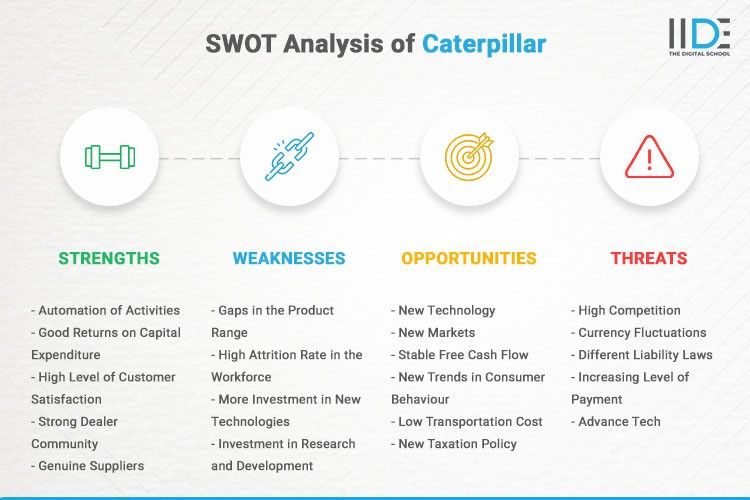
Your organization’s strength is something that makes it stand out from the rest. It can be a competitive advantage that sets it apart from its competitors. Some of the strengths of Caterpillar are as follows –
- Automation of Activities: Automation of activities has given rise to the density of quality to Caterpillar products and has permitted the company to scale up and scale down based on the demand conditions in the market.
- Good Returns on Capital Expenditure: Caterpillar is moderately successful at the performance of new projects and has developed good returns on capital expenditure by creating new revenue streams.
- High Level of Customer Satisfaction: Having a committed relationship with their customers helps them to achieve a high level of customer fulfilment among present customers and good brand equity among future customers.
- Strong Dealer Community: This culture encourages the dealers to promote the company’s products and services and also helps the sales team to explain the benefits of the products to the customers.
- Genuine Suppliers: It has a powerful base of reliable suppliers of raw material, thus facilitating the company to survive any supply chain bottlenecks.
- Highly Skilled Workforce: Caterpillar is Ji-empowering large resources in the training and development of its employees, resulting in a workforce that is not only highly competent but also motivated to achieve a surplus.
2. Weaknesses of Caterpillar
Weaknesses are negative factors that can prevent an organization from achieving its goals and objectives. Some of these include a poor brand, high levels of debt, inadequate supply chains, and lack of capital. So here are some of the weaknesses of Caterpillar –
- Gaps in the Product Range: There are gaps in the product range sold by the company. This deficiency of options can give a new competitor a foothold in the market.
- High Attrition Rate in the Workforce: As compared to other organizations, Caterpillar has a higher deterioration rate and has to spend a lot more as compared to its competitors.
- Days Inventory is High as Compared to the Competitors: Making the company boost more capital to empower in the channel. This can affect the long-term growth of Caterpillar.
- More Investment in New Technologies: As the company embarks on its next phase of expansion, it needs to invest in new technologies that can help it achieve its goals. Currently, investment in technology does not meet the ideas that a company has.
- Investment in Research and Development: Investment in Research and Development is below the rapidly growing players in the industry. Even though Caterpillar is consuming above the industry average on Research and Development, it has not been able to compete with the leading players in the industry regarding innovation.
3. Opportunities for Caterpillar
Opportunity is a type of competitive advantage that can be gained from various external factors. For instance, if a country lowers its tariffs, a car manufacturer can benefit by exporting its products to a new market. Opportunities for Caterpillar are as follows –
- New Technology: Caterpillar may now use differential pricing in the new market thanks to the new technology. It will motivate the company to reinforce its existing clients via excellent service while also attracting new customers through various value-oriented offers.
- New Markets: The adoption of new technology criteria and government free trade agreements has provided Caterpillar with an opportunity to enter a newly developing market.
- Stable Free Cash Flow: Stable free cash flow gives opportunities to empower contiguous product segments. With extra cash in the bank, the company can empower new technologies as well as in new product segments.
- New Trends in Consumer Behaviour: New trends in consumer behavior can open up a new market for Caterpillar. It gives a great opportunity for the organization to build new revenue streams and modify them into new product categories too.
- Low Transportation Cost: Decreasing the cost of transportation because of shorter shipping prices can also bring down the cost of Caterpillar’s products thus providing an opportunity to the company – either to increase the profitability of the company or acceptable on the benefits to the customers to gain market share. So this is one of the biggest opportunities for Caterpillar because by doing this they can save a lot of money.
- New Taxation Policy: The new taxation policy can considerably impact the way of doing business and can open new opportunities for established players such as Caterpillar to increase its profitability.
4. Threats to Caterpillar
Many factors can affect your business outside its immediate environment. Some of these include factors such as a shortage of skilled workers or a supply chain issue. The threats Caterpillar is facing are as follows –
- High Competition: Caterpillar’s stable profitability has increased many competitors in the industry over the last two years which has put downward pressure on not only profitability but also on overall sales, so this is one of the biggest threats for Caterpillar.
- Currency Fluctuations: As the company is operating in numerous countries it is exposed to currency fluctuations especially given the volatile political climate in several of the markets across the world.
- Different Liability Laws: Liability laws in different countries are different and Caterpillar may be exposed to various liability claims given changes in policies in those markets.
- Increasing Level of Payment: Rising pay levels, especially movements such as $15 an hour and increasing prices in China, can lead to serious pressure on the profitability of Caterpillar.
- Competitors Advance Technologies: New technologies developed by competitors or market disruptors could be a serious threat to the industry in the medium to long term future. This is because due to the new technologies developed by the competitors they would be able to do more production, and because of more production, they would be able to supply more as per the demand. New technologies also help in reducing the cost of production.
- Increasing Trend Towards Isolationism: An increasing trend towards isolationism in the American economy can lead to similar reactions from other governments, thus negatively impacting international sales.
On this note, we come to the end of the SWOT Analysis of Caterpillar. Let’s briefly conclude the case study in the following section.

Is Digital Marketing the Right Career for You?
Find out in a free 45-min masterclass · Career paths, roles and growth explained · By Karan Shah, Founder & CEO, IIDE

Is Digital Marketing the Right Career for You?
Find out in a free 45-min masterclass · Career paths, roles and growth explained · By Karan Shah, Founder & CEO, IIDE
Want to Know Why 2,50,000+ Students Trust Us?
Dive into the numbers that make us the #1 choice for career success



MBA - Level
Post Graduate in Digital Marketing & Business Strategy

Best For
Fresh Graduates

Mode of Learning
On Campus (Mumbai & Delhi)

Starts from
Oct 1, 2026

Duration
11 Months

Live & Online
Advanced Online Digital Marketing Course
Best For
Working Professionals
Mode of Learning
Online
Starts from
Sep 4, 2026
Duration
4-6 Months

Online
Professional Certification in AI Strategy
Best For
AI Enthusiasts
Mode of Learning
Online
Starts from
Sep 8, 2026
Duration
5 Months

Online or Offline
Top AI Courses to Make You Future Ready!
Best For
AI Enthusiasts
Mode of Learning
2–5 Month Program
Starts from
Sep 8, 2026
Duration
Flexiable

On Campus
Advanced Certification in Artificial Intelligence
Best For
AI Enthusiasts
Mode of Learning
On Campus (Mumbai)
Starts from
Sep 1, 2026
Duration
3 Months
Offline
Degree In 2026 ≠ Enough Degree + Digital Skills = Future-Ready
Best For
12th Passouts
Mode of Learning
At IIDE Campus
Starts from
Aug 31, 2026
Duration
3 Years

Offline
Undergraduate Program in Digital Business & Entrepreneurship
Best For
12th Passouts
Mode of Learning
On Campus (Mumbai)
Starts from
Aug 31, 2026
Duration
3 Years
Recent Post

Lead Trainer & Business Development Head at IIDE
Aditya Shastri leads the Business Development segment at IIDE and is a seasoned Content Marketing expert. With over a decade of experience, Aditya has trained more than 20,000 students and professionals in digital marketing, collaborating with prestigious institutions and corporations such as Jet Airways, Godrej Professionals, Pfizer, Mahindra Group, Publicis Worldwide, and many others. His ability to simplify complex marketing concepts, combined with his engaging teaching style, has earned him widespread admiration from students and professionals alike.
Aditya has spearheaded IIDE’s B2B growth, forging partnerships with over 40 higher education institutions across India to upskill students in digital marketing and business skills. As a visiting faculty member at top institutions like IIT Bhilai, Mithibai College, Amity University, and SRCC, he continues to influence the next generation of marketers.
Apart from his marketing expertise, Aditya is also a spiritual speaker, often traveling internationally to share insights on spirituality. His unique blend of digital marketing proficiency and spiritual wisdom makes him a highly respected figure in both fields.