
Students Centric
Placements Report
Trackable results, real numbers
Reviews
Proven success, real voices
Trainers
Expert-led, Industry-Driven Training
Life at IIDE
Vibrant Spirit student life
Alumni
Successful Journeys, Inspiring Stories
Learning Centre
Webinars
Blogs
Case studies
Live, Interactive Masterclasses
Fresh Insights, quick reads
Real-life, Industry relevant
More
Hire from us
Hire Top Digital Marketing Talent
Work with us
Join Our Team, Make an Impact
Customised Training
Personalised digital marketing training for your company
Refer & earn
Simple, easy rewards
Contact us
Get the answers you need
About us
Know more about IIDE
Explore all course options

FOR FRESH GRADUATES
Post Graduation Program in Digital Marketing & Business Strategy- Ideal for Age: 20–25 Years

Can’t decide? Explore all our
Digital Marketing Courses
FOR STUDENTSOn-campus
Advanced Certification in AI
FOR WORKING PROFESSIONALSOnline
Professional Certification in AI StrategyIndustry-Aligned TRACKMost Popular
UG Program in Digital Business & Entrepreneurship- Ideal for 12th Pass out / FY Degree Student

PARTNER PROGRAMS







Can’t decide? Explore all
BBA In Digital Marketing Colleges
Orginally Written by Aditya Shastri
Updated on Jun 25, 2026
|2,715K+ views
Caliber Shoes' biggest strength is a loyal domestic customer base backed by 25+ years of manufacturing expertise and a 25+ outlet network built in just three years. Its main weakness is limited digital infrastructure. The biggest opportunity is Nepal's 7.2% CAGR footwear market growth, while cheap Chinese imports remain its most persistent threat.
Before diving into the article, I'd like to inform you that the research and initial analysis for this piece were conducted by Jhanvi Kotian, a current student in the IIDE's online digital marketing course batch, December 2025. If you found this helpful, feel free to send Jhanvi Kotian a quick note of appreciation. It will mean a lot!
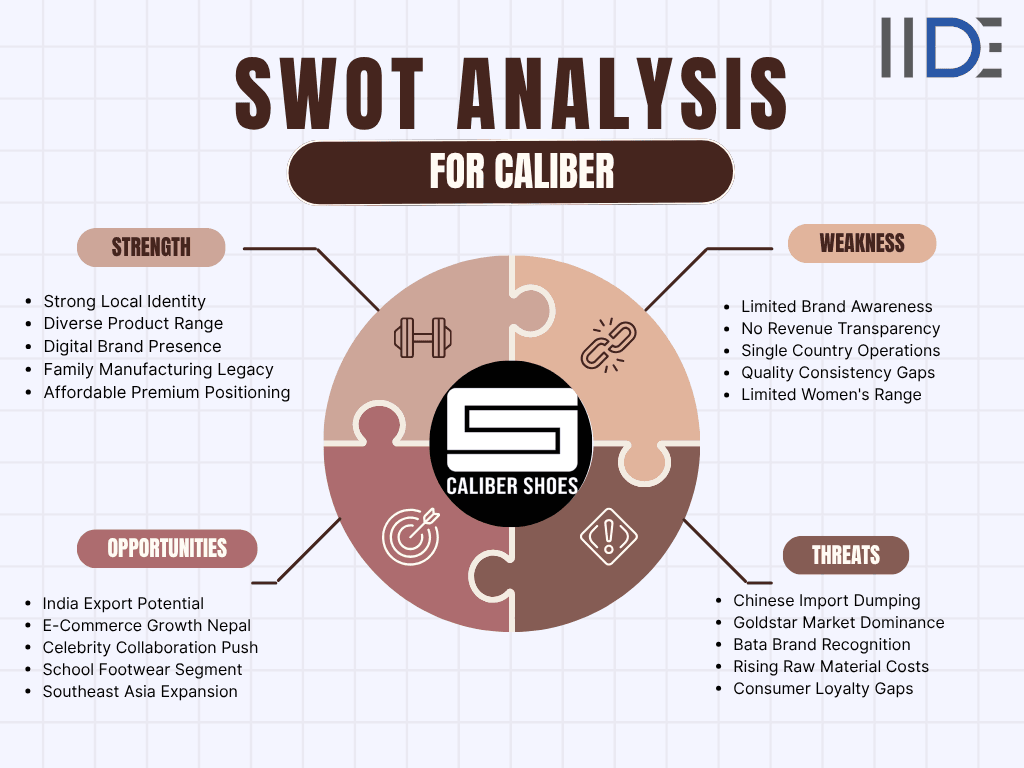
SWOT Quadrant:
| STRENGTHS | WEAKNESSES |
|---|---|
| 25+ years of manufacturing expertise | Limited DTC e-commerce infrastructure |
| 25+ outlets achieved in just 3 years | No publicly disclosed financial data |
| Malaysia outlet first international step | Limited brand awareness outside Kathmandu |
| 70%+ women workforce, strong CSR story | Heavy dependence on Nepal's domestic market |
| Full range: Men, Women, Junior across all categories | Smaller scale vs Goldstar's 75,000 pairs/day |
| OPPORTUNITIES | THREATS |
| Nepal footwear market growing at 7.2% CAGR | Cheap Chinese imports are flooding the market |
| Strengthen the DTC e-commerce channel | Goldstar's dominant scale and 50+ year legacy |
| Growing "Buy Nepali" consumer sentiment | International brands: Nike, Adidas gaining traction |
| Export expansion to India and SE Asia | Counterfeit products are damaging local brand trust |
| Tier-2 city retail and marketing expansion | Consumer trade-down under economic pressure |
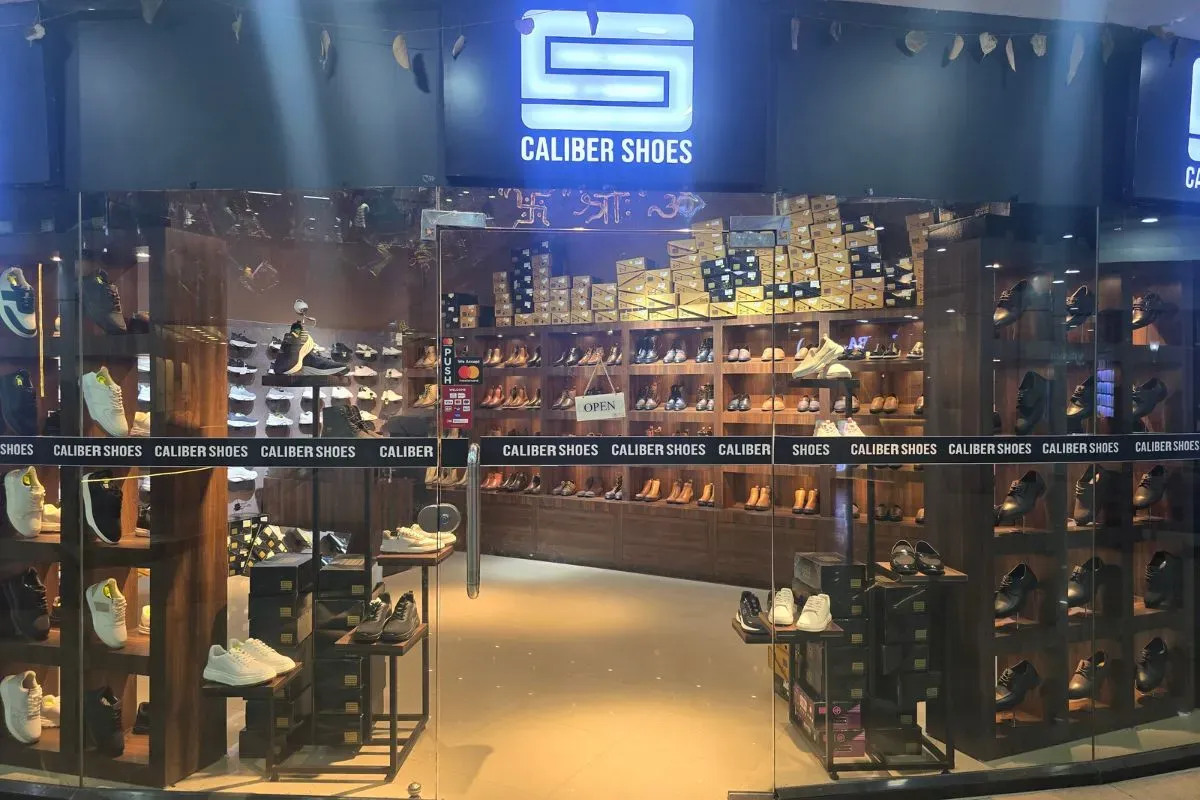
Calibre's diverse product range, from sports sneakers to formal shoes, mirrors the brand-building journey of India's most iconic footwear company, best explored through the Marketing Strategy of Bata India.

Learn Digital Marketing for FREE


Strengths of Caliber Shoes
Caliber's strengths are not built on marketing spend; they are built on craft, consistency, and a founding team that came up through the shoemaking business before they built a brand around it. Every strength listed below is traceable to a verifiable operational fact.
1. Deep Manufacturing Expertise Across the Founding Team
- K.D. Shoes Industries, Caliber's parent company, has over 20 years of experience in shoe manufacturing.
- Chairman Kalidash Goutama has dedicated 25+ years to shoe manufacturing and transformed the traditional footwear landscape in Nepal.
- Director Prashanna Gautam brings 15+ years of experience and was trained at the Footwear Design & Development Institute (FDI) in Noida, India.
- Director Aman Gautam adds 10+ years in the business and holds an MBA in Marketing from Ace Institute of Management.
Why it matters: In a market flooded with cheap imports, a brand with verifiable manufacturing depth has a quality argument that no amount of advertising spend can fake. Caliber's leadership did not grow up in this industry; they grew up in it.
2. Rapid Retail Expansion 25 Outlets Achieved 2 Years Ahead of Target
- Caliber's original plan was 25 outlets in 5 years from founding.
- The brand hit that target in just 3 years, two full years ahead of schedule.
- Outlets now span multiple major cities across Nepal.
- Growth was driven by what the brand calls a fine combination of comfort, style, and quality workmanship.
Why it matters: In Nepal's retail environment, physical store presence is still the primary trust signal. Hitting an aggressive expansion target two years early reflects genuine consumer demand, not manufactured hype.
3. First International Outlet in Malaysia
- Caliber has opened an outlet in Malaysia, becoming one of the very few Nepali footwear brands to establish an international retail presence.
- The Malaysia outlet was described by the brand as taking the local name to the international arena.
- It serves as an assurance of the brand's durability, quality, and international viability.
Why it matters: The Malaysia outlet proves Caliber's product quality can travel. It opens a proof-of-concept for export market positioning that no amount of domestic marketing can replicate.
4. Women-Led Workforce: A CSR Story Built Into the Business Model
- More than 70% of Caliber's total workforce is women.
- Artisan training starts with hand-sewing, progresses to simple machine patterns, and eventually full machine mastery.
- The brand provides training, fair wages, and meaningful employment to women in a country described by the brand itself as socially stratified.
- Caliber's mission statement includes empowering female artisans as a core pillar alongside product quality.
Why it matters: This is not a CSR add-on; it is embedded in the manufacturing model. As conscious consumerism grows among Nepal's urban middle class, a brand with a verifiable women-empowerment story has a loyalty advantage competitors cannot replicate.
5. Complete Product Range with 6-Month Warranty
- Caliber offers footwear for men, women, and juniors across sports, casual, formal, boot, sandal, and suede categories.
- Current price range runs from NPR 3,250 (sports shoes) to NPR 4,450 (premium casual sneakers).
- All products carry a 6-month warranty, backed by high-quality materials to maintain durability and aesthetics.
- The brand also sells accessories, shoe polish, and shoe shampoo , extending the product ecosystem.
Why it matters: A full family range with a warranty commitment signals quality confidence. It positions Caliber as a one-stop footwear destination rather than a single-segment niche brand.
Weaknesses of Caliber Shoes
Caliber's weaknesses are largely the structural gaps of a fast-growing private company that has prioritised physical expansion over digital maturity and operated largely on word-of-mouth rather than published data. None of these is fatal, but all of them are holding the brand back from the next level.
1. No Full DTC E-Commerce Outside Kathmandu Valley
- Caliber's website (calibershoes.com) is functional but restricts cash-on-delivery to Kathmandu Valley only.
- Customers outside the valley are pushed to third-party platforms like Daraz, where Caliber loses direct margin and customer data.
- No live chat, limited product reviews, and no visible nationwide delivery commitment are visible on the current website.
Why it matters: As Nepal's digital commerce infrastructure matures, brands that don't own their full-funnel digital sales channel permanently surrender margin and customer relationships to intermediaries.
2. No Publicly Disclosed Financial Data
- Caliber is a private company and publishes no revenue, profit, production volume, or growth figures.
- This makes it impossible for analysts, journalists, students, and investors to independently assess its actual market position.
- It also limits the verifiable, sourced authority that helps content about Caliber rank well on Google under E-E-A-T signals.
Why it matters: In an era of E-E-A-T, both brands and the content written about them are penalised for a lack of verifiable data. Publishing even basic metrics would significantly improve Caliber's credibility ceiling.
3. Limited Brand Visibility Outside Kathmandu
- Marketing activity, social media content, and brand events are visibly concentrated in Kathmandu.
- Rural Nepal and Tier-2 cities, which hold the majority of Nepal's population, are underserved from a brand-awareness standpoint.
- The Daraz store listing shows limited product availability with COD restricted to the valley.
Why it matters: The next wave of Nepali consumers with rising incomes will largely come from outside Kathmandu. Brands that build visibility in those markets now will be near-impossible to displace later.
4. Smaller Production Scale vs Dominant Competitor
- Goldstar produces over 75,000 pairs of footwear daily and has been building its brand for over five decades.
- Caliber, while growing steadily, has not disclosed its production capacity, making a direct comparison difficult, but the scale gap is real.
- Goldstar's price floor (from NPR 500) is well below Caliber's entry point of NPR 3,250.
Why it matters: Production volume drives cost efficiency. Until Caliber reaches a comparable scale, it will always carry a structural cost disadvantage against Goldstar in the price-sensitive segments where most Nepali buyers shop.
5. Heavy Dependence on Nepal's Single Domestic Market
- Outside of one Malaysia outlet, Caliber's entire revenue base sits in Nepal.
- Any economic shock, political instability, or consumer sentiment shift in Nepal hits the full business with zero geographic buffer.
- Nepal's economy has seen periods of inflation, remittance income volatility, and political uncertainty in recent years.
Why it matters: Market concentration risk is the silent weakness of every fast-growing domestic brand. Even modest export revenue from India would give Caliber a resilience cushion it currently does not have.
Opportunities for Caliber Shoes
Caliber's opportunity set in 2026 is real and well-aligned with the brand's existing strengths. The "Made in Nepal" story, women-led manufacturing, and multi-category product range are all assets that map directly onto the trends shaping the next phase of Nepal's footwear market.
1. Build a Full Nationwide DTC E-Commerce Channel
- Caliber already has a functioning website, and Daraz's presence is the foundationDaraz'.
- Extending cash-on-delivery and easy returns nationwide (beyond Kathmandu Valley) would unlock a significant portion of Nepal's online buyer base.
- Adding product reviews, size guides, and a live customer support channel would improve conversion meaningfully.
Why it matters: DTC channels carry better margins than marketplace distribution and provide direct consumer data that brick-and-mortar retail never can. The infrastructure exists; Caliber just needs to fully activate it.
2. Growing "Buy Nepali" Consumer Sentiment
- Nepali consumers, especially urban youth, are increasingly vocal about supporting domestic brands over imported ones.
- The "Made in Nepal" identity Caliber has championed from day one is becoming a genuine purchasing motivator across age groups.
- Caliber's women-empowerment manufacturing story amplifies this further; it is not just Nepali-made, it is Nepali-made with a social purpose.
Why it matters: This sentiment is a free tailwind that perfectly matches Caliber's brand DNA. No competitor built on imports or international licensing can credibly claim the same authenticity.
3. Export Expansion to India and Southeast Asia
- The Malaysia outlet establishes that Caliber can operate and succeed outside Nepal.
- India's large middle class, geographic proximity, and cultural familiarity with Nepali brands make it the most logical next export market.
- The brand has explicitly stated its aim to start exporting its products as a growth priority.
Why it matters: Export revenue diversifies market risk and builds international brand credibility. The Malaysia outlet is the proof-of-concept; India is the scale opportunity.
4. Tier-2 City Retail and Marketing Expansion
- Cities like Pokhara, Biratnagar, Birgunj, and Butwal represent largely untapped markets for Caliber's physical retail and brand marketing.
- Caliber's own stated aim is to increase the number of outlets in the major cities of the country.
- The brand's word-of-mouth strength suggests that pent-up demand exists in these markets that targeted marketing could convert quickly.
Why it matters: Urban Nepal outside Kathmandu is growing in both population and purchasing power. First-mover domestic brands that build loyalty in Tier-2 cities now will be difficult to displace later.
5. Suede and Accessories Lines: New Revenue Streams
- Caliber has recently expanded into suede footwear and accessories (shoe polish, shoe shampoo, socks) categories it did not previously compete.
- These higher-margin add-on categories extend the customer's engagement with the brand beyond just footwear purchase.
Why it matters: Accessories and care products have high margins and low competition from international brands in Nepal. They also increase average order value and give customers a reason to return more frequently.
To see how Nepal's biggest footwear brand navigates the same market opportunities, explore our in-depth SWOT Analysis of Goldstar Shoes.
Threats to Caliber Shoes
Caliber's threats come from multiple directions: cheap price competition from imports, scale competition from domestic rivals, and aspirational competition from global brands. What makes them serious is that all three are intensifying simultaneously.
1. Cheap Chinese and Indian Imports Undercut the Price
- Nepal's retail market is heavily impacted by low-cost footwear imports from China and India.
- Many imports are unbranded or counterfeit, sold at price points that Caliber's manufacturing cost structure cannot match.
- The Nepal government has introduced import duties to protect local manufacturers, but enforcement at the retail level remains inconsistent.
Why it matters: Price-sensitive buyers, the majority of Nepal's footwear market, always have a cheaper import option available. Caliber must compete on quality, warranty, and brand trust rather than price.
2. Goldstar's Dominant Scale and 50+ Year Legacy
- Goldstar has been Nepal's dominant footwear brand for over five decades, producing more than 75,000 pairs daily.
- Its price range starts at NPR 500, well below Caliber's entry point of NPR 3,250.
- Goldstar's distribution network reaches even remote areas of Nepal where Caliber has limited visibility.
Why it matters: Every category Caliber enters, Goldstar is already deeply embedded. Caliber must compete on brand differentiation and quality positioning rather than price or volume.
3. International Brands Gaining Aspirational Ground
- Nike, Adidas, and Puma are gaining traction among Nepal's urban youth despite starting prices well above domestic brands.
- As incomes rise, more consumers are willing to save up for a global brand name.
- International brands invest heavily in digital marketing, athlete endorsements, and visual identity areas where Caliber does not yet compete.
Why it matters: Caliber needs to build brand desire, not just brand awareness. Desire is what makes consumers choose Caliber over Nike when they can afford either.
4. Counterfeit Products Damaging Brand Reputation
- Counterfeit footwear sold under familiar local brand names is a documented problem in Nepal's retail markets.
- As Caliber's brand recognition grows, particularly outside Kathmandu, it becomes a more attractive target for imitation products.
- The brand currently has no publicly visible anti-counterfeit monitoring or reporting system.
Why it matters: One bad pair of counterfeit "Caliber" shoes in a Tier-2 city market can undo years of quality reputation-building in that area precisely where the brand has the least direct retail oversight.
5. Consumer Trade-Down Under Economic Pressure
- Nepal's economy has faced inflation and remittance income volatility in recent years.
- When household budgets tighten, footwear is one of the first non-essential categories where consumers trade down to unbranded or very low-cost alternatives.
- Caliber's price point of NPR 3,250 - 4,450 makes it vulnerable to this trade-down behaviour among price-sensitive segments.
Why it matters: Caliber's price point sits in a vulnerable middle ground above the cheapest imports but not yet premium enough to be insulated from economic softness through brand desire alone.
Competing against established players while building a homegrown brand identity is a challenge every local brand faces, much like the story in the SWOT Analysis of Nike, where brand dominance was built from the ground up.
About Caliber

Nepal's footwear industry has always had players but rarely builders. When brothers Aman Gautam and Prashanna Gautam launched Caliber Shoes in 2015, they weren't entering an empty market. They were entering a market dominated by cheap Chinese imports, unbranded local products, and a consumer base that had been conditioned to distrust anything stamped which is "Made in Nepal." That was exactly the problem they set out to fix.
The Gautam brothers came prepared. Their father, Kalidash Gautam, had spent 25+ years running K.D. Shoes Industries, which is one of Nepal's established footwear manufacturers. Armed with that manufacturing DNA and an MBA in Marketing, Aman brought something the industry was missing: how the brand thinks in a commodity market.
Caliber was named deliberately. The word means the quality of a standard. Every product decision, from material selection to design, was built around proving that Nepal could make shoes worth wearing.
A decade later, the numbers speak for themselves. Caliber operates 25+ outlets across Kathmandu and major Nepali cities, works with 150+ retail partners nationwide, has taken the brand international with an outlet in Malaysia, and carries 348+ products ranging from NPR 2,000 to NPR 6,000, which is accessible, aspirational, and entirely Made in Nepal.
Before we get into the SWOT, here's a data-backed snapshot of where Caliber Shoes stands today.
| Quick Stats Table | |
|---|---|
| Metric | Details |
| Founded | 2015, Kathmandu, Nepal |
| Founders | Aman Gautam & Prashanna Gautam |
| Parent Legacy | K.D. Shoes Industries (25+ years) |
| Chairman | Kalidash Gautam |
| Director | Aman Gautam |
| Headquarters | Durbar Marg, Capitol Mall, Kathmandu |
| Company Type | Private |
| Total Outlets | 25+ across Nepal |
| Retail Partners | 150+ nationwide |
| International Presence | 1 outlet in Malaysia |
| Total Products | 348+ SKUs |
| Price Range | NPR 2,000 – NPR 6,000 |
| Instagram Followers | 83,000+ |
| E-Commerce | calibershoes.com + Daraz.com.np |
| Key Competitors | Goldstar, Shikhar, BF Dearhill, Black Jack |
What's Happening with Caliber Shoes in 2026?
- Caliber has 25+ operational outlets across Nepal's major cities, with stated plans to expand into more cities and start exporting products.
- The brand's Malaysia outlet, its first international location, remains active, taking the "Made in Nepal" identity to the international arena.
- Caliber's full product catalogue, men's, women's, junior, accessories, and suede is available both in-store and online at calibershoes.com and Daraz.
- The brand offers a 6-month warranty on all footwear products, a differentiator that few domestic competitors match.
- Facebook following has crossed 154,629, and Instagram sits at 83,000 strong organic community for a domestic Nepali brand.
- Cheap imported footwear from China and India continues to be the biggest price-pressure challenge for local Nepali footwear brands, including Caliber.
Key Takeaways & Conclusion
Caliber Shoes has built something genuinely hard: a trusted, nationally distributed footwear brand in a market where cheap imports and a five-decade-old domestic giant make that very difficult. Its 25+ outlets built two years ahead of target, a full men's-women's-junior range, a Malaysia international outlet, a 6-month product warranty, and a 70%+ women-led workforce are real, verifiable achievements that most competitors in Nepal cannot match on paper.
The gaps are equally real. No full nationwide DTC e-commerce, no published financial data, limited visibility outside Kathmandu, and a production scale that cannot yet touch Goldstar's volume. These are the things separating a great brand story from a dominant market position. The Buy Nepali wave, Tier-2 city expansion, India export entry, and the new suede and accessories lines are all live opportunities, but they require investment decisions, not just good intentions.
Caliber's core story quality, manufacturing, women's empowerment, and domestic pride are genuinely compelling in a market flooded with faceless imports. The question for 2026 and beyond is whether the leadership team moves as fast on digital and geographic expansion as it moved on opening those first 25 outlets.
Recommendations:
- Extend COD and delivery nationwide on calibershoes.com, and remove the Kathmandu Valley restriction that limits the DTC channel
- Invest in Tier-2 city marketing in Pokhara, Biratnagar, Birgunj, and Butwal to capture the next wave of domestic consumers
- Publish basic brand metrics, outlet count, production volume, and workforce size to strengthen E-E-A-T for all content written about Caliber
- Accelerate India's export strategy using the Malaysia outlet as the operational blueprint
- Develop a visible anti-counterfeit programme to protect brand reputation in markets outside Kathmandu.
Want to Know Why 2,50,000+ Students Trust Us?
Dive into the numbers that make us the #1 choice for career success


MBA - Level
Post Graduate in Digital Marketing & Business Strategy

Best For
Fresh Graduates

Mode of Learning
On Campus (Mumbai & Delhi)

Starts from
Jul 31, 2026

Duration
11 Months

Live & Online
Advanced Online Digital Marketing Course
Best For
Working Professionals
Mode of Learning
Online
Starts from
Jul 3, 2026
Duration
4-6 Months

Online
Professional Certification in AI Strategy
Best For
AI Enthusiasts
Mode of Learning
Online
Starts from
Jul 28, 2026
Duration
5 Months

On Campus
Advanced Certification in Artificial Intelligence
Best For
AI Enthusiasts
Mode of Learning
On Campus (Mumbai)
Starts from
Jul 27, 2026
Duration
3 Months

Offline
Undergraduate Program in Digital Business & Entrepreneurship
Best For
12th Passouts
Mode of Learning
On Campus (Mumbai)
Starts from
Aug 1, 2026
Duration
3 Years
Offline
Undergraduate Program in Digital Business & Entrepreneurship
Best For
12th Passouts
Mode of Learning
On Campus (Mumbai)
Starts from
Aug 1, 2026
Duration
3 Years
Recent Post
Frequently Asked Questions
A SWOT analysis identifies a company's Strengths, Weaknesses, Opportunities, and Threats. It helps Caliber Shoes understand its current position and plan for future growth.
Their strengths include their "Made in Nepal" branding, diverse product range, and strong social media engagement.
They should look forward to opportunities like e-commerce stores as the world is now digital, and they can target an international audience, too.
They can do it by investing in a user-friendly website, streamlining the checkout process, and ensuring timely delivery.
It is very important as it allows them to reach a younger audience and promote their products effectively.


Lead Trainer & Business Development Head at IIDE
Aditya Shastri leads the Business Development segment at IIDE and is a seasoned Content Marketing expert. With over a decade of experience, Aditya has trained more than 20,000 students and professionals in digital marketing, collaborating with prestigious institutions and corporations such as Jet Airways, Godrej Professionals, Pfizer, Mahindra Group, Publicis Worldwide, and many others. His ability to simplify complex marketing concepts, combined with his engaging teaching style, has earned him widespread admiration from students and professionals alike.
Aditya has spearheaded IIDE’s B2B growth, forging partnerships with over 40 higher education institutions across India to upskill students in digital marketing and business skills. As a visiting faculty member at top institutions like IIT Bhilai, Mithibai College, Amity University, and SRCC, he continues to influence the next generation of marketers.
Apart from his marketing expertise, Aditya is also a spiritual speaker, often traveling internationally to share insights on spirituality. His unique blend of digital marketing proficiency and spiritual wisdom makes him a highly respected figure in both fields.