
Students Centric
Placements Report
Trackable results, real numbers
Reviews
Proven success, real voices
Trainers
Expert-led, Industry-Driven Training
Life at IIDE
Vibrant Spirit student life
Alumni
Successful Journeys, Inspiring Stories
Learning Centre
Webinars
Blogs
Case studies
Live, Interactive Masterclasses
Fresh Insights, quick reads
Real-life, Industry relevant
More
Hire from us
Hire Top Digital Marketing Talent
Work with us
Join Our Team, Make an Impact
Customised Training
Personalised digital marketing training for your company
Refer & earn
Simple, easy rewards
Contact us
Get the answers you need
About us
Know more about IIDE
Explore all course options

FOR FRESH GRADUATES
Post Graduation Program in Digital Marketing & Business Strategy- Ideal for Age: 20–25 Years

Can’t decide? Explore all our
Digital Marketing Courses
COMPARE BOTH OUR PROGRAMSOffline
Offline AI Courses with Dual CertificationsIndustry-Aligned TRACKMost Popular
UG Program in Digital Business & Entrepreneurship- Ideal for 12th Pass out / FY Degree Student

PARTNER PROGRAMS






Can’t decide? Explore all
BBA In Digital Marketing Colleges
Orginally Written by Aditya Shastri
Updated on May 19, 2026
Share on:


About 7-ELEVEN
John Jefferson Green opened a small icehouse on a street corner in Dallas, Texas, in 1927. He had one simple idea sell ice, milk, and eggs at odd hours when other stores were closed. That idea, almost a hundred years later, has become the world's largest convenience retail chain.
Today, 7-Eleven operates approximately 85,816 stores across the globe, more than double the number of McDonald's locations worldwide. It's not just big. It's the kind of big that's hard to even visualise standing on a street corner in Mumbai, Tokyo or Bangkok.
The brand is owned by Tokyo-based Seven & i Holdings, which described 2026 as a turning point for the company with a high-profile North American IPO in the works and a new CEO steering the ship after longtime leader Joe DePinto's retirement. The company that invented the convenience store is now reinventing itself for the next chapter.
| Quick Stats | 7-Eleven (2026) |
|---|---|
| Metric | Details |
| Founded | 1927, Dallas, Texas, USA |
| Parent Company | Seven & i Holdings Co., Ltd. |
| Headquarters | Irving, Texas, USA |
| CEO | Stephen Hayes Dacus |
| Total Global Stores | 85,816 across 20+ countries |
| Largest Market | Japan (21,700+ stores) |
| North America Stores | 13,000 |
| Thailand Stores | 14,500+ |
| Parent Revenue (FY25) | $67.3 billion |
| Parent Net Income (FY25) | $1.72 billion (+56% YoY) |
| Listed On | Tokyo Stock Exchange (TYO: 3382) |
| Key Competitors | Casey's, Circle K, Wawa, Amazon Go |
| Signature Products | Slurpee, Big Gulp, 7-Select Private Label |
Products & Services of 7-Eleven
- Fresh food & hot beverages - sandwiches, wraps, coffee, bakery items
- Iconic drinks - Slurpee, Big Gulp, Chillers
- 7-Select private label - snacks, beverages, household essentials
- Fuel & EV charging - petrol forecourts with growing EV infrastructure
- Financial services - ATMs, bill payments, mobile top-ups
- 7Rewards loyalty app - personalised deals, points, repeat purchase driver
- 7NOW delivery app - on-demand delivery under 30 minutes
- In-store restaurants - Laredo Taco Company and other fresh food concepts
Digital payments & prepaid cards - Health & beauty essentials - over-the-counter medicine, personal care
From Slurpee to EV charging, 7-Eleven's product range has evolved far beyond a simple icehouse, much like how Starbucks transformed from a coffee shop into a lifestyle ecosystem, as detailed in the Business Model of Starbucks.
Competitors of 7-Eleven
- Circle K (Alimentation Couche-Tard)
- FamilyMart
- Lawson
- Wawa
- Casey's General Stores
- OXXO (FEMSA)
- Amazon Go
Amazon Go represents perhaps the most technologically disruptive threat on this list, and understanding how Amazon builds competitive moats is best explored through the Business Model of Amazon.
SWOT Analysis of 7-ELEVEN
7-Eleven has 85,816 stores, a 99-year legacy, and a parent company preparing for one of the biggest IPOs of 2026. But scale alone doesn't tell you whether a business is built to last or quietly running out of road. That's exactly what a SWOT analysis cuts through, and in 7-Eleven's case, what it reveals is far more interesting than the store count suggests.
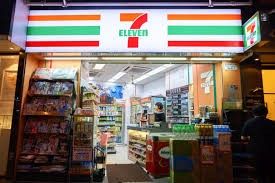
1. Strengths of 7-ELEVEN
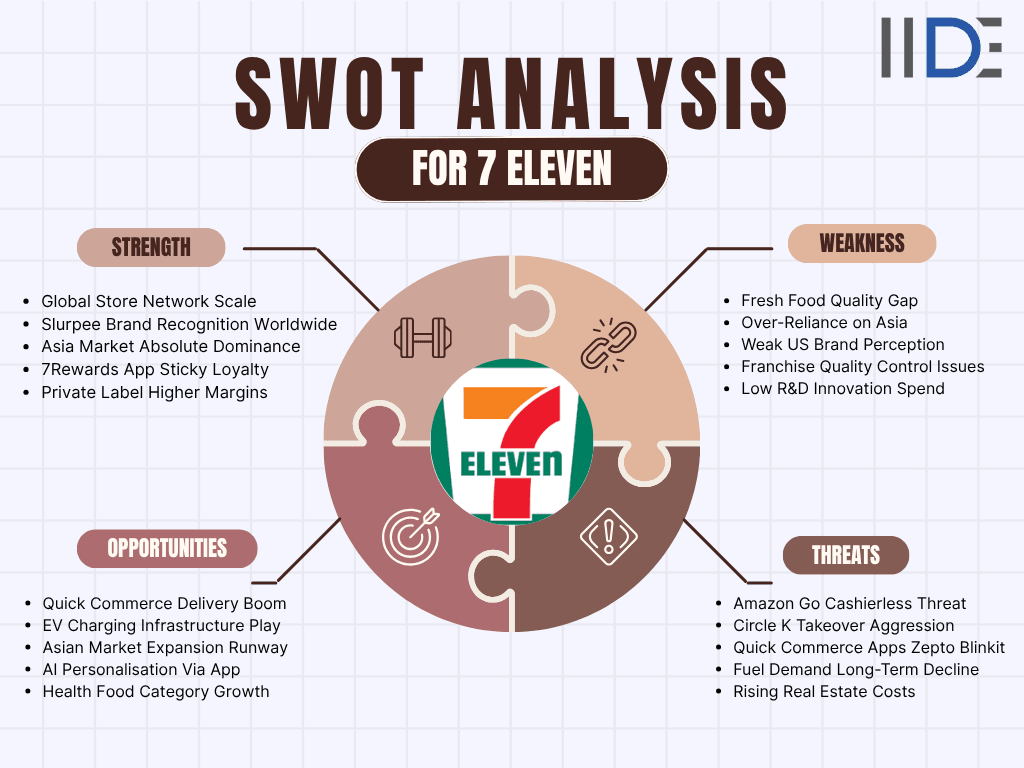
- Global Store Network Scale - No convenience retailer on the planet comes close. With approximately 85,816 stores across 20+ countries, 7-Eleven is more than double the size of McDonald's global footprint. That kind of scale means unmatched brand visibility, supplier negotiating power, and a distribution network most competitors can only dream of.
- Asia Market Absolute Dominance - Japan alone has over 21,700 stores, Thailand over 14,500, and South Korea more than 13,000. In these markets, 7-Eleven isn't just a convenience store; it's a daily infrastructure. People pay bills, collect parcels, and eat meals there. That level of embeddedness is nearly impossible for any competitor to disrupt.
- 7Rewards Loyalty App 60 Million Members - The 7Rewards loyalty program has reached over 60 million members globally, giving 7-Eleven something most convenience retailers don't have: first-party data at scale. That means personalised offers, smarter inventory decisions, and a direct relationship with the customer that goes beyond the transaction.
- 7-Select Private Label Margins - The 7-Select private label covers snacks, beverages, and daily essentials, all at prices that beat national brands while delivering significantly higher margins to the company. It's a quiet profit engine that most customers don't even think about.
- 24/7 Unmatched Convenience - In 2024, 7-Eleven reported $85 billion in global sales, a number built almost entirely on one promise: we're always open. In a world of irregular schedules, late nights, and impulse decisions, that promise is worth more than any marketing campaign.
- Franchising Model Drives Fast Expansion - 7-Eleven plans to open over 500 new convenience stores between 2025 and 2027, with 1,300 new stores targeted in North America by 2030. The franchise model means most of that expansion happens without the company taking on the full capital risk, a smart, scalable way to grow. Tracxn
2. Weakness of 7-ELEVEN
- Franchise Quality Control Is a Real Problem - Franchisees don't always maintain the same standards as corporate stores, leading to inconsistent customer experiences that damage the brand. Tokyo vs a random US location, the gap is impossible to ignore at 85,000 stores.
- Franchisee Relationships Under Strain - 97% of US franchise owners reported staffing trouble, and only 13% said overnight operations were financially profitable. Unhappy franchisees mean under-invested stores, and customers feel that directly.
- Fresh Food Quality Gap - Wawa and Casey's have built strong reputations around fresh food that 7-Eleven simply hasn't matched consistently. For a brand competing with QSRs, that's a gap that matters.
- Over-Reliance on Asia - Japan, Thailand, and South Korea together account for nearly 50,000 of its 85,000+ stores. Any disruption in Asia hits 7-Eleven's global numbers immediately.
- Weak US Brand Perception - In North America, 7-Eleven is still the place you stop when nothing else is open, not a destination. Wawa and Casey's have emotional loyalty that 7-Eleven's US business simply doesn't.
- Low Innovation Speed - 7-Eleven reacts to trends more than it sets them. For the world's largest convenience chain, that's a costly habit.
3. Opportunities for 7-ELEVEN
- North America IPO Biggest Near-Term Catalyst - Seven & i has confirmed plans to IPO 7-Eleven's North American business in the second half of 2026 on a major US stock exchange. The IPO is expected to generate significant capital for aggressive store upgrades, food expansion, and acquisitions. If it lands well, it reshapes the entire North American convenience story.
- Large Format Food-First Stores - 7-Eleven is already aiming to open 600 large-format, food-focused stores by 2027, roughly double the size of a traditional location, with expanded food and beverage offerings. This directly attacks the fresh food gap that Wawa and Casey's have exploited for years.
- North America Store Expansion Runway - Seven & i plans to open 1,300 new stores across North America by fiscal year 2031. With the US market still underpenetrated compared to Asia, there's real whitespace, especially in the South and Midwest, where competitors are weaker.
- AI and Personalisation via 7Rewards - 60 million loyalty members is a goldmine of first-party data. Deploying AI to personalise offers, predict buying behaviour, and optimise inventory across 85,000 stores could meaningfully improve margins, without opening a single new location.
- Quick Commerce & Delivery Growth - The 7NOW delivery app positions 7-Eleven directly in the quick commerce boom. As consumers increasingly expect under-30-minute delivery for everyday essentials, a brand with a store on every corner has a structural advantage that pure delivery players simply can't match.
- EV Charging Infrastructure - As fuel demand slowly declines, 7-Eleven's forecourt real estate becomes an EV charging opportunity. Early movers in this space will own the customer relationship for the next generation of drivers, and 7-Eleven has the locations to do it at scale.
4. Threats to 7-ELEVEN
- Circle K Is Coming for the Crown - Couche-Tard made a $47.2 billion takeover attempt for 7-Eleven's parent in 2024, and even after it failed, Circle K hasn't slowed down. It's aggressively upgrading its food programme and expanding its store network. The world's second-largest convenience chain wants the top spot badly.
- Store Closures Outpacing Openings - Fiscal 2026 will be the fifth consecutive year that 7-Eleven has closed more stores than it opened in North America, with 645 closures planned. While management calls it portfolio optimisation, five straight years of net closures is a pattern that IPO investors will scrutinise hard.
- IPO Delay Risk - The planned North American IPO has already been delayed by at least 11 months due to market uncertainty. A listing that keeps getting pushed back sends mixed signals and leaves the business in an uncomfortable limbo between Japanese parent oversight and the independence it needs to move faster.
- Consumer Spending Tightening - CEO Dacus himself flagged that "consumers are continuing to tighten their spending and be cautious about what they purchase." For a convenience retailer built on impulse purchases, that's a direct threat to same-store sales growth.
- Fuel Demand Long-Term Decline - Fuel drives footfall. As EV adoption accelerates globally, the petrol forecourt model that underpins much of 7-Eleven's traffic in North America faces a slow but structural decline. The EV charging pivot helps, but it's a long transition with real revenue risk in between.
- Leadership Vacuum at a Critical Moment - 7-Eleven is currently operating under two interim co-CEOs while it searches for a permanent replacement, right as it prepares for its biggest strategic move in decades. No permanent CEO during an IPO year is a risk that's hard to paper over.
Now that you have a clear picture of where 7-Eleven stands strategically, it's worth comparing it with another retail giant navigating similar challenges of scale and loyalty. Explore the SWOT Analysis of Costco to see how a warehouse model stacks up against convenience retail.

Is Digital Marketing the Right Career for You?
Find out in a free 45-min masterclass · Career paths, roles and growth explained · By Karan Shah, Founder & CEO, IIDE

Is Digital Marketing the Right Career for You?
Find out in a free 45-min masterclass · Career paths, roles and growth explained · By Karan Shah, Founder & CEO, IIDE
Want to Know Why 2,50,000+ Students Trust Us?
Dive into the numbers that make us the #1 choice for career success



MBA - Level
Post Graduate in Digital Marketing & Business Strategy

Best For
Fresh Graduates

Mode of Learning
On Campus (Mumbai & Delhi)

Starts from
Nov 27, 2026

Duration
11 Months

Live & Online
Advanced Online Digital Marketing Course
Best For
Working Professionals
Mode of Learning
Online
Starts from
Nov 2, 2026
Duration
4-6 Months

Offline
Top AI Courses to Make You Future Ready!
Best For
AI Enthusiasts
Mode of Learning
2–5 Month Program
Starts from
-
Duration
Flexiable
Offline
Undergraduate Program in Digital Business & Entrepreneurship
Best For
12th Passouts
Mode of Learning
On Campus (Mumbai)
Duration
3 Years
Offline
Degree In 2026 ≠ Enough Degree + Digital Skills = Future-Ready
Best For
12th Passouts
Mode of Learning
At IIDE Campus
Duration
3 Years
Recent Post
7-Eleven is owned by Tokyo-based Seven & i Holdings, one of Japan's largest retail conglomerates. The parent company also operates Speedway and Stripes convenience stores in North America alongside the 7-Eleven brand.
As of early 2026, there are approximately 85,816 7-Eleven stores operating globally across 20+ countries. Japan is the largest single market with over 21,700 stores, followed by Thailand and South Korea.
As of 2026, 7-Eleven operates approximately 85,816 stores across 20+ countries, making it the world's largest convenience retail chain, with more than double the number of McDonald's global locations. Its largest markets are Japan (21,700+ stores), Thailand (14,500+ stores), South Korea (13,000+), and North America (13,000 stores).
7-Eleven's main competitors globally include Circle K (owned by Alimentation Couche-Tard), FamilyMart, Lawson, Wawa, Casey's General Stores, OXXO (owned by FEMSA), and Amazon Go. In the US, Wawa and Casey's are considered the most serious threats in the fresh food and customer loyalty segments, while Circle K is the most aggressive competitor for global convenience store dominance.
7-Eleven operates in 20+ countries. Its key markets include Japan (the largest with 21,700+ stores), Thailand (14,500+), South Korea (13,000+), and the United States and Canada (combined 13,000). The brand also has a significant presence across Southeast Asia, including Taiwan, the Philippines, Malaysia, and Australia.

Lead Trainer & Business Development Head at IIDE
Aditya Shastri leads the Business Development segment at IIDE and is a seasoned Content Marketing expert. With over a decade of experience, Aditya has trained more than 20,000 students and professionals in digital marketing, collaborating with prestigious institutions and corporations such as Jet Airways, Godrej Professionals, Pfizer, Mahindra Group, Publicis Worldwide, and many others. His ability to simplify complex marketing concepts, combined with his engaging teaching style, has earned him widespread admiration from students and professionals alike.
Aditya has spearheaded IIDE’s B2B growth, forging partnerships with over 40 higher education institutions across India to upskill students in digital marketing and business skills. As a visiting faculty member at top institutions like IIT Bhilai, Mithibai College, Amity University, and SRCC, he continues to influence the next generation of marketers.
Apart from his marketing expertise, Aditya is also a spiritual speaker, often traveling internationally to share insights on spirituality. His unique blend of digital marketing proficiency and spiritual wisdom makes him a highly respected figure in both fields.