
Students Centric
Placements Report
Trackable results, real numbers
Reviews
Proven success, real voices
Trainers
Expert-led, Industry-Driven Training
Life at IIDE
Vibrant Spirit student life
Alumni
Successful Journeys, Inspiring Stories
Learning Centre
Webinars
Blogs
Case studies
Live, Interactive Masterclasses
Fresh Insights, quick reads
Real-life, Industry relevant
More
Hire from us
Hire Top Digital Marketing Talent
Work with us
Join Our Team, Make an Impact
Customised Training
Personalised digital marketing training for your company
Refer & earn
Simple, easy rewards
Contact us
Get the answers you need
About us
Know more about IIDE
Explore all course options

FOR FRESH GRADUATES
Post Graduation Program in Digital Marketing & Business Strategy- Ideal for Age: 20–25 Years

Can’t decide? Explore all our
Digital Marketing Courses
COMPARE BOTH OUR PROGRAMSOffline
Explore Top AI CoursesIndustry-Aligned TRACKMost Popular
UG Program in Digital Business & Entrepreneurship- Ideal for 12th Pass out / FY Degree Student

PARTNER PROGRAMS






Can’t decide? Explore all
BBA In Digital Marketing Colleges
Orginally Written by Aditya Shastri
Updated on Jun 23, 2026
Share on:


Reliance Jio, India's largest telecom operator, launched in 2016 with a single mission: to make digital access affordable for every Indian. Today, it serves 515 million subscribers across 4G, 5G, broadband, and digital services, with a valuation of $112 billion.
But what turned Jio from a telecom launch into a national disruption? The answer lies in its marketing. In this case study, we break down the complete 7Ps Marketing Mix of Jio, how it priced to dominate, built a distribution network that reached every pin code, promoted itself through India's biggest cultural icons, and created an ecosystem of products that keeps 515 million users locked in. If you want to understand what world-class telecom marketing looks like, this is it.
About Reliance Jio

Reliance Jio changed the way India uses the internet, and it did it almost overnight. The company was incorporated in 2007 as Infotel Broadband Services Limited, quietly acquired by Mukesh Ambani's Reliance Industries in 2010, and spent the next six years building a pan-India 4G network that cost over Rs 2 lakh crore before a single SIM card was sold to the public.
When Jio launched commercially in September 2016, it didn't follow the rules of the existing telecom industry. It made data free, voice calls free, and forced every major player, Airtel, Vodafone, Idea, to either cut prices sharply or lose subscribers fast. Within 83 days, Jio had 50 million users. Within three years, it had completely changed the shape of India's telecom industry.
Today, Reliance Jio operates as a subsidiary of Jio Platforms under Reliance Industries. It serves 515 million subscribers across 4G, 5G, JioFiber broadband, and JioAirFiber fixed wireless services. With 253 million 5G users, an ARPU of Rs 213.7 per month, and a planned IPO valuing the business at $112 billion, Jio is no longer just a telecom company; it is India's digital backbone.
Before we get into the Marketing Mix, here's a data-backed snapshot of where Reliance Jio stands today.
| Quick Stats Table | |
| Metric | Details |
| Founded | 2007 (as Infotel Broadband), Commercial Launch September 2016 |
| Founder | Mukesh Ambani |
| Parent Company | Jio Platforms Ltd. (Subsidiary of Reliance Industries) |
| Headquarters | Navi Mumbai, Maharashtra, India |
| CEO | Mathew Oommen |
| Total Subscribers | 515.3 Million (December 2025) |
| 5G Subscribers | 253 Million |
| JioAirFiber Users | 11.5 Million+ |
| JioFiber Premises | 25.3 Million Connected |
| ARPU | Rs 213.7 Per Month |
| Annual Revenue | Rs 1.7 Lakh Crore (FY2025) |
| Valuation | $112 Billion |
| IPO Status | Planned H1 2026 |
| Market Share | 50% of India's Wireless Subscribers |
| Key Competitors | Airtel, Vi (Vodafone Idea), BSNL |
Marketing Mix of Jio
Every successful business, whether a startup or a global giant, needs a clear framework to decide what to sell, at what price, where to sell it, and how to communicate its value to customers. That framework is the Marketing Mix.
For a company like Reliance Jio, operating across telecom, broadband, digital services, and entertainment, the Marketing Mix isn't just a textbook concept. It is the strategic backbone behind every decision the company makes, from pricing a data plan to choosing a brand ambassador.
Jio follows the 7Ps Marketing Mix framework:
- Product: What Jio offers its customers
- Price: How Jio prices its services to dominate the market
- Place: How Jio distributes its services across India
- Promotion: How Jio builds awareness and drives adoption
- People: The human element behind Jio's service delivery
- Process: How Jio delivers its services seamlessly
- Physical Evidence: The tangible proof of Jio's brand experience

Is Digital Marketing the Right Career for You?
Find out in a free 45-min masterclass · Career paths, roles and growth explained · By Karan Shah, Founder & CEO, IIDE

Is Digital Marketing the Right Career for You?
Find out in a free 45-min masterclass · Career paths, roles and growth explained · By Karan Shah, Founder & CEO, IIDE
1. Product Strategy of Reliance Jio
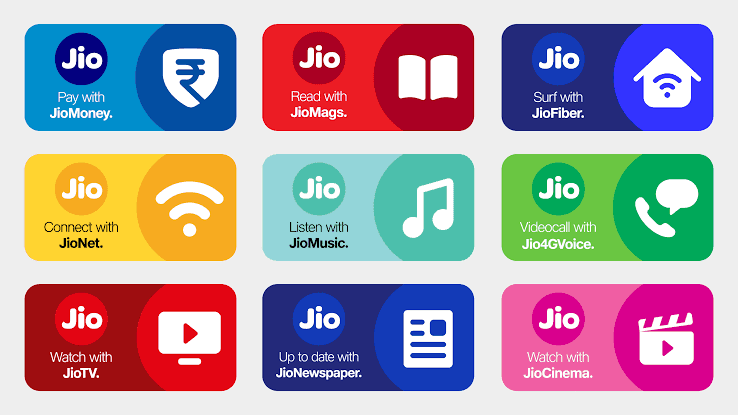
Jio's product strategy has always been built around one idea: giving Indians more than they expect, at a price they can actually afford. When it launched in 2016, the product wasn't just a SIM card. It was a complete digital ecosystem with free data, free voice calls, and a suite of 30+ apps covering entertainment, news, payments, and cloud storage. That bundled approach ensured that every new Jio user didn't just get connectivity, but also got a reason to stay.
In 2026, Jio's product portfolio will have grown significantly beyond its telecom roots:
Connectivity Products:
- Jio 4G & 5G Mobile Services
- JioFiber - Home broadband with speeds up to 1 Gbps
- JioAirFiber - Fixed wireless access, world's largest FWA platform with 11.5 million users
- JioPhone & JioPhone Next - Affordable smartphones for first-time internet users
Digital & Entertainment:
- JioCinema - India's largest OTT platform, home to IPL, NFL, and HBO content
- JioTV - Live TV streaming across 800+ channels
- JioSaavn - Music streaming with 100 million+ tracks
- JioCloud - Personal cloud storage
- JioNews - Aggregated news platform
Financial & Commerce:
- JioMart - Online grocery and e-commerce platform
- JioPay & JioMoney - Digital payments ecosystem
- JioFinance - Personal finance management app
Enterprise & Business:
- Jio Business Solutions - Enterprise connectivity and cloud services
- JioThings - IoT platform for smart cities and industries
- Jio-Gemini - AI-powered services in partnership with Google, offering free
- Gemini Pro access to 5G users
Jio's product ecosystem, from 5G services to JioCinema and JioMart, is only one side of the story. To understand how Jio built the brand behind the products, explore the Reliance Jio Marketing Strategy, a deeper look at the campaigns and decisions that shaped India's most talked-about telecom brand.
2. Pricing Strategy of Reliance Jio
Jio's pricing strategy is the most studied and most copied pricing playbook in Indian business history. It has gone through three distinct phases, each designed to serve a specific strategic objective.
Phase 1
- Free: Jio launched with completely free services for the first six months, later extended to over a year. The goal wasn't generosity; it was market capture. By the time Jio started charging, it had already built the largest telecom subscriber base in India.
Phase 2
- Penetration Pricing: Once the free period ended, Jio introduced prepaid plans starting as low as Rs 149 per month, significantly cheaper than any competitor. Data rates dropped from Rs 250 per GB industry average to Rs 10 per GB under Jio. Voice calls remained free on all plans. This pricing forced Vodafone and Idea to merge and effectively pushed Aircel out of the market entirely.
Phase 3
- Value-Based Pricing: As Jio's market dominance solidified, it began gradually increasing ARPU from Rs 160 in 2022 to Rs 213.7 in December 2025. In July 2024, Jio raised prepaid tariffs by 12-27% across plans. This shift signals a move from pure market capture to sustainable profitability without losing subscribers because the competition simply cannot match Jio's network quality at any price.
Jio's pricing disruption didn't just win customers; it forced India's second-largest telecom operator to completely rethink its strategy. See how Airtel responded in the SWOT Analysis of Airtel, a fascinating look at how an incumbent fights back against disruption.
3. Place and Distribution Strategy of Reliance Jio
Jio's distribution strategy solved a problem that had kept hundreds of millions of Indians offline for decades: last-mile connectivity in rural and semi-urban markets.
Physical Distribution:
- 1.5 million+ retail touchpoints across India, from large format stores in metros to small kirana shops in tier 3 towns
- Jio Stores in every major city and tier 2 town for SIM, device, and service support
Partnership with over 2 lakh common service centres (CSCs) for rural reach - JioPhone available through 1 lakh+ retailers, making smartphone access easier for first-time users
Digital Distribution:
- Jio app available on Android and iOS, the single point for plan management, payments, and support
- JioMart, integrated with WhatsApp, is allowing grocery orders directly through India's most used messaging app
- Self-care portal for enterprise and broadband customers
Network Infrastructure:
- 400,000+ telecom towers across all 22 telecom circles in India
5G coverage in 10,000+ cities and towns - JioAirFiber is expanding broadband to buildings and areas where fibre laying is not possible
4. Promotion Strategy of Reliance Jio
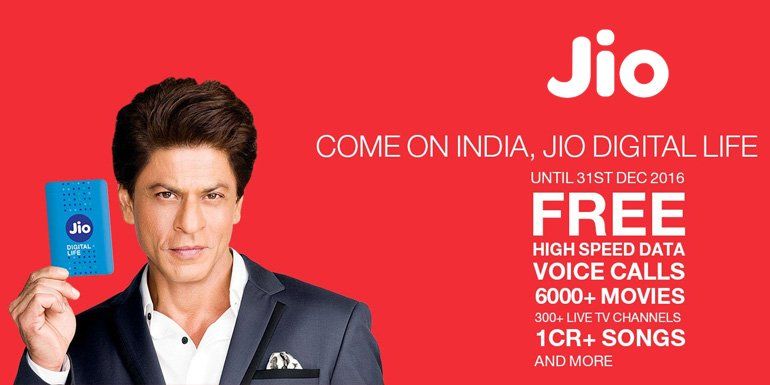
Jio's promotional strategy has always understood one fundamental truth about Indian consumers, they trust faces they recognise and respond to emotion before logic.
Launch Campaign:
- Digital Life - Jio's launch in September 2016 was not a product announcement; it was a cultural event.
- Mukesh Ambani announced it at Reliance's AGM in front of thousands of shareholders, with national media coverage that no paid campaign could have matched. The message was simple: "Jio is for every Indian."
Brand Ambassadors:
- Amitabh Bachchan and Shah Rukh Khan have been chosen specifically because they represent credibility across every age group, region, and income segment in India. No other combination of ambassadors reaches a broader cross-section of Indian society.
- Shah Rukh Khan's "Koi signal nahin" campaign directly addressed the network reliability concern, Jio's biggest barrier to adoption and made it memorable through humour.
IPL & Sports:
- Jio became the exclusive digital streaming partner for IPL through JioCinema, broadcasting the 2023, 2024, and 2025 seasons for free. At peak, IPL 2023 on JioCinema drew 32 million concurrent viewers on the largest streaming audience in history at that time.
- Free IPL streaming was not just a promotion, but it was a subscriber acquisition strategy that drove millions of new JioCinema and Jio SIM activations every season.
Digital Marketing:
- Active presence across YouTube, Instagram, Twitter/X, and Facebook
Jio's YouTube channel has 10 million+ subscribers - Regular regional language campaigns in Hindi, Tamil, Telugu, Bengali, Marathi, ensuring no Indian demographic feels excluded
5. People Strategy of Reliance Jio
In a service business like telecom, the people behind the brand are as important as the product itself. Jio has built its people strategy around two priorities: scale and simplification.
Customer-Facing Teams:
- 30,000+ customer service executives handling calls, chats, and in-store queries
- Dedicated Jio Store staff trained specifically on digital literacy, helping first-time smartphone users set up accounts, download apps, and make digital payments
- MyJio app's AI-powered chatbot handles millions of self-service queries daily, reducing wait times and human dependency for routine requests
Digital Literacy Mission:
- Jio has actively trained millions of first-time internet users, particularly in rural India, on how to use smartphones, apps, and digital services. This isn't just CSR.
- It is a direct investment in expanding its own addressable market. A user who doesn't know how to use the internet is not a potential subscriber until someone teaches them.
Enterprise Teams:
- Dedicated relationship managers for Jio Business solutions serve corporate clients, SMEs, and government institutions, providing customised connectivity and cloud solutions backed by SLA commitments.
6. Process Strategy of Reliance Jio
Jio's process strategy is built around one principle to make every interaction with the brand as frictionless as possible.
SIM Acquisition:
- Jio was among the first telecom operators in India to introduce paperless,
- Aadhaar-based instant SIM activation reduces the time from walk-in to active connection from 24 hours to under 15 minutes
- Home delivery of SIM cards within 90 minutes in major cities is a process innovation that no competitor has attempted at this scale
Digital Self-Service:
- MyJio app allows users to recharge, check data balance, raise complaints, port numbers, and manage multiple connections, all without visiting a store or calling customer care
- JioFiber installation process: online booking, automated slot scheduling, and technician tracking via app, mirroring the experience of premium service providers
5G Onboarding:
- Automatic 5G network switching for compatible devices, no manual settings, no store visit required
- Jio-Gemini AI integration delivered directly to eligible 5G users through a software update, no additional signup needed
7. Physical Evidence Strategy of Reliance Jio
Physical evidence in a telecom business is everything the customer can see, touch, or experience that proves the brand's promise is real.
Network Quality:
- Jio consistently ranks among the top operators in TRAI's network quality reports with data speeds, call drop rates, and coverage metrics that visibly outperform competitors in most markets
- 5G coverage in 10,000+ cities is physical evidence that Jio's infrastructure investment is real and accessible
Jio Stores:
- 9,000+ Jio-branded retail stores across India are designed with a consistent visual identity, trained staff, and digital demo zones where customers can experience
- JioCinema, JioFiber, and JioAirFiber before subscribing
The store design itself communicates modernity, accessibility, and trust
JioPhone & Devices:
- Physical Jio-branded devices, JioPhone, JioFiber router, JioAirFiber device, are tangible proof of the brand's commitment to making digital access affordable
- The JioFiber set-top box sits in millions of Indian living rooms, a daily, visible reminder of the brand
App Experience:
- MyJio app's UI, speed, and reliability are physical evidence in the digital world. Every smooth recharge or quick complaint resolution reinforces trust in the brand
Now that you have a complete picture of Jio's 7Ps strategy, explore how its parent company operates across retail, energy, and digital. The Business Model of Reliance Industries puts Jio's bigger story into perspective.
Jio's 7Ps marketing mix is not a textbook exercise; it is a real-time case study in how a single company can reshape an entire industry. The product ecosystem keeps 515 million users locked in across telecom, entertainment, and commerce. The pricing strategy didn't just win customers, it made competition almost irrelevant for nearly a decade.
The distribution network reached Indians that no telecom had ever bothered to serve, from metro cities to remote villages. Promotion through cricket, Bollywood, and free IPL streaming turned a telecom brand into a cultural institution. And the people, process, and physical evidence strategies ensure that every touchpoint from a SIM activation to a 5G upgrade feels seamless.
For any marketer studying disruption, Jio is not just a case study. It is the benchmark every Indian brand is now measured against.
Want to Know Why 2,50,000+ Students Trust Us?
Dive into the numbers that make us the #1 choice for career success



MBA - Level
Post Graduate in Digital Marketing & Business Strategy

Best For
Fresh Graduates

Mode of Learning
On Campus (Mumbai & Delhi)

Starts from
Oct 1, 2026

Duration
11 Months

Live & Online
Advanced Online Digital Marketing Course
Best For
Working Professionals
Mode of Learning
Online
Starts from
Oct 16, 2026
Duration
4-6 Months

Offline
Top AI Courses to Make You Future Ready!
Best For
AI Enthusiasts
Mode of Learning
2–5 Month Program
Starts from
Sep 29, 2026
Duration
Flexiable

On Campus
Advanced Certification in Artificial Intelligence
Best For
AI Enthusiasts
Mode of Learning
On Campus (Mumbai)
Starts from
Sep 29, 2026
Duration
3 Months

Offline
Undergraduate Program in Digital Business & Entrepreneurship
Best For
12th Passouts
Mode of Learning
On Campus (Mumbai)
Starts from
-
Duration
3 Years

Offline
Degree In 2026 ≠ Enough Degree + Digital Skills = Future-Ready
Best For
12th Passouts
Mode of Learning
At IIDE Campus
Starts from
-
Duration
3 Years
Recent Post

Lead Trainer & Business Development Head at IIDE
Aditya Shastri leads the Business Development segment at IIDE and is a seasoned Content Marketing expert. With over a decade of experience, Aditya has trained more than 20,000 students and professionals in digital marketing, collaborating with prestigious institutions and corporations such as Jet Airways, Godrej Professionals, Pfizer, Mahindra Group, Publicis Worldwide, and many others. His ability to simplify complex marketing concepts, combined with his engaging teaching style, has earned him widespread admiration from students and professionals alike.
Aditya has spearheaded IIDE’s B2B growth, forging partnerships with over 40 higher education institutions across India to upskill students in digital marketing and business skills. As a visiting faculty member at top institutions like IIT Bhilai, Mithibai College, Amity University, and SRCC, he continues to influence the next generation of marketers.
Apart from his marketing expertise, Aditya is also a spiritual speaker, often traveling internationally to share insights on spirituality. His unique blend of digital marketing proficiency and spiritual wisdom makes him a highly respected figure in both fields.