
Students Centric
Placements Report
Trackable results, real numbers
Reviews
Proven success, real voices
Trainers
Expert-led, Industry-Driven Training
Life at IIDE
Vibrant Spirit student life
Alumni
Successful Journeys, Inspiring Stories
Learning Centre
Webinars
Blogs
Case studies
Live, Interactive Masterclasses
Fresh Insights, quick reads
Real-life, Industry relevant
More
Hire from us
Hire Top Digital Marketing Talent
Work with us
Join Our Team, Make an Impact
Customised Training
Personalised digital marketing training for your company
Refer & earn
Simple, easy rewards
Contact us
Get the answers you need
About us
Know more about IIDE
Explore all course options

FOR FRESH GRADUATES
Post Graduation Program in Digital Marketing & Business Strategy- Ideal for Age: 20–25 Years

Can’t decide? Explore all our
Digital Marketing Courses
COMPARE BOTH OUR PROGRAMSOffline
Offline AI Courses with Dual CertificationsIndustry-Aligned TRACKMost Popular
UG Program in Digital Business & Entrepreneurship- Ideal for 12th Pass out / FY Degree Student

PARTNER PROGRAMS





Can’t decide? Explore all
BBA In Digital Marketing Colleges
Orginally Written by Aditya Shastri
Updated on Jun 16, 2026
Share on:


The marketing mix of Burger King (4Ps) covers Product, Price, Place, and Promotion, the four strategic decisions that explain how the world's second-largest fast food chain competes globally against McDonald's and other fast food players in 2026.
Burger King positions itself as the bold, quality-first challenger in fast food, built on one promise that has never changed: "Have It Your Way." Every patty is flame-grilled not fried, prices stay accessible without cheapening the brand, and its campaigns consistently earn more attention than they spend.
For marketing students and entrepreneurs, Burger King is proof that the clearest point of difference always beats the biggest budget.
About Burger King
Founded in 1953 in Jacksonville, Florida, Burger King is today the world's second-largest fast food chain, operating over 18,700 restaurants across 100+ countries. The brand is owned by Restaurant Brands International (RBI).
Its flagship product the Whopper, introduced in 1957 remains one of the most recognised fast food items in history and sits at the core of every major campaign the brand runs.
In FY2025, Burger King reported approximately $10+ billion in US system-wide sales, reflecting total sales across all franchise and company-owned locations.
The brand operates on a franchise model where over 95% of locations are independently operated, giving it enormous global reach with minimal capital exposure for the parent company.
In 2022, Burger King launched "Reclaim the Flame," a $400 million strategic reinvestment plan running through 2026.
The initiative commits capital to restaurant remodels, digital infrastructure, marketing, and franchisee support, making it the single most important strategic context for understanding how the brand operates and competes today.
Quick Stats of Burger King:
| Detail | Info |
|---|---|
| Founded | 1953, Jacksonville, Florida |
| Parent Company | Restaurant Brands International (RBI) |
| CEO | Joshua Kobza |
| Global Restaurants | 18,700+ |
| Countries | 100+ |
| Franchise Model | 95%+ franchised |
| US System Sales (FY2025) | $10+ billion |
| Signature Product | The Whopper |
| Brand Promise | "Have It Your Way" |
Burger King's Target Market
Burger King's core customer is a value-conscious young adult aged 18 to 35 who wants a real, customisable meal without a premium price tag, with families and teenagers rounding out the brand's broad global reach.
| Segment | Profile |
|---|---|
| Demographic | Young adults 18–35, students, working professionals |
| Geographic | Urban and suburban markets across 100+ countries |
| Psychographic | Bold, value-seeking, individuality-driven consumers |
| Behavioural | Frequent fast food visitors, deal-sensitive, BK app users |
| Secondary Segment | Families and teenagers attracted by value meals and Kids Meals |

Is Digital Marketing the Right Career for You?
Find out in a free 45-min masterclass · Career paths, roles and growth explained · By Karan Shah, Founder & CEO, IIDE

Is Digital Marketing the Right Career for You?
Find out in a free 45-min masterclass · Career paths, roles and growth explained · By Karan Shah, Founder & CEO, IIDE
Marketing Mix of Burger King (4Ps)
Burger King's 4Ps form a tightly connected system where each element makes the next one stronger. Lower prices drive footfall, footfall sustains franchisees, franchisees fund the global network, and that network amplifies some of the boldest advertising in Quick Service Restaurant (QSR) history. Together, they explain how a brand with no company-owned stores consistently challenges the world's largest fast food chain.
1. Product: What Burger King Sells
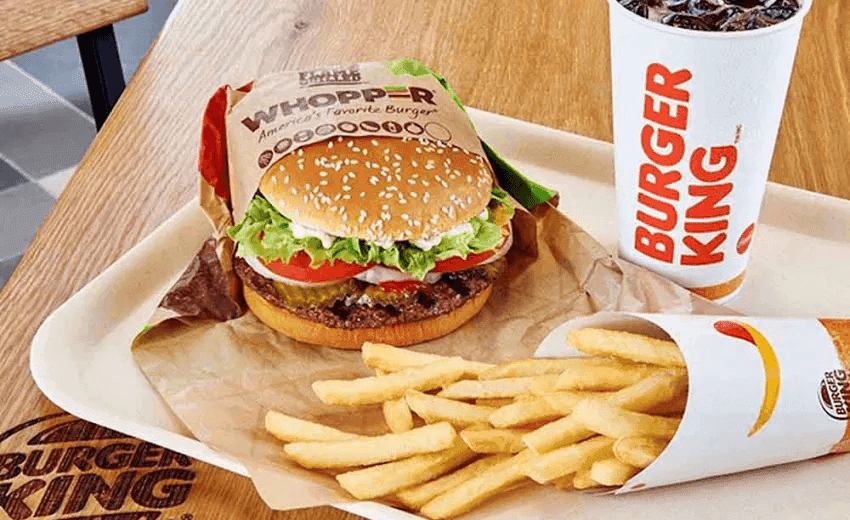
Burger King sells flame-grilled burgers, chicken sandwiches, plant-based options, sides, and beverages across 18,700+ locations in 100+ countries. Every beef patty is cooked over an open flame, not fried, making it the only QSR at global scale to offer this as a standard across its entire menu.
Core Product Range
The Whopper: Burger King's hero product since 1957. Flame-grilled beef, fully customisable, and the centrepiece of virtually every major campaign the brand runs.
- Chicken and Fish Sandwiches: The Crispy Chicken Sandwich and BK Fish, competing directly in the fastest-growing category in fast food.
- Breakfast Menu: A key battleground that Burger King has actively expanded under Reclaim the Flame, including the Croissan'wich and breakfast platters to compete with McDonald's McCafe and Starbucks.
- Sides: French fries, onion rings, and mozzarella sticks.
- Beverages: Soft drinks, milkshakes, and coffee.
- Desserts: Soft serve, pies, and sundaes.
- Plant-Based Range: The Impossible Whopper, launched as a strategic test in 2019 and now a permanent standard menu item across US locations, reflecting sustained demand from flexitarian consumers.
Limited-Time Offers (LTOs) as a Product Strategy
- Burger King uses Limited-Time Offers strategically to drive three specific outcomes: create urgency, generate organic social media buzz, and pull lapsed customers back into restaurants.
- The Halloween Black Whopper, seasonal value bundles, and creator-led custom burgers are all LTO formats that consistently outperform paid media in earned attention.
Flame-Grilling: The Core Differentiator
- The single biggest product differentiator Burger King holds over McDonald's is flame-grilling.
- Every beef patty is cooked over an open flame, not fried in oil, a tangible and demonstrable quality difference that the brand has built decades of advertising around and that no competitor at comparable scale has replicated.
Flame-grilling is the one product advantage Burger King has held over its biggest rival for decades. See how McDonald's builds its own product strategy in response with the Marketing Mix of McDonald's.
2. Price: Burger King's Pricing Strategy
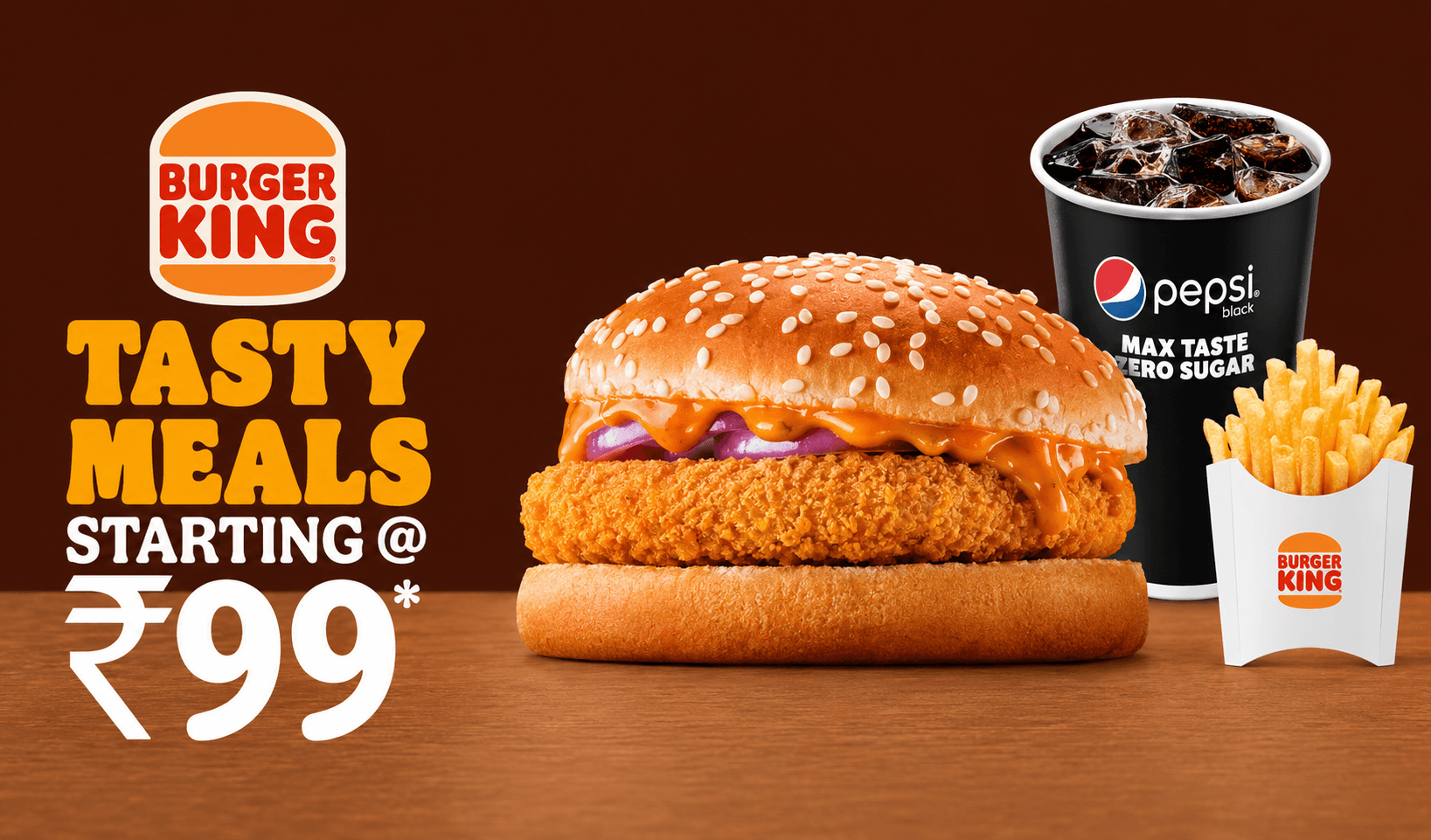
Burger King prices its menu based on local market conditions and competitor benchmarks, primarily McDonald's, to stay accessible without cheapening the brand. Combo meals, app-exclusive deals, and psychological pricing work together to make every visit feel like a deal.
Market-Oriented Pricing
- Prices are set based on local market conditions, competitor pricing (primarily McDonald's), and local purchasing power.
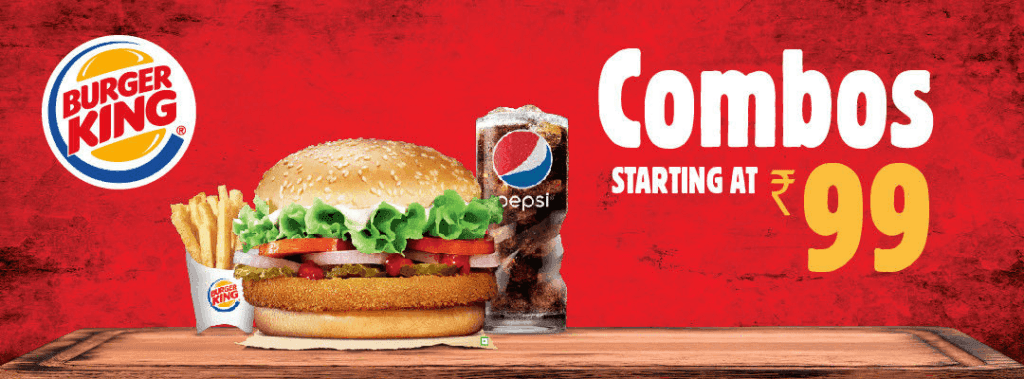
- In lower-income markets like India, menu prices are significantly reduced to match local affordability while maintaining full brand consistency.
Bundle and Value Meal Pricing
- Combo meals bundle a main, side, and drink at a lower combined price, increasing average basket size while making the total spend feel like a deal.
- Family bundles and shareable packs extend this further, encouraging larger group orders and driving higher per-visit revenue.
Psychological Pricing
- Prices ending in $X.99 or $X.49 create an instant perception of value, making every item feel meaningfully cheaper than its rounded equivalent.
- Burger King applies this tactic deliberately across all markets, ensuring the price point feels like a deal before the customer even reads the menu.
App-Exclusive and Promotional Pricing
- Limited-time digital coupons and BK App-exclusive deals drive app downloads and return visits simultaneously.
- Offers like "2 Whoppers for $6" are deliberately structured to reward digital engagement, a direct output of the Reclaim the Flame digital infrastructure investment.
Penetration Pricing
- When entering new international markets, Burger King uses aggressive penetration pricing to make trial effortless and immediate for first-time customers.
- This strategy allows Burger King to rapidly steal share from established local competitors before gradually normalising prices as brand loyalty builds.
Reclaim the Flame and Pricing Competitiveness
- A specific portion of RBI's $400 million Reclaim the Flame investment was allocated directly to value and pricing competitiveness.
- This subsidises digital deal infrastructure and franchisee margins, enabling more aggressive consumer-facing promotions.
- The result is a pricing model that feels generous to customers without eroding profitability at franchisee level.
Burger King vs McDonald's: Pricing Strategy Compared
Burger King and McDonald's price differently here is how each approach plays out across the key dimensions that matter most to customers.
| Element | Burger King | McDonald's |
|---|---|---|
| Pricing Model | Market-oriented, adjusted by country and competitor | Standardised globally with local adaptation |
| Flagship Price (US) | Whopper approx. $5.99 | Big Mac approx. $5.69 |
| App Deals | Aggressive and app-first, with exclusive limited offers | Moderate, built around MyMcDonald's Rewards loyalty |
| Bundle Strategy | Combo meals, LTO bundles, and family packs | Combo meals and Happy Meals |
| Localisation | Fully country-specific pricing in every market | Standardised base with local price tweaks |
| Digital Pricing Push | Reclaim the Flame investment funds deal infrastructure | MyMcDonald's Rewards programme drives repeat visits |
3. Place: Burger King's Distribution Strategy
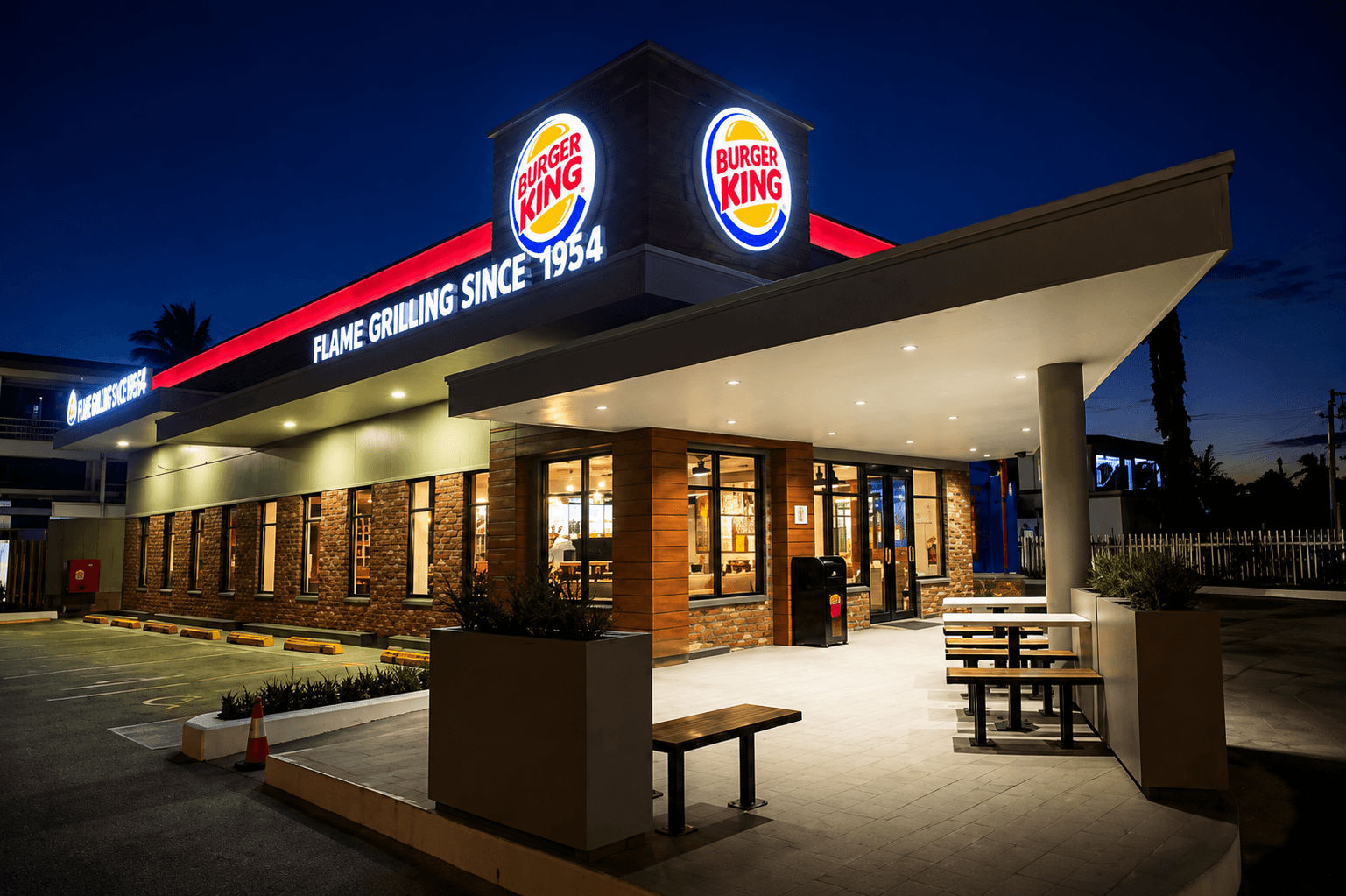
Over 95% of Burger King's 18,700+ restaurants are owned and operated by independent franchisees, giving it global reach across 100+ countries without owning a single location. Drive-throughs, ghost kitchens, and third-party delivery platforms extend this reach into every format a modern customer expects.
Franchise Model
- Over 95% of Burger King's 18,700+ locations are independently owned and operated by franchisees under a licensing agreement.
- RBI earns royalty fees while maintaining brand standards and operational systems globally, allowing the network to scale without direct capital exposure.
Burger King is far from the only QSR that built a global empire on franchising. The Marketing Mix of Subway shows how another franchise-first giant scaled to tens of thousands of locations using the same low-capital model.
Drive-Through: The Core Revenue Format
- Drive-through accounts for approximately 70% of US fast food revenue and is the single most important physical format in Burger King's distribution mix.
- Under the Reclaim the Flame remodel programme, Burger King has invested heavily in drive-through speed and digital ordering upgrades, prioritising this format above all others in suburban US and UK markets.
Physical Location Types
- Standalone full-format restaurants offering dine-in, takeaway, and drive-through services.
- Strategically located in high-traffic areas such as shopping malls, high streets, airports, and transport hubs.
- Drive-through-only formats primarily operating in suburban markets across the United States, United Kingdom, Australia, and Canada.
Ghost Kitchens and Dark Kitchens
- Since 2022, Burger King has actively expanded delivery-only ghost kitchen formats across global markets including the UK, India, and Southeast Asia.
- These locations have no dine-in capability.
- They exist purely to fulfil delivery orders at lower operational cost, extending Burger King's reach into dense urban zones where a full restaurant format is not economically viable.
Digital Distribution
- BK App: Orders, deals, loyalty points, and personalised offers in all major markets.
- Burger King Website: Full menu browsing and online ordering.
- Third-Party Platforms: Uber Eats, DoorDash, Deliveroo, Zomato, and Swiggy (India) across global markets.
International Presence
- Burger King India (BKIPL): Publicly listed entity, independently operated, one of the fastest-growing fast food expansion stories in India with 400+ locations.
- Latin America: Burger King operates through regional franchise partners across Brazil, Mexico, Colombia, and Argentina, among its fastest-growing markets globally.
Strong growth continues across Southeast Asia, the Middle East, and Eastern Europe.
4. Promotion: Burger King's Advertising
Burger King runs one of the most provocative promotional strategies in global fast food, consistently earning more media attention than it spends. Campaigns like the Whopper Detour and Moldy Whopper have won Cannes Grand Prix awards while costing a fraction of what McDonald's spends on traditional advertising.
Reclaim the Flame: The Marketing Commitment
Under RBI's Reclaim the Flame strategy, Burger King made the largest single marketing commitment in a decade, directing a specific portion of its $400 million investment into advertising funds and digital marketing infrastructure.
- Advertising fund contributions were increased directly to support franchisee-level marketing spend across all major markets.
- Digital marketing infrastructure was rebuilt from the ground up, enabling personalised offers, app-first promotions, and loyalty integration at scale.
- Every promotional decision Burger King has made since 2022 sits within this strategic framework.
Traditional Advertising
Burger King maintains strong investment in television, out-of-home, and radio advertising, scaling spend deliberately around the highest-traffic moments in the fast food calendar.
- TV investment peaks during Back-to-School and summer, the two highest-revenue QSR windows in the US.
- Out-of-home and radio campaigns support major product launches and value-season pushes across all markets.
Iconic Digital Campaigns
Burger King has built a global reputation for campaigns that turn conventional advertising logic on its head, consistently winning the industry's highest creative honours while spending a fraction of what competitors invest.
Moldy Whopper (2020)
Burger King filmed a 34-day time-lapse of a Whopper decomposing to prove it contains no artificial preservatives.
- Generated over 8.4 billion earned media impressions globally.
- Won the Grand Prix at Cannes Lions, the highest honour in global advertising.
- A campaign most brands would never dare to run, and proof that Burger King's boldest strategic asset is its willingness to take risks.
Whopper Detour (2018)
Burger King geofenced every McDonald's location in the US and offered a 1-cent Whopper to customers who opened the BK App within 600 feet of a competitor
- Drove 1.5 million app downloads in just 9 days.
- Won multiple Cannes Lions Grand Prix awards across digital and mobile categories.
- Turned a competitor's real estate into a Burger King acquisition channel.
Million Dollar Whopper Contest (2024)
Customers submitted their own custom Whopper creations for a chance to win $1 million and see their burger on the permanent menu.
- Generated enormous organic social engagement across TikTok, Instagram, and Twitter/X.
- Drove significant BK App downloads across all major markets.
- Reinforced the "Have It Your Way" brand promise through direct consumer participation.
Social Media Strategy
Burger King runs a platform-specific social media strategy designed to meet its core audience of 18 to 35 year olds where they already spend their time.
- TikTok: Short-form content, creator partnerships, and LTO launches targeting younger audiences.
- Instagram: Visually bold product photography and campaign content built for high shareability.
- Twitter/X: Real-time brand banter, competitive jabs at McDonald's, and direct community engagement.
- YouTube: Long-form campaign films and behind-the-scenes content that extend the life of major campaigns.
BK Royal Perks: Loyalty Programme
BK Royal Perks is Burger King's points-based loyalty programme and one of the most important digital retention tools in its marketing mix, rewarding customers on every purchase with points redeemable for free food.
- Drives repeat visits and increases average purchase frequency among enrolled members.
- Creates a direct CRM channel for personalised offers and app-exclusive deals.
- Acts as the primary digital engagement engine within the Reclaim the Flame strategy.
Influencer and Creator Marketing
Burger King uses creator partnerships strategically to reach audiences that traditional advertising cannot, with a localised approach that varies significantly by market.
- In India, Bollywood and regional celebrity tie-ins have been central to every major launch campaign.
- In the US, creator-led TikTok content consistently outperforms Burger King's own branded content in both reach and engagement.
- Global creator partnerships are prioritised for LTO launches and app download drives, where authentic peer recommendation outperforms paid media.
Conclusion
Burger King did not become the world's second-largest fast food chain by copying its competitors.
It got there by leaning into exactly what makes it different: a flame-grilled product no competitor has matched, a genuinely customisable menu, and a marketing playbook bold enough to turn a mouldy burger into a Cannes Grand Prix winner.
The 4Ps tell the complete story: a product built on real differentiation, a price that removes barriers without cheapening the brand, a franchise distribution network that reaches 100+ countries, and a promotional machine that earns more attention than it pays for.
In 2026, under the Reclaim the Flame strategy, Burger King is not playing defence. With $400M invested in remodels, digital infrastructure, and brand-building, it is the most strategically committed version of this brand in a decade.
That is what "Have It Your Way" actually means, not just a customisation promise, but a standard the entire business is held to.
Want to Know Why 2,50,000+ Students Trust Us?
Dive into the numbers that make us the #1 choice for career success


MBA - Level
Post Graduate in Digital Marketing & Business Strategy

Best For
Fresh Graduates

Mode of Learning
On Campus (Mumbai & Delhi)

Starts from
Nov 27, 2026

Duration
11 Months

Live & Online
Advanced Online Digital Marketing Course
Best For
Working Professionals
Mode of Learning
Online
Starts from
Nov 2, 2026
Duration
4-6 Months

Offline
Top AI Courses to Make You Future Ready!
Best For
AI Enthusiasts
Mode of Learning
2–5 Month Program
Starts from
Nov 23, 2026
Duration
Flexiable
Offline
Undergraduate Program in Digital Business & Entrepreneurship
Best For
12th Passouts
Mode of Learning
On Campus (Mumbai)
Starts from
-
Duration
3 Years
Offline
Degree In 2026 ≠ Enough Degree + Digital Skills = Future-Ready
Best For
12th Passouts
Mode of Learning
At IIDE Campus
Starts from
-
Duration
3 Years
Recent Post
You May Also Like
Burger King's 4Ps are Product (flame-grilled menu), Price (market-oriented and value-led), Place (18,700+ franchised locations), and Promotion (bold digital campaigns).
Burger King's primary advantage is flame-grilling. Every beef patty is cooked over an open flame rather than fried, delivering a quality difference McDonald's cannot replicate.
Burger King uses market-oriented pricing to match local purchasing power, combined with bundle pricing like combo meals and aggressive app-exclusive deals to drive frequency.
Burger King relies on a 95% franchised distribution model across 100+ countries, utilising physical restaurants, high-volume drive-throughs, and third-party delivery platforms.
Burger King targets value-conscious young adults aged 18 to 35 who prioritize bold flavours and customization, while also catering to families through value bundles.
Burger King adapts its menu locally, such as offering extensive vegetarian options like the Veg Whopper in India and fully halal-certified menus in the Middle East.
Burger King strategically deploys limited-time offers, like the Halloween Black Whopper, to create purchase urgency, generate organic social media buzz, and attract lapsed customers.

Lead Trainer & Business Development Head at IIDE
Aditya Shastri leads the Business Development segment at IIDE and is a seasoned Content Marketing expert. With over a decade of experience, Aditya has trained more than 20,000 students and professionals in digital marketing, collaborating with prestigious institutions and corporations such as Jet Airways, Godrej Professionals, Pfizer, Mahindra Group, Publicis Worldwide, and many others. His ability to simplify complex marketing concepts, combined with his engaging teaching style, has earned him widespread admiration from students and professionals alike.
Aditya has spearheaded IIDE’s B2B growth, forging partnerships with over 40 higher education institutions across India to upskill students in digital marketing and business skills. As a visiting faculty member at top institutions like IIT Bhilai, Mithibai College, Amity University, and SRCC, he continues to influence the next generation of marketers.
Apart from his marketing expertise, Aditya is also a spiritual speaker, often traveling internationally to share insights on spirituality. His unique blend of digital marketing proficiency and spiritual wisdom makes him a highly respected figure in both fields.