
Students Centric
Placements Report
Trackable results, real numbers
Reviews
Proven success, real voices
Trainers
Expert-led, Industry-Driven Training
Life at IIDE
Vibrant Spirit student life
Alumni
Successful Journeys, Inspiring Stories
Learning Centre
Webinars
Blogs
Case studies
Live, Interactive Masterclasses
Fresh Insights, quick reads
Real-life, Industry relevant
More
Hire from us
Hire Top Digital Marketing Talent
Work with us
Join Our Team, Make an Impact
Customised Training
Personalised digital marketing training for your company
Refer & earn
Simple, easy rewards
Contact us
Get the answers you need
About us
Know more about IIDE
Explore all course options

FOR FRESH GRADUATES
Post Graduation Program in Digital Marketing & Business Strategy- Ideal for Age: 20–25 Years

Can’t decide? Explore all our
Digital Marketing Courses
COMPARE BOTH OUR PROGRAMSOffline
Offline AI Courses with Dual CertificationsIndustry-Aligned TRACKMost Popular
UG Program in Digital Business & Entrepreneurship- Ideal for 12th Pass out / FY Degree Student

PARTNER PROGRAMS






Can’t decide? Explore all
BBA In Digital Marketing Colleges
Orginally Written by Aditya Shastri
Updated on Feb 18, 2026
Share on:


LG Electronics dominates the global consumer electronics and home appliances market through its transformative Affectionate Intelligence strategy that combines AI innovation with human-centric design. The South Korean giant reported record revenue of KRW 89.2 trillion (approximately $65 billion) in 2025, demonstrating the power of its B2B expansion, subscription services, and premium positioning.
LG's marketing approach in 2026 centers on showcasing AI in action through the revolutionary CLOiD home robot, will.i.am xboom audio collaborations, OLED evo displays, and smart mobility solutions.
Following a highly successful IPO of LG Electronics India that raised $1.3 billion, the brand leverages integrated omnichannel communication, experiential showcases at CES 2026 , celebrity partnerships, and sustainability messaging to maintain market leadership across 100+ countries while targeting 45% revenue from high-margin B2B operations.
The foundational research and initial analysis for this case study were conducted by Deepak Darji, a student from IIDE's Online Digital Marketing course (May 2025 Batch). His comprehensive examination of LG's marketing ecosystem provided valuable groundwork for this updated analysis.
If you found these insights helpful, consider reaching out to Deepak with appreciation your encouragement supports emerging marketing professionals building their portfolios!
About LG

LG Electronics was founded in 1958 by Koo In-Hwoi in Seoul, South Korea, originally as GoldStar. Operating across Home Appliance & Air Solutions, Media Entertainment Solutions, Vehicle Component Solutions, and Business Solutions, LG maintains 128 operations worldwide with over 83,000 employees across 100+ countries.
India emerged as a strategic growth market, with LG Electronics India's landmark IPO in October 2025 raising $1.3 billion and achieving $13 billion market capitalizationsurpassing its Korean parent company.
LG ranks as the world's second-largest television manufacturer behind Samsung with leading market share in washing machines, refrigerators, and air conditioners globally.
LG's 2026 identity centers on Affectionate Intelligence AI technology that cares about human needs through a Sense-Think-Act operating model. The marketing vision emphasizes innovation in tune with you across three pillars AI in Action, B2B Growth Acceleration, and Profitability-Driven Qualitative Growth targeting 45% revenue from high-margin businesses by 2030.
LG’s approach to AI-led appliances and B2B growth contrasts strongly with the Marketing strategy of Samsung, which places heavier emphasis on smartphone-led ecosystem dominance.

Is Digital Marketing the Right Career for You?
Find out in a free 45-min masterclass · Career paths, roles and growth explained · By Karan Shah, Founder & CEO, IIDE

Is Digital Marketing the Right Career for You?
Find out in a free 45-min masterclass · Career paths, roles and growth explained · By Karan Shah, Founder & CEO, IIDE
Marketing Objective or Business Challenge
LG's 2026 objective centers on demonstrating Affectionate Intelligence through tangible applications across homes, vehicles, and commercial spaces, targeting to increase high-margin qualitative growth businesses from 45% of revenue to portfolio dominance by 2030.
However, significant challenges persist. Display businesses experienced operating losses in 2025 due to delayed demand recovery and Chinese competition. U.S. tariff pressures threaten margins despite supply chain optimization.
Marketing expenditures increased substantially to combat competitive dynamics, pressuring profitability. The 2021 smartphone exit weakened connections with mobile-first younger generations.
Most critically, LG must make AI tangible and trustworthy demonstrating CLOiD actually folding laundry or FYI.RAiDiO genuinely curating personalized experiences to justify premium pricing in skeptical markets.
Compare LG's OLED dominance in the premium entertainment segment with the tactics found in the Marketing Mix of Sony.
Buyers Persona:

Priya & Arjun
Mumbai
Occupation: Working Profession
Age: 22 - 38 year old
Motivation
- Seeks reliable, AI-powered electronics that genuinely simplify daily routines
- Values brands demonstrating innovation leadership through CES showcases and industry awards
- Prioritizes energy efficiency and sustainability amid rising utility costs
- Desires seamless ecosystem integration across TVs, appliances, and entertainment systems
- Expects exceptional after-sales service backed by extensive service networks
(e.g., LG India’s 949 service centers)
Interest & Hobbies
- Follows tech trends via CES coverage, YouTube reviews, and influencer unboxings
- Actively experiments with smart home automation and IoT devices
- Consumes entertainment across OTT platforms on premium displays
- Shops online through e-commerce platforms with detailed product comparisons
- Engages in sustainability initiatives, including energy monitoring and carbon footprint reduction
Pain Points
- Overwhelmed by AI marketing claims lacking practical, real-world demonstrations
- Difficulty justifying premium pricing when competitors offer similar specifications at lower prices
- Concerns about proprietary ecosystems causing brand lock-in
- Frustration with complex setup and installation processes
- Skepticism about long-term software support and platform longevity
- Privacy concerns related to data collection by AI-powered home systems
Social Media Presence
Marketing Channels Used by LG Electronics
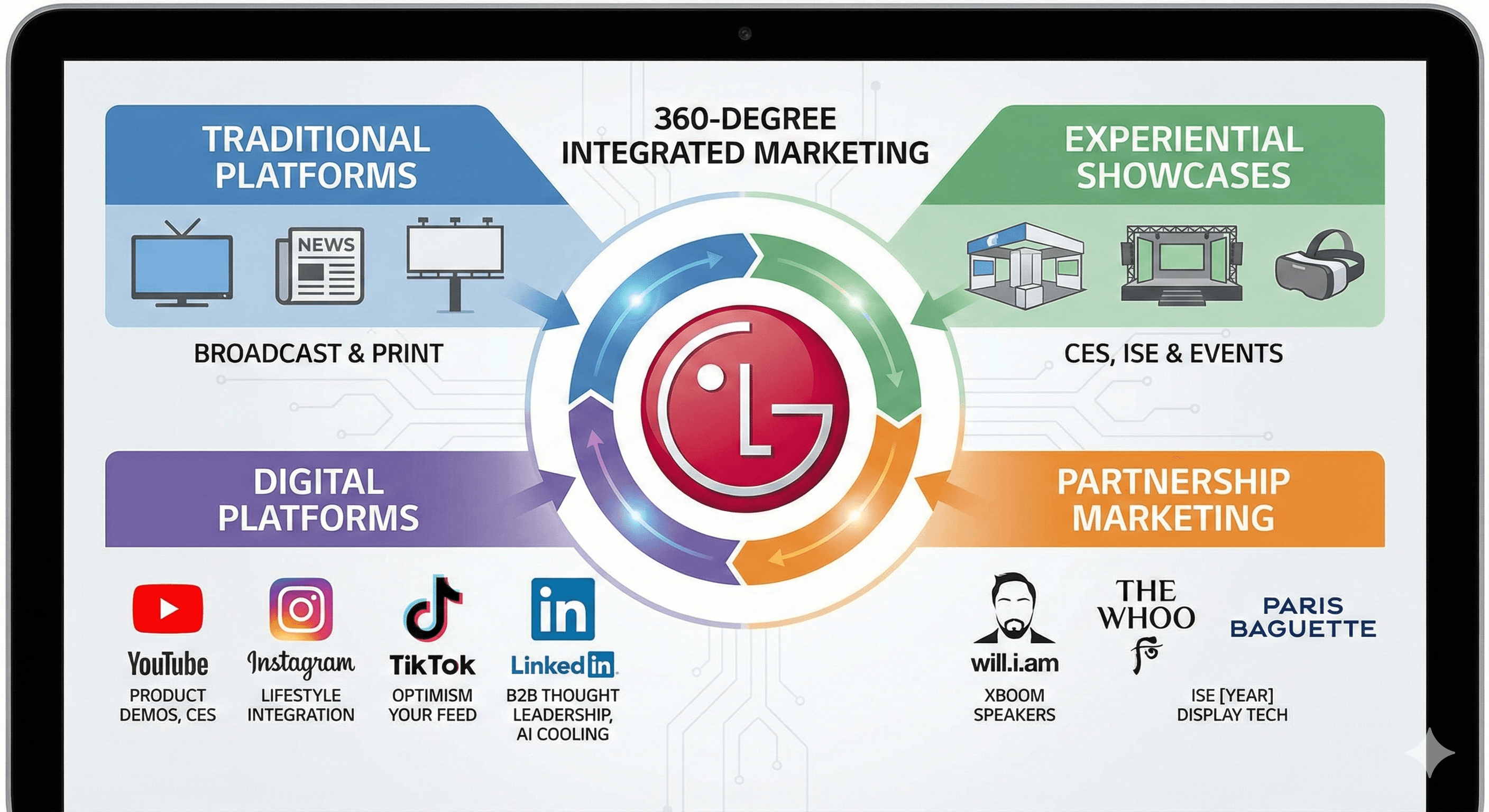
LG employs sophisticated 360-degree integrated marketing orchestrating traditional and digital platforms with experiential showcases.
Digital platforms: Operate channel-specifically: YouTube hosts product demonstrations and CES coverage; Instagram emphasizes lifestyle integration; TikTok continues "Optimism Your Feed" campaigns; LinkedIn targets B2B decision-makers with AI data center cooling and smart factory thought leadership.
Partnership Marketing: Includes the expanded will.i.am collaboration for xboom speakers and Korean brand partnerships (THE WHOO skincare, Paris Baguette) at ISE 2026 showcasing display technology.
Retail Experience Centers: Provide tactile interaction critical for premium electronics. Post-IPO India intensified presence through Thank You India promotions around Republic Day 2026.
LG Electronics Marketing Strategy Breakdown
1. Affectionate Intelligence in Action (AI Made Tangible)
LG’s 2026 marketing strategy focuses on making AI visible, practical, and trustworthy. Instead of abstract claims, LG showcased real-world AI applications at CES 2026 , led by the CLOiD home robot performing tasks like folding laundry, recognizing objects, and responding to household needs in real time.
To simplify AI communication, LG used its Sense Think Act framework:
- Sense: Devices detect environment and user behavior
- Think: AI analyzes data and patterns
- Act: Products respond with meaningful actions
This approach reduced AI intimidation and improved consumer understanding.
Product messaging avoided technical jargon and focused on everyday benefits:
- OLED evo W6 TV: Space-saving, wallpaper-like installation
- LG Gram laptops: All-day portability for hybrid work
- xboom speakers: Music discovery through FYI.RAiDiO, not algorithms
LG also leveraged third-party credibility by promoting CES Innovation Awards, Gizmodo’s Best Robot recognition, and CNET accolades strengthening trust beyond brand-led messaging.
2. Strategic B2B Expansion & Dual-Audience Messaging
LG’s marketing reflects a strong shift toward B2B and high-margin businesses, targeting nearly 45% of total revenue from this segment.
At ISE 2026 , LG avoided generic enterprise messaging and instead showcased industry-specific solutions, including:
- Hospitality and hotel display ecosystems
- Control rooms and command centers
- Interactive education environments
- Retail and drive-thru digital signage
LG also entered new B2B territory with AI data-center cooling, positioning HVAC as essential infrastructure for AI growth. Messaging focused on:
- Energy efficiency
- Precision heat management
- Scalability for enterprise workloads
In automotive solutions, LG positioned itself as an Experience Architect, marketing complete intelligent cabin ecosystems instead of individual components. This strategy supported Vehicle Component Solutions revenue of KRW 11.14 trillion in 2025.
Similar to the Marketing Mix of Apple, LG is steadily shifting from pure hardware sales toward ecosystem-based value through platforms, services, and subscriptions.
3. Post-IPO India Strategy & Localized Growth
LG Electronics India’s 2025 IPO became a major brand-building moment. After raising $1.3 billion with 54x oversubscription, LG converted financial success into consumer trust.
- “Thank You India” campaigns around Republic Day
- Emphasizing leadership across TVs, washing machines, refrigerators, ACs, and microwaves
LG reinforced credibility by highlighting:
- 97–98% local manufacturing
- 25 warehouses and 949 service centers
- 30,000+ sub-dealers nationwide
Marketing was localized:
- Metro cities focused on smart, time-saving appliances
- Tier-2 and Tier-3 cities emphasized durability, energy efficiency, and service reach
4. Celebrity & Influencer Partnerships (Beyond Endorsements)
LG’s influencer strategy prioritized co-creation over promotion.
The will.i.am xboom collaboration stood out because will.i.am actively contributed to:
- Sound design
- AI feature development
- FYI.RAiDiO music personalization
This made the partnership authentic and credible.
LG’s Optimism Your Feed campaign focused on lifestyle creators rather than product ads, driving emotional engagement and user-generated content. On the B2B side, LG worked with analysts and thought leaders on LinkedIn and webinars to build enterprise trust.
5. Sustainability & ESG Integration
Sustainability was embedded into LG’s core marketing, not treated as separate CSR.
Key focus areas:
- Energy-efficient appliances and HVAC systems
- Eco-friendly refrigerants
- Longer product lifecycles supporting circular economy goals
LG positioned its Eco Solution division as enabling sustainable AI infrastructure, especially for data centers. In India, local manufacturing was framed as both economic and environmental responsibility.
Smart appliances featured real-time energy monitoring, marketed as a way to reduce bills while lowering environmental impact.
6. webOS Platform as a Growth Engine
LG positioned webOS as more than a smart TV operating system it became a content, advertising, and service ecosystem.
Marketing emphasized:
- Premium content partnerships
- Seamless cross-device experience (TVs, monitors, vehicles)
- Optional ad-supported features that improve affordability
This helped LG generate recurring revenue beyond hardware sales.
7. Subscription & Product-as-a-Service Model
LG expanded subscription-based ownership, positioning it as worry-free access rather than rental.
Key benefits highlighted:
- Regular maintenance
- Automatic upgrades
- Replacement coverage
For B2B clients, LG promoted equipment-as-a-service models for HVAC and displays, emphasizing predictable costs and reduced capital expenditure.
Analyze the strengths and weaknesses of LG's primary competitor in the home appliance sector in our SWOT Analysis of Whirlpool.
Results & Impact
LG’s marketing strategy delivered solid, business-changing results heading into 2026. Here are the key highlights:
- LG recorded KRW 89.2 trillion in global revenue in 2025, marking its second straight year of record performance.
- The brand maintained a healthy 5-year growth rate of ~9% CAGR, showing long-term momentum.
- High-margin qualitative businesses (B2B, webOS, subscriptions, D2C) grew to nearly 45% of total revenue.
- These segments contributed around 90% of operating profit, proving the success of LG’s profitability-led strategy.
LG Electronics India’s IPO became a major brand credibility boost:
- Raised $1.3 billion with 54x oversubscription
- Achieved a 50.4% listing-day gain
- Reached a $13 billion market valuation, surpassing its Korean parent company
CES 2026 wins generated massive earned media:
- CLOiD robot won Gizmodo’s Best Robot
- SIGNATURE washers received CNET awards
- AI in-vehicle solutions earned Best of Innovation recognition
The will.i.am xboom partnership helped LG stand out in AI-powered audio:
- Strengthened brand relevance among younger audiences
- Created proprietary AI music discovery via FYI.RAiDiO
Vehicle Component Solutions delivered:
- KRW 11.14 trillion in revenue
- KRW 559 billion operating profit
- Strong demand from global automotive OEMs
Overall, LG’s mix of innovation, credibility, and execution reinforced its position as a global leader in AI-driven consumer and B2B technology.
What Worked & Why
LG succeeded by focusing on real value instead of hype.
- AI made tangible through live demos (like CLOiD folding laundry) built trust fast
- Industry-specific B2B marketing outperformed generic enterprise messaging.
- India IPO storytelling turned a financial milestone into consumer confidence.
- Authentic celebrity collaboration with will.i.am felt credible, not forced.
- Qualitative growth messaging highlighted better revenue, not just bigger revenue.
- Strong omnichannel execution connected CES, social media, retail, and PR seamlessly.
This approach helped LG build trust across consumers, enterprises, and investors.
What Didn’t Work & Why
Despite strong momentum, a few gaps remain:
- Display business losses continued due to pricing pressure from Chinese competitors.
- AI still feels complex for mass-market consumers because of setup and privacy concerns.
- Subscription services lack awareness beyond early adopters.
- Smartphone exit weakens LG’s connection with mobile-first Gen Z users.
- Premium pricing communication struggles against cheaper alternatives.
- webOS benefits are under-communicated beyond picture quality.
These challenges highlight that great marketing can’t always offset structural category issues.
Compared to the SWOT Analysis of Panasonic, LG adopts a more aggressive AI-first and platform-driven marketing strategy, strengthening its positioning across both consumer electronics and B2B solutions.
IIDE Student Recommendations: Key Areas for Brand Improvement
1. Build AI Literacy to Reduce Adoption Friction
LG should simplify AI adoption by educating users, not just selling technology. Launch AI literacy programs at LG Experience Zones through hands-on workshops that teach smart home basics in a simple, non-technical way.
Partner with community centers and senior groups for free Smart Home 101 sessions addressing setup challenges and privacy concerns.
Introduce AI concierge services offering installation, personalized configuration, and ongoing support for premium products. Market this as a value-added service that justifies premium pricingcustomers pay for working solutions, not unused features.
LG can also develop AI simulation and AR apps that allow users to experience smart homes virtually before purchase. Showing real-life use cases (like optimized wash cycles or recipe suggestions) will make AI benefits more tangible and boost conversion.
2. Scale Subscription Services Through Focused Marketing
LG should aggressively promote its subscription-based ownership model as a mainstream alternative to traditional appliance purchases. A campaign like Own Smart, Not Hardware can highlight freedom from maintenance, upgrades, and obsolescence especially appealing to younger consumers on Instagram and TikTok.
Introduce total cost of ownership calculators comparing subscription vs. purchase, factoring in repairs, depreciation, and energy savings. Add referral incentives so existing subscribers earn credits, creating organic growth.
Launching tiered subscription plans (Essential, Premium, Ultimate) across categories would create clear upgrade paths and maximize lifetime value.
3. Strengthen Mobile App Ecosystem to Offset Smartphone Exit
Since LG is no longer in smartphones, it should dominate the smart home app experience. Make the LG ThinQ app best-in-class fast, intuitive, and compatible across all smartphones so users prefer LG appliances for the app experience alone.
Add AR-based home visualization tools allowing users to preview appliances in their homes. Partner with interior designers to offer curated LG Home templates that turn product selection into lifestyle inspiration.
Gamify the app with energy-saving challenges, leaderboards, rewards, and exclusive perks to drive daily engagement beyond basic controls.
4. Invest in Hyperlocal Content and Regional Storytelling
LG should move beyond global campaign translations and focus on hyperlocalized marketing. In India, highlight extended families, festivals, and regional cooking habits. In the Middle East, focus on hospitality and entertaining. In Europe, emphasize sustainability and compact living.
Use regional micro-influencers and local brand ambassadors instead of only global celebrities. A creator speaking in local language with cultural relevance builds stronger trust than generic messaging.
Show culture-specific product use cases, such as sari-care washing modes in India or traditional garments in Gulf markets, to demonstrate genuine localization.
5. Improve Transparent Pricing & Value Communication
LG must address premium pricing concerns with clear, transparent value storytelling. Use infographics to explain what customers pay for better components, longer warranties, energy savings, resale value, and service networks.
Promote total cost of ownership messaging, showing how cheaper alternatives often cost more long-term. Warranty comparison charts can further reinforce LG’s value advantage.
Introduce price-match confidence programs, where LG matches prices if competitors truly offer equivalent technology backed by performance comparisons.
6. Make Sustainability Impact Visible and Measurable
Turn sustainability from an abstract idea into visible impact metrics. Smart appliances should show CO₂ savings, energy conserved, or environmental equivalents alongside electricity usage.
Create personal sustainability scorecards summarizing a household’s annual impact and gamify it with community challenges. Sharing these insights builds emotional attachment and brand loyalty.
Partner with credible environmental organizations for co-branded initiatives like tree-planting, appliance recycling, and energy audits to reinforce authenticity.
7. Strengthen Community & User-Generated Content (UGC)
LG should build an active brand community instead of a passive customer base. Launch an “LG Life” platform where users share smart home setups, tips, and creative use cases. Feature top setups in marketing to encourage participation.
Introduce regional customer advisory boards to gather feedback and show visible implementation of customer ideas turning users into advocates.
Encourage video testimonials and UGC through simple tools and incentives like service credits or early access. Real customer stories will always outperform polished brand ads.
Want to Know Why 50,00,00+ Students Trust Us?
Dive into the numbers that make us the #1 choice for career success


MBA - Level
Post Graduate in Digital Marketing & Business Strategy

Best For
Fresh Graduates

Mode of Learning
On Campus (Mumbai & Delhi)

Starts from
Nov 27, 2026

Duration
11 Months

Live & Online
Advanced Online Digital Marketing Course
Best For
Working Professionals
Mode of Learning
Online
Starts from
Nov 2, 2026
Duration
4-6 Months

Offline
Top AI Courses to Make You Future Ready!
Best For
AI Enthusiasts
Mode of Learning
2–5 Month Program
Starts from
-
Duration
Flexiable
Offline
Undergraduate Program in Digital Business & Entrepreneurship
Best For
12th Passouts
Mode of Learning
On Campus (Mumbai)
Duration
3 Years
Offline
Degree In 2026 ≠ Enough Degree + Digital Skills = Future-Ready
Best For
12th Passouts
Mode of Learning
At IIDE Campus
Duration
3 Years
Recent Post
You May Also like

Lead Trainer & Business Development Head at IIDE
Aditya Shastri leads the Business Development segment at IIDE and is a seasoned Content Marketing expert. With over a decade of experience, Aditya has trained more than 20,000 students and professionals in digital marketing, collaborating with prestigious institutions and corporations such as Jet Airways, Godrej Professionals, Pfizer, Mahindra Group, Publicis Worldwide, and many others. His ability to simplify complex marketing concepts, combined with his engaging teaching style, has earned him widespread admiration from students and professionals alike.
Aditya has spearheaded IIDE’s B2B growth, forging partnerships with over 40 higher education institutions across India to upskill students in digital marketing and business skills. As a visiting faculty member at top institutions like IIT Bhilai, Mithibai College, Amity University, and SRCC, he continues to influence the next generation of marketers.
Apart from his marketing expertise, Aditya is also a spiritual speaker, often traveling internationally to share insights on spirituality. His unique blend of digital marketing proficiency and spiritual wisdom makes him a highly respected figure in both fields.