
Students Centric
Placements Report
Trackable results, real numbers
Reviews
Proven success, real voices
Trainers
Expert-led, Industry-Driven Training
Life at IIDE
Vibrant Spirit student life
Alumni
Successful Journeys, Inspiring Stories
Learning Centre
Webinars
Blogs
Case studies
Live, Interactive Masterclasses
Fresh Insights, quick reads
Real-life, Industry relevant
More
Hire from us
Hire Top Digital Marketing Talent
Work with us
Join Our Team, Make an Impact
Customised Training
Personalised digital marketing training for your company
Refer & earn
Simple, easy rewards
Contact us
Get the answers you need
About us
Know more about IIDE
Explore all course options

FOR FRESH GRADUATES
Post Graduation Program in Digital Marketing & Business Strategy- Ideal for Age: 20–25 Years

Can’t decide? Explore all our
Digital Marketing Courses
COMPARE BOTH OUR PROGRAMSOffline
Offline AI Courses with Dual CertificationsIndustry-Aligned TRACKMost Popular
UG Program in Digital Business & Entrepreneurship- Ideal for 12th Pass out / FY Degree Student

PARTNER PROGRAMS






Can’t decide? Explore all
BBA In Digital Marketing Colleges
Orginally Written by Aditya Shastri
Updated on Aug 9, 2025
Share on:


FedEx runs a diversified logistics model combining air express, ground parcel, freight and supply chain services under one global network. It offers speed, reliability, and transparency through technology-enabled tracking and flexible shipping options. Efficiency gains via network optimisation and cost program DRIVE support competitive pricing. FedEx scales through infrastructure and digital tools, serving businesses and consumers worldwide. Scroll to decode its strategy secrets.
About FedEx
Founded in 1971 by Frederick W. Smith in Little Rock, Arkansas, FedEx pioneered guaranteed overnight delivery and built the first express shipping network. Today, headquartered in Memphis, Tennessee, it stands as a global leader in logistics, known for speed, reach, and reliability.
In fiscal year 2025 (ending May 2025), FedEx achieved approximately US $88 billion in revenue and about US $5.6 billion in operating income. The company employs over 500,000 staff, serving more than 220 countries and territories with over 16 million daily package shipments, supported by 650 airports and 2,400+ facilities worldwide.
Guided by values of customer-centric precision, operational excellence, and digital innovation, FedEx delivers real-time tracking, customizable delivery options, and proactive service updates. Its unmatched infrastructure helps it scale globally while improving operational fluidity through continuous optimisation. FedEx’s secret to success is rooted in merging expansive global logistics with a seamless user experience built on trust, visibility, and speed.
| Feature | Details |
|---|---|
| Founded | 1971 |
| Founder | Frederick W. Smith |
| Headquarters | Memphis, Tennessee, USA |
| Industry | Logistics, Express & Supply Chain Services |
| Revenue (2025) | ~ US$88 billion |
| Presence | 220+ countries; 16M+ shipments/day |
| Employees | ~500,000 |
| Popular for | Overnight delivery, tracking reliability, global logistics |

Is Digital Marketing the Right Career for You?
Find out in a free 45-min masterclass · Career paths, roles and growth explained · By Karan Shah, Founder & CEO, IIDE

Is Digital Marketing the Right Career for You?
Find out in a free 45-min masterclass · Career paths, roles and growth explained · By Karan Shah, Founder & CEO, IIDE
How does FedEx make money?
1. Revenue Stream Breakdown
- FedEx Express (air-based, time-definite parcel) generates approximately 82–83% of total revenue
- FedEx Ground (surface parcel delivery) accounts for about 3%
- FedEx Freight (less-than-truckload freight) contributes under 1%
Remaining revenue arises from supply-chain consulting, e‑commerce logistics, customs brokerage, and other enterprise services.
2. Revenue Contribution
- Express operations are the primary revenue and margin drivers
- Ground delivers cost-efficient parcel delivery for lower margins
- Freight revenues are smaller and slated for spin-off to refine focus
- Logistics and enterprise services provide breadth and diversification
3. Pricing Strategy
Express services use premium pricing for guaranteed delivery windows. Ground pricing remains competitive for surface deliveries. Freight and logistics contracts are priced per shipment or service tier, offering tailored solutions based on customer needs.
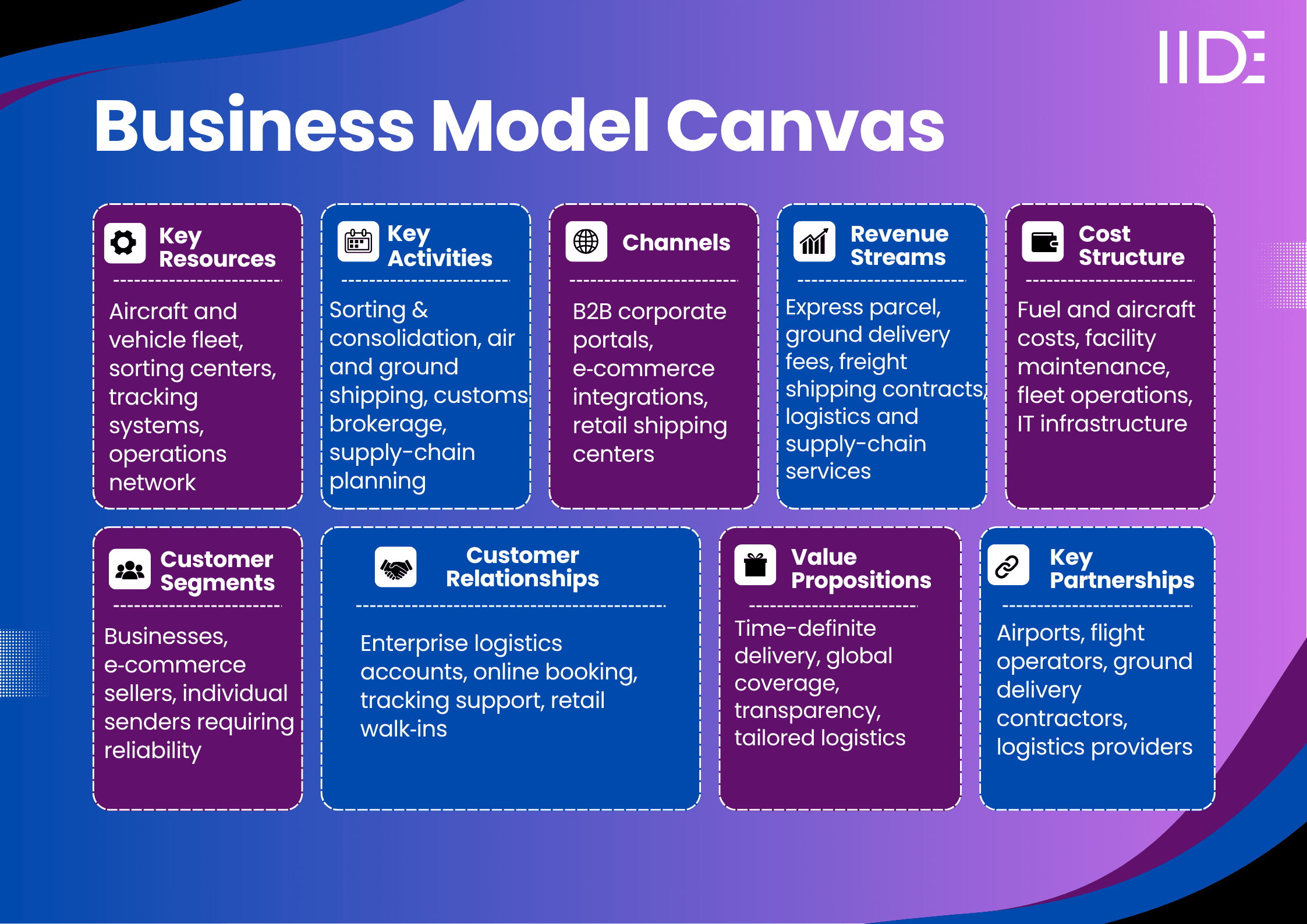
FedEx Business Model Canvas
FedEx Value Proposition
FedEx offers unmatched speed and reliability in global logistics. Its express service addresses critical shipping needs with guaranteed delivery windows, while ground and freight services offer cost-effective flexibility.
Customers benefit from 24/7 shipment tracking, proactive updates, and flexible delivery options that eliminate uncertainty. Emotionally, FedEx builds trust - clients depend on it when timing matters most.
Functionally, its global network of flight hubs, sorting centres, and delivery vehicles ensures seamless movement across borders and time zones. Enterprise customers leverage FedEx’s logistics insight, consulting, and customs expertise to simplify complex shipping.
FedEx differentiates itself through a combination of operational scale, digital tracking intelligence, and service transparency - a package difficult for competitors to replicate.
The business model of DHL reveals strategic logistics and global supply chain practices that are closely aligned with FedEx’s core operations.
FedEx Cost Structure
Major expenses include fuel and airline operations, maintenance of sorting hubs and delivery vehicles, workforce and contractor compensation, and IT and tracking infrastructure. The DRIVE optimisation program centralises operations to reduce redundancy. Efficiency is boosted through route optimisation, automation in sorting centres, and consolidating support services - helping maintain margins even as FedEx scales globally.
FedEx Customer Segment
FedEx serves B2B clients, including retailers, manufacturers, and e‑commerce platforms, as well as individual shippers, especially for urgent or large shipments. The audience includes businesses that prioritise speed, transparency, and reliability, and consumers who value guaranteed delivery windows. Customers choose FedEx for its trusted brand, real-time tracking, wide geographic coverage, and ability to handle complicated international logistics - covering everything from same-day delivery to cross-border trade needs.
Distribution Channels
FedEx delivers through corporate shipping portals, e‑commerce integrations, and brick-and-mortar shipping centres. Packages move via a hub‑and‑spoke system: express flights connect sorting hubs, parcels are automatically processed, and last-mile delivery is conducted by couriers or contractors. Options include overnight air delivery, multi-day ground shipping, and bespoke freight. Customer interfaces include mobile apps, email alerts, online dashboards, and retail storefronts, supporting omnichannel accessibility.
Key Partnerships
FedEx partners with airports and aviation service providers, local delivery contractors, e‑commerce platforms, customs and trade agencies, and Third‑Party Logistics (3PL) suppliers. It collaborates with technology firms on tracking, automation, and optimisation. Sustainability alliances support greener operations and energy-efficient fleet upgrades. These partnerships strengthen infrastructure, expand reach, and improve service quality - all aligned with FedEx’s commitment to speed and reliability.
SWOT Analysis of FedEx
| Strengths | Weaknesses | Opportunities | Threats |
|---|---|---|---|
| Global Express Lead | High express dependency | Trade growth in e‑commerce | Rising fuel & labour costs |
| Extensive network | Low-margin freight unit | Spin-off value capture | Fierce competition with UPS, DHL |
| Strong customer trust | Capital intensity | Supply-chain consulting growth | Global regulation & economic drag |
Competitor Comparison
| Brand | Pricing | Customer Experience | Channel Strategy | Market Focus | Innovation |
|---|---|---|---|---|---|
| FedEx | Premium value | Reliable, fully tracked | Global hub + retail access | Global B2B/B2C parcel | Tracking & operations tech |
| UPS | Comparable | Flexible delivery options | Integrated air-ground setup | Mass-market parcel | Robotics & automation |
| DHL | Competitive | High cross-border agility | International network focus | Global trade routes | E-commerce logistics tools |
The SWOT analysis of BDO Global showcases how global service firms handle scalability and operational risks, topics that parallel FedEx’s business concerns.
What’s New With FedEx?
FedEx is executing a planned spin-off of its Freight division, allowing focused financial transparency and operational agility. Its DRIVE initiative is consolidating sorting centres and networks, increasing efficiency and cost savings. Investments continue in automation, digital tracking upgrades, and fleet modernisation, including electrification and sustainability initiatives to advance green logistics by 2025.
Key Takeaways for Students & Marketers
- Operational scale and integrated services deliver global reach and reliability
- Centralized infrastructure and optimisation improve cost structure and margins
- Strategic spin‑off enables sharper focus on high-value segments
- A trusted brand, real-time tracking, and flexibility drive customer preference
Want to Know Why 2,50,000+ Students Trust Us?
Dive into the numbers that make us the #1 choice for career success



MBA - Level
Post Graduate in Digital Marketing & Business Strategy

Best For
Fresh Graduates

Mode of Learning
On Campus (Mumbai & Delhi)

Starts from
Nov 27, 2026

Duration
11 Months

Live & Online
Advanced Online Digital Marketing Course
Best For
Working Professionals
Mode of Learning
Online
Starts from
Nov 2, 2026
Duration
4-6 Months

Offline
Top AI Courses to Make You Future Ready!
Best For
AI Enthusiasts
Mode of Learning
2–5 Month Program
Starts from
Nov 24, 2026
Duration
Flexiable

Offline
Undergraduate Program in Digital Business & Entrepreneurship
Best For
12th Passouts
Mode of Learning
On Campus (Mumbai)
Duration
3 Years

Offline
Degree In 2026 ≠ Enough Degree + Digital Skills = Future-Ready
Best For
12th Passouts
Mode of Learning
At IIDE Campus
Duration
3 Years
Recent Post

Lead Trainer & Business Development Head at IIDE
Aditya Shastri leads the Business Development segment at IIDE and is a seasoned Content Marketing expert. With over a decade of experience, Aditya has trained more than 20,000 students and professionals in digital marketing, collaborating with prestigious institutions and corporations such as Jet Airways, Godrej Professionals, Pfizer, Mahindra Group, Publicis Worldwide, and many others. His ability to simplify complex marketing concepts, combined with his engaging teaching style, has earned him widespread admiration from students and professionals alike.
Aditya has spearheaded IIDE’s B2B growth, forging partnerships with over 40 higher education institutions across India to upskill students in digital marketing and business skills. As a visiting faculty member at top institutions like IIT Bhilai, Mithibai College, Amity University, and SRCC, he continues to influence the next generation of marketers.
Apart from his marketing expertise, Aditya is also a spiritual speaker, often traveling internationally to share insights on spirituality. His unique blend of digital marketing proficiency and spiritual wisdom makes him a highly respected figure in both fields.